
June 5, 2026
When Rally Exhaustion Meets Market Rotation: Reading the Signals Behind Physical Bullion Demand
Precious metals markets operate in cycles that are rarely linear. The retail bullion market, in particular, is governed by a distinct psychology: fear-driven accumulation during periods of macro stress, followed by rapid demand normalisation once perceived risks recede. Understanding this rhythm is essential for interpreting any single month's sales data in its proper context, and May 2026's figures from the world's most closely watched physical gold refiner demand exactly that kind of nuanced reading.
When big ASX news breaks, our subscribers know first
Perth Mint Gold Sales Hit Over One-Year Low: Breaking Down the May Numbers
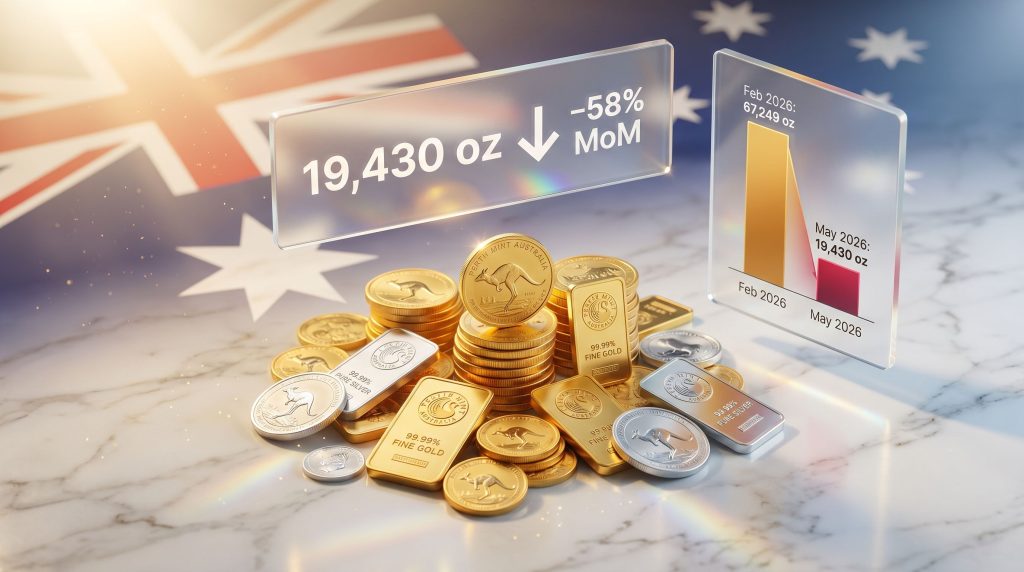
The headline figure is stark. Perth Mint gold sales hit over one-year low territory in May 2026, with gold coin and minted bar volumes collapsing to 19,430 ounces, representing a 58% month-on-month decline and a 31% fall year-on-year. Silver sales tracked a similar trajectory, contracting from 496,212 ounces in April to 363,976 ounces in May, a 27% monthly and annual decline.
To appreciate the full weight of these figures, the context of early 2026 is indispensable. February 2026 had delivered an extraordinary demand surge, with gold minted product sales rising 131% month-on-month and 168% year-on-year to 67,249 ounces, driven by a convergence of geopolitical anxiety, inflation fears, and peak safe-haven investment positioning. May's contraction, viewed against that elevated baseline, reflects a demand compression cycle that was statistically inevitable once the conditions driving that surge began to moderate.
| Metric | February 2026 | April 2026 | May 2026 | YoY Change (May) |
|---|---|---|---|---|
| Gold Sales (oz) | 67,249 | ~46,000 (est.) | 19,430 | -31% |
| Silver Sales (oz) | N/A | 496,212 | 363,976 | -27% |
| Gold Sales MoM Change | +131% | – | -58% | – |
Key Context: The February 2026 gold demand spike was not a sustainable baseline. It represented a fear-premium buying event, meaning subsequent months were always likely to read as weakness by comparison, regardless of underlying market health.
What Drove Physical Demand Lower in May 2026
The Dual Headwind of Price Softness and Shifting Risk Appetite
Two distinct forces converged to suppress physical bullion purchases in May. The first was price-related: spot gold declined approximately 1.9% during the month, as ongoing tensions in the Middle East paradoxically weighed on gold rather than supporting it. The mechanism here is counterintuitive but well-established. When geopolitical conflict stokes expectations of prolonged inflation and therefore higher-for-longer interest rates, the opportunity cost of holding non-yielding assets like physical gold increases, reducing its near-term appeal to rate-sensitive investors.
The second headwind was a rotation in investor sentiment. As global equity markets stabilised and trade conditions showed signs of improvement, capital began migrating away from defensive allocations toward growth-oriented instruments. This shift reduced the urgency that had characterised the early-2026 precious metals buying wave. Furthermore, gold in market volatility tends to behave differently once that volatility begins to subside.
Neil Vance, General Manager of Minted Products at Perth Mint, confirmed that following an exceptional start to the year, sales moderated as both metals softened from recent highs and investors redirected attention toward alternative asset classes.
Why Silver's Price Gain Failed to Protect Physical Sales
One of the more analytically revealing aspects of May's data is the divergence between silver's price performance and its physical demand outcome. Silver spot prices rose approximately 2% during the month, yet physical coin and bar sales still contracted by 27%. This is a critical signal for investors who assume price appreciation automatically translates into stronger retail buying.
The reality of the retail bullion market is more nuanced. Physical precious metals purchases are primarily sentiment-driven rather than price-momentum-driven. When the broader precious metals narrative weakens, as it did in May through gold's price retreat and reduced macro urgency, silver demand follows in sympathy regardless of its own price trajectory. Retail buyers who approach precious metals as a portfolio pair tend to reduce or suspend exposure across both metals simultaneously.
The silver-to-gold sales volume ratio in May, approximately 18.7:1, reflects silver's structural role as the lower-cost entry point for retail investors. Monitoring the gold-silver ratio more broadly can help investors understand when silver demand is likely to diverge meaningfully from gold. However, in May's case, it also underscores that physical silver demand is tethered to gold sentiment rather than operating as an independent demand driver.
Perth Mint's Role as a Global Demand Barometer
Why This Institution's Monthly Data Matters
Perth Mint is not simply a large gold refiner. Owned by the Government of Western Australia, it holds the distinction of being the world's leading processor of newly mined gold and Australia's largest refiner by volume. Its minted product sales data is monitored globally because it offers something that futures markets cannot: a clean signal of actual end-buyer delivery demand. According to Perth Mint's own market research, these monthly figures are among the most closely watched indicators of retail bullion sentiment globally.
Futures markets are heavily influenced by institutional positioning, leverage ratios, and short-term speculative flows. Physical minted product sales, by contrast, reflect the behaviour of retail investors, collectors, and smaller institutional buyers who are converting capital into tangible assets. When these buyers step back, as they did in May, the signal carries meaningful information about broader retail conviction.
Why It Matters for Investors: A sustained retreat in Perth Mint physical sales can be an early indicator of reduced speculative and defensive positioning across global retail precious metals markets, particularly across Asia-Pacific, one of the world's most significant retail gold demand regions.
The Boom-and-Bust Demand Cycle in Minted Products
Perth Mint's sales history illustrates a recurring pattern that investors should internalise. Physical minted product demand does not trend smoothly; it spikes during periods of acute macro anxiety and then contracts, sometimes sharply, as conditions normalise. This cyclicality is amplified in coin and bar formats because these products appeal primarily to retail and semi-retail buyers rather than industrial end-users or institutional hedgers.
Historical reference points reinforce this. In September 2025, gold minted product sales of 36,595 ounces were already 31% lower year-on-year at that time. May 2026's figure of 19,430 ounces represents a materially deeper contraction, suggesting either that the normalisation cycle is still running or that a structural shift in retail allocation preferences may be emerging. Notably, Perth Mint's October gold sales had previously hit a three-year high, which further contextualises the scale of the current pullback.
Scenario Analysis: Temporary Correction or Structural Demand Shift?
The Case for Demand Normalisation
The bullish interpretation of May's data rests on the argument that the contraction is a mechanical outcome of an unsustainable prior-year baseline rather than evidence of deteriorating structural demand for physical gold. Several factors support this view:
- The February 2026 surge was driven by specific fear catalysts, including elevated geopolitical risk premiums, that pulled forward buying activity from later months
- Year-on-year declines of 31% in gold and 27% in silver, while significant on paper, are partly a function of the exceptionally high comparison period rather than absolute demand collapse
- Central bank gold demand globally has remained robust throughout 2025 and into 2026, providing a structural demand floor that retail dynamics alone cannot undermine
- If macro uncertainty re-escalates, particularly around central bank policy surprises or renewed geopolitical stress, a rapid retail demand rebound is entirely plausible given how quickly the February surge materialised
The Case for Sustained Demand Suppression
The bearish interpretation focuses on structural shifts in investor behaviour that may not reverse quickly:
- Persistent equity market strength and improving risk appetite create a durable pull away from non-yielding defensive assets
- Higher-for-longer interest rate environments structurally increase the carrying cost disadvantage of physical bullion relative to interest-bearing instruments
- Retail investors who entered the precious metals market during the 2024–2025 anxiety cycle may have already achieved their target allocation, reducing the available buyer pool
- If gold prices remain range-bound or drift lower through Q3 2026, demand deferral behaviour tends to compound, as retail buyers typically wait for clearer directional signals before re-engaging
| Factor | Bullish for Demand | Bearish for Demand |
|---|---|---|
| Geopolitical Risk | Escalation drives safe-haven buying | De-escalation reduces urgency |
| Interest Rate Path | Rate cuts lower opportunity cost | Rates hold or rise, gold less attractive |
| USD Strength | Weaker USD supports gold prices | Stronger USD pressures gold |
| Equity Sentiment | Risk-off rotation boosts bullion | Risk-on conditions pull capital away |
| Spot Gold Price Trend | Rising prices trigger momentum buying | Falling prices encourage demand deferral |
Understanding the Physical Bullion Market: Key Concepts for Investors
What Separates Minted Products from Other Gold Formats
Not all gold demand is created equal. The precious metals market segments into distinct product categories, each with different buyer profiles, pricing premiums, and demand sensitivities. When comparing physical gold vs ETFs, for instance, the premium structures and demand drivers differ considerably. Perth Mint's minted products, specifically gold and silver coins and cast bars, carry a fabrication premium over spot prices that reflects the refining, minting, and distribution costs embedded in their production.
This premium structure has an important behavioural implication. During periods of rising spot prices, retail buyers are often willing to absorb higher premiums in the expectation of further appreciation. When spot prices plateau or decline, the premium becomes a psychological barrier to purchase, and discretionary buyers defer. This premium sensitivity effect amplifies the volatility in physical minted product sales relative to raw bullion or exchange-traded product flows.
The Concept of Demand Cannibalisation in Rally Cycles
A phenomenon less commonly discussed in mainstream precious metals commentary is demand cannibalisation across time periods. When an extraordinary rally occurs, as it did in early 2026, it does not simply represent a surge in the total pool of buyers. It also draws forward demand from buyers who would otherwise have purchased in subsequent months.
This temporal front-loading effect means that the pool of near-term buyers is measurably thinner in the months immediately following a demand spike, even if broader market conditions remain supportive. May 2026's result is consistent with this pattern. The buyers who responded to the February fear catalyst have already made their purchases; the market is now waiting for either a new cohort of buyers to emerge or a fresh catalyst to re-engage those who transacted earlier in the year.
The next major ASX story will hit our subscribers first
Key Takeaways for Precious Metals Investors
The May 2026 Perth Mint gold sales hit over one-year low data delivers several actionable insights for investors tracking physical bullion markets:
- Post-rally demand hangovers are structural, not random. The February 2026 surge created a borrowed demand pool; May's contraction to 19,430 ounces is the predictable reversion to that borrowing
- Physical demand follows sentiment, not spot price alone. Silver's 2% price gain in May was insufficient to prevent a 27% sales decline, confirming that narrative and risk appetite drive retail buying more than price momentum
- The opportunity cost calculation is central to retail behaviour. As long as interest rates remain elevated, non-yielding physical assets face a structural disadvantage compared to cash-equivalent instruments
- Perth Mint data is a leading retail sentiment indicator. Monthly figures from the world's largest processor of newly mined gold provide a real-time read on retail precious metals conviction that futures market data cannot replicate
- The medium-term outlook is macro-dependent. Rate policy trajectories, USD direction, and geopolitical risk escalation or de-escalation will collectively determine whether May 2026 marks a temporary pause or the beginning of a more sustained demand retreat
Disclaimer: This article is for informational purposes only and does not constitute financial or investment advice. Precious metals markets involve significant risk and past demand patterns are not necessarily indicative of future performance. Readers should seek independent financial advice before making investment decisions.
Want To Stay Ahead of Significant Mineral Discoveries on the ASX?
Discovery Alert's proprietary Discovery IQ model delivers real-time alerts the moment significant ASX mineral discoveries are announced, transforming complex data across 30-plus commodities into clear, actionable insights for both short-term traders and long-term investors. Explore Discovery Alert's dedicated discoveries page to understand how historic mineral discoveries have generated substantial market returns, and begin your 14-day free trial today to position yourself ahead of the broader market.