June 5, 2026
When Supply Chains Become the Geological Risk: Rethinking African Gold Production Volatility
The conventional framework for evaluating gold mining risk places geology at the centre. Investors model ore grade variability, recovery rates, and reserve depletion curves as the primary drivers of production uncertainty. Yet in sub-Saharan Africa, a fundamentally different category of risk has repeatedly proven its capacity to dwarf geological underperformance in its operational impact: the fragility of in-country supply chains in jurisdictions where security conditions are deteriorating.
This distinction matters enormously when assessing the Resolute Mining Syama Mali Q2 production miss, because the shortfall at Syama in the second quarter of 2026 was not the product of a disappointing ore body. The rock performed broadly as expected. What failed was the logistics infrastructure surrounding the mine, and that is a much harder problem to solve with capital expenditure or revised mine planning. Furthermore, understanding these geopolitical mining risks is increasingly essential for investors evaluating African gold producers.
When big ASX news breaks, our subscribers know first
Understanding Syama's Dual-Circuit Architecture and Why Grade Sensitivity Is Asymmetric
The Sulphide and Oxide Streams: Two Very Different Production Contributors
Syama's dual-circuit operation processes higher-grade refractory ore through a roaster and carbon-in-leach plant, whilst the oxide circuit treats softer, lower-grade near-surface material through a more conventional carbon-in-leach process. Understanding their respective economics is essential for interpreting any production update.
The two streams are not equivalent in their production contribution:
- The sulphide circuit carries disproportionate production weight, processing ore at significantly higher head grades and delivering the majority of recovered ounces
- In Q2 2025, the sulphide stream processed approximately 576,000 tonnes at 2.22 g/t Au with a 76% recovery rate, yielding roughly 31,500 ounces
- The oxide circuit processed around 395,000 tonnes at 0.95 g/t Au with an 81% recovery rate, contributing approximately 9,600 ounces
- When the sulphide stream underperforms, there is no realistic mechanism for the oxide circuit to compensate at equivalent scale
This asymmetry is critical. A disruption to sulphide mill feed quality cascades directly into group production figures in a way that oxide variability simply does not.
How Explosives Become the Most Underappreciated Input Variable in Underground Gold Mining
One of the least-discussed operational dependencies in underground hard-rock gold mining is explosives supply continuity. Blasting is not simply a productivity tool; it is the mechanism through which miners access fresh ore faces. Without reliable explosive delivery schedules, underground operations cannot advance development headings at planned rates, and the choice of which faces to blast becomes increasingly constrained.
The cascade mechanism that produced the Resolute Mining Syama Mali Q2 production miss followed a recognisable sequence:
- Road insecurity across Mali in late April and throughout May 2026 disrupted the delivery of explosives from suppliers
- Reduced blasting frequency limited access to higher-grade fresh ore faces within the underground sulphide operation
- To maintain mill throughput tonnage, operators shifted to lower-grade development ore and transitional material
- The sulphide mill head grade declined, reducing recovered ounces per tonne processed
- The plant transitioned progressively to lower-grade stockpile feed, further compressing recovered gold output
- Simultaneously, road insecurity delayed equipment delivery to the A21 open pit, removing a planned supplementary source of higher-grade sulphide ore
Industry Insight: Grade dilution caused by stockpile reliance is particularly persistent. Once a mill is running on lower-grade material, head grade recovery typically lags the restoration of supply by one to two full quarters, as the blend of fresh and stockpile ore normalises slowly. This means even a swift resolution of Mali's explosives supply problem will not produce an immediate rebound in recovered grade.
Q2 2026 Production Metrics at a Glance
| Metric | Q2 2026 Actual | Original Q2 Plan | Variance |
|---|---|---|---|
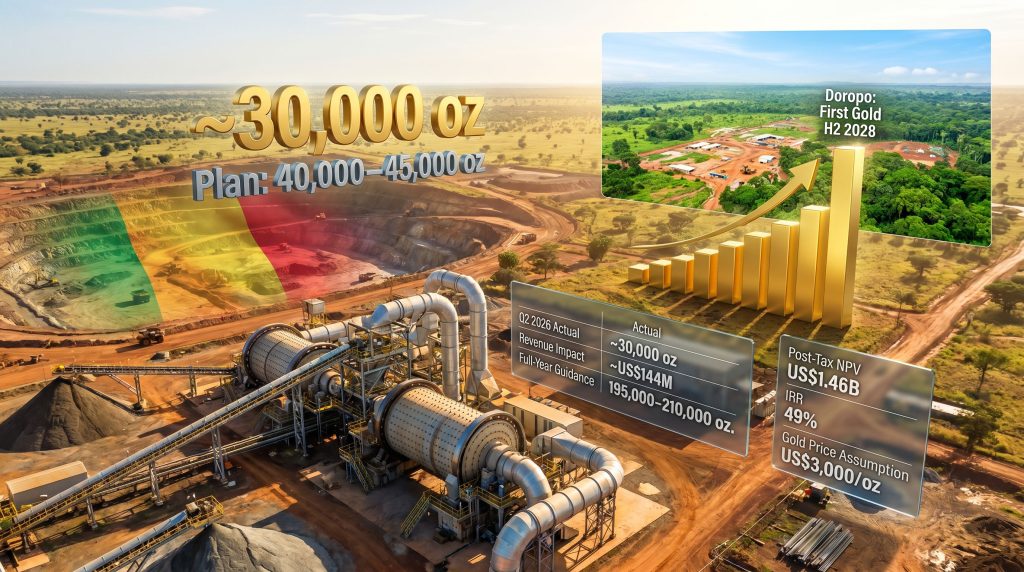
| Total Syama Production (est.) | ~30,000 oz | 40,000–45,000 oz | ~10,000–15,000 oz shortfall |
| Revenue Impact (at ~US$4,800/oz) | ~US$144M | ~US$192–216M | ~US$48–72M deferred |
| Sulphide Guidance (Full Year) | 150,000–160,000 oz | On track (lower end) | H2 recovery required |
| Oxide Guidance (Full Year) | 45,000–50,000 oz | Trending lower | Monitor for revision |
The revenue deferral of roughly US$48 million to US$72 million into the second half is not trivial. However, the operative word is deferred rather than lost, provided that H2 recovery assumptions hold. Investors tracking the broader gold price outlook will recognise how significantly elevated spot prices amplify the financial stakes of any production shortfall.
Mali's Security Environment: Why the Underlying Risk Is Structurally Different From Operational Risk
The Deteriorating Security Context in Mali From 2024 to 2026
Mali has experienced a profound deterioration in its security and governance environment following two successive military coups in 2020 and 2021. The ruling junta's subsequent expulsion of French military forces and alignment with Russian security contractors fundamentally altered the country's stability architecture. By 2024 and into 2026, road insecurity across significant portions of the country had become an operational constant rather than an episodic risk for resource companies.
For Resolute, this manifests in two distinct but interconnected ways:
- Equipment delivery timelines for open pit operations become unpredictable, as road convoys require security escort arrangements that are subject to availability and route safety assessments
- Consumables supply chains, particularly for explosive materials that require specialised transport permits and security protocols, face compounding vulnerabilities when road security deteriorates
What makes this risk category so analytically challenging is its asymmetry relative to geological risk. A lower-than-expected ore grade can be addressed through resampling, grade control drilling, and updated resource models. A deteriorating security environment cannot be resolved through capital allocation decisions within the mine's operational perimeter.
Key Analytical Framework: Investors assessing ASX-listed African gold producers should explicitly model explosives and consumables supply disruption as an independent scenario variable, not a footnote to geological risk. In landlocked or conflict-adjacent jurisdictions, logistics fragility has historically been responsible for more production volatility than ore body underperformance.
The Extended Maintenance Window: Operational Reset or Further Disruption?
The decision to extend the already-planned three-week sulphide plant maintenance shutdown by an additional week during Q2 deserves careful interpretation. On the surface, a longer shutdown during an already-compromised quarter appears to compound the production shortfall. The operational logic, however, is more nuanced.
Extending the maintenance window during a period when feed grade and underground ore availability are already constrained trades near-term ounces for improved plant availability rates heading into the second half. If the extended shutdown delivers demonstrably higher sulphide circuit availability in Q3 and Q4, the productivity gain may justify the immediate output cost. Investors should look for post-shutdown plant availability data in the July 2026 quarterly report as a key indicator of whether this decision delivered its intended outcome.
Full-Year Guidance: The Mathematical Reality of H2 Recovery
How the 195,000 to 210,000 Ounce Framework Holds Together
Management's decision to maintain full-year group guidance at the lower end of the 195,000 to 210,000 ounce range following the Q2 miss signals internal confidence in second-half recovery, but it also creates a specific mathematical obligation that the July quarterly will need to address.
Full-year group guidance draws on three distinct production contributors:
- Syama sulphide (Mali): full-year guidance range of 150,000 to 160,000 ounces, now tracking toward the lower end
- Syama oxide (Mali): full-year guidance range of 45,000 to 50,000 ounces, trending lower and flagged for monitoring
- Mako (Senegal): stockpile processing operations described as tracking to plan, providing a stabilising base contribution
The wet season logistics constraint that typically affects West African mining operations through the July to September period means Q3 2026 at Syama is likely to remain somewhat subdued even after explosives supply normalises. A strong Q4 is therefore the critical variable in the guidance maintenance thesis, and that creates a relatively narrow window for operational recovery.
What the July 2026 Quarterly Must Confirm
The July quarterly report is the first formal checkpoint for assessing whether the H2 recovery thesis is credible. Investors should look for:
- Actual realised production figures for Q2 against the flagged ~30,000 ounce estimate
- Post-shutdown sulphide plant availability rates and any improvement metrics
- Confirmation that new explosives supply arrangements are in place and underground blasting frequency has normalised
- Any revision to the Doropo project construction cost estimate or schedule envelope
- Updated oxide guidance, given the flagged downside pressure on that stream
Doropo: The Investment Thesis That Strengthens Every Time Mali Underperforms
Feasibility Economics at Spot Gold Prices
The Doropo gold project in Côte d'Ivoire was assessed in a feasibility study using a conservative US$3,000 per ounce gold price assumption, generating a post-tax NPV of US$1.46 billion and a 49% IRR. With gold prices trading at approximately US$4,700 to US$4,800 per ounce through the period surrounding the Q2 2026 update, the leverage between the study assumption and realised pricing materially expands the project's economic attractiveness above the figures published in the feasibility document.
Construction at Doropo was confirmed as on schedule as of the Q2 2026 update, with first gold targeted for the second half of 2028. This timeline has material significance for how investors should frame the current Syama disruption: it represents a finite period of Mali-concentrated risk that progressively diminishes as Doropo moves toward production. In addition, those monitoring the wider mining commodity outlook will appreciate how Doropo's economics are further enhanced by the sustained elevation in gold prices.
Balance Sheet Capacity Through the Volatility
Resolute's financial position entering the disruption period provides meaningful insulation against the Q2 production miss:
- Total liquidity entering Q1 2026 exceeded US$425 million
- Operating cash flow in Q1 2026 alone reached approximately US$120 million
- Even accounting for a materially softer Q2, the funding runway for Doropo's construction is not compromised by a single quarter's production shortfall at Syama
At realised gold prices above US$4,800 per ounce, even a constrained Syama operation generating 30,000 ounces in a quarter produces meaningful free cash flow. The strategic logic of using a cash-generative, higher-risk Mali asset to subsidise a high-IRR development project in a more stable jurisdiction remains coherent, even when the Mali asset underperforms its plan.
Jurisdiction Risk in Comparative Perspective
| Jurisdiction | Political Risk Profile | Key Resolute Asset | Operational Status |
|---|---|---|---|
| Mali | Elevated (post-coup instability, road insecurity) | Syama Gold Mine | Producing |
| Senegal | Moderate, gradually improving | Mako | Stockpile processing, on plan |
| Côte d'Ivoire | Comparatively stable | Doropo | Under construction, on schedule |
Each successive Syama disruption strengthens the strategic rationale for Doropo's construction timeline. As the Côte d'Ivoire project moves from development to production, it structurally rebalances the group's geographic risk concentration in a way that no amount of operational improvement at Syama can replicate.
Scenario Analysis: Three Paths Forward for Resolute Mining
Framing the Bear Case, Base Case, and Upside Scenario
| Scenario | Key Assumption | Likely Market Response |
|---|---|---|
| Base Case | Q3 remains wet-season constrained, strong Q4 recovery, guidance maintained at lower end | Modest re-rating as Doropo construction progress dominates the narrative |
| Upside Case | Explosives supply normalises ahead of schedule, Q3 beats revised expectations | Positive re-rating, Mali jurisdiction risk premium compresses |
| Downside Case | Guidance revised lower at July quarterly, wet season compounds H2 shortfall | Significant de-rating, fundamental reassessment of Syama's contribution to group thesis |
Investor Warning: The margin for further Syama disappointment is narrowing. A second consecutive guidance miss would likely force a structural reassessment of how the market values Syama's cash flow contribution relative to its jurisdiction risk, regardless of Doropo's progress or gold price levels.
The Syama Sulphide Conversion Project: Medium-Term Grade Recovery Pathway
One context that broadens the investment horizon beyond the immediate Q2 disruption is the Syama Sulphide Conversion Project, an expansion initiative designed to increase sulphide processing circuit capacity from 2.4 million tonnes per annum to 4.0 million tonnes per annum, representing a 60% throughput increase. This project addresses the longer-term question of whether Syama can grow its sulphide production base even whilst the near-term security environment creates periodic volatility.
The commissioning timeline on this project has previously slipped, providing the bears with a track record argument about execution risk at Syama. The bulls would counter that a 60% throughput expansion in a jurisdiction with known logistical complexity is inherently subject to timing variability, and that the underlying economics of higher-throughput sulphide processing remain intact.
The next major ASX story will hit our subscribers first
What Syama Reveals About Operational Risk in African Underground Gold Mining More Broadly
The Stockpile Dilution Problem as a Systemic Pattern
The grade dilution that accompanied the Resolute Mining Syama Mali Q2 production miss is not unique to this operation. Across sub-Saharan underground gold mines, forced reliance on lower-grade stockpiles during supply disruptions creates a recovery lag that extends significantly beyond the disruption period itself. This occurs because:
- Blending ratios between fresh ore and stockpile material take time to rebalance once supply normalises
- Underground development headings that were not advanced during the disruption period require additional blasting cycles to restore planned advance rates
- Mill feed blend optimisation is constrained by what physically exists in the stockpile inventory, not what mine planners had originally scheduled
The practical implication for investors is that a six-week explosives supply disruption does not produce a six-week production impact. The ripple effect on head grade and mill feed quality typically extends across one to two subsequent quarters, meaning the full production cost of the Q2 disruption at Syama may not be fully visible until the September 2026 quarterly report. Consequently, those familiar with gold equities sensitivity to operational disruptions will recognise how significantly these cascading effects can move share prices.
Per-Ounce Cost Pressure During Stockpile-Heavy Periods
All-in sustaining cost (AISC) metrics also deteriorate during stockpile-reliant operating periods in ways that headline production figures do not fully capture. Fixed costs across the operation, including underground development, plant maintenance, and site overhead, remain broadly constant regardless of mill feed grade.
When recovered ounces decline due to grade dilution, those fixed costs are spread across fewer ounces, pushing per-ounce costs higher. For Syama, where the sulphide processing circuit carries the majority of the cost base, a meaningful grade shortfall translates directly into AISC pressure that investors should anticipate in Q2 cost reporting. These dynamics are consistent with broader gold sector challenges that African producers continue to navigate in an increasingly complex operational environment.
Disclaimer: This article is intended for informational purposes only and does not constitute financial advice. All production estimates, financial projections, and scenario analyses referenced in this article involve a degree of forecasting uncertainty. Investors should conduct their own independent research and consult a licensed financial adviser before making any investment decisions. Past operational performance at Syama is not a reliable indicator of future production outcomes. References to gold price levels reflect market conditions at the time of writing and are subject to change.
For additional context on Resolute Mining's broader growth pipeline and the Doropo construction commencement, further background is available at stocksdownunder.com. For a broader overview of Resolute Mining's operational history, including previous guidance recovery efforts at Syama, further context is available through Australian Mining's ongoing coverage of the company.
Want to Identify the Next Major ASX Mineral Discovery Before the Broader Market?
Discovery Alert's proprietary Discovery IQ model delivers real-time alerts on significant ASX mineral discoveries, transforming complex geological and commodity data into actionable investment insights for both short-term traders and long-term investors — explore historic discoveries and their returns to understand what early positioning can mean, then begin your 14-day free trial at Discovery Alert to gain your market-leading edge.