
June 7, 2026
Global precious metals markets operate within complex frameworks where institutional demand, currency devaluation concerns, and portfolio allocation strategies converge to create investment opportunities. Perth Mint gold and silver sales decline patterns demonstrate how seasonal factors influence investment behavior, even as underlying fundamentals support longer-term demand trends. Understanding these mechanisms becomes crucial as central banks accumulate record quantities of gold reserves while retail investors navigate volatile pricing environments through physical metal ownership strategies.
The intersection of monetary policy shifts, geopolitical tensions, and supply chain dynamics creates unique market conditions where traditional safe‑haven investment insights demonstrate renewed relevance in modern investment portfolios. These macro-economic forces generate distinct regional demand patterns that institutional refiners must navigate to maintain market positioning.
Understanding Perth Mint's Market Position in Global Precious Metals
Australia's precious metals refining infrastructure centres around Perth Mint's dominant processing capabilities, handling approximately 75% of the nation's newly mined gold production. This market leadership position stems from the facility's strategic location within Western Australia, where mining operations produce roughly 70% of Australia's total gold output.
The government-owned refinery operates under the Gold Corporation Act 1987, providing institutional stability that differentiates it from private sector competitors. This ownership structure enables Perth Mint to maintain LBMA Good Delivery accreditation while processing gold from approximately 45 different Australian mining operations annually.
Furthermore, the Western Australia resources contribution underpins the region's strategic importance in global commodity markets. This foundation supports Perth Mint's operational advantages across multiple market segments.
Australia's Strategic Position in Global Gold Markets
Australia ranks as the world's second-largest gold producer, generating 310 tonnes in 2024 compared to China's 375 tonnes. This production volume contributed approximately AUD 34 billion in export value during the 2023-2024 financial year, representing 15% of the nation's total commodity exports.
Perth Mint's processing capabilities utilise both electrolytic and chemical refining methods to achieve 99.99% purity levels required for international bullion markets. The facility's annual processing capacity reaches approximately 600 tonnes, supporting both domestic mining operations and international refining services.
Key competitive advantages include:
- Strategic proximity to major Western Australian gold mining regions
- Long-term supply agreements with established mining companies
- Government backing providing institutional credibility
- LBMA Good Delivery certification for international market access
- Integrated retail distribution network spanning over 30 countries
Revenue Diversification Through Product Categories
Perth Mint's business model balances refining services for newly mined gold with retail minted products targeting investment demand. According to Gold Corporation's 2024 Annual Report, refining services represented approximately 60% of total revenue while minted products contributed 40%.
The minted products division manufactures coins, bars, and medallions ranging from 1-gram gold bars to 1-kilogram formats, alongside silver products from 1-ounce coins to 1,000-ounce bars. Online sales through digital channels accounted for approximately 35% of retail minted product sales in 2024, increasing from 28% in 2023.
When big ASX news breaks, our subscribers know first
How Do Seasonal Demand Cycles Impact Precious Metals Sales?
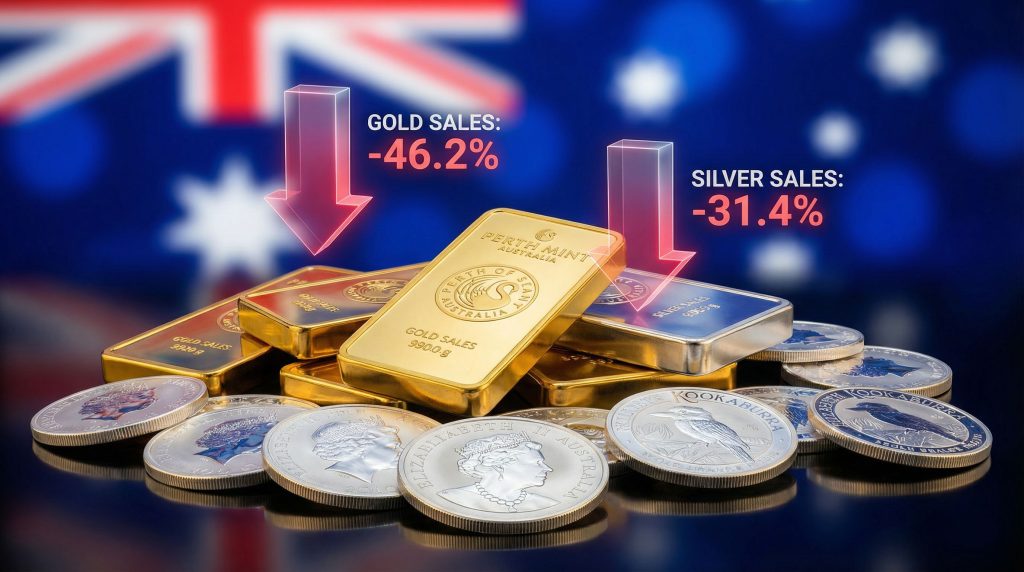
Perth Mint gold and silver sales decline during December 2025 revealed significant seasonal patterns affecting precious metals investment demand. Gold sales declined 46.2% month-over-month, falling from 66,710 ounces in November to 35,885 ounces in December. Similarly, silver sales decreased 31.4%, dropping from 875,487 ounces to 597,873 ounces during the same period.
These patterns align with broader industry trends where December typically experiences 18-25% lower sales compared to November across major mints and dealers. The U.S. Mint's comparative data shows December 2024 American Eagle gold coin sales totalling 55,000 ounces versus November's 83,500 ounces, representing a 34.1% decline.
Q4 Consumer Behaviour Analysis
| Perth Mint Metric | December 2025 | November 2025 | Monthly Change | YoY Change |
|---|---|---|---|---|
| Gold Sales (oz) | 35,885 | 66,710 | -46.2% | +13.1% |
| Silver Sales (oz) | 597,873 | 875,487 | -31.4% | -43.5% |
| Market Performance | Seasonal Decline | Baseline | Significant Drop | Mixed Results |
Neil Vance, Perth Mint's General Manager of Minted Products, characterises December as traditionally a quieter period for precious metals as customers focus attention on holiday and festive season activities. This observation reflects broader investment psychology where discretionary spending priorities shift during major cultural celebration periods.
Historical analysis of Perth Mint's monthly sales from 2020-2024 demonstrates consistent December weakness. December 2023 gold sales totalled 31,741 ounces compared to November 2023's 58,203 ounces, representing a 45.5% decline. December 2022 showed similar patterns with 28,956 ounces sold versus November 2022's 52,417 ounces, declining 44.8%.
However, these seasonal fluctuations must be viewed alongside seasonal market fluctuations that affect broader precious metals markets. Understanding these patterns helps investors develop more effective timing strategies.
International Seasonal Patterns
European precious metals dealers report similar trends, with Germany's Pro Aurum typically experiencing December sales volumes 25-35% below November levels. The Royal Canadian Mint's December 2024 gold Maple Leaf sales reached 62,500 ounces compared to November's 91,300 ounces, declining 31.6%.
Geographic variations emerge in Asian markets where Chinese gold demand peaks during January-February around Chinese New Year celebrations. The China Gold Association reported January-February 2024 gold consumption reaching 287.7 tonnes, approximately 30% higher than average monthly consumption during other periods.
What Economic Factors Drive Gold and Silver Investment Demand?
Monetary policy shifts significantly influence precious metals investment demand through real interest rate calculations. During 2024, real interest rates declined from approximately 2.7% in early 2024 to 1.8% by December, based on 10-year Treasury Inflation-Protected Securities (TIPS) yields. This decline supported precious metals allocation strategies as opportunity costs decreased.
Central bank gold purchasing reached 1,037 tonnes in 2024, marking the third consecutive year exceeding 1,000 tonnes in acquisitions. The People's Bank of China acquired 225 tonnes, while the National Bank of Poland purchased 90 tonnes, and the Reserve Bank of India added 77 tonnes to reserves.
Moreover, record high gold prices have influenced investment behaviour across multiple market segments. In addition, global gold production insights provide context for understanding supply-side dynamics affecting market conditions.
Investment Portfolio Allocation Trends
Portfolio rebalancing mechanics contribute to year-end precious metals demand fluctuations. Institutional investors maintaining fixed allocation targets must adjust holdings based on relative asset performance. During years when gold outperforms equities significantly, rebalancing requires selling gold to restore target allocations.
Global gold ETFs experienced mixed flows during 2024, with net outflows of 78 tonnes during Q1-Q2 followed by net inflows of 196 tonnes during Q3-Q4, resulting in net annual inflows of 118 tonnes. North American gold ETFs saw net inflows of 145 tonnes, while European funds experienced outflows of 89 tonnes.
Key investment drivers include:
- Currency debasement concerns driving physical metal ownership
- Geopolitical uncertainty correlation with safe-haven demand
- Interest rate policy impacts on opportunity cost calculations
- Inflation hedge strategies in institutional portfolios
- Dollar-cost averaging adoption among retail investors
Perth Mint December 2025 Sales Performance Analysis
Despite month-over-month declines, Perth Mint gold and silver sales decline figures showed year-over-year growth of 13.1% for gold, indicating underlying demand strength beyond seasonal factors. However, silver sales declined 43.5% year-over-year, suggesting distinct market dynamics affecting different precious metals categories.
Vance noted that minted bars performed strongly during December, reinforcing their ongoing appeal as core investment choices during market volatility periods. This observation highlights product category differentiation where larger-format bullion products maintain demand resilience compared to collectible coins during uncertain economic conditions.
Product Performance Differentiation
The varying performance between gold and silver reflects broader market dynamics where industrial demand influences silver pricing while investment demand primarily drives gold markets. Silver's dual nature as both precious metal and industrial commodity creates additional volatility during economic uncertainty periods.
Manufacturing demand for silver in electronics, solar panels, and medical applications typically accounts for approximately 50-60% of total silver consumption. Economic slowdown concerns can reduce industrial demand forecasts, impacting investment sentiment toward silver compared to gold's primarily monetary role.
Consequently, effective gold investment strategies must account for these fundamental differences between precious metals categories. The Perth Mint November sales data provides additional context for understanding recent performance trends.
How Do Price Volatility and Market Timing Affect Physical Precious Metals Demand?
Price-demand elasticity in physical precious metals markets demonstrates complex relationships where rising prices can simultaneously attract momentum investors while deterring price-sensitive buyers. This phenomenon creates volatility in monthly sales figures as different investor segments respond to market conditions with varying strategies.
Consumer behaviour during record-high pricing periods reveals psychological factors influencing purchasing decisions. Fear of missing out (FOMO) drives some investors to accelerate purchases during price rallies, while others implement dollar-cost averaging strategies to mitigate timing risks.
Market Psychology and Investment Behaviour
Behavioural finance principles in commodity investment decisions demonstrate how cognitive biases affect precious metals demand. Recency bias leads investors to extrapolate recent price movements into future expectations, creating pro-cyclical demand patterns that amplify price volatility.
Transaction costs in physical bullion markets, including bid-ask spreads of 2-5% plus storage and insurance expenses, discourage frequent trading compared to paper securities. These costs create natural barriers encouraging longer-term investment horizons among physical precious metals buyers.
Profit-taking strategies emerge during significant price appreciation periods, where investors realise gains to rebalance portfolios or fund other opportunities. This behaviour contributes to seasonal demand variations as year-end approaches provide natural selling triggers.
What Are the Strategic Implications for Australia's Precious Metals Industry?
Perth Mint's role within Australia's resource sector value chain extends beyond simple refining services to encompass strategic national interests in precious metals processing capabilities. Domestic refining capacity reduces dependence on international facilities while capturing value-added processing margins within Australian operations.
Supply chain resilience considerations have gained prominence following global logistics disruptions, emphasising the strategic value of regional processing capabilities. Perth Mint's processing capacity utilisation during demand fluctuations demonstrates operational flexibility essential for managing cyclical commodity markets.
Technology Integration and Market Evolution
Digital transformation in precious metals retail and distribution creates opportunities for market share expansion beyond traditional geographic constraints. Online sales growth from 28% to 35% of minted product sales between 2023-2024 illustrates evolving customer preferences toward digital purchasing channels.
ESG considerations in precious metals mining and processing increasingly influence institutional investment decisions. Government ownership structures like Perth Mint's Western Australian backing provide governance frameworks addressing environmental and social responsibility concerns that private sector competitors must establish independently.
Emerging market expansion potential exists for Australian precious metals through established trade relationships and currency arrangements. Asia-Pacific region growth, particularly in wealth management and investment diversification, creates demand opportunities for quality-assured precious metals products.
The next major ASX story will hit our subscribers first
Industry Outlook: Precious Metals Market Dynamics for 2026
Central bank gold purchasing trends indicate continued institutional demand supporting precious metals markets. Record accumulation levels since 2022 represent structural shifts in reserve management strategies rather than temporary tactical adjustments, suggesting sustained demand foundations.
Industrial demand growth projections for silver applications, particularly in renewable energy technologies and electronics manufacturing, provide fundamental support beyond investment flows. Solar panel production requiring approximately 100 million ounces annually creates baseline industrial consumption independent of precious metals investment cycles.
Risk Assessment and Market Volatility Factors
Regulatory changes affecting precious metals markets include potential modifications to capital gains tax treatment, bullion dealer licensing requirements, and international trade agreements. These policy shifts can significantly impact demand patterns and operational costs for market participants.
Currency fluctuation impacts on international demand create both opportunities and challenges for Australian precious metals exporters. Exchange rate movements between Australian dollar, U.S. dollar, and major trading partner currencies affect competitiveness in global markets.
Supply disruption risks in global precious metals production stem from:
- Geopolitical tensions affecting major producing regions
- Environmental regulations impacting mining operations
- Labour disputes and operational challenges at key facilities
- Energy cost fluctuations influencing refining economics
- Transportation and logistics constraints affecting distribution
Key Takeaways for Precious Metals Market Participants
Perth Mint gold and silver sales decline during December 2025 illustrates broader precious metals market dynamics where seasonal factors create predictable short-term volatility while underlying fundamentals support longer-term demand trends. The 46.2% monthly decline in gold sales and 31.4% decline in silver sales reflects normal holiday season patterns rather than fundamental market weakness.
Year-over-year comparison data provides more meaningful performance assessment, with gold sales increasing 13.1% demonstrating underlying demand strength despite seasonal fluctuations. Product category analysis reveals minted bars maintaining stronger resilience compared to collectible items during volatile market conditions.
Strategic planning considerations for precious metals market participants should incorporate seasonal demand patterns, geographic diversification opportunities, and product mix optimisation to mitigate concentration risks. Perth Mint's experience demonstrates the importance of balanced business models combining institutional refining services with retail investment products.
Furthermore, market participants can reference the Perth Mint October sales data to understand broader performance trends across multiple reporting periods.
Disclaimer: The precious metals markets involve significant risks and volatility. Historical performance does not guarantee future results. Investors should carefully consider their risk tolerance and investment objectives before making precious metals investments. Market forecasts and projections represent opinions based on current market conditions and may change without notice.
Looking for Investment Opportunities in Small-Cap ASX Mining Stocks?
Discovery Alert's proprietary Discovery IQ model delivers real-time alerts on significant mineral discoveries across the Australian Stock Exchange, empowering investors to identify actionable opportunities ahead of the broader market. Explore Discovery Alert's dedicated discoveries page to understand why historic discoveries can generate substantial returns, then begin your 30-day free trial today to position yourself ahead of seasonal market fluctuations and secure your competitive advantage.