
August 2, 2026
The Metallurgical Frontier: How a Single Gold Bar Redefined What Australian Refining Can Achieve
Precious metals refining has always operated at the intersection of industrial chemistry, materials engineering, and geopolitical economics. For most of its modern history, the benchmark for refined gold has been the London Good Delivery bar, a standardised ingot weighing approximately 400 troy ounces, or around 12.4 kilograms. That benchmark has governed global bullion trading for decades, shaping everything from central bank reserves to exchange-traded fund structures. Yet on 9 July 2026, a single event in East Perth quietly rendered that standard a footnote in a much larger story.
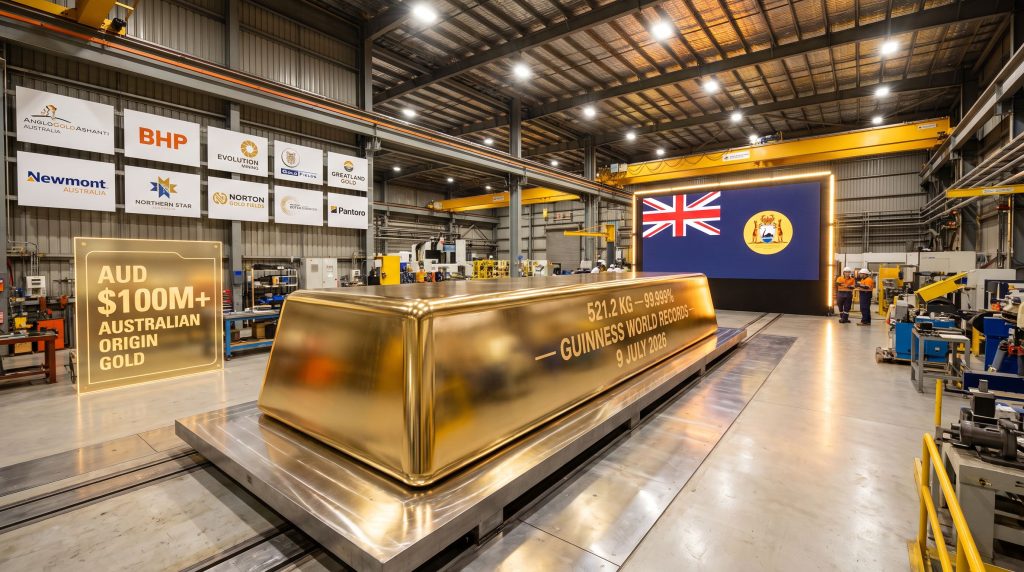
The Perth Mint world's largest gold bar, certified by Guinness World Records at 521.2 kilograms and refined to 99.999% purity, did not emerge from a single mine or a solitary industrial act. It was the product of a coordinated industry collaboration involving nine separate Western Australian gold producers, more than 35 specialist technicians, and one of the Southern Hemisphere's most sophisticated precious metals refining facilities. Understanding what this achievement actually required, technically, logistically, and economically, reveals far more about Western Australia's industrial maturity than any headline figure can convey.
When big ASX news breaks, our subscribers know first
The Record in Numbers: Key Metrics at a Glance
Before examining the technical substance of this achievement, the core metrics deserve direct presentation.
| Metric | Detail |
|---|---|
| Weight | 521.2 kilograms |
| Purity | 99.999% (Five Nines Fine) |
| Record Date | 9 July 2026 |
| Previous Record | Approximately 300 kilograms |
| Margin of Improvement | More than 200 kilograms above prior record |
| Estimated Raw Material Value | Over AUD $100 million |
| Specialists Involved | More than 35 |
| Gold Classification | Australian Origin Gold |
| Certification Body | Guinness World Records |
"The Perth Mint's 521.2 kg gold bar does not merely surpass the previous Guinness World Record. It exceeds it by more than 200 kilograms, representing a margin of improvement of roughly 66% over the prior benchmark. That is not incremental progress. That is a structural leap."
How the World's Largest Gold Bar Was Actually Constructed
A Multi-Producer Supply Chain Unlike Any Other
The bar's physical existence began not in a single mine but across multiple operations spanning Western Australia's goldfields. Nine producers contributed raw gold material, each sourcing from Australian-origin operations, qualifying the finished product under the Australian Origin Gold designation. This provenance classification carries genuine commercial weight in international bullion markets, particularly as institutional buyers, central bank gold demand, and ESG-focused investors increasingly demand documented chain-of-custody verification for the metal they hold.
The nine contributing companies were:
- AngloGold Ashanti Australia
- BHP
- Evolution Mining
- Gold Fields
- Greatland Gold
- Newmont Australia
- Northern Star
- Norton Gold Fields
- Pantoro
This list is not arbitrary. It spans the full spectrum of Western Australia's gold sector, from globally listed majors with NYSE and JSE listings to ASX-based mid-tier and development-stage operators. Collectively, these companies represent a substantial proportion of the state's annual gold output, making the bar a genuine cross-industry artefact rather than a single-company marketing exercise.
What Five Nines Fine Purity Actually Demands
The purity designation of 99.999%, known in the industry as Five Nines Fine, is not simply a marketing superlative. It represents the uppermost tier of commercial gold refining, and achieving it at the scale of 521.2 kilograms introduces metallurgical challenges that simply do not exist at standard bar sizes.
To contextualise the purity hierarchy:
| Purity Grade | Classification | Typical Application |
|---|---|---|
| 99.5% minimum | LBMA Good Delivery | Wholesale bullion trading |
| 99.9% | Three Nines Fine | Jewellery, industrial use |
| 99.99% | Four Nines Fine | Investment coins, sovereign mint products |
| 99.999% | Five Nines Fine | Ultra-premium bullion, record applications |
Achieving Four Nines Fine purity across a standard coin blank is technically demanding but well-understood. Scaling that same requirement to a 42-times heavier mass introduces compounding variables: thermal gradients during cooling can create localised segregation of trace impurities, meaning the assay verification process must account for purity distribution across the entire bar's volume, not merely its surface.
The refining process itself likely involved a combination of pyrometallurgical smelting to consolidate the contributed gold, followed by electrolytic refining to strip residual base metal contaminants down to parts-per-million concentrations. At each stage, multi-point assay sampling would have been required to confirm uniform purity distribution before the bar could be certified.
The Engineering Challenges of Casting at This Scale
A detail frequently overlooked in discussions of this record is the mould engineering problem. Casting 521.2 kilograms of molten gold into a structurally sound, geometrically precise ingot requires purpose-built tooling. Standard refinery moulds are designed for Good Delivery bar volumes. The thermal mass of 521 kilograms of gold at casting temperature, approximately 1,200 degrees Celsius for pure gold, creates cooling dynamics that demand precise control to prevent internal voids, surface cracking, or compositional stratification.
The involvement of more than 35 specialists across The Perth Mint's Refinery and Assay Laboratory reflects this complexity. Those roles would have spanned:
- Pyrometallurgical processing engineers overseeing smelting and casting operations
- Electrolytic refining technicians managing the high-purity separation process
- Assay laboratory analysts conducting multi-point purity verification
- Mould engineers designing and validating the custom casting infrastructure
- Logistics and security coordinators managing a single asset valued at over AUD $100 million
Western Australia's Gold Industry: The Geological Foundation Behind the Record
The Yilgarn Craton: A World-Class Geological Endowment
Western Australia's dominance in global gold production is not accidental. It is rooted in the geological characteristics of the Yilgarn Craton, an ancient Archaean greenstone belt approximately 2.6 to 3.0 billion years old that underlies much of the state's interior. Greenstone belts of this age are among the most gold-endowed geological formations on Earth, and the Yilgarn represents one of the largest and best-preserved examples anywhere in the world.
Gold mineralisation in the Yilgarn is dominated by orogenic lode deposits, formed when gold-bearing hydrothermal fluids migrated along deep crustal fault systems during ancient tectonic events. These deposits tend to produce high-grade ore in structurally controlled zones, which is why WA's major producing mines, concentrated around Kalgoorlie, Leonora, and the broader Eastern Goldfields, have sustained economically viable grades for more than a century of extraction.
"What makes the Yilgarn particularly valuable from a long-cycle mining perspective is the scale of its endowment relative to exploration maturity. Despite more than 130 years of systematic mining, the belt continues to yield new discoveries, suggesting that the structural floor of Western Australian gold production remains substantially higher than many comparable mining jurisdictions globally."
WA's Position in the National and Global Gold Hierarchy
Western Australia accounts for the overwhelming majority of Australia's gold production, and Australia itself has become one of the world's largest gold-producing nations. By 2025, Australian gold exports had reached a valuation of $71 billion, positioning gold among the country's single most economically significant export commodities, a status that would have seemed improbable a decade ago when the national export narrative was dominated almost entirely by iron ore and thermal coal.
The structural factors behind this transformation include:
- Sustained elevation in global gold spot prices, driven by central bank gold reserves accumulation programs, geopolitical uncertainty, and an accelerating de-dollarisation trend among emerging market reserve managers
- Production expansions at established WA operations, enabled by improved ore body delineation through modern geophysical and drilling techniques
- Growing institutional demand for traceable, responsibly sourced gold, an area where Australian-origin material commands a measurable provenance premium
- Increased domestic refining throughput at The Perth Mint, capturing downstream value before export rather than shipping partially processed doré material
The Perth Mint: Institutional Profile and Historical Context
From Royal Mint Branch to World-Class Sovereign Refiner
The Perth Mint traces its origins to 1899, when it was established as a branch of the Royal Mint of the United Kingdom to process gold from Western Australia's expanding goldfields. Over the following century, it transitioned from a colonial assay facility to one of the world's most respected sovereign mints, operating under ownership by the Western Australian Government.
Its current functions span the full precious metals value chain:
- Bullion refining, operating under London Bullion Market Association (LBMA) accreditation for gold, silver, and platinum group metals
- Coin and bar manufacturing, including internationally recognised products such as the Australian Gold Kangaroo and Lunar series
- Precious metals custodial and storage services, offering both allocated and unallocated gold programs to institutional and retail clients globally
- Wholesale and retail bullion distribution, serving domestic and international markets
LBMA accreditation is a critical credentialing point. It means The Perth Mint's refined gold meets the assay, weight, and documentation standards required for acceptance on the global wholesale market, enabling direct participation in the international physical gold trading system without the friction of third-party re-refining.
Why Government Ownership Shapes This Achievement
As a Western Australian Government-owned enterprise, The Perth Mint operates under a mandate that extends beyond commercial returns. The world record project reflects this dual commercial-and-developmental purpose: generating international visibility for WA's refining capability while simultaneously validating the state's advanced manufacturing credentials on a globally recognised platform.
The project sits alongside the Western Australian Government's Made in WA agenda, which prioritises domestic processing and value-adding across the state's resource industries. Western Australian Minister for Mines, Petroleum and Exploration Daniel Pastorelli noted that the achievement demonstrates how WA adds value to its resources through world-class refining, advanced technology, and highly skilled people. He also described the record as belonging not only to The Perth Mint but to the broader community of Western Australians working across the state's gold industry.
Comparative Context: How This Record Stacks Up Historically
World Record Gold Bars: A Historical Comparison
| Record Holder | Weight | Purity | Year |
|---|---|---|---|
| Perth Mint (current) | 521.2 kg | 99.999% | 2026 |
| Previous Guinness Record holder | ~300 kg | Not specified | Pre-2026 |
| Standard LBMA Good Delivery Bar | ~12.4 kg | Minimum 99.5% | Ongoing standard |
| Typical sovereign mint coin blank | Less than 1 kg | 99.99% | Ongoing |
The previous record holder weighed approximately 300 kilograms. The Perth Mint's bar surpasses that figure by more than 221 kilograms, a margin that speaks to the scale of ambition behind this project. It was not designed to edge past a prior record by a narrow margin. It was engineered to establish a benchmark that would be difficult to challenge without an equivalent level of industry coordination and refining capability.
The next major ASX story will hit our subscribers first
The Strategic Significance of Australian Origin Gold
Provenance as a Competitive Advantage in Modern Bullion Markets
One dimension of this record that carries growing commercial importance is the Australian Origin Gold classification. In contemporary bullion markets, provenance has shifted from a secondary consideration to an active differentiator. This is partly driven by regulatory pressure, as jurisdictions across Europe and North America tighten due diligence requirements for conflict mineral sourcing, and partly by voluntary ESG frameworks adopted by institutional investors and central banks.
Gold sourced from large-scale, regulated, and auditable operations in a stable, rule-of-law jurisdiction like Australia presents a fundamentally different risk profile compared to artisanal or small-scale mining (ASM) output from higher-risk regions. For institutional buyers managing reputational exposure, that difference increasingly translates into a willingness to pay a provenance premium. Furthermore, with gold price record highs reinforcing the asset's appeal, the demand for verified, high-quality supply chains has never been stronger.
"The bar's creation using gold from nine separately operated, LBMA-compliant or equivalent supply chains, all traceable to specific Western Australian operations, positions it as a proof-of-concept for the kind of verifiable, large-volume, high-purity gold supply that institutional markets are actively seeking."
The Value-Adding Argument: Beyond Raw Commodity Export
Australia has historically exported significant volumes of gold in doré form, meaning partially refined gold-silver alloy, which is then processed at overseas refineries. Each tonne of doré exported rather than fully refined domestically represents foregone value-added revenue. The Perth Mint's expanding throughput capacity, now demonstrably capable of achieving Five Nines Fine purity at world-record scale, strengthens the economic case for retaining more of that refining margin within Australia.
Investors considering exposure to Australia's gold sector will find that understanding the distinction between physical gold vs ETFs is increasingly relevant, particularly as provenance-verified bullion commands growing premiums in institutional markets. Consequently, the bar's existence adds tangible weight to the argument for domestic value-adding across Australia's entire resource export chain.
Frequently Asked Questions: Perth Mint World's Largest Gold Bar
How much is the world's largest gold bar worth?
The raw material value of the 521.2 kg gold bar is estimated at over AUD $100 million based on prevailing spot prices at the time of its creation. No official definitive valuation has been published by The Perth Mint, and the figure naturally fluctuates with gold market movements. At current elevated gold price levels, this bar represents one of the highest-value single refined gold ingots ever produced.
Where is the world's largest gold bar displayed?
The bar is intended for permanent public display at The Perth Mint in East Perth, Western Australia, where it will serve as both a record-holding artefact and a tangible demonstration of the state's refining expertise for visitors and industry stakeholders.
What purity is the world's largest gold bar?
The bar is refined to 99.999% purity, designated Five Nines Fine gold. This is the highest commercially achievable purity standard in gold refining and is exceptionally rare at the physical scale of 521.2 kilograms. For reference, the Guinness World Records organisation, which officially certified this achievement, maintains rigorous verification standards that ensure the record's global credibility.
Who certified the world's largest gold bar?
The record was officially certified by Guinness World Records, with formal recognition granted on 9 July 2026.
How many companies contributed gold to the bar?
Nine Western Australian gold mining companies contributed gold: AngloGold Ashanti Australia, BHP, Evolution Mining, Gold Fields, Greatland Gold, Newmont Australia, Northern Star, Norton Gold Fields, and Pantoro.
Key Takeaways: What the Perth Mint's World Record Reveals About WA's Industrial Trajectory
-
Western Australia's gold sector has evolved from a raw extraction economy into a vertically integrated industry capable of demonstrating world-record refining performance at the highest purity standards
-
The collaborative model, nine producers contributing to a single record-breaking ingot, demonstrates the strategic value of industry coordination and shared infrastructure investment that individual operators could not replicate unilaterally
-
At $71 billion in annual export value, gold has become a foundational pillar of Australia's commodity export portfolio, and The Perth Mint's expanding capabilities are central to capturing domestic value from that output
-
The Five Nines Fine purity standard achieved across 521.2 kilograms of consolidated gold represents a genuine technical milestone, requiring advanced electrolytic refining, precision mould engineering, and multi-point assay verification at an unprecedented scale
-
The Australian Origin Gold classification applied to the bar positions WA's gold sector advantageously in international markets where provenance traceability and ESG compliance are becoming structural purchasing criteria rather than optional premiums
-
The Perth Mint world's largest gold bar, now on permanent public display, ensures this record functions not only as an industry benchmark but as a long-duration showcase of Western Australia's advanced manufacturing credentials for the global visitors and investors who pass through its doors
Want to Capitalise on the Next Major ASX Gold Discovery Before the Market Does?
Western Australia's gold sector is demonstrating world-class capability at every level of the value chain, and Discovery Alert's proprietary Discovery IQ model ensures subscribers receive real-time alerts the moment significant ASX mineral discoveries are announced — turning complex data across 30-plus commodities into clear, actionable insights. Start your 14-day free trial today and explore historic discovery returns to understand how early positioning in major mineral finds has delivered exceptional outcomes for informed investors.