August 1, 2026
The Monetary Policy Credibility Gap and What It Means for Hard Assets
Across modern financial history, the periods that have proven most consequential for gold pricing have rarely been the ones defined by sharp policy moves. They have been the ones defined by institutional hesitation, contradictory signals, and the creeping suspicion among market participants that the people managing the money supply have run out of easy answers. That pattern is unfolding again with fed cracks and gold at the centre of this dynamic, and the implications for precious metals are worth examining carefully.
When a central bank operates with a unified voice, markets can price risk efficiently. Forward guidance carries weight. Investors calibrate portfolios around a predictable policy trajectory. However, when that unity splinters, something structurally different happens. The institution's credibility becomes a variable rather than a constant, and capital begins migrating toward assets that require no institutional trust to hold their value.
Gold is the oldest and most liquid of those assets. Understanding why it is rising now requires looking not just at price charts, but at the deeper mechanics of how monetary policy authority erodes, and what historically fills the vacuum when it does.
When big ASX news breaks, our subscribers know first
How the FOMC Became a Divided House
From Consensus Institution to Contested Committee
The Federal Open Market Committee has long cultivated an image of deliberate, measured consensus. Even when individual members hold divergent views, the institution has historically managed to present a coherent policy front. That carefully maintained appearance of unity has itself been a monetary policy tool, because market confidence in the Fed's direction influences financial conditions almost as powerfully as rate decisions themselves.
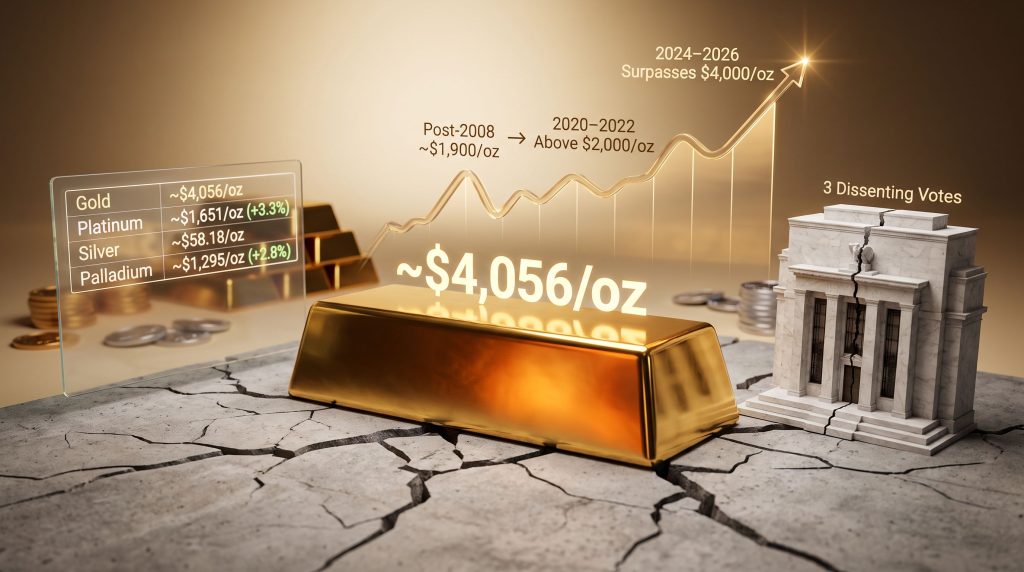
What makes the most recent FOMC meeting notable is not the rate hold in isolation. It is the visible scale of internal disagreement. Three voting members formally dissented, pushing for an immediate rate increase rather than another pause. This is not a minor procedural footnote. Within the architecture of monetary policymaking, a multi-member dissent signals that the committee's internal models are producing genuinely conflicting conclusions about where inflation is headed and how aggressively the Fed should respond.
Markets read this kind of fracture carefully. When the institution responsible for managing dollar purchasing power cannot agree on whether inflation is under control, that disagreement itself becomes a price signal. The gold price forecast remains deeply tied to how this internal division resolves.
Current FOMC Policy Parameters in Context
| Policy Parameter | Current Level | Market Expectation (Next Meeting) |
|---|---|---|
| Federal Funds Rate Target Range | 3.50% to 3.75% | Possible hike under pressure |
| Dissenting Votes (Latest Meeting) | 3 members favouring hike | Signals unresolved inflation debate |
| Gold Price (as of reporting) | ~$4,056/oz | Sensitive to September outcome |
| Silver Price | ~$58.18/oz | Down ~1.3% on week |
| Platinum | ~$1,651/oz | Up ~3.3% on week |
| Palladium | ~$1,295/oz | Up ~2.8% on week |
The Rate Hold Paradox
There is a counterintuitive dynamic embedded in the decision to hold rates steady when inflation remains elevated. On the surface, a hold appears neutral. In practice, it can function as a form of passive monetary loosening when inflation is still running above the Fed's target. Every month that real yields remain negative or barely positive is another month that the purchasing power of dollar-denominated savings erodes. This is not a speculative scenario. It is the arithmetic of inflation compounding against a stationary nominal rate.
For gold, this creates structural support. The opportunity cost of holding non-yielding bullion decreases as real yields compress, and compressed real yields are precisely what a rate hold in an inflationary environment produces. Furthermore, gold as a strategic investment becomes increasingly compelling when this dynamic is in play.
Is the Fed Losing Its Inflation-Fighting Credibility?
The Gap Between Hawkish Rhetoric and Cautious Action
Central bank credibility is not an abstraction. It has a measurable market effect. When the Fed commits vocally to inflation control but repeatedly chooses the cautious path at the policy meeting, forward guidance loses its anchoring power. Investors and traders begin discounting official statements at a higher rate, because the institution's track record of following through on its hawkish language has become inconsistent.
This credibility erosion does not happen overnight. However, it accumulates across meetings, across press conferences, and across the gap between what officials say and what they actually do. The current environment, with three dissenting votes demanding action while the majority opts for patience, is a visible symptom of that accumulation.
Three Structural Forces Keeping Inflation Elevated
-
Persistent energy cost escalation driven by constrained supply investment and geopolitical disruption to production corridors
-
Entrenched housing market pricing that has proven highly resistant to the rate increases already implemented, partly because the existing housing stock is locked in by homeowners holding low fixed-rate mortgages from prior cycles
-
Consumer credit rates remaining near cycle highs, which compress disposable income and slow the demand destruction that rate hikes are designed to produce, without delivering the disinflationary relief that theory predicts
Federal Debt as a Constraint on Policy Capacity
One of the less frequently discussed dimensions of the current monetary environment is the degree to which the US federal debt load limits the Fed's practical capacity to raise rates aggressively. When government debt is sufficiently large, rising interest rates translate directly into rising debt service costs, which feed back into larger deficits, which create pressure for additional money creation.
This fiscal-monetary feedback loop does not make rate hikes impossible, but it does make sustained aggressive tightening politically and fiscally more complex than simple inflation economics would suggest. According to analysis published by The Dark Side of the Boom, gold's break above $4,000 directly exposes this debasement dynamic.
When the cost of servicing government debt rises faster than the economy grows, the central bank faces a structural tension between its inflation mandate and the fiscal sustainability of the sovereign it ultimately backstops. This tension is not resolved by policy statements. It is resolved by gold prices.
The Three Channels Through Which Fed Cracks Flow Into Gold Pricing
When analysts discuss the relationship between fed cracks and gold, they are describing a specific transmission mechanism that operates across three distinct channels simultaneously.
-
Real yield compression occurs when the Fed holds nominal rates steady while inflation remains elevated, pushing inflation-adjusted yields lower or negative. Since gold carries no coupon or dividend, its relative attractiveness improves as the yield on competing assets deteriorates in real terms.
-
Dollar debasement risk accumulates when persistent fiscal deficits combine with policy hesitation. The dollar's long-term purchasing power becomes a function of whether the Fed can credibly commit to limiting money supply growth, and visible internal disagreement undermines that credibility.
-
Safe-haven rotation accelerates when institutional and sovereign capital managers perceive that the policy environment has become genuinely uncertain. This is not purely a retail investor phenomenon. Pension funds, sovereign wealth funds, and central bank reserve managers all incorporate policy credibility assessments into their allocation frameworks.
When the Federal Reserve displays internal division through dissenting votes, contradictory forward guidance, or a sustained gap between inflation rhetoric and actual rate decisions, gold markets typically respond with upward price pressure. Policy uncertainty reduces confidence in the dollar's stability, compresses real yields, and accelerates demand for tangible stores of value. In structural terms, a fractured Fed creates a structurally supportive environment for gold.
Where Gold Sits in Its Long-Term Bull Market Cycle
Historical Context: Fiat Currency Confidence Across Eras
| Era | Key Policy Action | Impact on Gold Demand |
|---|---|---|
| Post-2008 | Quantitative easing begins at scale | Initial gold bull run to approximately $1,900/oz |
| 2011 to 2018 | Tightening cycle, dollar strength | Gold consolidation and multi-year base-building |
| 2020 to 2022 | Pandemic stimulus, record deficit spending | Gold breaks above $2,000/oz for the first time |
| 2024 to 2026 | Persistent inflation, visible policy division | Gold surpasses $4,000/oz |
A Generational Shift in Fiat Currency Confidence
John Paulson, the hedge fund manager whose accurate prediction of the 2008 US housing market collapse built his reputation for identifying major systemic turning points, has publicly argued that the current gold rally is not a reaction to any single macroeconomic data point. His position, articulated in multiple public forums, is that the rally reflects something more durable: a gradual, broad-based erosion of investor confidence in paper currencies as reliable long-term stores of value.
This is a meaningful framing distinction. If gold is rising because of temporary inflation fears, the bull market has a natural endpoint when inflation is credibly defeated. However, if gold is rising because investors are fundamentally reassessing the long-run reliability of fiat money systems, the demand drivers are structural rather than cyclical, and the duration of the trend extends well beyond any single rate cycle.
Paulson's view is that the underlying investment case for gold is strengthening, and that the current period represents early innings rather than a late-stage rally running out of momentum. In addition, the gold safe-haven appeal underpins much of this structural confidence shift.
Separating Short-Term Volatility From Structural Demand
Gold closed the most recent reporting week at approximately $4,056 per ounce, representing a marginal decline of roughly 0.2% for the week after giving back gains posted earlier in the period. This kind of weekly correction within an extended bull market is entirely consistent with normal price behaviour.
Long-term bull markets are routinely interrupted by consolidation phases that shake out short-term speculative positions before the next structural leg higher begins. The distinction between a healthy consolidation and a genuine trend reversal requires examining the underlying demand drivers rather than the short-term price action.
Central Bank Gold Accumulation: The Sovereign Demand Signal
Why Nation-States Are Buying Gold at Historic Rates
Central bank gold demand has reached historically elevated levels in recent years, driven by a combination of reserve diversification strategy and deliberate reduction of dollar concentration risk. This sovereign-level demand carries informational weight that retail price movements often obscure. Central bank reserve allocation decisions reflect multi-decade strategic planning horizons. They are not responsive to quarterly earnings cycles or short-term sentiment shifts.
When the institutions that create and manage fiat currencies are simultaneously accumulating gold at record rates, the message embedded in that behaviour deserves careful attention. It suggests that those with the most direct insight into the structural vulnerabilities of paper money systems are actively hedging against those vulnerabilities at scale.
De-Dollarisation and Reserve Diversification
The broader de-dollarisation trend, visible in the growing number of bilateral trade agreements denominated in non-dollar currencies and in the expansion of alternative reserve frameworks, reinforces gold's strategic role. Furthermore, central bank gold reserves continue to expand as sovereigns seek assets with no counterparty risk, no issuer credit risk, and no dependency on the political reliability of any single sovereign.
As Reuters has reported on record safe-haven demand, this dynamic is accelerating across multiple markets simultaneously, reinforcing the structural underpinning of the current bull cycle.
The next major ASX story will hit our subscribers first
Precious Metals Weekly Snapshot: Reading Divergence as a Signal
| Metal | Price (Reporting Period) | Weekly Change | Primary Demand Driver |
|---|---|---|---|
| Gold | ~$4,056/oz | -0.2% | Monetary safe-haven, central bank accumulation |
| Silver | ~$58.18/oz | -1.3% | Industrial and monetary dual demand |
| Platinum | ~$1,651/oz | +3.3% | Industrial uses including hydrogen economy |
| Palladium | ~$1,295/oz | +2.8% | Autocatalyst demand, supply constraints |
The divergence between platinum and palladium's weekly gains and gold and silver's mild retreats reflects the different demand compositions underlying each metal. Platinum's 3.3% advance and palladium's 2.8% gain suggest that industrial demand signals, particularly in clean energy transition applications, are providing independent price support that operates separately from the monetary thesis driving gold.
Silver's dual nature as both monetary metal and industrial input means it often lags gold during periods when monetary concerns dominate, before potentially outperforming during the acceleration phase of a broader precious metals cycle.
Scenario Framework: Three Fed Paths and Their Gold Implications
Investors navigating the current environment benefit from thinking in scenarios rather than single-point forecasts. The September FOMC meeting represents the next major decision node, and three plausible outcomes carry meaningfully different short-term implications for gold.
Scenario 1: Fed Hikes in September
The dollar strengthens in the near term and gold faces short-term price pressure. However, a hike in this environment also signals that inflation remains sufficiently problematic to justify action, which reinforces the long-term structural thesis for gold. The medium-term bullish case strengthens even as the near-term price softens.
Scenario 2: Fed Holds Again
Real yields remain compressed, dollar confidence remains uncertain, and gold finds continued structural support. The credibility gap between hawkish rhetoric and cautious action widens, potentially accelerating institutional allocation toward hard assets.
Scenario 3: Fed Cuts Prematurely
This is the most immediately bullish outcome for gold. A premature cut would signal that the inflation fight has been effectively abandoned in favour of economic growth support, dramatically accelerating safe-haven rotation and potentially validating the fiat currency confidence erosion thesis in a highly visible way.
Frequently Asked Questions: Fed Policy and Gold
Does a Fed Rate Hike Always Push Gold Down?
Not necessarily, and this is a common oversimplification. What matters for gold is not the nominal rate itself but the real rate, which is the nominal rate minus inflation. If the Fed hikes but inflation remains elevated, real yields may barely move or even remain negative, providing continued structural support for gold even as nominal rates rise.
What Does a Divided FOMC Vote Mean for Gold Investors?
A multi-member dissent reveals genuine internal uncertainty about where inflation is headed and how aggressively the Fed should respond. This type of visible institutional disagreement reduces market confidence in forward guidance and tends to support gold by increasing policy uncertainty as a risk factor.
How Long Can a Gold Bull Market Last When Driven by Fiat Currency Concerns?
Cycles driven by structural confidence erosion in monetary systems tend to last considerably longer than those driven by temporary inflation spikes or geopolitical events. The 1970s gold bull market, which was fundamentally driven by the collapse of the Bretton Woods gold standard and the resulting fiat currency experiment, lasted approximately a decade. Current conditions share some structural similarities with that era, though the specific mechanisms and magnitudes differ.
Is Gold Still a Safe Haven When Inflation Is High?
High inflation is actually one of the environments in which gold's safe-haven properties are most directly relevant, because inflation is itself a form of currency debasement. Gold's historical role has been to preserve purchasing power across long time horizons, which makes it particularly relevant in environments where the purchasing power of paper money is visibly declining.
What Is the Relationship Between Federal Debt Levels and Gold Prices?
Elevated federal debt constrains the Fed's capacity for sustained aggressive rate hiking, because higher rates translate into higher debt service costs, which expand deficits, which create pressure for eventual monetisation. Gold tends to perform well in environments where this fiscal-monetary feedback loop is operating, because it prices in the long-term risk of currency debasement that the loop implies.
Key Takeaways: What Fed Cracks Mean for Gold's Long-Term Trajectory
The convergence of forces currently supporting fed cracks and gold is not a collection of independent coincidences. It is a structurally coherent pattern rooted in three reinforcing dynamics:
-
Visible institutional credibility erosion at the world's most systemically important central bank, expressed through public FOMC dissent and the persistent gap between hawkish rhetoric and cautious action
-
Sovereign-level demand for gold as a reserve diversification tool, reflecting strategic decisions made with multi-decade time horizons by the institutions that understand fiat currency vulnerabilities most directly
-
Growing recognition among retail and institutional investors alike that physical precious metals function as monetary insurance rather than purely speculative instruments
Whether gold experiences near-term volatility around the September FOMC meeting is largely beside the point for investors focused on the structural thesis. The more consequential question is whether the underlying reasons to hold gold are becoming more or less compelling over time. Based on the trajectory of Fed credibility, federal debt dynamics, sovereign accumulation patterns, and the broader fiat currency confidence cycle, the weight of evidence currently points toward those reasons becoming stronger rather than weaker.
Disclaimer: This article is intended for informational and educational purposes only. It does not constitute financial advice or a recommendation to buy or sell any security or commodity. Precious metals investing involves risk, including the potential loss of principal. Past performance of any asset class is not indicative of future results. Readers should conduct their own research and consult a qualified financial adviser before making investment decisions.
Want to Know When the Next Major ASX Mineral Discovery Hits the Market?
While gold's structural bull market reflects deepening cracks in monetary policy credibility, Discovery Alert's proprietary Discovery IQ model scans ASX announcements in real time, instantly identifying significant mineral discoveries across 30-plus commodities and translating complex data into actionable insights — explore historic discoveries and their remarkable returns, then begin your 14-day free trial to position yourself ahead of the broader market.