August 1, 2026
When Open-Pit Grade Becomes a Strategic Weapon: The Tower Hill Advantage
Across the global gold mining landscape, a quiet but consequential threshold separates profitable open-pit operations from marginal ones: reserve grade. Most open-pit gold mines worldwide operate on reserve grades well below 1.5 grams per tonne (g/t), with many large-scale operations processing ore in the 0.8–1.2 g/t range. At these grades, economics become tightly sensitive to gold price movements, diesel costs, and contractor pricing. Every dollar shift in the gold price carries outsized consequences for project margins.
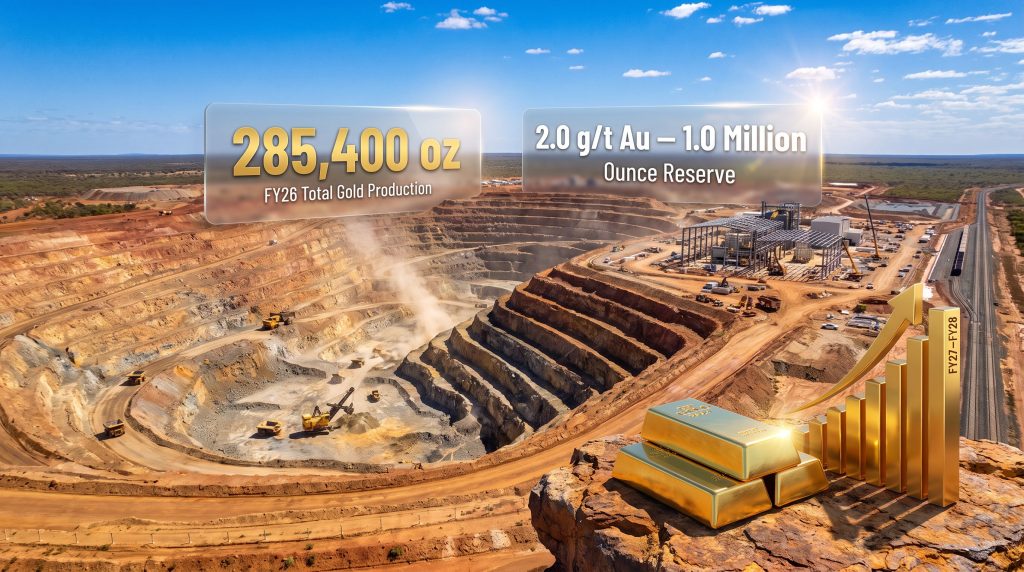
This is precisely why the Genesis Tower Hill gold project production profile warrants close attention from anyone tracking Western Australian gold sector developments. Tower Hill's mineral reserve grades at 2.0 g/t gold within a shallow, open-pittable configuration, a figure that sits meaningfully above what most comparable operations achieve. Furthermore, combined with a reserve base of approximately 15 million tonnes containing roughly 1.0 million ounces, the deposit occupies a rare position in the open-pit development pipeline: genuinely high-grade at large scale.
When big ASX news breaks, our subscribers know first
What Tower Hill Brings to Genesis Minerals' Western Australian Portfolio
Genesis Minerals has spent several years assembling a multi-asset gold platform across two of Western Australia's most historically productive gold districts: Leonora and Laverton. The company's portfolio consolidation strategy has involved targeted acquisitions, underground development, and now a flagship open-pit growth project in Tower Hill. The Tower Hill project sits at the heart of this growth ambition.
What distinguishes Tower Hill from most development-stage open-pit projects is its geological pedigree. The deposit has a recorded mining history extending back to approximately 1898, with around 220,000 ounces produced from intermittent, small-scale extraction over more than a century. This historical production record, while modest relative to the deposit's full potential, provides something that exploration-stage projects fundamentally lack: geological confirmation at depth and across strike. The orebody is not theoretical. It has been mined, assayed, and re-evaluated across multiple technological generations.
The distinction between historical artisanal and small-scale extraction versus modern large-scale open-pit development is important. Early miners at Tower Hill were constrained by primitive equipment, shallow working depths, and an absence of bulk processing infrastructure. The deposit's full economic potential was structurally inaccessible to them. Today, however, with advanced pit design software, high-capacity earth-moving equipment, and a purpose-built processing facility in development, the economics of Tower Hill are fundamentally different.
Tower Hill Deposit Metrics at a Glance
| Attribute | Detail |
|---|---|
| Reserve Tonnage | ~15 million tonnes |
| Reserve Grade | 2.0 g/t gold |
| Contained Reserve Ounces | ~1.0 million oz |
| Total Resource Base | Exceeds 1.0 million oz |
| Pit Configuration | Single open pit |
| Historical Production | ~220,000 oz since circa 1898 |
| Development Stage (as of FY26) | Mining commenced; plant commissioning FY28 |
FY26 Performance: The Financial Foundation for Tower Hill's Development
Understanding why Genesis is now in a position to self-fund a large-scale processing plant construction without requiring dilutive equity raises requires examining the company's recent operational trajectory. The gold price outlook has also played a meaningful role in strengthening the company's financial position heading into this critical development phase.
Genesis delivered 285,400 ounces of gold in FY26, finishing squarely within its guided range of 260,000 to 290,000 ounces at all-in sustaining costs (AISC) maintained within the $2,500 to $2,700 per ounce range. Critically, this marked the third consecutive financial year in which the company met its production guidance, a track record that carries significant weight with institutional investors evaluating execution risk.
FY26 Financial and Operational Summary
| Metric | Result |
|---|---|
| Annual Gold Production | 285,400 oz |
| Production Guidance Range | 260,000–290,000 oz |
| AISC (Guided Range) | $2,500–$2,700/oz |
| June Quarter Underlying Cash | ~$258 million |
| Full-Year Underlying Cash | ~$893 million |
| Consecutive Years of Guidance Delivery | 3 |
The June 2026 quarter result deserves particular analytical attention. Despite facing a combination of compounding headwinds including a lower prevailing gold price, elevated diesel input costs, the cessation of third-party ore purchase agreements, and simultaneous contractor transitions across all underground operations, Genesis generated more underlying cash during the June quarter than it did in the March quarter.
This is not a trivial achievement. In the WA gold sector, contractor changeouts at underground mines are among the most operationally disruptive events a producer can navigate. Managing all underground operations through simultaneous contractor transitions while still improving quarter-on-quarter cash generation signals a level of operational maturity that distinguishes companies genuinely capable of executing complex development programs from those whose development timelines frequently slip.
Genesis Minerals' Executive Chair Raleigh Finlayson has pointed to safety, growth, and delivering on market commitments as the company's three foundational objectives, noting that all three were achieved simultaneously during FY26, with the June quarter's approximately $258 million in underlying cash representing the culmination of that effort. The full-year tally of approximately $893 million in underlying cash provides a substantial self-funding reservoir for Tower Hill's capital-intensive next stage.
Development Sequencing: Understanding the Gap Between Mining and Production
One of the most commonly misunderstood aspects of open-pit gold project development is the distinction between mining commencement and nameplate production. These are not the same event, and conflating them creates unrealistic production expectations.
At Tower Hill, open-pit mining commenced during the June 2026 quarter following the completion of dewatering operations. Dewatering at shallow open-pit deposits is a technically intensive prerequisite. Groundwater must be systematically extracted and managed to stabilise pit walls, prevent material slippage, and create safe working conditions for mining equipment operators. In Western Australia's Goldfields region, where weathered profiles can extend to significant depths, dewatering programs require careful hydrogeological modelling and staged pumping operations.
Mining commencement marks the transition from project development to active ore exposure, but first gold production from Tower Hill remains tied to the commissioning of a dedicated processing facility, which is not expected until FY28.
Tower Hill Development Timeline
| Milestone | Target Period |
|---|---|
| Dewatering completion | FY26 (completed) |
| Open-pit mining commencement | FY26 (completed) |
| Long-lead equipment procurement | FY26 (initiated) |
| Rail terminal construction | FY26 (commenced) |
| Mine development phase | FY27 |
| First ore to processing facility | FY28 |
| Nameplate processing capacity | FY28–FY29 ramp-up |
Why Long-Lead Equipment Procurement Is a Critical Risk Mitigation Step
In the current Western Australian construction environment, processing plant equipment supply chains remain constrained. Mill shells, ball mill drives, thickeners, and flotation circuits all carry extended manufacturing and delivery lead times, frequently ranging from 12 to 24 months from order placement to site delivery.
Genesis has already initiated procurement of long-lead equipment for a 3.5 to 4.0 million tonne per annum (Mtpa) processing facility at Tower Hill. This procurement decision, taken during FY26, effectively locks in equipment delivery schedules that align with the FY28 commissioning target. Failing to initiate long-lead procurement at this stage would almost certainly push first production into FY29 or beyond.
GR Engineering has been appointed as the preferred contractor for processing plant construction, having executed the EPC contract for this critical infrastructure. GR Engineering brings relevant WA gold processing experience and a track record of delivering ore processing infrastructure across multiple Australian gold projects, reducing the counterparty execution risk inherent in engaging a less specialised builder.
The commencement of rail terminal construction represents a further infrastructure commitment that signals confidence in Tower Hill's multi-decade mine life. Rail logistics reduce long-term haulage costs for consumables and concentrates, and the capital investment in terminal infrastructure is consistent with an operation designed to process ore at 3.5 to 4.0 Mtpa for an extended period.
Implied Production Economics: What 2.0 g/t at 4 Mtpa Actually Means
While Genesis has not published a formal annual production target for Tower Hill operating at nameplate capacity, the underlying mathematics are instructive. A processing rate of 3.5 to 4.0 Mtpa applied to a 2.0 g/t reserve grade, with typical gold processing recovery rates for free-milling Goldfields-style ore in the range of 88 to 92 percent, implies a potential annual production profile of approximately 180,000 to 230,000 ounces per year. Understanding the cut-off grade economics that underpin these figures is essential for any investor assessing project viability.
Disclaimer: This production estimate is derived from publicly available reserve grade and processing throughput data. It has not been independently verified and does not constitute a formal guidance figure from Genesis Minerals. Investors should not rely on this estimate as a basis for investment decisions.
If realised at the midpoint, Tower Hill's contribution could increase Genesis' total group production from approximately 285,000 ounces per year toward a potential range of 400,000 to 500,000+ ounces annually, a transition that would elevate the company into a genuinely different tier of Australian gold producer.
Benchmarking Tower Hill Against Peer WA Open-Pit Projects
| Attribute | Tower Hill (Genesis) | Typical WA Open-Pit Peer |
|---|---|---|
| Reserve Grade | 2.0 g/t Au | 0.8–1.5 g/t Au |
| Reserve Size | ~1.0 Moz | 0.5–2.0 Moz |
| Processing Capacity (Planned) | 3.5–4.0 Mtpa | 2.0–5.0 Mtpa |
| Pit Configuration | Single open pit | Often multi-pit |
| Historical Production | ~220,000 oz since 1898 | Varies |
The single open-pit configuration at Tower Hill delivers a planning simplicity advantage that multi-pit or underground hybrid operations cannot match. Mine scheduling, equipment deployment, waste stripping sequencing, and grade control programs are all materially simpler when designed around one contiguous orebody rather than multiple discrete pits or mixed mining methods.
Magnetic Resources Acquisition and the Laverton Growth Pipeline
Genesis completed its acquisition of Magnetic Resources during the June 2026 quarter, adding the Lady Julie gold project to its existing Laverton district asset base. Lady Julie provides incremental resource optionality and potential future mill feed flexibility, particularly relevant as Tower Hill's processing infrastructure is commissioned and production ramp-up creates increasing appetite for supplementary ore sources. In addition, the Australian gold M&A environment has broadly supported this type of consolidation strategy across the sector.
The geological prospectivity of the Laverton corridor is well-documented. It sits within the broader Eastern Goldfields Superterrane, an Archaean greenstone belt system that hosts some of Australia's largest gold accumulations. The structural controls that concentrate gold mineralisation in this corridor, particularly shear zone-hosted lode systems and komatiite-basalt contacts, are laterally extensive and remain incompletely explored across many tenement packages.
Genesis has signalled its intention to increase its exploration budget to $80 to $90 million in FY27, representing a material uplift in discovery-phase investment. Consequently, at this spend level, the company is clearly positioning the Genesis Tower Hill gold project production as the foundation of a larger production platform rather than the ceiling of its growth ambitions. Reviewing gold drilling results from across the Laverton corridor will be key to understanding how effectively that exploration capital is deployed.
The next major ASX story will hit our subscribers first
Key Risks Investors Should Monitor During Tower Hill's Ramp-Up
No development-stage assessment is complete without a frank examination of execution risks. Several factors warrant ongoing monitoring:
- Processing plant construction execution: Delivering a 3.5–4.0 Mtpa plant on schedule in WA's tight construction labour market carries inherent schedule and cost risk, notwithstanding the long-lead procurement already initiated.
- Diesel price volatility: Open-pit operations in remote WA locations are structurally exposed to diesel price movements. Genesis has already demonstrated its ability to absorb elevated diesel costs during FY26, but sustained price increases would pressure AISC guidance for FY27 and FY28.
- Contractor market tightness: Concurrent development activity across multiple WA gold projects creates competition for specialised mining contractors. Genesis' experience managing simultaneous underground contractor transitions in FY26 provides relevant institutional knowledge, but open-pit scale-up introduces different contractor requirements.
- Gold price sensitivity: While Tower Hill's 2.0 g/t reserve grade provides meaningful downside protection relative to lower-grade peers, a sustained fall in the Australian dollar gold price below approximately AUD $3,500/oz would require project economics to be re-evaluated. At prevailing mid-2026 levels of approximately AUD $4,500/oz or above, the project carries substantial margin headroom.
- Delineation risk at depth: Tower Hill's resource remains open in several directions. Future drilling results that fail to extend or upgrade the resource could affect long-term mine life projections, though the current reserve base is sufficient to justify the planned processing infrastructure investment.
A definitive feasibility study framework underpins the confidence with which Genesis has committed capital at this stage, however investors should remain attentive to any revisions in project scope or cost estimates as construction progresses.
Frequently Asked Questions: Genesis Tower Hill Gold Project Production
Has Tower Hill Started Producing Gold?
Open-pit mining commenced at Tower Hill during the June 2026 quarter following the completion of dewatering. The current phase represents active mining and development activity, not nameplate gold production. First ore delivery to a processing facility is targeted for FY28, once the dedicated plant is commissioned.
What Is Tower Hill's Gold Reserve Grade and Size?
Tower Hill holds a mineral reserve of approximately 15 million tonnes grading 2.0 g/t gold, containing roughly 1.0 million ounces within a single planned open pit. The total resource base also exceeds 1.0 million ounces.
Who Is Building the Tower Hill Processing Plant?
GR Engineering has been appointed as the preferred contractor for the Tower Hill processing facility, which is designed to treat between 3.5 and 4.0 million tonnes of ore per annum.
How Much Cash Did Genesis Generate in FY26?
Genesis Minerals generated approximately $893 million in underlying cash across FY26 as a whole, including approximately $258 million in the June quarter alone, a result achieved despite lower gold prices, higher diesel costs, the end of third-party ore purchase agreements, and simultaneous contractor transitions at underground operations.
When Will Tower Hill Reach Full Production?
Based on Genesis' current development schedule, mine development is targeted throughout FY27, with first ore expected in FY28. Nameplate processing capacity would follow commissioning and ramp-up of the plant, with full production throughput likely achievable in the FY28 to FY29 timeframe, subject to construction and commissioning outcomes.
This article is for informational purposes only and does not constitute financial advice. Production estimates and forward-looking projections discussed herein involve assumptions and uncertainties that may cause actual results to differ materially. Readers should conduct their own due diligence before making any investment decisions.
Want to Spot the Next Major ASX Gold Discovery Before the Market Does?
Discovery Alert's proprietary Discovery IQ model scans ASX announcements in real time, instantly identifying high-potential mineral discoveries across gold and 30+ other commodities — the same kind of transformative opportunities that have historically generated exceptional returns, as showcased on Discovery Alert's dedicated discoveries page. Begin your 14-day free trial today and position yourself ahead of the broader market.