
June 29, 2026
Physical Aluminum Markets Face Historic Concentration Risk
The global aluminum market operates through a complex network of production facilities, storage systems, and trading mechanisms that most investors never fully grasp. Understanding these underlying mechanics becomes critical when geopolitical forces reshape fundamental supply patterns. Exchange-traded aluminum exists in two distinct categories: warranted metal available for immediate delivery and non-warranted inventory that remains locked in warehouse systems. This technical distinction drives price discovery across international markets, yet few market participants appreciate how Russian aluminum LME stocks concentrations can create systemic vulnerabilities in this $150 billion annual commodity market.
Regional production capacity rarely translates directly into exchange inventory patterns. Aluminum smelting requires enormous electricity inputs, making geographic proximity to cheap power sources more important than proximity to end markets. This creates unusual supply chain dynamics where Russian production, despite sanctions pressure, continues flowing into London Metal Exchange warehouses through complex routing mechanisms that exploit regulatory gaps and timing differences between jurisdictions.
When big ASX news breaks, our subscribers know first
Understanding LME Aluminum Stock Composition and Market Mechanics
Physical Storage Networks Drive Market Access
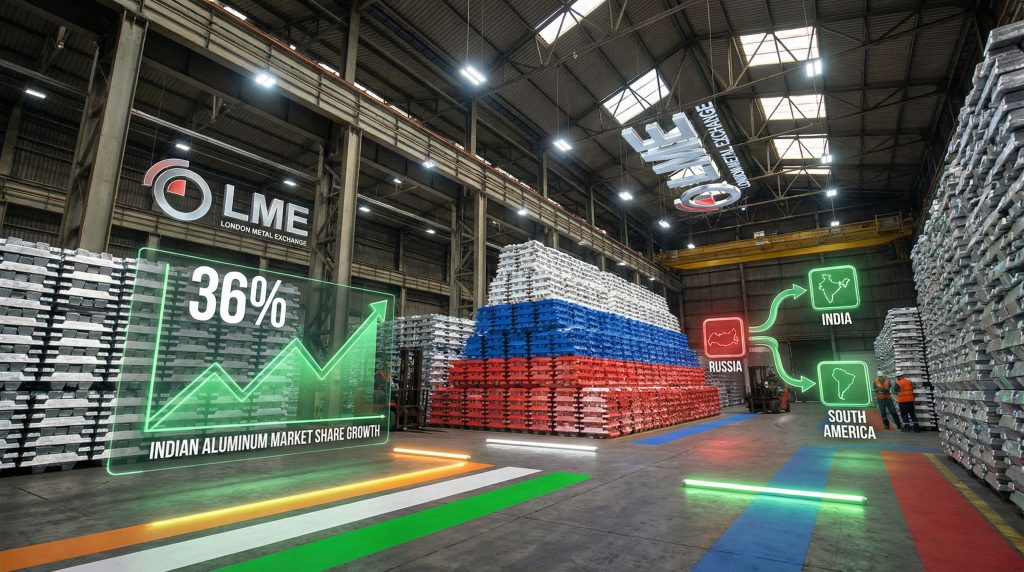
The London Metal Exchange operates through a global network of approved warehouses where metal owners can deposit aluminum for warrant issuance. These warrants become tradeable instruments representing physical delivery rights, but the geographic distribution of storage capacity creates natural bottlenecks. Russian aluminum LME stocks reached 60% of available inventories by February 2026, up from 58% in January, despite ongoing sanctions pressure and trader reluctance to handle Russian-origin metal.
Available aluminum inventories on warrant have contracted to their lowest levels since May 2025, creating physical tightness that amplifies price volatility. The total decline of nearly 20,000 tons in February 2026 occurred even as Russian aluminum decreased by only 3,375 metric tons to 251,700 tons, indicating that alternative supply sources failed to fill the inventory gap.
Indian aluminum maintained steady representation at 36% of available stocks, with absolute holdings of 152,500 tons falling by 4,225 tons during the same period. The combined Russian and Indian share of 96% demonstrates extreme concentration among just two origin countries, creating systemic risk that few market participants fully appreciate.
Sanctions Create Operational Complexity in Metal Exchanges
The evolution of sanctions enforcement reveals the complexity of commodity market regulation across jurisdictions. The April 13, 2024 implementation of US and British production bans created a clear cutoff date, but metal produced before that deadline remained technically tradeable. However, market behaviour suggests that regulatory compliance extends beyond legal requirements into reputational risk management.
The February 25, 2026 EU warehouse restrictions added another layer of complexity by requiring attestation documents demonstrating sanctions compliance. This shifted verification responsibility to metal owners and exchange members, creating operational barriers that effectively reduce tradability even for previously-permitted inventory.
Key Regulatory Timeline:
- April 2024: US/UK production ban implementation
- February 2025: EU warehousing attestation requirements
- Ongoing: Trader avoidance of pre-sanction Russian metal
Metal inventory management under evolving regulatory frameworks requires sophisticated compliance systems that many smaller trading operations cannot efficiently maintain. This creates competitive advantages for larger market makers with dedicated compliance infrastructure, potentially leading to further market concentration among major players. Furthermore, the complexity of managing such systems has led many traders to seek guidance through comprehensive exchange-traded commodities guide resources.
Regional Supply Chain Transformation Analysis
Alternative Supply Sources Struggle to Fill Russian Void
The aluminum market's response to Russian supply constraints reveals fundamental limitations in global production flexibility. Unlike crude oil markets where spare capacity can quickly respond to supply disruptions, aluminum smelting capacity requires years to develop and cannot easily substitute for existing supply sources.
Indian aluminum producers have emerged as the primary beneficiary of Russian market exit, maintaining steady market share even as absolute inventory volumes declined. The 152,500 tons of Indian-origin aluminum in LME warehouses represents substantial investment in logistics infrastructure connecting Indian smelters to global exchange networks.
South American aluminum producers face different challenges integrating into European warehouse systems. Geographic distance creates higher transportation costs, while limited warehouse capacity in traditional European hubs constrains their ability to quickly scale market presence. Similarly, Southeast Asian smelters encounter logistical barriers, despite having excess production capacity available for export markets.
China's Role in Global Aluminum Redistribution
Chinese aluminum market dynamics provide important context for understanding global supply chain adaptation. The LME aluminum market data reveals how Chinese supply can simultaneously increase in absolute terms while declining in percentage share when alternative sources enter the market. Chinese copper stocks increased by 60,450 tons to 155,600 tons in February 2026, yet their overall share fell from 70% to 64% as inflows from Chile, Peru, and South Korea expanded total inventories.
This pattern suggests that Chinese aluminum operations may be following similar supply chain diversification strategies. The Shanghai Exchange versus LME arbitrage opportunities create financial incentives for Chinese traders to redirect aluminum flows based on relative price differences and regulatory constraints across jurisdictions.
Secondary aluminum processing operations in China could potentially rebrand Russian primary metal through complex industrial processes, though such operations would face increasing scrutiny under evolving sanctions enforcement mechanisms. Consequently, the broader implications of trade tensions are analysed in detail within discussions of US-China trade war impact on global markets.
Inventory Tightness and Price Discovery Mechanisms
Physical Constraints Drive Market Volatility
The relationship between exchange inventory levels and aluminum price formation operates through multiple interconnected mechanisms that amplify supply disruptions. Available warrant inventory declines create immediate pressure on market participants seeking physical delivery, while reducing the buffer that typically absorbs short-term supply variations.
Middle East disruptions compound Russian supply restrictions by removing additional production capacity from global markets. This multiplicative effect demonstrates how geopolitical risks can cascade through interconnected supply networks, creating price impacts that exceed the simple addition of individual supply losses.
Current Market Dynamics:
- Available inventories at lowest levels since May 2025
- Russian aluminum LME stocks maintains 60% share despite sanctions pressure
- Nearly 20,000 ton inventory decline in February 2026 alone
- Middle East supply disruptions creating additional constraints
Backwardation patterns emerge when immediate delivery commands premium pricing over future contracts, indicating genuine physical scarcity rather than financial speculation. Storage cost calculations become critical during these periods, as warehouse operators must balance holding costs against expected price appreciation.
Premium Structures Reflect Supply Chain Stress
The comparison with copper markets illustrates how inventory dynamics affect premium structures between exchanges. LME copper prices commanded premiums over US Comex exchange pricing as available copper inventories reached their highest levels since September 2024, demonstrating inverse correlation between inventory levels and price premiums.
Aluminum markets display opposite dynamics, with contracted inventories supporting premium structures that favour LME pricing over regional alternatives. This creates arbitrage opportunities for market participants with access to diverse supply sources and storage capacity across multiple jurisdictions. Moreover, traders are raiding LME aluminum stockpiles as physical shortages become increasingly apparent.
Regional exchange relationships become particularly important during supply disruptions, as traders seek alternative delivery mechanisms when traditional supply chains face constraints. The technical requirements for warrant conversion between exchanges create barriers that can maintain price differentials for extended periods.
Investment and Trading Strategy Considerations
Navigating Russian Metal Exposure Requires Sophisticated Approach
Market participants face complex decisions regarding Russian aluminum exposure that extend beyond simple regulatory compliance. Even metal produced before April 13, 2024 faces trader reluctance that reduces liquidity and complicates valuation methodologies.
Pre-sanction inventory valuation requires assessment of multiple risk factors including regulatory evolution, reputational concerns, and operational complexity. Financial institutions must balance potential returns against compliance costs and relationship risks with counterparties who may avoid Russian-origin metal regardless of legal status.
Risk Assessment Framework Components:
- Legal compliance across multiple jurisdictions
- Operational verification and documentation requirements
- Reputational impact on client relationships
- Liquidity constraints in secondary markets
Portfolio diversification strategies must account for geographic concentration risks that may not appear in traditional commodity exposure analysis. The 96% combined share of Russian and Indian aluminum creates correlation risks that could amplify losses during further geopolitical developments.
Supply Chain Restructuring Creates Investment Opportunities
Infrastructure investment requirements for alternative aluminum supply scaling present opportunities for investors willing to accept longer development timelines. New smelting capacity typically requires 3-5 years from initial investment to full production, making early-stage project identification critical for capturing supply chain transformation benefits.
Technology transfer partnerships between Western aluminum consumers and alternative suppliers could accelerate capacity development while ensuring supply chain security. Strategic partnership formation often provides more reliable returns than direct commodity exposure during periods of supply chain volatility. In addition, the European raw materials supply initiatives are creating new frameworks for securing alternative sources.
Alternative processing hubs outside traditional European centres may offer geographic diversification benefits, though infrastructure development requires substantial capital commitment and regulatory coordination across multiple jurisdictions.
Regulatory Evolution and Market Structure Adaptation
Exchange Rules Adapt to Geopolitical Supply Disruptions
The LME's sequential regulatory responses demonstrate how commodity exchanges balance market liquidity against compliance requirements. The progression from production bans to warehousing restrictions with attestation requirements reflects escalating enforcement approaches that may set precedents for other sanctioned materials.
Country-of-origin transparency requirements have evolved from basic classification to detailed documentation systems that create operational barriers for market participants. These verification systems place responsibility on metal owners and exchange members while creating competitive advantages for organisations with sophisticated compliance infrastructure.
Alternative delivery point establishment outside traditional European hubs requires coordination between exchanges, warehouse operators, and regulatory authorities across multiple jurisdictions. The technical complexity of warrant system modifications often creates implementation delays that can persist for months or years.
Precedent-Setting Implications for Commodity Markets
The aluminum market disruption provides lessons for other commodity sectors facing similar geopolitical pressures. International coordination mechanisms for exchange rule harmonisation remain underdeveloped, creating opportunities for regulatory arbitrage that complicate enforcement efforts. However, recent developments in US steel-aluminum tariff exemptions demonstrate how policy frameworks continue to evolve.
Future commodity exchange governance must balance market efficiency against supply chain security considerations that extend beyond traditional financial regulation. The integration of geopolitical risk assessment into exchange operations represents a fundamental shift in commodity market structure.
Regulatory Development Areas:
- Enhanced country-of-origin reporting protocols
- Cross-jurisdictional coordination mechanisms
- Alternative delivery point establishment procedures
- Compliance verification standardisation across exchanges
The next major ASX story will hit our subscribers first
Market Outlook and Strategic Implications
Supply Chain Diversification Remains Incomplete
The concentration of Russian aluminum LME stocks at 60% combined with Indian supplies at 36% demonstrates that supply chain diversification efforts have achieved limited success. Future disruptions to either source would create severe market stress given the lack of readily available alternative supplies.
Capacity utilisation optimisation across non-Russian production facilities faces constraints from electricity availability, raw material access, and environmental regulations that limit rapid scaling of alternative supplies. These structural limitations suggest that current supply chain vulnerabilities may persist for years rather than months.
Infrastructure development timelines for genuinely alternative supply routes require substantial capital investment and regulatory coordination that extends beyond simple production capacity expansion. Regional hub development outside European centres must overcome established logistics networks and customer relationships that favour existing supply chains.
Long-term Market Structure Evolution
The aluminum market disruption may permanently alter global trade patterns as consuming industries invest in supply chain security measures that prioritise reliability over cost optimisation. Long-term supply agreement restructuring between producers and consumers could reduce market liquidity while increasing price stability. These trends align with broader market concerns about Trump tariffs market impact on global commodity flows.
Technology and sustainability considerations in supply chain design create additional complexity as environmental regulations increasingly influence aluminum production location decisions. The integration of carbon intensity metrics into supply chain evaluation may favour certain geographic regions regardless of production cost advantages.
Investment Thesis Components:
- Infrastructure development in alternative supply regions
- Technology transfer partnerships for capacity scaling
- Regional hub establishment outside traditional centres
- Supply chain security premiums in long-term contracts
Market participants must recognise that current supply chain disruptions may represent permanent structural changes rather than temporary adjustments. Investment strategies that assume eventual return to previous supply patterns may face extended periods of underperformance as geopolitical factors continue reshaping global commodity flows.
Disclaimer: This analysis contains forward-looking statements and market projections that involve substantial risks and uncertainties. Commodity markets face significant volatility, and geopolitical factors can create unpredictable supply chain disruptions. Investment decisions should account for the potential for material changes in market conditions, regulatory frameworks, and supply availability that could substantially affect aluminum pricing and availability.
Ready to Capitalise on Commodity Market Disruptions?
Discovery Alert's proprietary Discovery IQ model delivers real-time alerts on significant ASX mineral discoveries, instantly empowering subscribers to identify actionable opportunities ahead of the broader market during periods of supply chain volatility. Understand why historic discoveries can generate substantial returns by exploring Discovery Alert's dedicated discoveries page, showcasing examples of exceptional market outcomes when major mineral finds reshape global supply dynamics.