
August 21, 2026
When Supply Collapses Faster Than Demand: The Mechanics Behind Platinum's Deepening 2026 Deficit
Most commodity markets operate on a relatively intuitive logic: when consumption falls, prices tend to follow. Investors conditioned by this pattern often interpret declining demand figures as a bearish signal, prompting repositioning away from the affected metal. Platinum in 2026 is exposing the limits of that framework in a particularly instructive way. Total demand for the metal is forecast to drop by 9% year-on-year, yet the platinum deficit despite falling demand has not narrowed — it has expanded. Understanding why requires shifting analytical focus from consumption to the supply side of the ledger, where a slower, structural erosion has been quietly widening the gap for four consecutive years.
When big ASX news breaks, our subscribers know first
What a Platinum Deficit Despite Falling Demand Actually Tells Us
The phrase platinum deficit despite falling demand contains a counterintuitive premise that deserves careful unpacking. A deficit, by definition, means annual consumption exceeds the combined output of mines and recycling facilities. Most investors assume that declining demand relieves deficit pressure. That assumption holds only when supply remains stable or grows. When supply contracts faster than demand falls, the arithmetic moves in the opposite direction.
This is a supply-led deficit, and it behaves very differently from a demand-led one. A demand-led shortfall tends to self-correct as buying activity weakens and existing supply gradually catches up. A supply-led deficit, however, persists until mine production or recycling output structurally increases — a process that in the platinum sector can take the better part of a decade under normal conditions.
The 2026 numbers make this dynamic explicit:
| Market Variable | 2026 Forecast |
|---|---|
| Total Platinum Demand | 7,674 koz (down 9% year-on-year) |
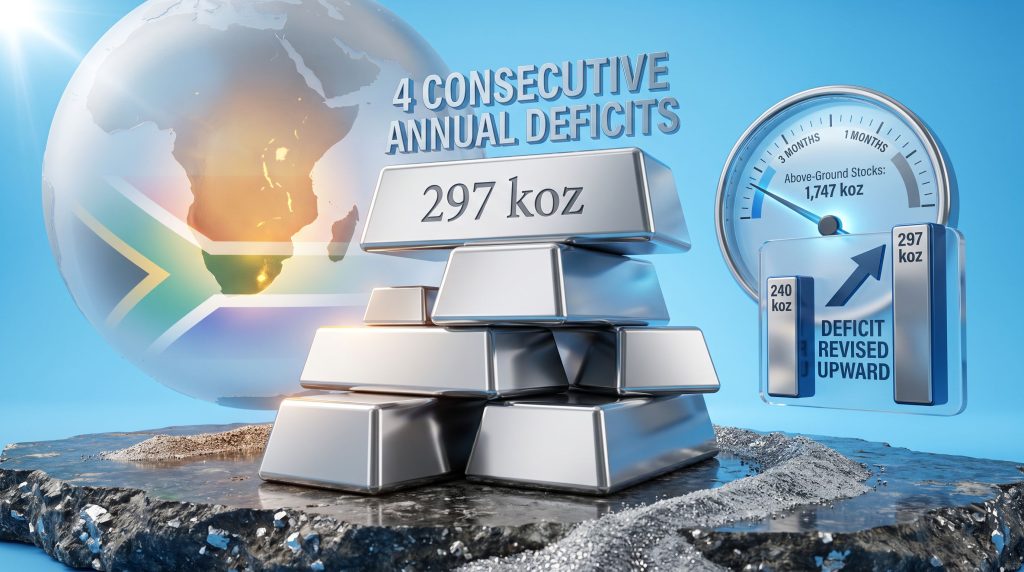
| Projected Market Deficit | 297 koz (revised from 240 koz) |
| Deficit Expansion | +57 koz wider despite demand decline |
| Above-Ground Stocks (Year-End) | 1,747 koz |
| Inventory Cover | Just under 3 months of global demand |
| Consecutive Annual Deficits | 4 years running |
The World Platinum Investment Council (WPIC) revised its 2026 deficit forecast upward from 240 koz to 297 koz at the same time it was lowering its demand projection. That simultaneous movement — a smaller demand figure producing a larger shortfall — is the clearest possible evidence that mine supply and recycled output are contracting at a pace that outstrips even falling consumption. Johnson Matthey's independent 2026 PGM Market Report arrives at the same conclusion, forecasting a fourth consecutive annual shortfall as lower mine shipments from South Africa and Russia more than offset any recovery in automotive recycling volumes.
Three Structural Forces Compressing Platinum Supply
Mine Output Deterioration in the World's Dominant Producing Jurisdiction
No single geography holds a comparable position in the platinum supply chain to South Africa. The US Geological Survey's Mineral Commodity Summaries 2026 estimates South African PGM reserves at 63 million kilograms against a global total exceeding 76 million kilograms. That concentration — roughly 83% of known global reserves — means that any sustained operational deterioration in South Africa carries consequences that no other producing jurisdiction can offset in the near term.
June 2026 data showed South African total mining production declining 4.0% year-on-year, surpassing the consensus forecast of a 3.4% contraction and following a revised 5.1% decline in May. While these headline figures cover all mined commodities rather than isolating PGM output specifically, the consistent underperformance against consensus expectations signals that broader operational pressures in South African mining are deepening rather than stabilising.
Recycling Growth That Cannot Bridge the Gap
Secondary supply from spent automotive catalytic converters is recovering, but the pace of that recovery is structurally constrained. Three factors limit how quickly recycling can substitute for lost mine output:
- Collection infrastructure remains fragmented across key vehicle retirement markets
- Smelter throughput capacity is finite and cannot be expanded rapidly
- The global vehicle fleet's age profile determines the volume of spent catalysts entering the recycling stream, and this operates on a multi-year lag relative to original vehicle sales
In practical terms, near-term relief from recycling is limited. Even if automotive scrapping rates accelerate, the metal takes months to move through collection, processing, and refining before reaching the market as usable supply.
A Critically Shallow Development Pipeline
Only five listed PGM development projects have been identified globally. This is an extraordinarily thin pipeline for a metal facing a fourth consecutive annual deficit. New mine development requires sequential progression through resource studies, preliminary economic assessments, environmental licensing, project financing, and construction — a timeline that routinely spans five to ten years from resource definition to first production.
Critically, higher platinum prices do not compress this timeline. Understanding permitting timelines in mining makes clear that these processes operate on regulatory schedules, not commodity price cycles. Capital raising for early-stage projects remains challenging when financing costs are elevated. The result is a supply pipeline that simply cannot respond to price signals with the speed that financial market participants might expect.
How Thin Inventories Amplify Price Risk
When above-ground inventory cover falls below three months of demand, the platinum market loses its primary buffer against unplanned operational disruptions. Price responses to outages become sharper, faster, and harder to predict.
Above-ground stocks serve as the market's shock absorber. When a shaft floods, a smelter requires unplanned maintenance, or labour disruptions interrupt processing, buyers can draw on these stockpiles rather than bidding aggressively in the spot market. WPIC forecasts end-2026 above-ground stocks of 1,747 koz, equivalent to just under three months of global consumption.
Four consecutive annual deficits have progressively eroded this buffer from levels that offered meaningful coverage. The consequences of a thinner buffer are visible across two connected pricing mechanisms:
| Inventory Scenario | Market Impact |
|---|---|
| High above-ground stocks (6+ months) | Supply disruptions absorbed through drawdowns; limited spot price pressure |
| Moderate stocks (3-6 months) | Partial drawdown capacity; moderate price sensitivity to outages |
| Low stocks (under 3 months) | Limited drawdown buffer; unplanned outages drive immediate spot price and lease rate pressure |
Lease rates — the cost of borrowing physical platinum for short periods — rise when inventory buffers tighten because lenders demand higher compensation for parting with metal that is increasingly difficult to replace. Any shaft outage, smelter shutdown, or processing delay in South Africa now carries a more immediate and more pronounced price response than it would have carried two or three years ago.
One important caveat applies: above-ground stock estimates incorporate private, undisclosed holdings and should be treated as modelled estimates rather than audited totals. Revisions to supply and demand inputs in future quarterly reports could alter the assessed buffer and platinum's estimated sensitivity to disruptions.
The Rand-Rate Double Bind Limiting South African Supply Growth
South African PGM producers operate within a structural currency and financing constraint that limits their capacity to translate higher dollar prices into replacement supply investment. The mechanics are straightforward but often underappreciated by investors focused on headline US dollar price movements.
Producers sell their output in US dollars but pay the vast majority of their operating costs — wages, electricity, reagents, and consumables — in South African rand. When the rand strengthens against the dollar, the local-currency value of dollar-denominated revenue falls even if the platinum price holds steady or rises. The rand traded at approximately R16.14 per US dollar in mid-August 2026, near its strongest level in five months. A firmer currency compresses the margin available for shaft deepening, smelter rebuilds, and any capital-intensive investment in replacement production.
Overlaying this currency constraint is a challenging financing environment. The South African Reserve Bank held its repo rate at 7.00% following a 25 basis point increase in May 2026, while 10-year South African government bonds yielded approximately 8.45%. For capital-intensive mining and processing projects requiring multi-year payback periods, these benchmark rates establish a high hurdle that materially reduces the economic attractiveness of new capacity investment even when platinum prices are elevated.
What Major Producers Are Doing With Higher Earnings
The strong PGM price environment of 2026 has significantly improved producer earnings. Whether those earnings are flowing into replacement supply is the critical question for anyone assessing whether the platinum deficit can close within a two-to-three-year horizon.
The available evidence suggests a pattern weighted toward distributions:
- Impala Platinum guided to headline earnings of R21.8 billion to R23.8 billion, up from R0.7 billion a year earlier, as revenue per six-element (6E) ounce rose 51% while production increased only 5%
- Valterra Platinum reported first-half headline earnings of R21.5 billion, achieved a 21% decline in all-in sustaining cost to $996 per 3E ounce, and declared a R57-per-share dividend representing 70% of headline earnings, all while maintaining production guidance of 3.0 to 3.4 million ounces
- Northam Platinum raised its minimum annual dividend payout ratio from 25% to 40% of headline earnings, reported a 4.4% increase in own-operation PGM production to 938,754 ounces, and outlined brownfield expansion targets under its Vision 2031 programme
Northam's brownfield programme represents perhaps the clearest example of earnings being directed partly toward supply growth rather than purely toward distributions. However, brownfield expansions at existing operations remain constrained by infrastructure depth, regulatory requirements, and processing capacity. They offer shorter lead times than greenfield development, but they are not a rapid mechanism for closing a 297 koz structural shortfall.
The next major ASX story will hit our subscribers first
The PGM Complex Is Not Uniform: A Metal-by-Metal Breakdown
One of the more consequential analytical errors in PGM investing is treating the entire basket as homogeneous. Furthermore, the 2026 supply-demand picture varies sharply across individual metals. For a comprehensive view of the platinum and palladium market dynamics at play, it's essential to examine each metal independently.
| PGM Metal | 2026 Market Balance | Key Driver |
|---|---|---|
| Platinum | Deficit (~297 koz) | Lower South African and Russian mine supply |
| Palladium | Surplus (~0.3 Moz) | Rising Russian output toward ~2.7 Moz by 2027 |
| Rhodium | Moving toward surplus | Higher recycling volumes increasing secondary supply |
| Ruthenium | Deficit | Supply constraints extending to minor PGMs |
| Iridium | Deficit | First commercial-scale use in proton exchange membrane electrolysis for hydrogen production adds new demand in 2026 |
Nornickel forecasts a 0.3 Moz palladium surplus in 2026 and a 0.2 Moz surplus in 2027, supported by production growth from the Chernogorskoye deposit. Heraeus forecasts rhodium transitioning from a small deficit into surplus as recycling supply increases. Meanwhile, PEM electrolysis growth in green hydrogen production is adding a new consumption vector for iridium, a metal already facing supply constraints.
Treating PGM producers as a homogeneous group risks overstating upside from metals moving toward surplus while understating the scarcity premium building in metals facing structural deficits. Platinum, ruthenium, and iridium warrant independent analysis from palladium and rhodium.
US Trade Policy and the Tariff Variable
Proclamation 11001, issued January 14, 2026, directed negotiations over processed critical mineral imports and preserved the option for tariffs or other trade measures depending on negotiation outcomes. An update to the President was required by July 13, 2026, though no public release was mandated. All five PGM metals — platinum, palladium, rhodium, ruthenium, and iridium — appear on the US critical minerals demand list, reflecting their strategic importance to the energy transition and industrial supply chains.
The key analytical distinction is that tariffs on PGM imports would affect where metal is held, priced, and delivered — not how much is produced globally. Regional price premiums could widen significantly under a tariff regime, but the underlying global supply shortfall would remain unchanged. Investors with PGM exposure across multiple jurisdictions would consequently face differential price outcomes depending on how policy evolves, making geographic diversification of exposure a relevant consideration.
The Development Pipeline and What It Takes to Close the Deficit
With only five listed PGM development projects identified globally, the replacement pipeline is critically inadequate relative to the scale and duration of the structural shortfall. Projects that can advance through the milestone sequence — resource updates, preliminary economic assessments, environmental licensing, and financing — represent scarce optionality in a supply-constrained market.
ValOre Metals is one example of a pre-production developer advancing through this sequence. Its 100%-owned Pedra Branca PGM project in Brazil hosts a 2.2 Moz inferred resource of palladium, platinum, and gold across seven near-surface zones, with the company targeting a resource update in Q3 2026, a preliminary economic assessment in Q4 2026, and licensing and environmental work in Q1 2027.
The significance of Pedra Branca's near-surface geometry is worth noting: deeper deposits require substantially more capital and longer development timelines, while near-surface zones generally allow for lower strip ratios and simpler mining methods. A thorough definitive feasibility study at such projects can accelerate the path to production economics, provided metallurgical work confirms viable recoveries and payability at prevailing prices.
The broader geological reality of PGM projects outside South Africa is instructive. The Bushveld Igneous Complex, which hosts the vast majority of South African PGM mineralisation, produces exceptionally high-grade, laterally consistent reef deposits that are difficult to replicate elsewhere. Projects in other jurisdictions typically encounter more variable grades, different mineralogy, and distinct metallurgical challenges that require tailored processing solutions.
Scenario Analysis: Three Pathways to Deficit Resolution
Understanding the range of outcomes requires examining the plausible mechanisms through which the 297 koz shortfall could narrow or widen:
Scenario A: Recycling-Led Closure
Automotive recycling volumes accelerate materially beyond current forecasts as vehicle retirement rates increase and collection infrastructure expands. Feasible within two to three years but dependent on scrap metal economics and smelter throughput capacity remaining unconstrained.
Scenario B: Mine Supply Recovery
South African producers benefit from rand weakness, lower energy costs, and stable labour relations, justifying accelerated shaft deepening and smelter investment. Realistic timeline for meaningful additional production from brownfield expansions is three to five years minimum.
Scenario C: Demand Collapse
A sharper-than-forecast decline in automotive, industrial, or investment demand narrows the deficit without supply growth. This scenario, however, suppresses prices simultaneously, reducing producer incentive to invest in replacement capacity and potentially deepening future shortfalls.
None of these scenarios resolves the structural deficit quickly. The extended timelines across all three pathways reinforce why above-ground inventory coverage is so important as a near-term price stabilisation mechanism, and why its erosion below three months of demand represents a material shift in the market's risk profile.
Key Takeaways for Investors
- A platinum deficit despite falling demand confirms that supply contraction, not consumption growth, is driving the market imbalance in 2026
- Four consecutive annual deficits have reduced above-ground stocks to an estimated 1,747 koz, equivalent to less than three months of demand, amplifying price sensitivity to any operational disruption
- South Africa's ~83% share of global PGM reserves means rand strength and elevated financing costs have outsized global supply consequences that dollar-price analysis alone cannot capture
- Major producer capital allocation is weighted toward distributions, with selective brownfield investment unlikely to materially close the shortfall within a two-year horizon
- PGM market balances diverge sharply by metal: platinum, ruthenium, and iridium face deficits while palladium and rhodium are moving toward surplus
- US trade policy under Proclamation 11001 introduces regional price premium risk without addressing the underlying global supply shortfall
Risk Disclosure: Pre-production PGM projects carry significant execution, financing, and price risk. Early-stage exposure can result in total capital loss and should be sized accordingly within a diversified portfolio. Forecasts cited in this article represent modelled estimates from third-party research providers and should not be treated as guaranteed outcomes.
Want to Identify the Next Major Mineral Discovery Before the Market Does?
Discovery Alert's proprietary Discovery IQ model scans ASX announcements in real time, instantly translating complex mineral data into actionable investment insights across platinum, palladium, and more than 30 other commodities — so subscribers can position themselves ahead of the broader market. Explore how historic discoveries have generated substantial returns on Discovery Alert's dedicated discoveries page, and begin your 14-day free trial today to secure your market-leading edge.