June 16, 2026
Understanding Platinum Group Metal Grade Classification Systems
Platinum group metal discoveries require sophisticated evaluation frameworks to assess their economic potential. The mineral exploration industry employs standardised grade classification systems that help investors understand the significance of new discoveries within the broader context of global PGM operations.
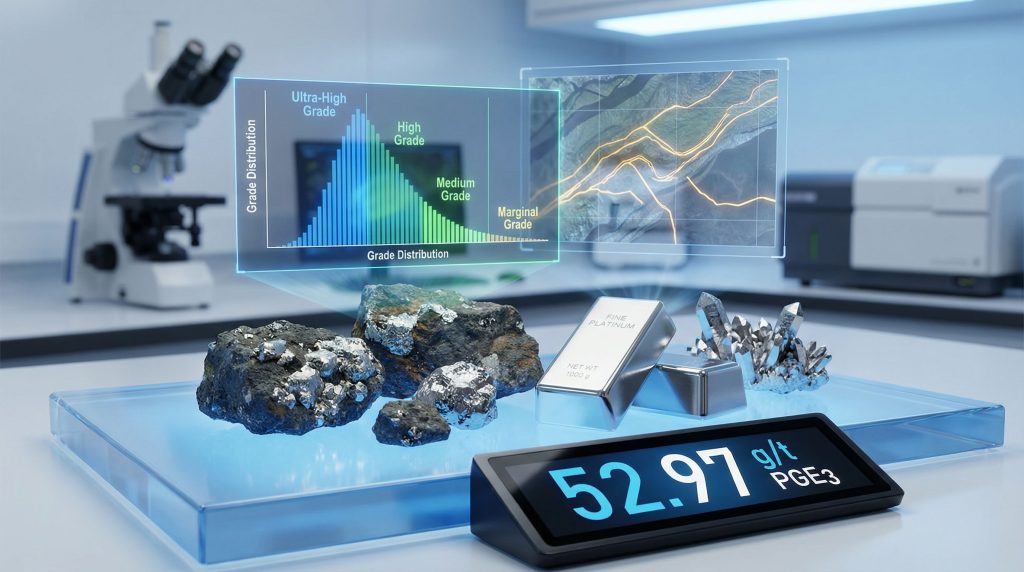
Ultra-high grade PGM intersections, typically exceeding 50 grams per tonne PGE3, represent exceptional concentrations rarely encountered in hard rock mining environments. These grade levels indicate potential for selective mining approaches that can generate premium extraction economics. The Terra Metals high-grade PGM discovery at Southwest Prospect demonstrates this classification with intersections reaching 52.97 g/t PGE3 over one-meter intervals.
Technical Grade Distribution Analysis
| Grade Category | PGE3 Content (g/t) | Global Context | Development Implications |
|---|---|---|---|
| Ultra-High Grade | 50+ g/t | Rare occurrence | Premium extraction potential |
| High Grade | 10-50 g/t | Selective mining zones | Enhanced economics |
| Commercial Grade | 2-10 g/t | Standard operations | Bulk tonnage approach |
| Marginal Grade | 0.5-2 g/t | Resource definition | Future consideration |
Commercial-grade intersections between 2-10 g/t PGE3 typically form the backbone of viable PGM mining operations worldwide. These grades allow for sustainable bulk tonnage mining methods while maintaining acceptable strip ratios and processing costs. The Southwest discovery exhibits commercial-grade continuity across 35-meter intervals averaging 2.90 g/t PGE3, suggesting potential for large-scale extraction scenarios.
High-grade zones between 10-50 g/t provide opportunities for selective mining within broader ore bodies, creating blending opportunities that enhance overall project economics. Furthermore, the presence of 14-meter intervals grading 6.71 g/t at Southwest demonstrates this intermediate grade category within the mineralised system.
When big ASX news breaks, our subscribers know first
Formation Mechanisms of Conduit-Associated PGM Systems
Magmatic sulphide systems develop through complex crystallisation processes within cooling mafic-ultramafic intrusions. Understanding these formation mechanisms provides critical insight into exploration targeting and resource continuity expectations for discoveries like the Southwest Prospect, particularly when utilising 3D geological modelling techniques.
Sulphide Melt Segregation Processes
Primary sulphide formation occurs when parental magmas reach sulphur saturation during crystallisation. Temperature-dependent solubility relationships control when immiscible sulphide melts separate from silicate melts within the magma chamber. This segregation process concentrates platinum group elements due to their strong affinity for sulphide phases relative to silicate minerals.
Density contrasts between sulphide melts (approximately 4.5-5.0 g/cm³) and silicate melts (2.6-2.8 g/cm³) drive gravitational settling and accumulation in structural depressions or along favourable lithological contacts. The Southwest mineralisation occurs within oxide-poor mafic units, consistent with focused sulphide accumulation near interpreted feeder conduit zones.
Multiple magmatic pulses create opportunities for repeated sulphide melt introduction and metal concentration. Evidence for multi-phase intrusion at Southwest includes stacked mineralised horizons spanning vertical intervals, suggesting cyclical magma replenishment events that enhanced precious metal accumulation.
Feeder System Architecture
Conduit-associated PGM systems develop along magma transport pathways that connect deep-seated source regions with upper crustal intrusion levels. These feeder systems facilitate metal concentration through several mechanisms:
- Flow differentiation: Magma velocity variations within conduits promote sulphide melt concentration along conduit margins
- Thermal gradients: Cooling rate variations create preferential crystallisation zones for sulphide accumulation
- Structural controls: Conduit geometry changes, such as widening zones or structural intersections, provide traps for dense sulphide melts
- Repeated magma pulses: Multiple intrusion events through established conduits enhance cumulative metal concentration
The 850-meter strike length and 450-meter width of mineralisation at Southwest suggests a substantial feeder system rather than isolated sulphide pods. This scale implies significant magma flux through the interpreted conduit zone over extended timeframes.
Advanced Geophysical Exploration Methodologies
Modern PGM exploration employs integrated geophysical techniques that can delineate large-scale intrusive systems before drilling commences. These methods provide cost-effective targeting tools that significantly improve exploration success rates, particularly when integrated with data-driven mining operations approaches.
Gravity Survey Applications
High-resolution gravity surveys identify density contrasts between mafic-ultramafic intrusions and surrounding host rocks. Layered intrusions typically exhibit densities between 2.8-3.2 g/cm³, contrasting with typical crustal rocks at 2.6-2.7 g/cm³. Modern gravity instruments achieve precision levels of 0.01 milligals, enabling detection of subtle density variations associated with sulphide concentrations.
Gravity data modelling reveals three-dimensional intrusion geometry, including:
- Intrusion lateral extent and depth continuation
- Feeder conduit positioning and orientation
- Internal layering and compositional variations
- Structural disruptions affecting continuity
Electromagnetic Survey Techniques
Sulphide minerals, particularly pyrrhotite and pentlandite identified at Southwest, exhibit conductive properties that generate distinctive electromagnetic signatures. Airborne electromagnetic systems provide rapid regional coverage for initial target generation, while ground-based surveys deliver higher resolution data for drill target refinement.
Time-domain electromagnetic (TDEM) surveys measure conductivity-thickness products that correlate with sulphide abundance and continuity. Fixed-loop configurations achieve investigation depths exceeding 300 meters, suitable for near-surface mineralisation like the Southwest discovery starting at 48 meters depth.
Moving-loop surveys provide detailed conductivity mapping along traverse lines, enabling three-dimensional modelling of conductor geometry and strength variations. Integration with geological mapping and geochemical results optimises drill hole positioning and orientation.
Geochemical Pathfinder Systems for Large-Scale PGM Exploration
Systematic geochemical exploration employs multi-element analytical suites that identify pathfinder elements associated with PGM mineralisation. These geochemical signatures extend beyond immediate sulphide zones, creating larger exploration footprints around concealed mineralisation.
Primary Pathfinder Elements
- Copper and nickel: Direct association with PGM-bearing sulphide assemblages provides primary targeting criteria
- Sulphur content: Total sulphur measurements indicate sulphide mineral abundance and distribution
- Chrome and titanium: Mafic-ultramafic source signatures that define favourable intrusion types
- Platinum/palladium ratios: Discriminate between different PGM deposit styles and formation environments
Surface geochemical sampling at Southwest identified anomalous PGM concentrations measured in parts per billion, creating coherent patterns that guided initial drill targeting. These surface expressions provide evidence for vertical leakage from deeper mineralised zones through weathering and dispersion processes.
Multi-Element Signature Integration
Advanced analytical techniques, including inductively coupled plasma mass spectrometry (ICP-MS), enable detection of PGM concentrations at sub-ppb levels in surface samples. These analytical capabilities expand the effective exploration footprint around mineralised zones significantly beyond traditional geochemical methods.
Factor analysis and multivariate statistics identify element associations that distinguish PGM-fertile systems from barren mafic intrusions. The presence of elevated copper-nickel-PGM associations at Southwest supports interpretation of a large, coherent mineral system rather than isolated high-grade intersections.
Near-Surface Mining Advantages and Development Economics
The shallow depth to mineralisation at Southwest Prospect, beginning at 48 meters below surface, provides significant economic advantages for potential development scenarios. Near-surface high-grade discoveries enable lower-cost extraction methods while reducing technical risks associated with underground mining.
Open-Pit Development Potential
Several factors favour open-pit mining consideration at Southwest:
- Shallow mineralisation: Starting depth of 48 meters enables low strip ratio scenarios
- Broad intersections: 35-meter mineralised intervals support bulk mining approaches
- Near-surface grades: Commercial-grade mineralisation (2.90 g/t PGE3) near surface reduces waste dilution
- System scale: 850-meter strike length provides substantial tonnage potential
Strip ratio calculations, representing the ratio of waste rock to ore removal, directly impact project economics. Near-surface mineralisation typically achieves strip ratios below 3:1, considered favourable for precious metal operations. The broad mineralised intervals at Southwest suggest potential for strip ratios in this favourable range.
Processing and Metallurgical Considerations
The sulphide mineral assemblage identified at Southwest, comprising pyrrhotite, pentlandite, and chalcopyrite, represents well-understood metallurgical characteristics. These mineral associations typically respond favourably to conventional flotation processing methods used throughout the global PGM industry.
Recovery optimisation strategies for PGM sulphide ores include:
- Bulk sulphide flotation: Initial concentration of all sulphide minerals into composite concentrates
- Sequential flotation: Separation of copper sulphides from nickel-PGM sulphides for separate processing streams
- Magnetic separation: Recovery of magnetic pyrrhotite for additional concentration stages
- Hydrometallurgical treatment: Final PGM extraction from sulphide concentrates using established pressure leaching methods
Scale Indicators for Large PGM Systems
Multiple target areas across the Southwest corridor provide compelling evidence for system-scale mineralisation rather than isolated high-grade occurrences. Understanding these scale indicators helps evaluate long-term resource potential and development scenarios, particularly when considering broader mining industry evolution trends.
Prospect-Scale Mineralisation Evidence
The identification of nine separate target areas (SW1-SW9) within the Southwest corridor suggests continuous mineralisation controlled by shared geological processes. This target distribution indicates:
- Consistent geological controls: Similar structural and lithological settings across multiple targets
- Shared magmatic processes: Evidence for common feeder system connections between targets
- Lateral continuity: Geophysical signatures linking separate drill intersections
- Vertical repetition: Multiple stacked horizons suggesting extended crystallisation history
Large-scale PGM systems typically display continuous mineralisation across multiple drill intersections, consistent geological controls, and evidence of shared magmatic processes across prospect areas.
Resource Expansion Methodology
Systematic expansion of drilling coverage follows established protocols for PGM resource definition:
- Initial discovery validation: Confirm high-grade intersections through twin hole drilling
- Lateral extent testing: Step-out drilling to define mineralisation boundaries
- Down-dip continuity: Deeper drilling to test vertical extent of mineralised system
- Density infill: Closer-spaced drilling for resource classification upgrade
- Geological modelling: Three-dimensional interpretation of structural and lithological controls
The early termination of drillhole SWT008 at 102 meters while still in mineralisation demonstrates immediate follow-up opportunities for resource expansion. Planned drilling depths of 240 meters indicate significant untested potential below current intersections.
The next major ASX story will hit our subscribers first
Global PGM Industry Context and Benchmarking
The Terra Metals high-grade PGM discovery gains significance when evaluated against established global PGM operations and development projects. This comparative analysis provides investors with context for assessing the discovery's relative importance within the broader industry landscape.
International Grade Comparisons
Major global PGM operations typically exhibit grade profiles significantly lower than the peak intersections at Southwest:
- Bushveld Complex (South Africa): Merensky Reef averages 4-6 g/t combined PGMs
- Stillwater Complex (Montana, USA): J-M Reef averages 15-20 g/t combined PGMs
- Norilsk deposits (Russia): Average 3-15 g/t PGMs within nickel-copper ores
- Great Dyke (Zimbabwe): Main Sulphide Zone averages 3-4 g/t PGMs
The 52.97 g/t PGE3 peak intersection at Southwest exceeds typical production grades from these established operations by factors of 3-15 times, indicating exceptional metal concentration.
Development Timeline Considerations
PGM project development typically requires 5-10 years from discovery to production, depending on project scale and complexity. Key development phases include:
- Resource definition: 2-3 years for drilling and geological modelling
- Feasibility studies: 1-2 years for technical and economic evaluation
- Environmental permitting: 1-3 years depending on jurisdiction
- Construction and commissioning: 2-4 years based on project scale
The near-surface nature of Southwest mineralisation potentially accelerates development timelines by reducing technical complexity associated with underground mining scenarios.
Investment Risk Assessment Framework
Evaluating early-stage PGM discoveries requires systematic assessment of technical, geological, and market risks that could affect development potential and investment returns. This process is enhanced by effective interpreting drill results methodologies.
Technical Risk Factors
Key technical considerations for the Southwest discovery include:
- True width determination: Current intersections require structural validation through oriented drilling
- Grade continuity: Additional drilling needed to confirm consistency of high-grade zones
- Metallurgical recovery: Laboratory testing required to validate processing assumptions
- Geotechnical conditions: Rock mechanics studies needed for mining method selection
Geological Risk Assessment
Geological uncertainties that require resolution include:
- Structural complexity: Fault systems or intrusion disruptions affecting continuity
- Alteration effects: Weathering or hydrothermal modification of primary mineralisation
- Intrusion geometry: Three-dimensional shape and orientation of mineralised zones
- Grade distribution: Statistical analysis of grade continuity and predictability
Market Positioning Advantages
Several factors support favourable market positioning for the Southwest discovery, particularly within the context of evolving precious metals market analysis:
- Jurisdiction stability: Australian mining law provides established regulatory framework
- Infrastructure access: West Musgrave region accessible via existing transportation networks
- PGM market dynamics: Growing demand for platinum and palladium in automotive and industrial applications
- Polymetallic credits: Copper and nickel co-products provide revenue diversification
Future Technical Program Priorities
Systematic advancement of the Southwest discovery requires carefully planned technical programs that address key geological and engineering questions while building toward resource definition and development studies.
Immediate Exploration Objectives
Priority technical activities include:
- Oriented core drilling: Determine true widths and structural orientation of mineralised zones
- Infill drilling: Test continuity between existing intersections across target areas
- Deep drilling: Extend holes to planned depths for down-dip extent evaluation
- Geophysical integration: Refine three-dimensional models using gravity and electromagnetic data
Metallurgical Testing Requirements
Comprehensive metallurgical programmes should address:
- Mineral liberation analysis: Determine optimal grinding requirements for sulphide separation
- Flotation testing: Optimise recovery of PGM-bearing sulphide concentrates
- Concentrate characterisation: Analyse PGM distribution within sulphide mineral phases
- Hydrometallurgical studies: Evaluate leaching methods for final metal extraction
Resource Classification Pathway
Advancement toward Inferred and Indicated resource classification requires:
- Drill spacing optimisation: Achieve appropriate confidence levels for resource reporting
- Geological modelling: Develop robust three-dimensional representations of mineralisation
- Grade estimation: Apply appropriate statistical methods for resource calculation
- Classification criteria: Meet international standards for resource confidence levels
Disclaimer: This analysis is based on publicly available technical information and should not be considered investment advice. Mineral exploration and development involve significant risks, and there can be no guarantee that reported drill intersections will lead to economically viable mineral resources. Potential investors should conduct their own due diligence and consult with qualified professionals before making investment decisions. Grade and tonnage estimates are preliminary and subject to revision based on additional drilling and technical studies.
The Terra Metals high-grade PGM discovery represents a significant development in Australian PGM exploration, with technical characteristics suggesting potential for a substantial mineral system. According to recent industry reports, the discovery has garnered significant attention from industry analysts. Furthermore, additional coverage has highlighted the promising nature of these intersections. Continued systematic exploration and technical studies will determine the ultimate scale and economic viability of this promising discovery.
Want to Get Ahead of the Next PGM Discovery Before the Market Catches On?
Discovery Alert instantly alerts investors to significant ASX mineral discoveries using its proprietary Discovery IQ model, turning complex mineral data into actionable insights for traders and investors alike. Discover how historic mineral discoveries have generated substantial returns for early investors, and begin your 30-day free trial today to position yourself ahead of the market.