May 18, 2026
When Markets Panic, Fundamentals Get Forgotten
Precious metals have a long history of behaving counterintuitively during geopolitical crises. The instinct is to assume that conflict drives safe-haven buying and pushes metal prices higher. But the reality of how sophisticated financial markets operate is far more complex. When institutional portfolios come under sudden stress, even assets with strong underlying fundamentals become casualties of liquidity-driven selling. Understanding this dynamic is essential to interpreting what happened to platinum in the first quarter of 2026, and why the Iran war platinum market surplus story is far more nuanced than the headline figure suggests.
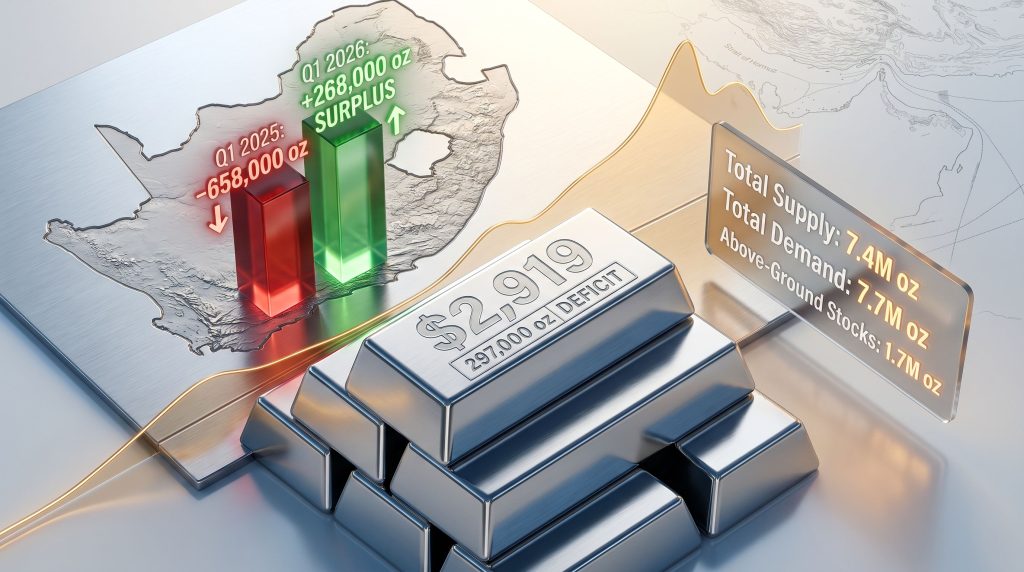
The platinum market recorded a 268,000-ounce surplus in Q1 2026, ending a run of six consecutive quarterly deficits. To anyone watching the market casually, this might appear to signal an oversupplied market losing its investment appeal. The data, however, tells a very different story.
When big ASX news breaks, our subscribers know first
The Three Forces That Converged in Q1 2026
No single factor created the Q1 surplus. Instead, three independent forces aligned simultaneously to swing the market balance by nearly 926,000 ounces compared with the same quarter in 2025, when a 658,000-ounce deficit was recorded.
- A demand-side shock driven primarily by investment outflows triggered by margin call liquidation across financial markets
- A supply-side base effect reflecting the normalisation of South African mine output after severe 2025 flooding disruptions
- A shifting macro backdrop in which rising energy prices and interest rate expectations suppressed appetite for non-yielding assets
Each of these forces has a distinct origin and a distinct shelf life. That distinction is what separates a cyclical anomaly from a structural shift.
How a Record High Became a Sharp Retreat
To appreciate the scale of the Q1 dislocation, context is essential. After surging 127% during 2025, platinum reached a record price of approximately $2,919 per troy ounce in January 2026. This was a remarkable run, driven by genuine supply-demand tightness and growing investor conviction in the metal's industrial and investment credentials.
When conflict escalated in the Middle East in late February 2026, the macro environment shifted abruptly. Equity markets experienced sharp volatility. Energy prices climbed. Critically, leveraged investors across asset classes began receiving margin calls, forcing them to liquidate whatever positions remained profitable or liquid enough to sell quickly.
Platinum, having rallied so strongly, was precisely that kind of position. The result was a retreat from near $2,919 to approximately $2,000 per troy ounce — not because the platinum market's fundamentals had deteriorated, but because platinum was being used as a source of liquidity to plug losses elsewhere. The market volatility in metals during this period underscored how interconnected precious metal pricing can be with broader financial stress.
This is one of the least understood dynamics in commodity markets: during acute financial stress, even structurally tight markets can experience sudden price collapses driven entirely by portfolio mechanics rather than physical supply and demand realities.
Dissecting the 31% Demand Collapse
Total platinum demand fell to 1.5 million ounces in Q1 2026, a 31% year-on-year decline. The breakdown of that contraction reveals exactly where the pressure originated.
| Demand Category | Q1 2026 Change | Primary Driver |
|---|---|---|
| Net Investment Flows | -225,000 oz (outflow) | Margin calls, risk-off liquidation |
| Jewellery Demand | Declined | Consumer spending pressure, China weakness |
| Automotive Demand | Declined | Broader industrial slowdown |
| Total Demand | -31% year-on-year | Broad-based across all sectors |
The 225,000-ounce net investment outflow was the single largest contributor to the demand collapse. This figure represents the net position of all investors exiting platinum holdings during the quarter — a combination of ETF redemptions, futures liquidation, and physical selling by institutional holders.
What is particularly instructive here is that investment demand is the most volatile component of platinum demand. Unlike automotive or industrial consumption, which moves gradually with production schedules, investment demand can reverse in weeks or even days. A sudden shift in sentiment, interest rate expectations, or currency dynamics can erase months of accumulated positions almost overnight.
Jewellery demand also contracted, reflecting subdued consumer confidence in key markets including China, where economic conditions have remained challenging. Automotive demand declined modestly, consistent with a broader softening in global industrial activity.
How Does This Compare to Other Metals?
Furthermore, the platinum and palladium dynamics across this period highlight a broader pattern: geopolitical shocks tend to compress demand for the entire platinum group metals (PGM) complex, even when supply chains remain physically unaffected.
South Africa's Base Effect: Understanding the Supply Recovery
On the supply side, total platinum production reached 1.7 million ounces in Q1 2026, an 18% year-on-year increase. Mine supply specifically rose by 22%, whilst recycling volumes grew by 7% in response to the elevated price environment that persisted from late 2025 into early 2026.
These numbers look impressive in isolation, but require important qualification. The surge in mine supply was not the product of new mine development, expanded capacity, or improved ore grades. It was a base effect recovery following the severe flooding that disrupted South African platinum operations during 2025, artificially depressing that year's production figures.
South Africa's outsized role in global platinum supply cannot be overstated. The country accounts for the majority of primary platinum mine production worldwide, with the Bushveld Igneous Complex hosting some of the highest-grade platinum group metal (PGM) deposits on the planet. The Merensky Reef and UG2 chromitite layer within the Bushveld Complex are the two primary ore bodies mined, with typical platinum grades ranging from approximately 3 to 6 grams per tonne depending on the reef and mining operation.
This geographic concentration creates a structural vulnerability. When South African operations are disrupted — whether by flooding, labour action, or energy constraints from Eskom's ongoing power reliability challenges — the impact on global supply is immediate and significant. Conversely, when production normalises after a disruption year, the year-on-year comparison creates an optical surge that overstates the underlying supply trend.
The 22% mine supply increase in Q1 2026 is best understood through this lens. Strip away the base effect and the underlying supply trajectory is far less dramatic.
The Iran War's Actual Mechanism: Indirect, Not Direct
A common misconception about the Iran war platinum market surplus is that the conflict directly disrupted platinum supply chains or physical demand. According to the World Platinum Investment Council's analysis, the data does not support this interpretation. The Middle East accounts for roughly 2.5% of global platinum demand, and Iran is not a meaningful platinum producer.
The conflict's impact on platinum operated through entirely different channels:
- Energy price inflation pushed Brent crude higher, elevating the probability of sustained inflation and prompting reassessment of central bank policy trajectories
- Interest rate expectations shifted upward, strengthening the US dollar and reducing the relative appeal of non-yielding metals like platinum
- Strait of Hormuz risk premium introduced uncertainty into global energy logistics, compounding inflationary pressures
- Investor psychology shifted abruptly from risk-on accumulation to liquidity preservation, triggering the margin call cascade described above
- Semiconductor supply chain sensitivity emerged as a secondary concern, given that elevated energy prices and potential constraints on helium — a byproduct of natural gas processing used in chip manufacturing — could affect vehicle production volumes and therefore automotive platinum demand over subsequent quarters
This indirect transmission mechanism is sophisticated and not widely appreciated outside professional commodity circles. Indeed, the broader financial market volatility reset that accompanied the conflict reshaped pricing across multiple asset classes simultaneously. The Iran war did not take platinum out of catalytic converters or close mines. It changed the financial environment in which platinum was being priced, and that was sufficient to produce a 31% demand collapse in a single quarter.
The next major ASX story will hit our subscribers first
Full-Year 2026 Outlook: The Deficit Returns
Despite the Q1 surprise, the World Platinum Investment Council's revised full-year forecast makes clear that the structural platinum deficit narrative remains intact. The WPIC's latest report confirms that the council, which sources its market data from consultancy Metals Focus, has raised its full-year 2026 deficit estimate to 297,000 ounces, up from the 240,000 ounces projected just two months earlier.
| Metric | 2026 Full-Year Forecast | Direction vs. Prior Year |
|---|---|---|
| Annual Market Deficit | 297,000 oz | Widened from 240,000 oz estimate |
| Total Supply | 7.4 million oz | +2% year-on-year |
| Total Demand | 7.7 million oz | -9% year-on-year |
| Mine Output | Broadly stable | Minimal growth |
| Recycling Growth | +9% | Price-incentivised |
| Above-Ground Stocks | 1.7 million oz | -15% decline |
This would mark the fourth consecutive annual deficit for the platinum market, a streak that has been progressively eroding the above-ground inventory buffer that markets rely on to absorb short-term imbalances.
Where Is Sectoral Demand Heading?
Sectoral demand forecasts for the full year paint a detailed picture of where the pressure is concentrated:
- Investment demand is forecast to fall by 54%, the most severe decline across all categories, reflecting the sustained macro headwinds from conflict-driven financial stress
- Jewellery demand is projected to contract by 12%, with Chinese consumer weakness as a primary driver
- Automotive demand is expected to decline by just 2%, underscoring that the industrial fundamentals of platinum remain relatively resilient
The comparatively modest automotive decline is significant. Platinum's primary industrial application remains catalytic converters for internal combustion engine vehicles, particularly diesel-powered vehicles where platinum is preferred over palladium. The continued, if modest, softening in this category reflects a broader global shift in the automotive mix rather than any sudden structural break.
The Three-Month Inventory Warning
Perhaps the most consequential single data point in the WPIC's Q1 2026 report is the projected decline of above-ground platinum stocks to 1.7 million ounces, equivalent to less than three months of global demand.
Above-ground stocks function as the market's physical buffer. When supply disruptions occur or demand surges unexpectedly, these inventories prevent immediate price spikes by providing a reservoir of available metal. As that reservoir shrinks, the market's resilience to shocks diminishes.
Historically, when platinum inventory coverage has approached or fallen below the three-month threshold, price volatility tends to increase materially. The safe-haven market dynamics observed in gold during similar periods of inventory tightness offer a useful parallel: markets become sensitive to events that would otherwise be absorbed without significant price movement. A flooding event in South Africa, a labour dispute at a major mine, or a sudden recovery in investment demand could each, in this inventory environment, produce a pronounced price response.
Investors who focus exclusively on the surplus headline from Q1 2026 risk missing the more important signal: the structural deficit is quietly consuming the market's shock-absorbing capacity, and that process has a definable endpoint.
Scenario Pathways for Late 2026 and Beyond
Three plausible trajectories deserve consideration as the year progresses.
Scenario 1: Conflict resolution and sentiment normalisation
If the Iran conflict de-escalates and financial market stress subsides, investment demand in platinum could recover sharply. Given that the Q1 outflow of 225,000 ounces was driven by forced liquidation rather than fundamental disenchantment, a reversal of those flows combined with the ongoing structural deficit could produce significant upside price pressure in the second half of 2026 or into 2027.
Scenario 2: Prolonged conflict and persistent macro headwinds
An extended conflict sustains elevated energy prices and keeps interest rate expectations elevated. Investment demand remains subdued, but the annual deficit continues grinding away at above-ground stocks. Price recovery is delayed, but the fundamental tightening continues beneath the surface, building potential energy for a sharper eventual rebound.
Scenario 3: South African supply disruption recurs
Any return of operational or weather-related disruptions to South African mining operations would eliminate the base-effect supply recovery that created the Q1 surplus. This scenario would dramatically compress the inventory drawdown timeline and could bring forward a price response to levels well above the current trading range.
What This Means for Investors Assessing Platinum Now
The analytical framework that matters most here is the distinction between event-driven price weakness and fundamental deterioration. The Q1 2026 data reflects the former, not the latter.
Investors who conflate a temporary surplus — produced by forced liquidation and a base-effect supply recovery — with a genuine structural shift in platinum's supply-demand balance risk making a significant analytical error. Furthermore, the commodity market volatility observed across the broader resources sector during this period reinforces the view that macro-driven dislocations rarely reflect true changes in underlying fundamentals.
The four-year consecutive deficit trajectory, the progressive drawdown of above-ground stocks toward critically low levels, and the resilience of automotive and industrial demand all point to an underlying market that remains structurally tight. The Iran war platinum market surplus is, in this reading, less a warning signal and more a window of opportunity for investors who can distinguish between what the market's price is doing and what the market's fundamentals are doing. Those two things are not always the same, and in Q1 2026, they were demonstrably pointing in opposite directions.
This article is intended for informational purposes only and does not constitute financial advice. Commodity markets involve significant risk, and past performance is not indicative of future results. Investors should conduct their own due diligence or consult a licensed financial adviser before making investment decisions. Forecasts cited from the World Platinum Investment Council are projections subject to revision as market conditions evolve.
Want to Stay Ahead of the Next Major Mineral Discovery Before the Market Moves?
Discovery Alert's proprietary Discovery IQ model delivers real-time alerts on significant ASX mineral discoveries, cutting through complex commodity data to surface actionable opportunities the moment they are announced — explore historic discoveries and their exceptional returns to understand the potential, then begin your 14-day free trial at Discovery Alert to position yourself ahead of the broader market.