
August 6, 2026
The Slow Death of Consensus: Why the EV Revolution Has Given PGMs a Second Life
For years, the dominant narrative surrounding platinum group metals was one of managed decline. Analysts built models forecasting a steady erosion of autocatalyst demand as battery electric vehicles displaced internal combustion engines at an accelerating pace. Portfolio managers trimmed PGM exposure. Mining companies deferred capital expenditure. The consensus was remarkably unified: these metals were structural sell candidates in an electrifying world.
That consensus is now being systematically dismantled. The EV transition, while real, has moved considerably more slowly than the models assumed. Autocatalyst demand has proven far more resilient than projected. Furthermore, into that demand resilience, a set of supply constraints have arrived that were years in the making. The result is a PGM complex undergoing one of its most significant revaluations in recent memory, though not all metals within it are benefiting equally.
Understanding why platinum rhodium to outperform palladium requires more than reading a price forecast. It demands examining the structural mechanics beneath the surface, particularly when considering PGM supply constraints that have been accumulating for years.
When big ASX news breaks, our subscribers know first
2026 PGM Performance at a Glance
According to Metals Focus, a leading independent precious metals research consultancy, the divergence in 2026 PGM forecasts reflects fundamentally different supply-demand realities across each metal in the complex.
| Metal | Forecast 2026 Price Gain | Year-on-Year Change vs. 2025 |
|---|---|---|
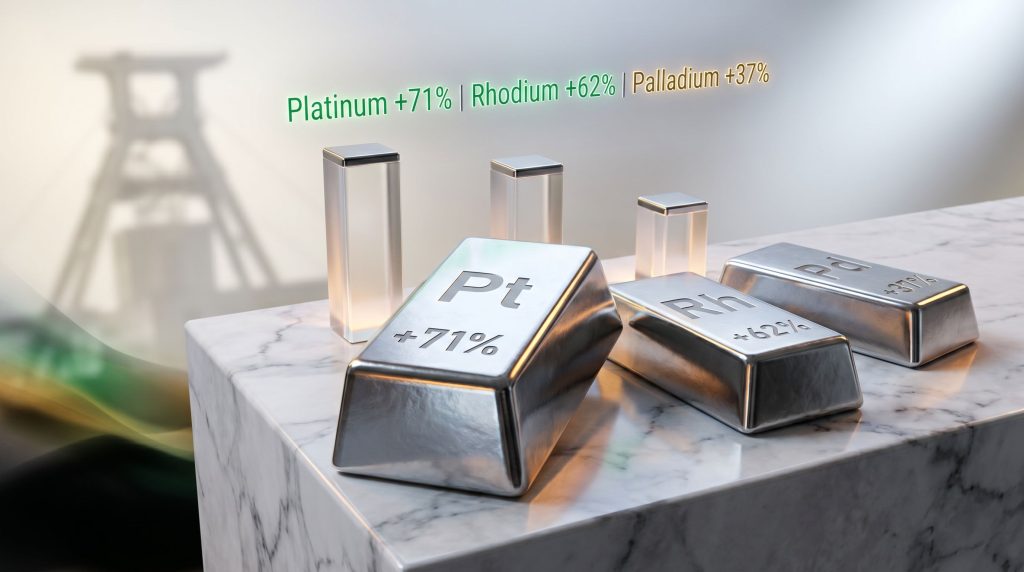
| Platinum | +71% | +110% YoY |
| Rhodium | +62% | +83% YoY |
| Palladium | +37% | +51% YoY |
| Ruthenium | Not specified | +158% YoY |
Ruthenium's extraordinary year-on-year gain of 158% is perhaps the most overlooked data point in the complex. While not explicitly forecast in the same detail as the others, its performance signals that tightness is extending beyond the headline metals. Ruthenium is used in electronics, hard disk drives, and increasingly in electrochemical applications, meaning demand from technology sectors is compounding supply constraints that already exist at the mine level.
The broader context matters here. After three consecutive years of declining PGM basket prices, 2025 delivered a 28% annual basket gain, the first meaningful recovery in the cycle. That momentum has carried into 2026, supported by physical tightness, investor demand for hard assets, and a geopolitical environment that has renewed appetite for tangible commodity exposure. In addition, precious metals market trends across gold and silver have reinforced broader investor interest in the asset class.
The PGM basket breaking out from its long-term trading range in 2025 was not a price spike. It was a regime change, underpinned by accumulating supply deficits and a demand base that refused to collapse on schedule.
What Is Driving the Bullish Case for Platinum in 2026?
Supply Deficits and the Physical Market Signal
Platinum has entered a structural supply deficit, with above-ground inventories declining as mine output from South Africa and Russia, the two dominant producing nations, consistently falls short of total demand. This is not a new development, but its cumulative effect is now becoming visible in the metrics that matter most to market participants.
London platinum lease rates, which reflect the cost of borrowing physical metal in the spot market, remain significantly elevated following extreme spikes in 2025. When lease rates rise sharply, it signals that holders of physical metal are reluctant to lend, typically because they anticipate tighter conditions ahead or because visible inventory has genuinely contracted.
The 2025 spike was partly triggered by concerns over US import tariffs on precious metals, which prompted large-scale preemptive transfers of platinum from London vaults to US-based storage facilities. That regional dislocation created a localised shortage in London that has not fully normalised, maintaining upward pressure on lease rates well into 2026.
This tariff-driven inventory repositioning is a technically important dynamic. Global supply did not change, but the geographic distribution of above-ground stocks shifted in a way that created localised scarcity with global price implications. It is the kind of mechanism that rarely appears in top-down demand models but has material consequences for physical market participants.
Platinum's Multi-Sector Demand Architecture
The structural advantage platinum holds over palladium is rooted in its demand diversification. While palladium is overwhelmingly dependent on gasoline-engine catalytic converters, platinum draws from a considerably broader set of end markets:
- Automotive catalysts, primarily for diesel engines, remain a significant demand pillar
- Jewellery consumption, particularly in China and Japan, provides a substantial and relatively stable demand base
- Industrial applications, including chemical processing, glass manufacturing, and electrodes, absorb a meaningful share of annual supply
- Hydrogen economy applications, including fuel cell electrolysers and catalysts for green hydrogen production, represent an energy transition demand channel with long-term growth potential
- Investment demand, driven by platinum's strong positive correlation with gold, attracts inflows during periods of macroeconomic and geopolitical stress
According to Wilma Swarts, PGMs director at Metals Focus, platinum stands out within the complex precisely because of this multi-sector exposure. Her view, reported by Reuters via Mining.com in May 2026, is that platinum benefits from demand sectors unavailable to palladium, and that all PGMs have benefited from investment inflows into physical assets amid ongoing geopolitical uncertainty.
The slower-than-expected adoption of PGM-free electric vehicles has preserved autocatalyst demand longer than consensus models predicted. This is the single most important revision to the bearish thesis that had weighed on platinum prices through the early 2020s. Earlier projections modelled steep declines in autocatalyst loadings that have simply not materialised at the pace assumed.
Why Rhodium Is Expected to Outpace Palladium Despite Its Volatility
Concentration Risk as a Price Amplifier
Rhodium occupies a unique position in the PGM complex. Its production is among the most geographically concentrated of any industrially critical metal, with South Africa accounting for the overwhelming majority of global output. Consequently, supply disruptions — whether from energy constraints at South African operations, labour disputes, capital underinvestment, or infrastructure challenges — translate almost immediately into price dislocations.
The metal's low absolute production volumes relative to its demand base mean that even marginal shortfalls can trigger outsized price responses. Rhodium's historical price range illustrates this vividly, having traded below $1,000 per ounce in depressed cycles and above $29,000 per ounce at peak tightness, a range that dwarfs the volatility profile of virtually any other commodity. For a detailed look at how analysts assess these dynamics, Metals Focus forecasts provide further context on the 2026 outlook.
Current Deficit Conditions Support the 2026 Forecast
Rhodium's market balance oscillates sharply between deficit and surplus depending on autocatalyst loading rates and South African production levels. Current conditions are consistent with a deficit environment, which underpins the forecast 62% price appreciation projected for 2026.
The key risk to the rhodium thesis is that its extreme volatility cuts in both directions. An unexpected surplus, driven by reduced autocatalyst demand or improved South African output, could reverse gains with the same speed that deficits generate them. Investors approaching rhodium should treat it as a high-conviction, high-risk component of any PGM-focused allocation rather than a stable return generator.
Why Palladium Is the Relative Underperformer of the Complex
Structural Demand Erosion and Limited Substitution Pathways
Palladium's underperformance relative to platinum and rhodium is not a sign of weakness in absolute terms. A 37% projected price gain and 51% year-on-year increase represent a strong performance by almost any commodity market standard. However, the underperformance is relative, and its causes are structural rather than cyclical.
Palladium's demand is concentrated in gasoline-engine catalytic converters to a degree unmatched by any other PGM. This concentration creates a single-point-of-failure risk for long-term demand: as battery electric vehicle penetration gradually increases over a multi-year horizon, the volume of gasoline vehicles requiring catalytic treatment will eventually decline. That directional risk is negative, even if the timeline has extended beyond earlier projections.
| Demand Factor | Platinum | Palladium |
|---|---|---|
| Primary use case | Diesel catalysts, jewellery, hydrogen | Gasoline catalysts |
| EV sensitivity | Lower, due to broader use base | Higher, concentrated in ICE vehicles |
| Jewellery demand | Significant | Minimal |
| Gold price correlation | Strong | Weak |
| Supply concentration | South Africa, Russia | South Africa, Russia |
| 2026 price forecast | +71% | +37% |
The Palladium-to-Platinum Substitution Trend
An underappreciated dynamic currently redistributing demand within the PGM complex is the active substitution of palladium with platinum in gasoline catalytic converters. Automotive manufacturers and their catalyst suppliers have been quietly engineering reformulations that partially replace palladium loadings with platinum, driven by both cost management and supply security considerations following the extreme palladium price spikes of 2021 and 2022.
This substitution does not happen overnight. It requires extensive testing, regulatory homologation, and supply chain reconfiguration. However, the direction of travel is clear, and its cumulative effect is gradually shifting autocatalyst demand away from palladium and toward platinum. This is a structural demand transfer that reinforces platinum's relative outperformance and compounds the existing supply deficit dynamic. For a broader perspective on these platinum and palladium dynamics, the investment implications are considerable.
The Mine Supply Constraint That No Price Signal Can Quickly Fix
Structural Inelasticity in PGM Production
One of the least appreciated aspects of the PGM bull thesis is the inherent inelasticity of mine supply. Even with AISC margins recovering to three-year highs in 2025 following three years of compression, the mining sector cannot rapidly expand production to meet higher prices.
PGM mining, particularly in South Africa, involves deep-level hard rock operations with multi-year development timelines. New shaft development, reef access, and ore body preparation require capital commitments years before the first tonne of ore reaches surface. The years of margin compression that preceded the current recovery led to significant underinvestment in sustaining capital and expansion projects, creating a supply pipeline that cannot be quickly filled regardless of price incentive.
South Africa, which supplies the majority of global platinum and rhodium, continues to face structural operational challenges:
- Energy supply instability, with Eskom's grid constraints continuing to affect mining operations through load-shedding and voltage fluctuations
- Rising input costs, including labour, electricity, and consumables, which have eroded margins even as metal prices recover
- Ageing infrastructure at many established mining operations, where ore bodies are accessed at increasing depth and complexity
- Capital allocation uncertainty, as mining companies balance shareholder return demands against reinvestment requirements
Russia, the second largest producer, adds an additional layer of supply uncertainty through ongoing geopolitical and sanctions-related constraints that limit market access and introduce operational complexity for Russian producers.
What London Lease Rates Tell Us About Physical Availability
Elevated PGM lease rates in London serve as a real-time proxy for above-ground stock depletion. In a well-supplied market, lease rates remain low because metal holders are willing to lend inventory for modest returns. When rates spike, as they did dramatically in 2025 and remain elevated today, it reflects genuine competition for scarce physical inventory among industrial consumers, investors, and financial counterparties.
The 2025 tariff-driven stock relocation from London to the United States was not merely logistical. It created a structural dislocation between where metal is held and where industrial consumers need to access it, with consequences that persist into 2026. The normalisation of this dislocation will take time and depends partly on the resolution of US trade policy uncertainty.
The next major ASX story will hit our subscribers first
Geopolitical Risk Premiums and Hard Asset Demand
The PGM price rally has not occurred in a vacuum. The broader macro environment, characterised by ongoing geopolitical instability including the Iran conflict, has reinforced investor appetite for hard assets across precious and industrial metals. Furthermore, platinum's strong correlation with gold has made it a natural beneficiary of the gold safe-haven demand that initially propelled gold prices to multi-year highs in early 2026.
While the gold-led rally subsequently moderated as some speculative positions unwound, platinum, rhodium, and palladium retained their substantial year-on-year gains. This retention of gains after speculative momentum faded is an important signal. It suggests that underlying fundamental support — physical tightness, structural deficits, and supply inelasticity — is carrying prices rather than sentiment alone.
Investment inflows into physical PGM products have accelerated through early 2026, driven by this combination of geopolitical risk premiums and recognition that the bearish EV transition thesis had been significantly overstated. The re-rating of PGMs as a legitimate hard asset allocation, rather than a declining industrial commodity, represents a shift in investor psychology that may provide a sustained demand floor. Analysts exploring why PGMs could outperform traditional safe-haven assets have increasingly highlighted this psychological shift as a structural driver.
Mining Sector Profitability: Margin Recovery After Three Difficult Years
The improvement in PGM basket prices has had a direct and material impact on mining sector profitability. According to Metals Focus's May 2026 report, even though production costs in South Africa and Russia increased, the improvement in metal prices was sufficient to more than double all-in sustaining cost margins to a three-year high in 2025.
This margin expansion comes after an extended period of compression that forced difficult decisions across the sector:
- Deferred sustaining capital expenditure across multiple operations
- Workforce reductions and restructuring at higher-cost mines
- Closure or care-and-maintenance decisions at marginal operations
- Reduced exploration spending and new project development
The legacy of these cost-reduction responses is a mining sector that is currently generating improved cash flows but has limited near-term capacity to grow production. Metals Focus explicitly notes that even with the prospect of further margin recovery in 2026, it takes years to ramp up production, meaning the supply response to current price signals will be measured in years rather than quarters.
The primary beneficiaries of this margin environment are existing large-scale, diversified PGM producers with meaningful exposure to both platinum and rhodium in their production portfolios. Producers carrying high rhodium by-product credits will experience disproportionate margin uplift compared to their platinum-dominant peers, given rhodium's stronger relative price trajectory.
The capital allocation response from the mining sector remains structurally constrained. Years of underinvestment during the margin compression period have limited the industry's ability to quickly scale production, reinforcing the multi-year bullish thesis for platinum rhodium to outperform palladium regardless of near-term price volatility.
Frequently Asked Questions: Platinum, Rhodium, and Palladium in 2026
Why are platinum and rhodium forecast to outperform palladium in 2026?
Platinum and rhodium benefit from diversified demand bases, greater supply concentration risk, and structural deficits that are deepening. Palladium, by contrast, is heavily exposed to gasoline-engine catalytic converters, a demand category facing long-term structural erosion as electric vehicle adoption gradually accelerates.
What is a PGM basket price and why does it matter?
The PGM basket price is a weighted composite reflecting the collective performance of platinum group metals primarily used in vehicle exhaust catalysts. Its breakout from a long-term trading range in 2025 signalled a fundamental shift in market equilibrium rather than a temporary price anomaly.
How do London PGM lease rates signal market tightness?
Lease rates represent the implied cost of borrowing physical metal in the spot market. When rates are elevated, it indicates that holders of physical inventory are reluctant to lend, typically because above-ground stocks are genuinely contracting and forward supply visibility is limited.
Can mine supply respond to higher PGM prices?
Not quickly. PGM mining involves multi-year development timelines, deep-level operations, and significant capital requirements. Years of underinvestment during the margin compression period further constrain the sector's near-term production flexibility, reinforcing the supply-side support for current prices.
What is the palladium-to-platinum substitution trend?
Automotive manufacturers are increasingly engineering platinum into gasoline catalytic converters as a partial replacement for palladium. This substitution trend gradually redistributes autocatalyst demand within the PGM complex, providing an additional structural tailwind for platinum rhodium to outperform palladium over the medium term.
This article is based on publicly available market research and forecasts as of May 2026. Price forecasts involve inherent uncertainty and should not be interpreted as investment advice. Past performance and analyst projections are not guarantees of future outcomes. Readers should conduct independent research and seek professional financial advice before making investment decisions in commodity markets.
Want to Track the Next Major PGM or Mineral Discovery the Moment It Hits the ASX?
Discovery Alert's proprietary Discovery IQ model scans ASX announcements in real time, instantly identifying significant mineral discoveries across platinum group metals and over 30 other commodities — turning complex data into actionable insights before the broader market reacts. Explore how historic discoveries have generated substantial returns on Discovery Alert's dedicated discoveries page, and begin your 14-day free trial today to position yourself ahead of the market.