June 9, 2026
When Capital Structures Expose the Real Risk in Mining's Final Mile
Project finance in large-scale mining operates on a logic that market observers frequently misread. Visible progress across financing workstreams, completed lender roadshows, term sheets in negotiation, due diligence finalised by development institutions, creates an impression of proximity to financial close that the actual mechanics of capital commitment rarely support. The gap between advanced process and binding commitment is not a formality. In project finance, it is the entire game.
Understanding this distinction is essential for accurately reading where the Kabanga project financing and FID sits relative to construction readiness. The capital structure, the sequencing dependencies, and the liquidity position each tell a specific part of a story that requires careful assembly before the timeline to construction can be meaningfully assessed. Furthermore, nickel market fundamentals play a critical role in how lenders ultimately price and size the debt facilities underpinning the entire structure.
When big ASX news breaks, our subscribers know first
How the Kabanga Capital Structure Is Actually Designed
The financing architecture being assembled for Kabanga reflects standard practice for large-scale greenfield mining projects in emerging markets, where commercial debt, strategic equity, and development finance institution participation are stacked together into a single coordinated structure rather than negotiated independently.
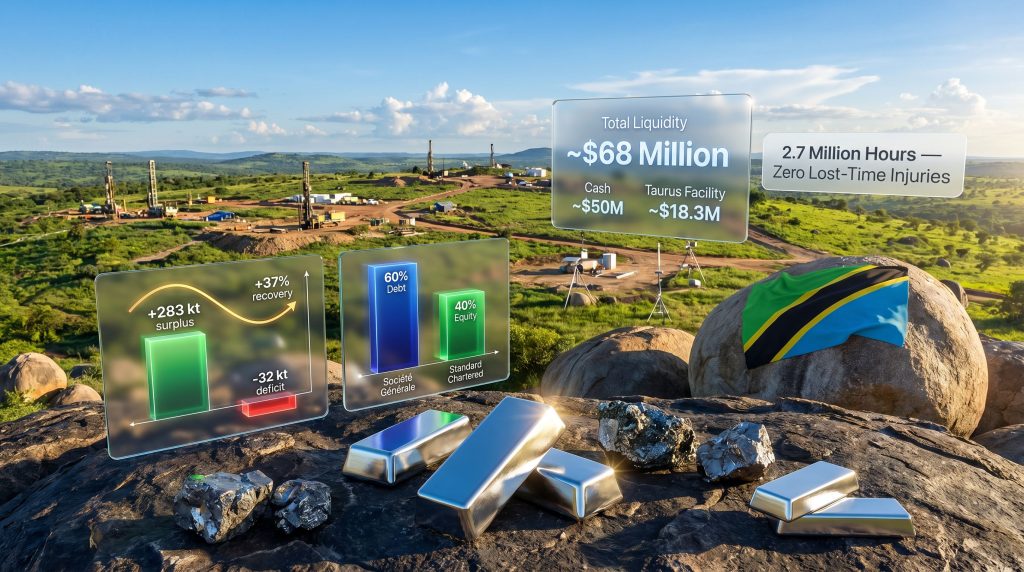
The intended split is approximately 60% debt and 40% equity. This ratio is not arbitrary. It reflects the risk allocation framework that lenders and equity providers negotiate to balance return expectations against the sovereign, operational, and commodity risks inherent in a project of this scale and location.
Three parallel workstreams are advancing toward that structure simultaneously:
- Société Générale is leading the project finance process, responsible for structuring and syndicating the debt tranche. Lender roadshows were completed during the first quarter of 2026, representing a material milestone in the syndication process.
- Standard Chartered Bank is managing the strategic investment process on the equity side. This process had reached the term sheet stage as of the March 31, 2026 reporting date, meaning detailed commercial terms were under negotiation but no binding commitment had been executed.
- The US Development Finance Corporation (DFC) completed its technical and financial due diligence during the quarter. Formal capital commitment, however, remained outstanding.
Bridging the period between current operations and financial close is the $60 million Taurus Mining Finance senior secured bridge loan facility. As of March 31, 2026, $25 million had been drawn, with a further $16.7 million received on April 29, 2026. This facility is specifically designated for pre-FID activities, early works, and financing process costs. It does not form part of the construction capital structure and should not be interpreted as a proxy for financial close.
Key Structural Distinction: Bridge financing and construction capital serve entirely different functions in project development. The Taurus facility funds the runway to financial close. The Société Générale and Standard Chartered processes must produce binding commitments before the first dollar of construction capital can be deployed.
Liquidity Position and Effective Runway: The Arithmetic That Matters
As of April 29, 2026, Lifezone Metals reported total liquidity of approximately $68 million, assembled from two sources: the April 23, 2026 closing of a $25 million registered direct offering priced at $4.40 per share, generating net proceeds of $23.3 million, and the remaining $18.3 million available under the Taurus facility. Cash on hand stood at approximately $50 million.
| Liquidity Component | Amount |
|---|---|
| Cash on hand | ~$50 million |
| Remaining Taurus facility availability | ~$18.3 million |
| Total liquidity (as of April 29, 2026) | ~$68 million |
| Q1 2026 investing cash outflows | ~$6.2 million |
| Direct Kabanga investment (Q1 2026) | ~$6.3 million |
At the reported quarterly investing outflow rate of $6.2 million, the current liquidity position theoretically supports approximately 11 quarters of activity at current burn levels. However, this calculation carries an important caveat: expenditure rates typically accelerate as projects approach financial close, with owner's team expansion, contractor mobilisation, and documentation costs increasing the quarterly spend profile.
A partial offset to operating burn is provided by Simulus Laboratories, which generated $1.2 million in third-party revenue during the first quarter of 2026, up from just $0.2 million in the equivalent period of 2025. That represents a 500% year-on-year increase driven by external technical and laboratory service contracts. While this revenue reduces net operating burn, its scale does not materially compress the financing timeline calculus.
Revenue Context: Simulus Laboratories generated $1.2 million in third-party revenue during Q1 2026, compared to $0.2 million in Q1 2025. While this trajectory is commercially meaningful, it functions as a burn-rate offset rather than a financing solution for a project requiring capital commitments measured in hundreds of millions of dollars.
Net cash used in operating activities during the first quarter was $1.2 million, representing a $2.0 million improvement over the first quarter of 2025. Income before tax of $2.4 million included $8.7 million in non-cash fair value gains on embedded derivatives, warrant liabilities, and deferred consideration to BHP, which inflates reported income without contributing to operational cash flow.
The Pre-FID Sequencing: Five Steps That Must All Close
Reaching Kabanga project financing and FID requires satisfying a specific sequence of interdependent conditions. These are not parallel milestones that can be independently completed; each step creates a prerequisite for the next. Consequently, understanding this sequencing is essential for any investor tracking the project's trajectory toward construction. For additional context, the definitive feasibility study that underpins this process reflects years of technical groundwork that now informs every stage of capital commitment.
- Finalise the Tanzania Joint Financial Model: The Framework Agreement renegotiation between Lifezone and the Tanzanian government must produce a mutually agreed fiscal benefit-sharing structure and staging concept. Lenders cannot finalise debt sizing without this document, making it a gating item for the entire capital structure rather than a workstream that can close independently.
- Commit the Equity Tranche: The Standard Chartered-led strategic investment process must advance from the current term sheet stage to an executed, binding capital commitment representing the full equity portion of the 40% equity requirement.
- Execute the Main Debt Facility: The Société Générale-led project finance process must progress from completed lender roadshows through credit committee approvals and full documentation execution to a signed, binding facility agreement.
- Formalise DFC Participation: The US Development Finance Corporation's completed due diligence must convert into a formal capital commitment, adding the development finance institution layer that enhances the overall risk profile of the structure for commercial lenders.
- Execute Construction Contracts: Owner's team scaling, Project Execution Plan finalisation, and Project Labour Plan approval must be aligned with financial close timing to enable immediate construction commencement upon capital commitment.
None of these steps was fully complete as of the March 31, 2026 reporting date. All were materially advanced.
Why the Tanzania Framework Agreement Is the Gating Document
In mining project finance, the relationship between host government fiscal terms and debt sizing is direct and non-negotiable. Commercial lenders do not finalise the quantum or pricing of debt facilities until the fiscal framework governing the project's cash flows is locked. This is because the debt service capacity of a project, its ability to generate sufficient free cash flow to meet loan repayments, is directly determined by the fiscal take applied by the host government.
For Kabanga, the joint financial model being developed in conjunction with the Tanzanian government must establish:
- The agreed fiscal benefit-sharing structure between the project and the Tanzanian state
- The staging concept governing how project development phases will be sequenced
- The fiscal terms that will govern royalties, taxes, and profit-sharing over the project's life
During the first quarter of 2026, the Framework Agreement renegotiation progressed constructively. Lifezone's Chief Executive Officer, Chris Showalter, met with Tanzania's Minister of Finance, Balozi Khamis Mussa Omar, at the International Monetary Fund and World Bank Group Spring Meetings in Washington D.C. Separately, the Kabanga site hosted the Acting US Ambassador to Tanzania, Andrew Lentz, on March 31, 2026.
Analytical Note: In large-scale mining project finance, host government fiscal terms are typically required to be fully agreed before debt facility documentation can be finalised. The joint financial model is therefore a prerequisite for financial close, not a concurrent workstream. Progress in negotiations is necessary but insufficient; it is the binding agreement that unlocks the debt facility.
The phrase "advancing constructively" in project finance communication carries specific meaning. It signals active engagement without implying imminent resolution, a distinction that experienced capital markets participants read carefully when assessing timeline risk. For further background on how Lifezone is advancing the project toward its 2026 FID target, Lifezone's own press releases provide useful primary source context.
The Nickel Market Reversal and What It Means for Lender Confidence
The commodity price environment facing Kabanga project financing and FID shifted materially between late 2025 and the first quarter of 2026. The London Metal Exchange nickel price rose 37% from its late-2025 low by April 2026, driven primarily by supply-side policy changes in the Indonesian nickel industry, where the world's dominant nickel producer introduced several simultaneous supply constraints.
| Metric | 2025 Actual | 2026 Projected |
|---|---|---|
| Global nickel market balance | +283 kt surplus | -32 kt deficit |
| LME nickel price movement | Late-2025 low (base) | +37% recovery by April 2026 |
| Spot prices vs. Kabanga 2025 FS assumptions | At or below | Above |
The International Nickel Study Group revised its 2026 global nickel market balance from a 283 kilotonne surplus to a projected 32 kilotonne deficit, a swing of more than 300 kilotonnes representing one of the most significant short-cycle revisions in the nickel market's recent history. Furthermore, Indonesian nickel price trends have played a central role in driving this shift, as government-imposed quota reductions and revised royalty structures altered the supply outlook almost overnight.
The primary driver of this reversal was Indonesian government policy tightening, which introduced several simultaneous supply constraints:
- A reduced 2026 mining quota of 270 wet metric tonnes against expected demand of 345 wet metric tonnes, creating an immediate structural shortfall
- A shift from multi-year to annual quota validity, reducing producer certainty and discouraging inventory building
- Revised benchmark pricing mechanisms that altered the economics of Indonesian nickel production
- Introduction of tiered royalty rate structures that increase the fiscal burden on higher-volume producers
For Kabanga, the practical implication is that spot prices for nickel, copper, and cobalt were all above the assumptions used in the project's 2025 Feasibility Study as of the reporting date. This repositions the published feasibility economics as a conservative floor rather than a central estimate, which has direct implications for lender confidence, debt sizing capacity, and the attractiveness of the project to strategic equity investors.
A critical nuance for investors to understand: lenders do not price debt facilities based on current spot prices. They apply long-run price assumptions derived from independent price forecasts, typically at a discount to spot, and stress-test the capital structure against downside scenarios. The current price environment improves the base case but does not eliminate downside price risk from lender credit models.
The next major ASX story will hit our subscribers first
Pre-FID Site Execution: What Has Already Been Built
Despite the absence of binding financing commitments, the operational and technical preparation at the Kabanga site has advanced substantially. This pre-FID execution work reduces the time between financial close and construction commencement, an important consideration for lenders assessing execution risk.
Geotechnical Programme Completed:
- 163 test pits completed across the project footprint, providing ground condition data for infrastructure and underground access design
- Geotechnical holes drilled for 8 ventilation raises, critical underground infrastructure requiring detailed subsurface characterisation before design can be finalised
- A production water borehole drilled to 132 metres, yielding 28,000 litres per hour, confirming the water supply capacity required for processing operations
Organisational and Planning Milestones:
- The Project Execution Plan was developed across five execution pillars, providing the framework for construction sequencing and contractor management
- The Project Labour Plan was submitted to the Tanzanian Labour Commissioner, satisfying a regulatory prerequisite for workforce mobilisation
- The owner's team was scaled up across seven critical senior pre-FID roles, building the internal capability required to manage major construction contractors
- 230 employees and contractors were on site as of March 31, 2026
Safety and ESG Performance:
- More than 2.7 million hours worked without a lost-time injury, a safety record that exceeds industry benchmarks for projects at comparable development stages and is increasingly scrutinised by development finance institutions as part of their social performance assessments
- An ISO-compliant Life Cycle Assessment confirmed a low climate change emission impact for nickel concentrate production, with full public release scheduled for the second quarter of 2026
The life cycle assessment result carries particular significance for the financing process. Development finance institutions, including the DFC, apply environmental and social governance criteria to capital deployment decisions. A confirmed low-emissions profile strengthens Kabanga's positioning within these frameworks and may influence the terms available under DFC participation. In addition, growing critical minerals demand tied to the global energy transition further reinforces the strategic rationale for development finance institution involvement in projects of this nature.
Musongati: What a 14-Month Exclusivity Window Actually Signals
On March 10, 2026, Lifezone entered into a 14-month exclusivity agreement with the Government of Burundi over the Musongati Nickel Project, located approximately 200 kilometres southwest of Kabanga within the East African Nickel Belt. A resource estimate based on 321 drillholes, completed in 2011, indicates more than 140 million tonnes grading 1.31% nickel, with additional by-product potential across copper, cobalt, platinum group metals, and scandium.
The strategic significance of this move extends beyond the resource itself. During the exclusivity period, Lifezone geologists reviewed historical drilling data, inspected core storage facilities, and initiated a preliminary infill drilling programme to assess the reliability and upgradeability of the existing resource estimate.
Several aspects of the Musongati resource warrant technical attention:
- The 1.31% nickel grade is materially higher than typical laterite nickel deposits, which commonly grade between 0.8% and 1.2%. The Musongati mineralisation is hosted in the same East African Nickel Belt geological setting as Kabanga, suggesting sulphide-associated mineralisation with potentially superior metallurgical characteristics.
- The scandium by-product potential is rarely highlighted in coverage of the project but carries meaningful economic significance. Scandium commands significant price premiums and is used in solid oxide fuel cells and aerospace aluminium alloys, markets where supply remains extremely constrained.
- The 321-drillhole dataset from 2011 provides a substantial historical base, but infill drilling is required to upgrade the resource classification from inferred to indicated, a prerequisite for any bankable feasibility study.
A 14-month exclusivity window is not an exploration commitment; it is a structured option to assess whether the project merits a larger capital allocation. The signal it sends to the market is that Lifezone is positioning for regional consolidation across the East African Nickel Belt rather than remaining a single-asset development company.
Simulus Laboratories and the PGM Recycling Optionality
The Simulus Laboratories subsidiary provides a second value pathway that remains underweighted in most assessments of the Lifezone investment case. During the first quarter of 2026, the PGM recycling pilot processed one tonne of US-sourced spent automotive catalytic converter material, achieving recovery rates of up to 99% for platinum and palladium, and 95% for rhodium.
These recovery rates are technically significant. Commercial PGM recycling operations typically achieve platinum and palladium recoveries in the range of 90% to 97%, meaning the Simulus process, if replicable at scale, sits at the upper boundary of what is currently achievable in the sector. Rhodium recovery at 95% is similarly competitive given the metal's extreme price volatility and scarcity.
The commercialisation pathway is being pursued on two fronts:
| Initiative | Detail |
|---|---|
| PGM Recycling Project FID | Targeting Q2 2026 |
| DOE funding applications submitted | January 2026 |
| Federal funding requested | $41.5 million |
| Private cost share committed | $24 million |
| Total project cost implied | ~$65.5 million |
The US Department of Energy funding applications represent a meaningful potential capital injection into the recycling programme, though award decisions involve competitive assessment processes with uncertain timelines and outcomes. Investors should treat the DOE application as a potential upside catalyst rather than a committed funding source.
From a corporate risk perspective, the PGM recycling operation provides geographic and commodity diversification relative to the Kabanga nickel project. Revenue generated from a US-based recycling operation is denominated in US dollars, subject to a different regulatory jurisdiction, and exposed to PGM price cycles rather than base metal cycles, providing a partial natural hedge against nickel price weakness.
Key Risk Variables: An Honest Assessment of What Remains Open
| Risk Category | Current Status | What Resolution Requires |
|---|---|---|
| Tanzania Framework Agreement | Negotiations active, described as constructive | Binding joint financial model agreement |
| Strategic equity commitment | Term sheet stage under Standard Chartered process | Executed binding capital commitment |
| Project debt facility | Lender roadshows completed under Société Générale process | Signed facility agreement post credit committee approval |
| DFC participation | Due diligence finalised | Formal capital commitment from DFC |
| Commodity price sustainability | Spot above 2025 Feasibility Study assumptions | Sustained price environment through financial close |
| Bridge facility adequacy | ~$68 million liquidity, ~$6.2 million per quarter burn rate | Sufficient if financing closes within approximately 2 to 3 quarters of acceleration |
The intersection of these variables defines the realistic range of outcomes for the Kabanga project financing and FID timeline. The most favourable scenario involves simultaneous resolution of the Framework Agreement and binding equity commitment, which would likely accelerate the debt facility signing given lender roadshows are already complete. The least favourable scenario involves protracted government negotiations delaying the joint financial model, which would push the debt facility signing regardless of progress on the equity side. For a broader perspective on what makes a mining project truly bankable, The Assay provides useful independent analysis on the transition from feasibility study to financial close.
This analysis is prepared for informational purposes only and does not constitute financial advice. Forward-looking statements regarding timelines, financing outcomes, and commodity prices involve material uncertainty and may not reflect actual results. Investors should conduct independent due diligence and consult qualified financial advisers before making investment decisions related to any securities discussed herein.
Frequently Asked Questions: Kabanga Project Financing and FID
What does FID mean in the context of the Kabanga project?
Final Investment Decision represents the formal approval to proceed with full construction, requiring all financing to be committed, host government agreements finalised, and construction contracts executed. For Kabanga, FID is contingent on closing a multi-source capital package comprising strategic equity, project debt, and development finance institution participation simultaneously.
Why has Kabanga not yet reached FID despite years of development?
The project has progressed through feasibility study completion, extensive pre-FID engineering, and advanced financing negotiations. The remaining gap reflects the complexity of assembling a multi-party capital structure involving commercial banks, development finance institutions, strategic investors, and government fiscal agreements, all of which must be satisfied concurrently rather than sequentially.
What is the expected capital structure for Kabanga's construction financing?
The project is being structured around an approximately 60% debt and 40% equity split. Société Générale is leading the project finance process on the debt side, while Standard Chartered is managing the strategic investor process on the equity side, with DFC providing development finance institution participation as a third capital layer.
How does the Tanzanian government's role affect the financing timeline?
The joint financial model between Kabanga's operator and the Tanzanian government must be agreed before lenders can finalise debt sizing and terms. This makes government negotiation a prerequisite for financial close rather than a concurrent activity, meaning delays in the Framework Agreement directly delay the entire capital structure.
What happens if nickel prices fall before financial close is achieved?
Kabanga's 2025 Feasibility Study used price assumptions that spot markets had already exceeded as of Q1 2026. A return to Feasibility Study-level pricing would revert project economics to their published base case rather than triggering a fundamental reassessment, though sustained price weakness would affect lender appetite, debt sizing capacity, and the attractiveness of the project to strategic equity investors.
What is the Taurus bridge facility and why does it exist?
The $60 million Taurus Mining Finance senior secured bridge loan facility provides liquidity for pre-FID activities, early works, and financing process costs. It bridges the period between current operations and financial close but does not form part of the construction capital structure and should not be interpreted as a measure of proximity to FID.
What makes Kabanga's nickel resource significant compared to other global projects?
Kabanga is a high-grade sulphide nickel deposit, a mineralisation type that is increasingly rare among undeveloped projects globally. Sulphide deposits typically offer lower processing costs and higher recovery rates than laterite deposits, which dominate the current development pipeline. This geological characteristic underpins the project's position at the upper end of the nickel cost curve on an inverted basis, meaning it is positioned as a lower-cost producer relative to most laterite alternatives.
Ready to Identify the Next Major Nickel Discovery Before the Market Does?
Discovery Alert's proprietary Discovery IQ model delivers real-time alerts on significant ASX mineral discoveries — including high-grade nickel sulphide projects — instantly translating complex geological and market data into actionable investment insights for both short-term traders and long-term investors. Explore Discovery Alert's dedicated discoveries page to understand how historic mineral discoveries have generated extraordinary returns, and begin your 14-day free trial today to position yourself ahead of the broader market.