
August 2, 2026
What's Driving the January 2026 Precious Metals Rally?
Global financial markets have entered a new year characterized by heightened uncertainty across multiple dimensions. From persistent inflation pressures to evolving geopolitical tensions, investors are seeking reliable hedges against systemic risks that traditional asset classes may not adequately address. This environment has created fertile ground for precious metals to demonstrate their enduring value as portfolio insurance, with the latest gold and silver market update revealing significant momentum.
Global Economic Uncertainty Fuels Safe-Haven Demand
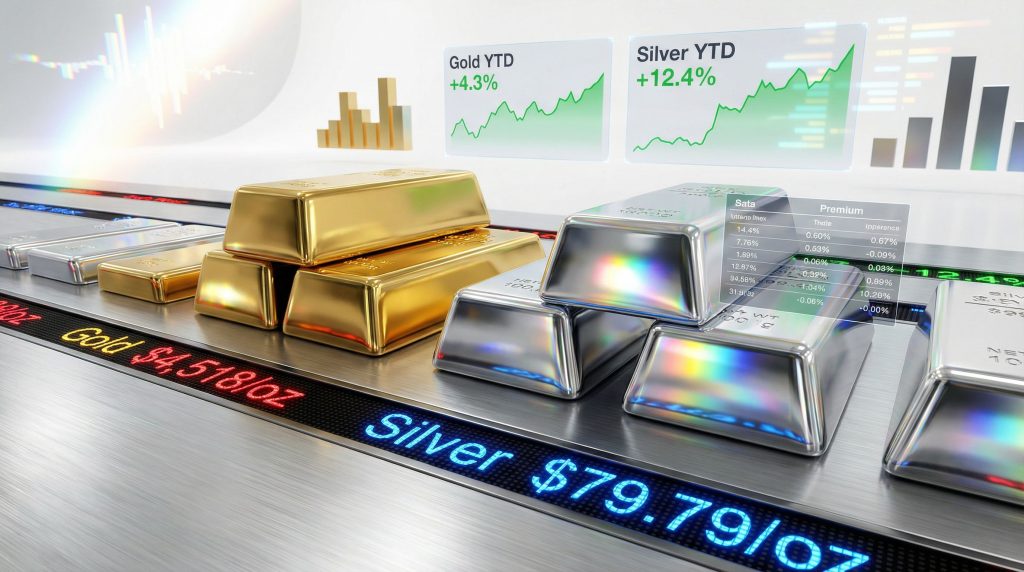
The early 2026 trading sessions have witnessed remarkable momentum in precious metals markets, with gold achieving a 4.3% year-to-date gain and silver surging 12.4% within just six trading days. These gains reflect more than simple momentum trading; they represent institutional recognition of mounting systemic risks across global financial systems.
Central bank reserve managers have accelerated gold accumulation strategies as part of broader diversification initiatives away from traditional reserve assets. This institutional demand stems from concerns over currency stability and the long-term sustainability of expansive monetary policies implemented across major economies. Furthermore, the historic gold surge reflects a fundamental reassessment of counterparty risk in sovereign debt markets.
Market internals reveal consistent buying pressure, with gold recording positive sessions in 81 of 138 trading hours (59% success rate) during the initial 2026 trading period. Silver demonstrated similar strength with 75 positive hours out of 138 total sessions, indicating broad-based precious metals demand rather than isolated speculation.
The unemployment rate declined to 4.4% in December 2025 from 4.5% the previous month, yet this improvement masks underlying labour market weaknesses. Payroll growth remained anaemic, with December estimates falling short of expectations and prior months subject to downward revisions. This disconnect between headline unemployment figures and employment quality creates uncertainty about economic resilience.
Industrial Silver Demand vs. Investment Flows
Silver's outperformance relative to gold reflects dual demand pressures from both industrial applications and investment positioning. Manufacturing sector recovery has increased silver consumption across multiple industries, particularly in electronics and renewable energy applications where silver's unique properties remain irreplaceable.
Green technology deployment continues expanding globally, with solar photovoltaic installations requiring significant silver content for optimal electrical conductivity. Each solar panel contains approximately 20 grams of silver, making renewable energy expansion a substantial demand driver for industrial silver consumption. Additionally, the silver market squeeze has intensified supply constraints.
The automotive industry's electrification trend further supports silver demand through:
- Electric vehicle electrical systems requiring enhanced conductivity
- Battery management systems utilising silver-based components
- Charging infrastructure dependent on silver's electrical properties
- Advanced driver assistance systems incorporating silver-enhanced circuits
This industrial demand provides fundamental support beneath silver's current price levels, distinguishing it from purely speculative precious metals positioning.
When big ASX news breaks, our subscribers know first
How Do Current Gold and Silver Valuations Compare to Historical Norms?
Gold Price Analysis: Fair Value vs. Market Premium
Current gold trading levels around $4,518 per ounce represent a significant premium above calculated fair value metrics. Analysis using multi-market correlation methodologies indicates gold trades 15.9% above fair value of $3,898, while maintaining a more modest 5.5% premium to market value of $4,282.
This valuation framework employs correlation analysis across five primary markets: bonds, euro, gold, oil, and S&P 500 indices. By measuring gold's price movement relative to these correlated assets, analysts can establish independent valuation anchors beyond traditional spot price analysis.
Historical precedent suggests similar parabolic trends have occurred during previous bull market phases. The period from May 2005 to May 2006 witnessed gold appreciation of 69%, rising from $421 to $712 per ounce. However, current price action exhibits structural similarities to this historical pattern, though magnitude and duration remain uncertain.
The following comparison illustrates current market premiums. For the most current pricing, investors should monitor live precious metals prices to track real-time movements:
| Asset Class | Current Price | Fair Value | Premium/Discount |
|---|---|---|---|
| Gold | $4,518/oz | $3,898/oz | +15.9% Premium |
| Silver | $79.79/oz | $56.17/oz | +42.0% Premium |
| S&P 500 | 58.5x P/E | 15-18x P/E | +225% Premium |
Silver's Volatility Premium and Risk-Reward Profile
Silver's current valuation presents a more pronounced disconnect from fundamental metrics, trading 42.0% above fair value of $56.17 per ounce. This premium significantly exceeds gold's overvaluation, suggesting differential correction risk in potential mean-reversion scenarios.
The gold-silver ratio analysis currently stands at approximately 56.6:1, derived from current spot prices. This ratio provides insight into relative value positioning between the metals, though historical context indicates this ratio has fluctuated considerably during different market cycles.
Silver's higher volatility profile creates both opportunity and risk for investors. Expected daily trading range calculations indicate silver contracts may experience $26,650 in daily range variation, compared to gold's $9,100 expected range. This volatility premium reflects silver's dual nature as both industrial commodity and monetary metal.
Mean reversion represents a natural market phenomenon that affects all asset classes over time. While markets can remain mispriced for extended periods, gravitational forces eventually restore valuations toward fundamental equilibrium levels. Consequently, both gold and silver face potential retrenchment pressures despite bullish longer-term forecasts.
What Are the Key Technical Indicators Signalling for Q1 2026?
Market Structure and Trading Volume Analysis
Technical analysis reveals important insights about precious metals momentum sustainability. Gold's trend consistency indicators show declining momentum persistence, with measurement dots trickling lower despite continued price appreciation. This divergence suggests internal market structure may be weakening even as prices reach new highs.
Volume-weighted support analysis identifies critical price levels for both metals:
- Gold's primary support: $4,459 per ounce (highest volume concentration)
- Silver's key support area: $75 per ounce region
- Gold's parabolic trend duration: Five weeks as of January 10, 2026
Silver demonstrates superior internal momentum characteristics compared to gold, with trend consistency measurements remaining above the critical 80% threshold. This technical strength suggests silver's December price rise exhibited more uniform characteristics than gold's advance. In addition, the gold and silver market update reveals these momentum differences are becoming increasingly pronounced.
Expected daily trading range (EDTR) metrics provide valuable context for risk management:
- Gold EDTR: 91 points = $9,100 per contract daily expectation
- Silver EDTR: 5.33 points = $26,650 per contract daily expectation
- S&P 500 EDTR: 56 points = $2,800 per contract daily expectation
These volatility measurements highlight precious metals' elevated risk profiles compared to equity index futures, requiring appropriate position sizing considerations.
Short-Term Correction Risks Within Bullish Framework
Technical study optimisation suggests different analytical approaches work best for each metal based on recent performance patterns:
Gold Technical Recommendations:
- Swing consistency: Parabolic indicators on 12-hour timeframes
- Profit targeting: Daily MACD provides superior signal quality
Silver Technical Recommendations:
- Swing consistency: Parabolic indicators on 30-minute timeframes
- Profit targeting: 2-hour MACD offers optimal profit signal timing
Critical methodology considerations emphasise that technical analysis success rates can change abruptly despite recent historical accuracy. Even studies demonstrating ten consecutive profitable signals may fail due to evolving market dynamics and participant behaviour changes.
How Does Precious Metals Performance Compare to Equity Market Valuations?
S&P 500 Overvaluation Metrics and Systemic Risk
Equity market valuations have reached historically extreme levels that dwarf precious metals overvaluation concerns. The S&P 500 currently trades at a price-to-earnings ratio of 58.5x, representing more than triple the historical bull market average of 15-18x earnings.
This valuation extreme creates an implied yield of just 1.709% for equity investors, while actual dividend yields remain at 1.134%. Investors purchasing the S&P 500 at current levels pay $58.50 for every $1.00 of corporate earnings, creating substantial capital risk in mean reversion scenarios.
Market capitalisation analysis reveals additional warning signals:
- S&P 500 market cap: $61.8 trillion
- U.S. M2 money supply: $22.6 trillion
- Market cap to money supply ratio: 2.7x
This relationship indicates equity valuations have expanded far beyond monetary base support, suggesting potential vulnerability to liquidity constraints or monetary policy tightening. Furthermore, these conditions highlight the importance of understanding safe-haven market dynamics in portfolio construction.
Asset Allocation Implications for Portfolio Diversification
Precious metals provide essential portfolio insurance against equity market corrections that traditional diversification strategies may not adequately address. During market stress periods, correlations between asset classes often converge toward positive territory, eliminating diversification benefits precisely when investors need them most.
Gold and silver maintain negative or low correlations with equity markets during normal conditions, while potentially offering positive returns during crisis periods. This asymmetric risk profile makes precious metals valuable for tail risk hedging despite current overvaluation concerns.
Risk-adjusted return analysis suggests precious metals allocation may enhance portfolio efficiency even at elevated price levels. The key consideration involves position sizing appropriate to volatility levels rather than avoiding precious metals exposure entirely.
What Economic Data Points Should Investors Monitor in 2026?
Employment and Inflation Metrics Impact Assessment
Labour market dynamics require careful monitoring beyond headline unemployment figures. While December unemployment declined to 4.4%, underlying employment quality metrics suggest continued weakness in job creation and wage growth sustainability.
Key employment indicators to watch include:
- Labour force participation rates and demographic trends
- Average hourly earnings growth adjusted for inflation
- Job openings and quit rates indicating labour market tightness
- Unemployment duration statistics measuring structural employment health
Inflation pressures remain persistent despite central bank policy interventions. Consumer price pressures continue challenging monetary policy effectiveness, while real yield calculations indicate negative returns for many fixed-income alternatives. Consequently, the gold price forecast remains bullish amid these conditions.
Global Trade and Currency Stability Factors
Dollar strength implications significantly affect precious metals pricing dynamics. Despite currency instability concerns globally, the U.S. dollar has received notable bidding during early 2026 trading, creating headwinds for dollar-denominated commodities.
International reserve currency dynamics continue evolving as central banks diversify away from traditional reserve assets. This structural shift supports long-term precious metals demand regardless of short-term dollar strength fluctuations.
Cross-border capital flow patterns reveal investor preference for hard assets amid geopolitical uncertainty. Trade tensions and sovereign debt concerns drive institutional allocation toward assets with intrinsic value rather than counterparty-dependent instruments. For current market analysis and pricing, investors can reference precious metals market data.
Which Investment Strategies Work Best in Current Market Conditions?
Risk Management Approaches for Precious Metals Exposure
Current market volatility requires sophisticated risk management approaches rather than simple buy-and-hold strategies. Position sizing must account for elevated expected daily trading ranges that exceed many investors' risk tolerance levels.
Effective risk management strategies include:
- Volatility-adjusted position sizing based on expected daily range calculations
- Staged entry approaches to average into positions over time
- Profit-taking protocols for managing parabolic trend sustainability
- Stop-loss implementation appropriate to precious metals volatility characteristics
Dollar-cost averaging strategies may prove particularly valuable given current overvaluation concerns combined with bullish longer-term fundamentals. This approach allows investors to participate in precious metals uptrends while reducing timing risk.
Physical vs. Financial Instruments Comparison
Physical precious metals ownership provides ultimate counterparty risk elimination but requires consideration of storage, insurance, and liquidity constraints. Current market conditions favour physical allocation for long-term strategic positioning rather than tactical trading.
Exchange-traded fund (ETF) alternatives offer enhanced liquidity and reduced storage complexity while maintaining precious metals exposure. However, ETF structures introduce counterparty risk and potential tracking efficiency concerns during extreme market conditions.
Futures market participation requires sophisticated risk management due to leverage effects and margin requirements. Current expected daily trading ranges suggest futures positions could experience significant intraday volatility requiring active management.
The next major ASX story will hit our subscribers first
What Are the Long-Term Outlook Scenarios for Gold and Silver?
Supply-Side Constraints and Production Challenges
Mining industry capacity limitations continue constraining precious metals supply growth despite elevated price incentives. Major producing regions face geological depletion, regulatory challenges, and infrastructure constraints that limit expansion possibilities.
Gold mining requires increasingly complex extraction processes as easily accessible deposits become depleted. Average ore grades have declined significantly over recent decades, requiring greater energy input and environmental mitigation for equivalent production volumes.
Silver production faces unique challenges due to its primary extraction as a byproduct of base metal mining. Approximately 70% of silver supply derives from lead, zinc, and copper operations rather than dedicated silver mines, making supply responsive to base metal demand cycles rather than silver price incentives alone.
Demand Evolution and Market Structure Changes
Central bank gold purchasing patterns suggest structural demand shifts favouring precious metals accumulation. These institutional buyers typically maintain long-term holding periods, removing supply from circulation and supporting price floors during market corrections.
Technological advancement impacts silver demand through expanding applications in:
- 5G telecommunications infrastructure requiring enhanced electrical conductivity
- Medical device manufacturing utilising silver's antimicrobial properties
- Water purification systems employing silver's sterilisation capabilities
- Advanced battery technologies incorporating silver for improved performance
Demographic trends in emerging markets support jewellery and investment demand growth as rising middle-class populations seek wealth preservation vehicles. Cultural affinity for precious metals in Asian markets provides fundamental demand support independent of Western investment flows.
How Should Investors Position for Potential Market Volatility?
Scenario Planning for Different Economic Outcomes
Stagflation environment implications favour precious metals as traditional asset classes struggle with simultaneous inflation and economic stagnation. Historical precedent from the 1970s demonstrates gold and silver's ability to preserve purchasing power during currency debasement periods.
Deflationary pressure scenarios present more complex dynamics for precious metals. While deflation typically supports real asset values, liquidity constraints and forced selling pressure could create temporary price weakness before fundamental support reasserts.
Currency crisis preparation requires geographic and asset class diversification beyond domestic markets. Precious metals provide internationally recognised value storage that transcends individual currency systems or political jurisdictions.
Portfolio Integration and Rebalancing Considerations
Correlation benefits during market stress periods justify precious metals allocation despite current overvaluation concerns. Portfolio insurance value often manifests during crisis periods when traditional diversification strategies fail to provide expected protection.
Rebalancing protocols should account for precious metals' volatility characteristics and mean reversion tendencies. Systematic rebalancing approaches can capture volatility premiums while maintaining strategic allocation targets.
Tax-efficient holding structures vary significantly across jurisdictions and investor circumstances. Physical precious metals may qualify for different tax treatment compared to financial instruments, requiring professional consultation for optimisation.
Estate planning applications benefit from precious metals' portability, divisibility, and international recognition. These characteristics make precious metals valuable for generational wealth transfer strategies, particularly in uncertain political environments.
Current market conditions present both opportunities and risks for precious metals investors. While overvaluation concerns suggest potential short-term corrections, fundamental drivers supporting precious metals demand remain robust. Successful navigation requires sophisticated risk management, appropriate position sizing, and realistic expectations about volatility and timing uncertainty. The gold and silver market update indicates continued institutional recognition of precious metals' portfolio insurance value despite elevated price levels.
Looking to Position Yourself in the Next Major Mineral Discovery?
Discovery Alert's proprietary Discovery IQ model instantly alerts investors to significant ASX mineral discoveries, transforming complex geological data into actionable investment insights for both short-term traders and long-term investors. With precious metals demonstrating such strong momentum in early 2026, discover why historic mineral discoveries can generate substantial returns by visiting Discovery Alert's dedicated discoveries page and begin your 30-day free trial today to secure a market-leading advantage.