August 6, 2026
Why Most Investors Misunderstand What Precious Metals Actually Are
Across centuries of financial history, no asset class has generated more misunderstanding among retail investors than physical precious metals. Most beginners arrive at the bullion market with one of two misconceptions: either that gold and silver are relics of a pre-digital financial world with diminishing relevance, or conversely, that they are guaranteed vehicles for rapid wealth creation. Neither framing captures the true nature of these metals, and both lead to poor decisions.
The reality is more nuanced and, for long-term investors, considerably more compelling. Gold and silver occupy a structurally unique position within a diversified portfolio, functioning neither as growth assets nor as income-generating instruments, but as stores of value with properties that behave differently from virtually every other investable asset class. Understanding this distinction is the starting point for any serious beginner's guide to gold and silver bullion investing.
When big ASX news breaks, our subscribers know first
The Monetary Foundation That Gives Precious Metals Their Power
Thousands of Years of Proven Value Preservation
Few assets can claim the longevity of gold and silver as stores of wealth. Across empires, wars, currency collapses, and technological revolutions, these metals have maintained their purchasing power in ways that paper currencies never have. The Roman denarius, the Spanish real, the British pound, and the US dollar have all experienced significant debasement over time. Gold has not.
Central bank gold demand continues to reflect this reality in global balance sheets. According to the International Monetary Fund, global official gold reserves across central banks total approximately 54,500 metric tonnes, with the United States Federal Reserve holding roughly 8,133 tonnes as monetary reserves. The IMF itself holds approximately 2,814 tonnes of gold as part of its reserve assets. These institutions are not holding gold out of sentiment — they are holding it because it functions as a non-sovereign, non-counterparty monetary anchor.
This institutional validation is one of the most important, and often overlooked, arguments for including physical precious metals in a personal investment strategy.
How Precious Metals Differ From Every Other Portfolio Asset
The core investment thesis for gold and silver rests on their non-correlation with conventional financial assets. Precious metals are not tied to corporate earnings cycles, dividend policies, or credit ratings. Their prices respond to an entirely different set of macroeconomic forces, including inflation expectations, currency dynamics, real interest rates, and geopolitical risk.
During the 2008 global financial crisis, while the S&P 500 declined approximately 37%, gold prices increased approximately 5%, demonstrating this inverse relationship during periods of systemic stress. Academic research examining commodity markets during equity disruptions consistently finds that precious metals exhibit negative correlation to equity indices precisely when diversification is most needed.
Furthermore, gold as a safe haven is not simply a matter of historical sentiment — it is a structurally distinct price behaviour pattern that emerges most reliably during the periods when portfolio protection matters most.
Key Analytical Point: The diversification benefit of gold is not that it always rises when stocks fall. It is that its price drivers are structurally distinct, meaning it tends to behave differently from equities during the periods when portfolio protection matters most.
Gold vs. Silver: Two Metals With Fundamentally Different Profiles
While gold and silver are often discussed together, they are distinct assets with different demand structures, volatility profiles, and investment characteristics. Understanding these differences is essential before committing capital to either.
| Attribute | Gold | Silver |
|---|---|---|
| Primary Role | Monetary store of value | Monetary + industrial demand |
| Price Volatility | Lower | Considerably higher |
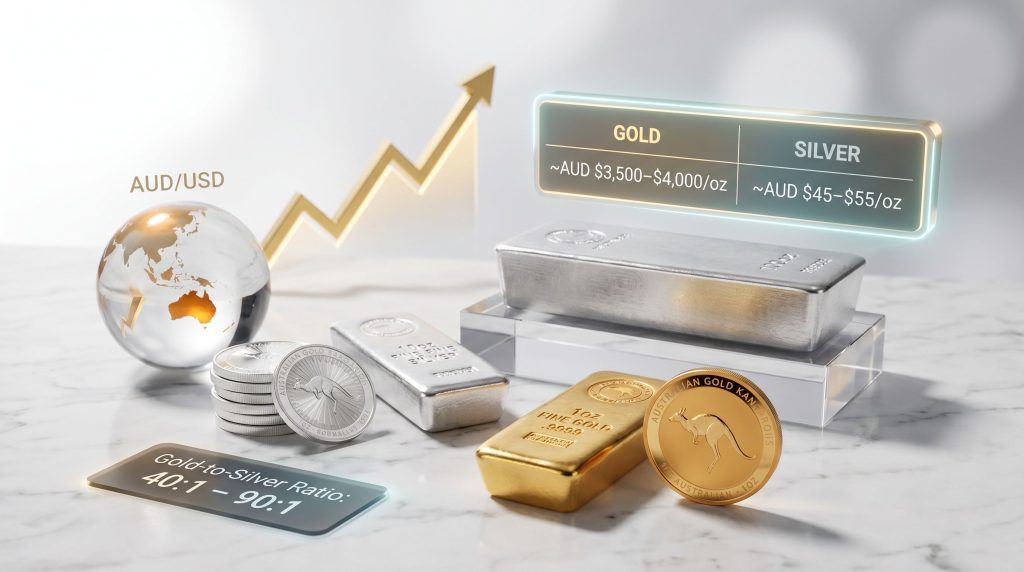
| Entry Cost (approx. AUD, 2025) | ~$3,500–$4,000/oz | ~$45–$65/oz |
| Industrial Use Share | Minimal (~10%) | Significant (~50%+) |
| Real Interest Rate Sensitivity | High | Moderate |
| Global Liquidity | Very high | High |
| Upside Potential | Moderate, more stable | Higher, more cyclical |
Silver's dual function as both a monetary metal and a critical industrial input creates a more complex demand structure than gold. Solar photovoltaic cells, consumer electronics, electric vehicle components, and medical devices all require silver as a manufacturing input. This means silver prices respond not only to financial sentiment but also to global manufacturing cycles and technology adoption rates.
Gold, by contrast, is predominantly driven by real interest rates, US dollar strength, and institutional risk appetite. Its industrial use is minimal, making its price behaviour more predictable as a financial instrument. For most beginners, holding a combination of both metals provides exposure to different demand drivers and different market conditions. The gold-silver ratio analysis can further guide decisions about appropriate allocation between the two.
What Bullion Actually Is, and Why the Distinction Matters
Bars, Coins, and Rounds: The Three Physical Forms
The term bullion refers to physical precious metal valued primarily by its metal content — specifically its weight multiplied by its purity — rather than by collector appeal or numismatic rarity. This distinction is critical, as it separates investment-grade bullion from collectible coins whose value depends on condition, rarity, and collector demand.
Precious metals are measured in troy ounces, not standard avoirdupois ounces. One troy ounce equals 31.1035 grams, compared to 28.35 grams for a standard ounce. This distinction matters when calculating quantities and verifying product weight specifications.
Three primary physical formats exist for bullion investors:
- Cast bars — produced by pouring molten metal into moulds with minimal surface finishing; typically carry the lowest premium over spot price and represent the most cost-efficient form of metal accumulation
- Minted bars — machine-pressed with polished finishes and often include security features such as serial numbers, assay cards, and tamper-evident packaging; carry slightly higher premiums but provide enhanced authentication and documented provenance
- Government-issued coins — produced by sovereign mints with guaranteed weight and purity backed by the issuing government; carry a symbolic legal tender face value and command higher premiums than bars but offer the greatest global recognition and liquidity
Standard gold bullion purity is .9999 fineness (99.99% pure gold). Standard silver bullion purity is .999 fineness (99.9% pure silver). Products from reputable government mints, including The Perth Mint and the Royal Australian Mint, consistently meet or exceed these standards. For those new to the market, reviewing a beginner's guide to bullion can provide helpful context on product selection.
Physical Bullion vs. Paper Gold: A Critical Distinction Beginners Must Understand
One of the most consequential misunderstandings in the retail precious metals space is the assumption that owning a gold exchange-traded fund (ETF) is equivalent to owning physical gold. These are fundamentally different instruments with different risk profiles, and conflating them is a significant analytical error. In addition, understanding the difference between physical gold vs ETFs is essential before committing capital to either format.
| Ownership Type | Counterparty Risk | Storage Required | True Metal Ownership | Physical Redemption |
|---|---|---|---|---|
| Physical bullion (in possession) | None | Yes | Yes | Immediate |
| Physical bullion (professional vault) | Minimal (vault only) | Managed | Yes | On request |
| Gold/Silver ETF | Yes (fund manager) | No | Typically no | Rarely available to retail investors |
| Mining stocks | High (company risk) | No | No | Not applicable |
| SMSF-held bullion | Custodian risk | Managed | Depends on structure | Governed by trust deed |
Global gold ETFs collectively managed approximately USD $170 billion in assets as of late 2024, representing the scale of exposure through paper instruments rather than physical holdings. Most mainstream gold ETFs do not provide ordinary retail investors with the right to redeem shares for physical metal. Redemption rights are typically reserved for authorised participants, meaning retail holders receive cash at net asset value rather than actual gold in a redemption scenario.
Physical bullion held in your possession or a professionally managed segregated vault account carries zero counterparty risk. No third party can default on a tangible asset you directly own. This property is most valuable precisely during systemic financial crises, when counterparty risk materialises across the financial system simultaneously.
Important Distinction: Segregated storage means your bullion is identified as specifically belonging to you, stored separately from other clients' holdings. This differs from pooled storage, where metals are commingled. Segregated storage preserves direct ownership claims even in the event of a storage facility's insolvency.
Understanding Spot Price, Premiums, and the True Cost of Bullion
How the Spot Price Is Determined
The spot price is the globally traded price for one troy ounce of gold or silver for near-immediate delivery. It is established through continuous trading on major commodity exchanges. The LBMA and COMEX markets are the primary venues for this price discovery, with COMEX trading approximately 130,000 to 150,000 gold futures contracts daily.
Spot prices are quoted in US dollars globally and then converted to local currencies through live foreign exchange rates. For Australian investors, this creates an important secondary variable: the AUD/USD exchange rate.
Over a recent 24-month period, the AUD/USD rate fluctuated between approximately 0.63 and 0.72, creating roughly 14% variance in effective bullion prices for Australian buyers based solely on currency movements. A weakening Australian dollar makes bullion more expensive in local terms regardless of what gold is doing in USD-denominated markets. Monitoring both the USD spot price and the AUD/USD rate simultaneously is therefore essential for Australian investors evaluating entry points.
What Is a Premium and How Should Beginners Evaluate It?
The premium is the amount paid above the spot price to acquire a physical bullion product. It covers fabrication costs, distribution, dealer margin, and in some cases, the collectibility or sovereign backing of the product. Every premium paid represents additional price appreciation required before a position becomes profitable, making premium management a core element of value-focused bullion investing.
| Product Type | Typical Premium Over Spot |
|---|---|
| Large cast bars (10oz+) | 0.5% to 2% |
| 1oz cast bars | 2% to 4% |
| 1oz minted bars | 3% to 6% |
| Government-minted 1oz coins | 4% to 8% |
| Fractional coins (1/4 oz and below) | 8% to 15%+ |
A general principle applies consistently: larger bars carry lower per-ounce premiums, while fractional products carry higher premiums due to the proportionally greater fabrication cost per unit of metal. Beginners focused on cost-efficient metal accumulation should prioritise larger formats where practical, reserving fractional products for situations where lower absolute entry costs or gifting purposes justify the additional cost.
It is also worth monitoring premium trends over time. Unusually elevated premiums relative to historical averages can indicate strong retail demand or temporary supply constraints. Compressed premiums may signal weaker demand or excess supply, providing contextual market intelligence beyond the spot price itself.
The Bid-Ask Spread: Understanding the Round-Trip Cost
When you purchase bullion, you pay the ask price (spot plus dealer premium). When you sell, dealers purchase at the bid price, which sits below the current spot price. The difference between your purchase price and your potential sale price represents the full round-trip transaction cost of a bullion position.
For standard cast bars from major Australian dealers, bid-ask spreads typically range from 0.5% to 2%. For coins, spreads may reach 2% to 4%. This means an investor purchasing a 1oz gold cast bar at AUD $3,700 might receive approximately AUD $3,626 when selling back, assuming a 2% round-trip spread, before considering any change in the underlying spot price.
Calculating your breakeven spot price before purchasing is a straightforward but valuable discipline:
Breakeven Spot Price = (Total Purchase Price including premium) divided by (Weight in troy ounces)
For long-term holders, these transaction costs are relatively immaterial against years of potential price appreciation. For short-term traders, however, they represent a meaningful headwind.
A Practical Guide to Bullion Products for New Australian Investors
Gold Bullion: Product Options From Entry Level to Institutional
Cast Bars represent the most cost-efficient format for investors focused on acquiring maximum gold content per dollar spent. Produced by pouring molten gold into moulds with minimal surface treatment, they carry the lowest premiums of any gold product. The Perth Mint produces individually numbered cast bars to .9999 fineness, making them among the most verifiable products available to Australian investors.
Minted Bars offer the same metal content as cast bars but with added security and presentation features. Machine-pressed surfaces, serial numbers, assay certificates, and tamper-evident packaging make minted bars preferable for investors who may gift bullion, require documented provenance for insurance purposes, or hold metal within formal structures requiring clear authentication.
Government-Minted Coins, including the Australian Gold Kangaroo (produced by The Perth Mint), the American Gold Eagle, and the Canadian Gold Maple Leaf, combine guaranteed purity and weight with sovereign backing and globally recognised designs. Their higher premiums over spot are justified by their universal liquidity. A Gold Kangaroo purchased in Melbourne can be sold with minimal friction in Tokyo, London, or New York — a property that cast bars from less recognised refiners may not share.
Silver Bullion: High Accessibility, Multiple Entry Points
Silver's lower per-ounce price makes it the most accessible starting point for budget-conscious investors. Key product options include:
- 1oz silver coins (Silver Kangaroo, American Silver Eagle, Canadian Silver Maple Leaf) typically priced in the AUD $45 to $65 range depending on current premiums; ideal entry-level products combining guaranteed authenticity and strong liquidity
- Silver bars available in 1oz, 5oz, 10oz, and 100oz formats, with progressively lower per-ounce premiums as size increases; suited to investors accumulating larger positions with a focus on cost efficiency
- Silver rounds are privately minted non-legal-tender discs carrying lower premiums than government coins but without sovereign backing; appropriate for experienced investors who understand the liquidity trade-off
Beginner Recommendation: For first-time silver buyers, a government-minted 1oz coin from The Perth Mint or Royal Australian Mint delivers the best combination of authenticity assurance, liquidity, and manageable entry cost. For gold, a 1oz cast bar from an authorised government mint distributor typically provides the strongest value per gram for investors focused on accumulation rather than presentation.
How to Structure Your First Bullion Purchase
Matching Your Strategy to Your Objective
Different investment objectives call for different allocation strategies. Before purchasing any bullion product, clearly defining your primary purpose will significantly improve both product selection and long-term satisfaction with the position.
| Investor Profile | Suggested Allocation | Recommended Starting Product |
|---|---|---|
| Conservative (capital preservation) | 70% gold / 30% silver | 1oz gold cast bar + 10oz silver bar |
| Balanced (portfolio diversification) | 50% gold / 50% silver | Mixed coins and bars |
| Growth-oriented (higher risk tolerance) | 30% gold / 70% silver | Silver coins + fractional gold |
| Budget-constrained (under AUD $500) | 100% silver initially | 1oz silver coins, DCA monthly |
A commonly referenced benchmark from financial strategists is a 5% to 10% allocation to precious metals within a diversified portfolio, serving as a hedge against inflation, currency debasement, and systemic financial risk. This allocation level provides meaningful portfolio protection without over-concentrating in non-income-producing assets.
Dollar-Cost Averaging: The Most Practical Risk Management Tool for Beginners
Rather than committing capital in a single transaction at one price point, dollar-cost averaging (DCA) involves purchasing a fixed dollar amount of bullion at regular intervals, typically monthly. This approach reduces exposure to short-term price peaks and smooths the average acquisition cost across market cycles.
DCA is particularly well-suited to silver given its higher price volatility. A beginner allocating AUD $200 per month to 1oz silver coins over 12 months will end the year with diversified entry points rather than a concentrated position at a potentially disadvantageous price. Over time, this approach tends to outperform attempts to identify perfect entry points, particularly for investors without dedicated market monitoring time.
Short-term precious metal price movements are notoriously difficult to predict accurately, even for professional commodity traders. Consequently, a disciplined systematic accumulation strategy almost invariably produces better outcomes for retail investors than attempts to time market bottoms.
The next major ASX story will hit our subscribers first
Identifying and Buying From a Reputable Australian Bullion Dealer
The Most Important Trust Signal: Authorised Distributor Status
The single most important verification step for any Australian bullion buyer is confirming whether a dealer holds authorised distributor status from government mints. Dealers listed on The Perth Mint's and Royal Australian Mint's official distributor pages have been formally vetted and maintain direct supply relationships with the mints themselves. This status is publicly verifiable directly on the mints' websites. For practical guidance on this process, getting started with bullion through a reputable source can provide additional reassurance for first-time buyers.
Additional trust signals to verify include:
- Transparent live pricing displayed in real time, reflecting current spot prices plus stated premiums
- A verifiable physical business address, registered ABN, and published terms of business
- A documented history of market operations and independently verifiable customer reviews
- Clearly disclosed sourcing practices and the ability to provide product documentation
Red Flags That Should Stop a Purchase Immediately
- Premiums significantly below market average for comparable products; this can indicate counterfeit or substandard metal
- No verifiable physical address or registered business details beyond a website
- Pressure to purchase rare or collectible coins positioned as superior investment vehicles (numismatic premiums are highly illiquid and rarely recoverable unless sold to specialist collectors)
- Inability to provide documentation of mint origin or chain of custody for products sold
Verifying Authenticity Before You Accept Delivery
Government-minted coins include multiple anti-counterfeit security features including micro-engraving, reeded edges, and in some cases holographic elements. However, the most effective protection against counterfeit risk is purchasing exclusively through authorised distributors of sovereign mints, which eliminates the primary counterfeit risk at the point of acquisition.
Professional dealers use Sigma Metalytics testers and XRF (X-ray fluorescence) analysers to verify metal content non-destructively. Asking whether a dealer employs these verification methods provides insight into their operational standards.
Storage Solutions for Physical Bullion
Home Storage: Accessible but Limited
Home storage offers immediate accessibility and eliminates third-party custody costs, but introduces risks including theft, fire, and flood. A quality home safe that is bolted to the building's structure and fire-rated to an appropriate standard represents the minimum acceptable infrastructure for storing any meaningful bullion holding at home.
Importantly, storing bullion above certain value thresholds at home may require explicit disclosure to your home insurer and the addition of a specific bullion rider to your policy. Standard home contents insurance policies typically exclude or severely limit coverage for precious metals. Verify this with your insurer before storing significant holdings at home.
Professional Vault Storage: Institutional-Grade Security
Private vaulting facilities offer segregated, insured storage in purpose-built high-security environments that are not affiliated with banks, meaning holdings remain outside the banking system entirely. Two primary models exist:
- Safe deposit box (key-holder model): The investor retains physical key access to a dedicated, individually assigned box within the vault facility. This provides direct personal control of access.
- Remote/registered vaulting: Bullion is individually registered as belonging to the investor but stored in a managed facility accessible on request. This suits investors who do not require frequent physical access to their holdings.
Annual storage fees for professional vaulting typically range from approximately 0.5% to 1.5% of stored value depending on the facility, storage type, and holdings size. These costs should be factored into the total cost of ownership calculations before purchase.
Holding Bullion Within a Self-Managed Super Fund
Australian investors can hold physical bullion within a Self-Managed Super Fund (SMSF) as a complying investment asset under the Superannuation Industry (Supervision) Act 1993. According to the Australian Taxation Office, approximately 11% of SMSFs held precious metals as an asset class as of the most recent statistical period, reflecting growing acceptance of bullion within retirement planning frameworks.
Critical regulatory requirements for SMSF-held bullion include:
- Bullion must be held in the name of the superannuation fund trustee, not in the individual member's personal name
- Storage must comply with ATO guidelines and typically requires professional vaulting rather than home storage
- The investment must satisfy the fund's investment strategy documentation and comply with the sole purpose test
This structure allows Australian investors to accumulate precious metals within a concessionally taxed retirement environment, a meaningful advantage for long-term wealth preservation strategies.
The Four Primary Forces That Drive Precious Metal Prices
Understanding what moves gold and silver prices transforms a beginner's guide to gold and silver bullion investing from theory into practice. Four primary drivers dominate:
- Real interest rates: The relationship between real yields (nominal interest rates minus inflation) and gold prices is one of the most consistent correlations in financial markets. When real interest rates fall toward zero or turn negative, gold becomes more attractive relative to yield-bearing assets because the opportunity cost of holding a non-yielding asset declines.
- Currency dynamics: Gold is priced globally in US dollars. A weakening dollar typically supports higher gold prices as the same ounce becomes cheaper in foreign currency terms, stimulating demand. For Australian investors, AUD/USD movements add a secondary layer of price sensitivity independent of what gold itself is doing.
- Geopolitical risk and systemic uncertainty: Gold historically experiences price surges during periods of war, institutional breakdown, and financial crisis. This flight-to-safety demand reflects gold's property as a non-sovereign asset that cannot be sanctioned, frozen, or devalued by any government action.
- Industrial and technology demand (silver-specific): Silver's growing role in photovoltaic solar cells, EV components, and electronics manufacturing creates a structural demand floor absent from gold. The silver intensity of solar panel production has increased as photovoltaic technology evolves, creating additional demand linked to global energy transition trends.
The Gold-to-Silver Ratio as an Analytical Tool
The gold-to-silver ratio measures how many ounces of silver are required to purchase one ounce of gold at current spot prices. Historically, this ratio has ranged between approximately 40:1 and 90:1, with extremes in both directions providing analytical signals for relative value assessments.
Analytical Insight: When the gold-to-silver ratio exceeds approximately 80:1, silver is trading at a historical discount relative to gold, suggesting potential relative value in silver for investors willing to accept its higher volatility. Conversely, ratios below 50:1 have historically indicated silver is expensive relative to gold. Monitoring this ratio provides a tool for timing allocation shifts between the two metals rather than simply tracking absolute prices.
Five Mistakes That Cost Beginner Bullion Investors the Most
Mistake 1: Overpaying on Premiums Without Calculating the Breakeven
Every premium point above spot represents additional price appreciation required before a position enters profit. Before any purchase, calculate the spot price at which your investment breaks even:
Required Spot Price to Break Even = Total Purchase Price divided by Weight in Troy Ounces
A beginner paying a 15% premium on a fractional gold coin needs a 15% spot price increase just to recover their cost, before any profit materialises.
Mistake 2: Treating Numismatic Coins as Investment-Grade Bullion
Collectible coins carry premiums driven by rarity, condition, and collector demand — not metal content. These premiums are highly illiquid and can only be recovered by selling to specialist collectors willing to pay them. For investment purposes, bullion-grade products where the premium reflects fabrication cost rather than collectibility should be the default choice.
Mistake 3: Neglecting Storage and Insurance From Day One
Uninsured bullion stored insecurely represents a total loss risk in the event of theft or disaster. Storage and insurance costs must be factored into the full cost of ownership before any purchase, not as an afterthought after capital is already committed.
Mistake 4: Attempting to Time the Market Instead of Accumulating Systematically
Precious metal markets are influenced by geopolitical events, monetary policy decisions, and currency movements that are genuinely unpredictable over short timeframes. A disciplined DCA strategy consistently produces more predictable outcomes for retail investors than attempting to identify precise market bottoms — a challenge that defeats most professional traders as well.
Mistake 5: Conflating ETF Exposure With Physical Ownership
An ETF provides price exposure to precious metals. It does not provide ownership of physical metal, elimination of counterparty risk, or protection in the specific scenario where physical ownership matters most. In a systemic financial disruption, ETF counterparty risk may materialise at the worst possible moment. For a broader perspective on how different investment structures compare, the Perth Mint's investor guidance outlines practical considerations across formats.
Frequently Asked Questions About Gold and Silver Bullion for Beginners
Is gold bullion a suitable investment for someone just starting out in Australia?
Gold bullion is widely considered appropriate for investors at all experience levels as a portfolio component. It requires no specialist knowledge to acquire or hold, carries no counterparty risk in physical form, and has demonstrated long-term purchasing power preservation across historical periods spanning multiple centuries. Beginners should focus on low-premium products from authorised distributors and approach bullion as a long-term holding rather than a short-term trading vehicle.
How much money do I need to start investing in precious metals?
Silver bullion offers entry points from approximately AUD $50 to $70 for a single 1oz government-minted coin, making it the most practical starting point for investors with limited initial capital. Gold entry begins at approximately AUD $350 to $600 for fractional products (1/10 oz to 1/4 oz) and AUD $3,500 to $4,000+ for a full 1oz bar or coin, with prices varying according to current spot prices and product premiums. All prices are indicative and subject to market conditions at the time of purchase.
What is the practical difference between a gold coin and a gold bar?
Both products contain equivalent purity-grade gold and are valued primarily by their metal content. Government-issued coins carry a symbolic legal tender face value, are produced by sovereign mints with guaranteed weight and purity, and command higher premiums due to their universal recognition and liquidity. Bars, particularly cast formats, carry lower premiums and represent more cost-efficient metal acquisition. For investors prioritising maximum metal content per dollar, cast bars are typically superior. For investors prioritising global liquidity and ease of authentication, government coins are preferable. Understanding the complete beginner's guide to gold and silver bullion investing — including these product distinctions — is essential before making any initial purchase.
Disclaimer: This article is intended for general informational and educational purposes only. It does not constitute financial product advice. Precious metal prices, premiums, and market conditions referenced throughout this article are subject to change and may differ from current market rates at the time of reading. Past performance of any asset class is not indicative of future results. Readers should seek advice from a licensed and appropriately qualified financial adviser before making investment decisions. Gold and silver investments carry risks including price volatility, liquidity risk, and storage-related costs.
Want To Know When The Next Major Mineral Discovery Hits The ASX?
Discovery Alert's proprietary Discovery IQ model delivers real-time alerts on significant ASX mineral discoveries, instantly translating complex geological data into actionable investment insights — explore the historic returns major discoveries have generated and begin your 14-day free trial to position yourself ahead of the broader market.