
June 8, 2026
The Hidden Complexity Inside Europe's Aluminium Supply Chain
The global transition to electrified transport is often framed as a clean energy story, but underneath the headline narrative lies a far more complicated industrial puzzle. At the centre of that puzzle is aluminium, a material so embedded in modern vehicle architecture that its supply dynamics will quietly determine whether Europe's automotive decarbonisation ambitions succeed or stall. Understanding primary vs recycled aluminium in Europe's automotive sector is not simply an exercise in materials science — it is a strategic question with consequences that span carbon policy, geopolitical risk, manufacturing competitiveness, and investor capital allocation.
When big ASX news breaks, our subscribers know first
Demand Is Accelerating, but the Composition Matters More Than the Volume
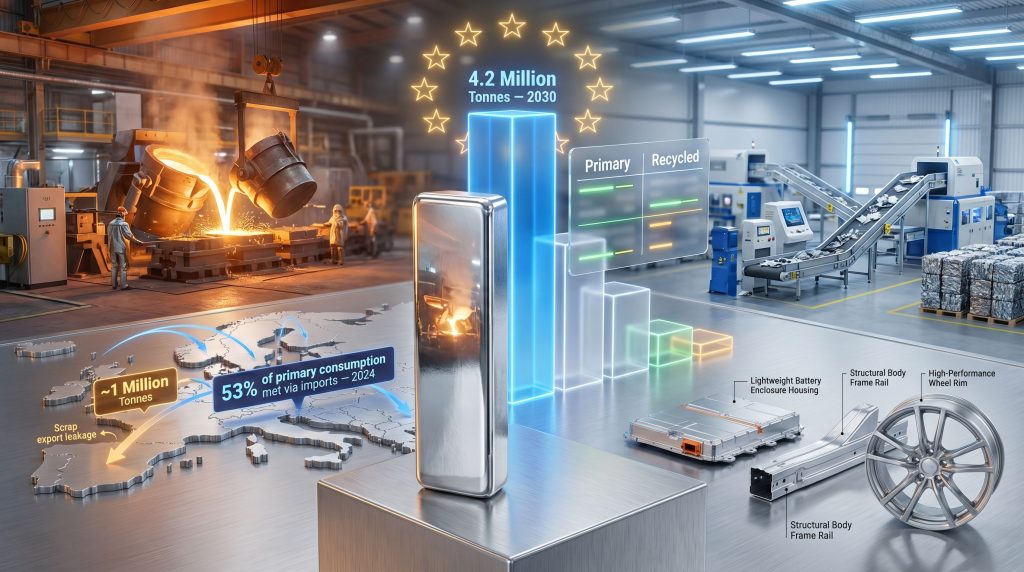
Europe's automotive sector is on a trajectory toward consuming approximately 4.2 million tonnes of aluminium annually by 2030. The force behind this growth is not simply that more cars are being built. It is that each car being built requires fundamentally more aluminium than its predecessor, particularly as battery electric vehicles displace internal combustion platforms.
Per-vehicle aluminium intensity is rising sharply across several structural applications:
- Battery enclosure systems, which require lightweight yet thermally resilient housings capable of managing heat dissipation across large cell arrays
- Multi-material body structures where aluminium extrusions and castings replace steel in crash management systems and floor frames
- Thermal management circuits including cooling plates, heat exchangers, and fluid conduit systems serving both battery packs and power electronics
- Front and rear end structures designed to absorb impact while contributing minimal mass to the vehicle's overall weight
What makes this demand surge strategically significant is not the volume alone. It is the character of the demand. Different applications require different alloy families, different levels of metallurgical purity, and different tolerances for contamination in the feedstock. This distinction is what makes the primary vs recycled aluminium in Europe's automotive sector debate far more nuanced than a simple carbon accounting exercise.
How Primary and Recycled Aluminium Actually Function in a Vehicle Context
Defining the Supply Streams
Before examining the competitive dynamics, it is worth understanding how these two supply streams differ at a technical level.
| Attribute | Primary Aluminium | Recycled (Secondary) Aluminium |
|---|---|---|
| Production energy intensity | High, requires electrolytic smelting | Roughly 5% of primary production energy |
| Carbon footprint | Depends heavily on grid electricity source | Approximately 95% lower emissions than primary |
| Alloy flexibility | Full alloy range available from virgin metal | Constrained by scrap composition and contamination |
| Automotive fit | Sheet, extrusions, structural and high-purity components | Cast parts, wheels, powertrain housings, brackets |
| European supply dependency | Around 53% of primary consumption met via imports in 2024 | Largely domestic, scrap sourced within Europe |
| End-of-life recovery rate | Not applicable | Exceeds 90% in Europe |
The Quality Ceiling Problem
A common misconception is that recycled aluminium is simply a lower-cost, lower-carbon version of primary metal that can substitute wherever primary is used. In reality, recycled feedstock faces a fundamental metallurgical constraint known in the industry as the quality ceiling.
When aluminium scrap from mixed sources enters a remelting furnace, it carries trace quantities of elements — including copper, iron, silicon, and zinc — absorbed from prior alloying, coatings, and contamination during collection. These tramp elements cannot be economically removed using conventional remelting technology. As a result, the alloys that can be reliably produced from mixed scrap are predominantly secondary cast alloys, which tolerate broader compositional ranges.
Wrought alloys, the grades required for body panels, structural extrusions, and the outer surfaces of vehicles, demand tight compositional control that mixed scrap streams cannot consistently deliver. This is why:
- Body-in-white sheet, used in door skins, hoods, and structural panels, currently relies heavily on primary or carefully segregated recycled input
- Outer Class A surfaces require near-virgin purity to achieve the surface finish quality that automotive paint processes demand
- Battery enclosure housings for EVs, where thermal conductivity and structural integrity interact, often specify alloys that are difficult to replicate from open-loop scrap
Advances in sensor-based scrap sorting, including X-ray fluorescence and laser-induced breakdown spectroscopy, are gradually improving the ability to segregate alloy families within mixed streams. However, the industry remains some years away from closed-loop automotive-to-automotive recycling at the scale needed to meaningfully shift the quality ceiling upward.
Where Primary Aluminium Remains Structurally Irreplaceable
Even assuming optimistic trajectories for recycling technology, certain applications maintain a structural preference for primary feedstock. Recycled aluminium currently accounts for roughly 36% of total European aluminium supply, a figure that underscores both the progress already achieved and the volume gap that still requires primary supplementation. Furthermore, with demand headed toward 4.2 million tonnes in the automotive segment alone, that gap is not narrowing quickly enough through recycling alone. The European Aluminium Circular Action Plan outlines the structural steps needed to close this gap over the coming decade.
Europe's Scrap Export Paradox: The 1 Million Tonne Problem
A Circular Economy Contradiction
One of the most striking structural inefficiencies in European aluminium supply is the region's continued export of approximately 1 million tonnes of aluminium scrap annually. This volume, if retained and processed domestically, could theoretically offset close to 24% of Europe's primary aluminium import dependency.
The reasons scrap continues leaving Europe reveal the depth of the structural problem:
- Price arbitrage: processors in Southeast Asia and other regions offer competitive buying prices, particularly for lower-grade mixed scrap that European remelters cannot economically process into automotive-grade output
- Processing capacity gaps: Europe lacks sufficient secondary smelting infrastructure in certain regions to absorb available scrap volumes, particularly for grades requiring sophisticated pre-treatment
- Collection infrastructure mismatches: scrap collection logistics and sorting facilities are unevenly distributed, creating regional bottlenecks that push material toward export rather than domestic processing
The situation creates a striking contradiction: Europe simultaneously imports primary aluminium to fill automotive demand while exporting the very feedstock that could reduce that dependency. Closing this loop represents one of the highest-leverage interventions available to European industrial strategy.
Import Dependency and Geopolitical Exposure
With approximately 53% of European primary aluminium consumption sourced via imports in 2024, the region carries significant supply chain exposure. The geographic concentration of primary aluminium production globally — particularly in regions where energy costs and political dynamics differ substantially from European norms — creates a risk premium that industrial planners are increasingly factoring into procurement strategy.
The aluminium tariff impacts introduced through recent US trade policy have further complicated the global supply picture, prompting European buyers to reassess procurement strategies across both primary and secondary markets. Meanwhile, Europe's supply chain resilience remains under strain as the EU's broader industrial policy frameworks, including classification of aluminium within strategic materials discussions, reflect an awareness of this vulnerability. However, it is important to distinguish between policy frameworks and project-specific support.
How Decarbonisation Pressure Is Restructuring Procurement
OEM Scope 3 Exposure and the Green Premium
Automotive original equipment manufacturers are under growing pressure to account for emissions embedded in their supply chains, not just those produced during vehicle operation. Scope 3 emissions accounting, now standard practice among major European OEMs, places aluminium sourcing under direct carbon scrutiny. An aluminium-intensive vehicle architecture can carry substantial embodied carbon in its bill of materials before a single component is manufactured in the assembly plant.
This pressure is reshaping procurement in several measurable ways:
- OEMs are increasingly embedding maximum embodied carbon thresholds into supplier qualification requirements for aluminium sheet and extrusions
- Environmental Product Declarations are becoming standard documentation requirements, particularly for Tier 1 structural aluminium suppliers
- Long-term offtake agreements now regularly include carbon intensity clauses, with pricing mechanisms that reward low-carbon supply
- The Aluminium Stewardship Initiative (ASI) certification, which verifies responsible production practices and chain-of-custody standards, is transitioning from a voluntary differentiator to a baseline procurement expectation among leading OEMs
Low-Carbon Primary Aluminium: A Third Category Emerges
The conventional binary of primary versus recycled misses an increasingly important third category: low-carbon primary aluminium produced using hydroelectric or other renewable electricity sources. Smelters in Norway, Iceland, and parts of Canada produce primary aluminium with carbon intensities that approach the lower end of the secondary aluminium range, fundamentally changing the competitive calculus.
For applications where recycled feedstock cannot meet quality specifications, low-carbon primary aluminium offers automotive OEMs a pathway to meet sustainability commitments without compromising metallurgical requirements. Initiatives such as a low-carbon aluminium venture are demonstrating how new production models can accelerate this transition. The green premium attached to this material is expected to narrow as carbon border mechanisms tighten and as more renewable-powered smelting capacity comes online.
Furthermore, aluminium decarbonisation efforts at the smelter level — including repowering major operations with renewable energy — are beginning to shift the economics of low-carbon primary in ways that will matter considerably to European procurement strategy by the end of the decade.
Application-Level Analysis: Matching Supply Type to Vehicle Components
Where Each Feedstock Belongs
Understanding which vehicle components are served by which supply stream is essential for any realistic assessment of how demand will be met.
| Vehicle Component | Preferred Feedstock | Key Rationale |
|---|---|---|
| Battery enclosure/housing | Low-carbon primary or high-purity recycled | Tight alloy specification, thermal performance requirements |
| Structural body frame | Primary (wrought alloys) | Strength and formability limits recycled content penetration |
| Wheel rims | Recycled (cast alloys) | Established closed-loop scrap streams exist |
| Engine and powertrain castings | Recycled (secondary cast alloys) | High tolerance for mixed alloy inputs |
| Heat exchangers | Primary (high-purity extrusion alloys) | Corrosion resistance and thin-wall requirements |
| Interior structural brackets | Recycled | Lower specification tolerances allow broader scrap use |
Does EV Growth Help or Hinder Recycled Aluminium?
Electric vehicles use more aluminium per vehicle than internal combustion equivalents, sometimes significantly more when battery system mass is accounted for. However, the composition of that additional demand is not uniformly favourable to recycled feedstock. Research into reducing the carbon footprint of aluminium in cars confirms that battery system components skew toward higher-purity, tighter-specification alloys, giving primary aluminium a structural advantage in the fastest-growing application segment.
Meanwhile, body-in-white lightweighting applications, where EV platforms also invest heavily, are becoming more accessible to high-quality recycled content as sorting technology improves. The net assessment is that EV growth modestly increases the proportion of automotive aluminium demand that is difficult to serve with recycled feedstock alone, at least until closed-loop automotive-to-automotive recycling infrastructure matures over the coming decade.
The next major ASX story will hit our subscribers first
Three Pathways to 4.2 Million Tonnes by 2030
Scenario Analysis
Scenario 1: Recycling-Led Growth
Aggressive scrap retention policy eliminates the 1 million tonne export leakage. Investment in advanced sorting and remelting infrastructure expands recycled content share. The constraint here is the quality ceiling: even with improved sorting, the volume of wrought-grade recycled aluminium available by 2030 falls short of structural demand. A meaningful residual primary requirement persists.
Scenario 2: Import-Dependent Continuation
The current trajectory continues. Primary imports fill the demand gap. Carbon intensity risk accumulates in OEM supply chains. As the EU's Carbon Border Adjustment Mechanism (CBAM) phases in its full carbon pricing effect on imported aluminium, this scenario becomes progressively more expensive. Geopolitical concentration risk is not addressed.
Scenario 3: Balanced Transition
Simultaneous expansion of domestic recycling capacity, targeted scrap retention incentives, and selective investment in low-carbon primary production. This scenario aligns with the emerging industry consensus and represents the most credible pathway to meeting 4.2 million tonne demand with acceptable carbon intensity. It requires policy coherence across multiple EU regulatory instruments and sustained capital deployment across the aluminium value chain. Strengthening European raw materials supply through dedicated critical materials facilities will be a key enabler of this scenario.
No single supply stream can independently satisfy Europe's automotive aluminium demand trajectory to 2030. The competitive question is not which supply type dominates, but how the optimal blend is managed across quality, carbon, cost, and supply security dimensions simultaneously.
Regulatory Architecture Reshaping the Supply Balance
Key EU Policy Instruments
Several converging regulatory developments are actively restructuring the economics of the primary vs recycled aluminium in Europe's automotive sector decision:
- Carbon Border Adjustment Mechanism (CBAM): Applies a carbon cost to imported goods including aluminium, based on production emissions intensity. This progressively disadvantages high-carbon imported primary, improving the relative economics of domestic recycling and low-carbon primary production
- End-of-Life Vehicle Directive revisions: Strengthening scrap collection mandates and increasing recycled content requirements for new vehicles entering the European market
- EU Battery Regulation: Establishes recycled content thresholds for battery materials, with indirect structural effects on aluminium supply chain design for EV battery housings
- Critical Raw Materials Act: Frames aluminium within a strategic materials context, influencing investment policy and industrial planning frameworks
The Carbon Price Breakeven Calculation
As EU Emissions Trading System carbon prices trend toward their projected 2030 levels, the cost differential between high-carbon imported primary and domestically recycled or low-carbon primary aluminium will continue to compress. The breakeven point at which low-carbon primary becomes cost-competitive with standard primary — once carbon costs are internalised — is likely to arrive before the end of the decade under most carbon price trajectory models. Precise thresholds, however, depend heavily on energy costs, smelter efficiency, and scrap market dynamics.
Frequently Asked Questions
Is recycled aluminium structurally adequate for automotive applications?
Recycled aluminium performs well in cast applications including powertrain components, wheels, and structural brackets. For wrought applications such as body panels and crash management systems, the alloy purity requirements currently limit recycled content penetration, though improving scrap sorting technology is gradually expanding the accessible application range.
Why does Europe import so much primary aluminium despite high recycling rates?
Europe's end-of-life vehicle aluminium recovery rate exceeds 90%, but the total volume of scrap available from vehicles reaching end-of-life today reflects the much lower aluminium intensity of vehicles sold a decade ago. Demand growth from EV adoption is structurally outpacing near-term scrap availability, creating a gap that only primary aluminium can fill in the short to medium term.
What is low-carbon primary aluminium and why is it gaining importance?
Low-carbon primary aluminium is produced using renewable or low-emission electricity, reducing the carbon intensity of the smelting process by a substantial margin compared to coal-powered equivalents. As OEMs face intensifying pressure to reduce Scope 3 emissions, this material category bridges the gap between sustainability requirements and quality specifications that recycled feedstock cannot yet consistently meet.
Could Europe achieve meaningful self-sufficiency in automotive aluminium?
Full self-sufficiency by 2030 is unlikely given current smelting capacity constraints and the finite rate at which domestic scrap availability can grow. A combination of scrap retention policy, recycling infrastructure investment, and selective expansion of low-carbon primary capacity could, however, meaningfully reduce import dependency from its current level of approximately 53% of primary consumption.
How does CBAM specifically affect aluminium import economics?
CBAM assigns a carbon price to the emissions embedded in imported goods. For aluminium, this means high-carbon primary imported from coal-powered smelters faces a progressively larger cost penalty as the mechanism's scope expands, making domestically recycled or renewably produced aluminium more price-competitive than the headline metal price alone would suggest.
The Strategic Verdict: Complementary Systems, Not Competing Champions
The framing of primary vs recycled aluminium in Europe's automotive sector as a competitive contest fundamentally misrepresents the challenge facing European automotive supply chains. The two streams serve structurally different applications, operate under different quality constraints, and respond to different policy levers. Treating them as substitutes is as misleading as treating cast and wrought alloys as interchangeable.
What the evidence supports is a complementary dual-stream model in which:
- Recycled aluminium delivers the circularity credentials, energy efficiency, and cost competitiveness the industry needs across high-volume cast and lower-specification applications
- Primary aluminium, particularly low-carbon primary, provides the metallurgical quality, alloy flexibility, and volume scalability that recycled feedstock cannot yet replicate across the full demand spectrum
- Policy coherence across CBAM, the ELV Directive, the Battery Regulation, and the Critical Raw Materials Act will determine how efficiently the transition to a lower-import, lower-carbon supply mix actually progresses
For automotive OEMs, the strategic imperative is to develop tiered procurement frameworks that specify recycled content floors by application type while maintaining primary supply arrangements for specification-critical components. For aluminium producers, the investment case spans both recycling infrastructure and low-carbon smelting capacity. For investors, the metrics to monitor are the green premium trajectory on certified low-carbon primary aluminium and the capital expenditure cycle in European secondary smelting — both of which will price in long before the 2030 demand inflection arrives.
Want to Identify the Next Major Mineral Discovery Before the Market Does?
Discovery Alert's proprietary Discovery IQ model delivers real-time alerts on significant ASX mineral discoveries — including those driving demand for critical materials like aluminium — turning complex data into actionable investment insights for both short-term traders and long-term investors. Explore historic discoveries and their exceptional returns, then start your 14-day free trial at Discovery Alert to position yourself ahead of the market.