June 8, 2026
India's Resource Investment Landscape and the State That's Redefining It
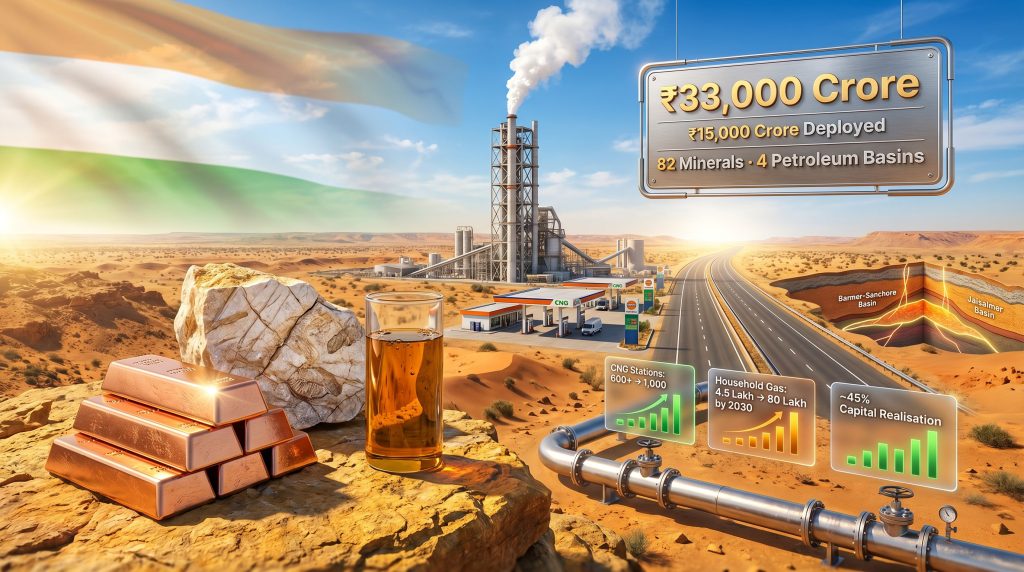
Few investment cycles in India's resource sector have moved as decisively from commitment to capital deployment as what is now unfolding across Rajasthan. Across most state-level investment summits, MoUs function as aspirational signalling devices rather than binding commitments, with conversion rates frequently falling below 30% over five-year horizons. What makes the Rajasthan mining and petroleum investment pipeline structurally different is not the headline figure of ₹33,000 crore in committed investment, but the velocity at which that capital is moving through execution stages.
With approximately ₹15,000 crore already deployed and a further ₹6,500 crore in the final stages of project completion, the state has achieved a capital realisation rate approaching 45% across its mining and petroleum MoU base, a figure that stands well above the national average for comparable state-level initiatives. Understanding why this is happening, and what it signals for the next phase of industrial development in western India, requires examining Rajasthan's geology, its policy architecture, and the specific projects now crossing the operational threshold.
When big ASX news breaks, our subscribers know first
Why Rajasthan's Geology Creates a Structurally Different Investment Case
The Aravalli-Delhi Orogenic Belt and Mineral Diversity
Most resource-rich Indian states derive their investment appeal from concentration in one or two commodity categories. Rajasthan's competitive position is built on something far more unusual: geological diversity spanning 82 identified minerals, of which 58 are under active commercial exploitation, making it the most mineralogically varied state in India by a considerable margin.
This diversity originates in the state's position within the Precambrian Aravalli-Delhi orogenic belt, one of the oldest geological formations on the subcontinent, with rock sequences dating back 2.5 to 3.0 billion years. The mineralisation processes that occurred across multiple phases of tectonic activity, volcanism, and sedimentation deposited a resource base that spans everything from copper and lead-zinc to limestone, potash, and rare earth elements. Furthermore, understanding geological logging codes is increasingly important in capturing the full value of such diverse formations during active exploration.
Key commercially significant minerals currently under exploitation include:
- Copper (Khetri-Singhana belt, one of India's primary domestic copper sources)
- Lead and zinc (Zawar and Rampura-Agucha, among the world's largest zinc deposits by reserve size)
- Limestone (high-grade deposits underpinning Rajasthan's position as India's largest cement-producing state)
- Rock phosphate (Jhamarkotra, holding approximately 90% of India's total identified rock phosphate reserves)
- Potash (emerging Nagaur-Ganganagar potash belt with estimated reserves exceeding 2.5 billion tonnes)
- Sandstone, granite, and marble (Rajasthan controls roughly 40% of India's dimensional stone production)
This commodity breadth means the investment thesis does not depend on the price trajectory of any single mineral, providing a structural diversification that single-commodity resource states cannot replicate.
Four Petroleum Basins and the Mangala Legacy
Rajasthan's petroleum sector is organised across four distinct petroliferous basins: Jaisalmer, Bikaner-Nagaur, Barmer-Sanchore, and Vindhyan. Active exploration and production operations currently span more than 21,347.65 square kilometres across 14 Petroleum Exploration License blocks and 13 Petroleum Mining Lease blocks.
The geological turning point for Rajasthan's petroleum sector arrived with the Mangala discovery in 2004, which identified waxy crude oil in Tertiary sediments of the Barmer-Sanchore Basin at a depth of approximately 800 to 1,200 metres. The Barmer-Sanchore Basin contains geological formations characterised by excellent reservoir porosity and permeability within the Fatehgarh and Thumbli formations, properties that have sustained production rates well above initial projections for more than two decades since first oil.
The Barmer Basin's reservoir characteristics bear notable similarities to prolific Middle Eastern oil-bearing formations, a geological parallel that continues to attract interest in enhanced oil recovery techniques as primary production matures.
Current production from the Mangala Development Pipeline and surrounding Barmer Basin assets contributes meaningfully to Rajasthan's position as a significant domestic crude oil producer, with the state's petroleum sector now forming the backbone of its upstream hydrocarbon investment case.
The ₹33,000 Crore Investment Pipeline: Anatomy of a Capital Stack
Breaking Down the Investment Stack by Execution Stage
The total investment commitment generated through the Rising Rajasthan initiative across mining and petroleum sectors reached ₹33,000 crore, spanning more than 300 MoUs valued at over ₹1 lakh crore across all sectors combined. Within the mining and petroleum concentration, capital has progressed through implementation stages at a pace that distinguishes this pipeline from comparable state-level commitments.
| Execution Stage | Investment Value | Implementation Status |
|---|---|---|
| Total MoU-stage pipeline | ₹33,000 crore | All implementation phases |
| Capital deployed | ₹15,000 crore | Operational or under active construction |
| Near-completion projects | ₹6,500 crore | Final execution stage |
| Commissioned projects (>₹100 crore each) | Multiple | Fully operational |
Capital Realisation Context: A 45% deployment rate against a committed pipeline base places Rajasthan's mining and petroleum MoU conversion performance significantly ahead of the national average for state investment summits, where conversion rates below 30% within two years are more typical.
Sector Composition of the Investment Portfolio
The ₹33,000 crore pipeline is not concentrated in a single commodity or infrastructure category. The portfolio spans five primary investment verticals:
- Upstream petroleum exploration covering crude oil and natural gas activity across active basin blocks
- City gas distribution and CNG infrastructure supporting the domestic piped natural gas network expansion
- Cement manufacturing at industrial scale, leveraging Rajasthan's high-grade limestone resource base
- Copper production capacity expansion at established mining and processing complexes
- Major and minor mineral projects across the broader resource extraction and processing portfolio
This sector spread reduces execution risk concentration and ensures that delays or commodity price headwinds in one category do not compromise pipeline progress across the remaining verticals. Consequently, investors assessing mining grades and permitting as part of their due diligence will find Rajasthan's multi-commodity breadth provides a more resilient base than comparable single-sector commitments.
Which Projects Are Crossing the Commissioning Threshold?
UltraTech Cement Plant: Operational and Generating Returns
The UltraTech Cement plant, developed at an investment of approximately ₹2,230 crore, has already been commissioned and is generating production output. This represents the pipeline's most advanced execution milestone and demonstrates that large-scale industrial manufacturing investments linked to Rajasthan's mineral resource base can move from MoU to full operation within the summit's implementation cycle.
For context, UltraTech Cement is India's largest cement producer by capacity, and its decision to commit capital of this scale to a Rajasthan greenfield facility reflects confidence in both the state's limestone deposit quality and its regulatory execution environment. Rajasthan accounts for approximately 15% of India's total installed cement manufacturing capacity, with the state's high-grade limestone deposits in Nagaur, Chittorgarh, and Sirohi districts providing a cost-competitive feedstock base.
Hindustan Copper Khetri Facility: Nearing Completion
The Hindustan Copper capacity expansion at Khetri represents a ₹1,000 crore investment in one of India's most historically significant copper mining and smelting complexes. The Khetri Copper Complex, operational since 1967, processes ore from the Khetri and Kolihan mines in the Khetri-Singhana copper belt of Jhunjhunu district.
This expansion is strategically significant beyond its investment quantum. India imports approximately 95% of its refined copper requirements, making domestic production expansion a structurally important priority for industrial supply chain security. The Khetri expansion directly addresses this gap by increasing domestic processing capacity within an established infrastructure footprint.
The ore grades at Khetri typically range between 0.8% and 1.4% copper, which, while lower than some high-grade global deposits, are processed through a well-optimised flotation and smelting circuit that has been refined over five decades of continuous operation.
Indian Oil Mundra Crude Oil Pipeline: Nearing Completion
The Indian Oil crude oil pipeline project from Mundra carries the largest individual investment in the near-completion category at ₹3,600 crore. This pipeline connects Gujarat's Mundra coastal terminal, which handles imported crude oil, with refining and distribution infrastructure across Rajasthan.
The strategic logic is clear: inland refining operations in Rajasthan currently face elevated logistics costs for crude supply. A dedicated pipeline from a major port terminal eliminates the cost and reliability risks associated with road and rail crude transport, directly improving the economics of downstream petroleum processing in the region. In addition, critical minerals and energy security considerations are increasingly shaping how state governments prioritise pipeline and refining infrastructure investment decisions of this kind.
Combined Near-Completion Value: The three flagship projects above account for approximately ₹6,830 crore in capital investment, broadly consistent with the state's reported ₹6,500 crore near-completion figure, confirming these as the primary drivers of imminent commissioning activity.
Rajasthan's Policy Architecture: Three Reforms Enabling Execution
The Three-Policy Reform Stack (2024-2025)
Investment execution at scale requires not just capital commitment but a regulatory environment that converts approvals into operational projects without prolonged procedural delay. Rajasthan has deployed a three-policy reform stack designed specifically to address this execution gap.
| Policy | Year | Primary Function |
|---|---|---|
| Mineral Policy 2024 | 2024 | Streamlines lease procedures, reduces regulatory friction in mining approvals |
| M-SAN Policy 2024 | 2024 | Governs mineral-based industrial activity and downstream value addition |
| CGD Policy 2025 | 2025 | Accelerates city gas distribution network rollout and CNG infrastructure investment |
The combined effect of these three instruments represents a deliberate shift in the state's approach, moving from MoU generation as the primary metric of investment attraction toward execution facilitation as the primary metric of investment success.
What These Reforms Mean in Practical Terms
For investors and analysts assessing the Rajasthan mining and petroleum investment pipeline, the policy reforms signal several concrete changes:
- Mineral lease grant and renewal timelines have been materially shortened through streamlined application procedures under Mineral Policy 2024
- The M-SAN Policy creates a structured framework for downstream industrial units to co-locate adjacent to raw material extraction sites, reducing logistics costs and improving processing economics
- CGD Policy 2025 establishes incentive structures specifically designed to attract private sector capital into last-mile gas distribution infrastructure, a segment that has historically struggled to attract investment due to long payback periods
- A structured Rajasthan Petro Zone initiative provides a designated development cluster for downstream petrochemical processing units positioned near existing petroleum infrastructure, creating integrated industrial corridor potential
The Additional Chief Secretary for Mines and Petroleum, Aparna Arora, has maintained that continuous coordination between government officials and investors is essential to maintaining execution timelines, particularly for projects exceeding ₹100 crore in scale where regulatory interface points multiply. The Rajasthan Mines and Petroleum Department provides ongoing guidance on regulatory processes that directly affect investment timelines across the state's resource sectors.
The Gas Distribution Build-Out: Ambition at an Unprecedented Scale
Current Metrics vs. 2030 Targets
Perhaps the most ambitious component of Rajasthan's resource sector transformation is its city gas distribution expansion programme. The targets set against current network parameters represent expansion at a scale rarely attempted at state level in India.
| Metric | Current Position | 2030 Target | Expansion Multiple |
|---|---|---|---|
| Household pipeline gas connections | ~4.5 lakh | 80 lakh | ~17.8x |
| Operational CNG stations | 600+ | 1,000 | ~1.67x |
| Geographic coverage | Select urban centres | State-wide | Significant expansion |
The 17.8x expansion required in household gas connections by 2030 compresses what would typically be a decade-long infrastructure build into a four-year execution window. This demands not just regulatory consistency and capital availability, but parallel progress across pipeline laying, equipment procurement, workforce training, and consumer activation.
Infrastructure Enabling the Gas Network
The gas distribution expansion builds on existing petroleum transportation infrastructure:
- The Mangala Development Pipeline carries crude oil from the Barmer Basin toward Gujarat, providing the primary logistics backbone for Rajasthan's upstream petroleum sector
- The Langtala to Ramgarh gas pipeline supports regional gas supply distribution across western Rajasthan's major consumption centres
- CGD Policy 2025 is specifically designed to accelerate private sector participation in last-mile distribution, where the economics of network investment depend critically on connection density and tariff certainty
Scale Context: Achieving 80 lakh household pipeline gas connections by 2030 would position Rajasthan among the top three states in India by gas distribution reach, representing a transformative shift in domestic energy access for a state where LPG cylinders currently dominate household cooking fuel consumption.
The next major ASX story will hit our subscribers first
AI and Machine Learning Enter India's State-Level Mineral Exploration
Technology-Driven Exploration: A Competitive Differentiator
One of the least-discussed but potentially most consequential elements of Rajasthan's resource development strategy is its adoption of artificial intelligence and machine learning-based geological exploration, developed in partnership with IIT-Hyderabad and IIT-ISM Dhanbad. The broader role of AI in mineral exploration is rapidly evolving, and Rajasthan's institutional partnerships place it at the forefront of this shift within India's state mining sector.
This represents a significant departure from conventional state mining department exploration methodologies, which have historically relied on ground-based geological mapping, basic geochemical surveys, and 2D seismic interpretation. The AI/ML approach integrates multiple data streams including:
- Hyperspectral remote sensing data from satellite and airborne platforms
- Historical drill core data and geochemical assay records
- Geophysical survey outputs including gravity, magnetic, and electromagnetic measurements
- Regional structural geology interpretations
The AI models process these datasets simultaneously to identify subsurface mineralisation probability zones, reducing the area requiring physical exploration drilling by prioritising the highest-probability targets. This materially reduces exploration cost and time-to-discovery, two variables that have historically deterred private capital from early-stage mineral projects in India.
Mineral Dump Commercialisation: Unlocking Stranded Value
Beyond primary exploration, Rajasthan is also pursuing commercialisation of mineral dumps, a technically sophisticated initiative that addresses an often-overlooked opportunity in mature mining districts.
Mineral dumps are stockpiles of previously mined rock that was uneconomic to process at the time of extraction due to low grade or the absence of appropriate processing technology. As processing technology has improved and commodity prices have shifted, many of these dumps now contain sufficient mineral content to justify reprocessing. The Khetri copper district, the Zawar lead-zinc mines, and the Udaipur mineral processing corridor all contain significant historical dump material.
Quantifying and commercialising these resources requires detailed sampling, metallurgical testing to establish process recoveries, and economic modelling to determine viability at current metal prices. Furthermore, advances in direct extraction technologies are increasingly influencing how previously marginal mineral stockpiles are being reassessed for commercial potential. The state government's initiative to systematically catalogue and tender these resources adds an incremental supply layer to the investment pipeline without requiring new greenfield exploration expenditure.
Economic Multipliers: Employment, Revenue, and Industrial Activation
The Downstream Effects of Capital Deployment
The ₹33,000 crore Rajasthan mining and petroleum investment pipeline generates economic value across several distinct channels beyond the direct capital expenditure itself:
- Employment generation during both construction and operational phases, with large-scale projects like the Mundra pipeline and Khetri expansion creating significant skilled and semi-skilled labour demand across engineering, construction, logistics, and maintenance functions
- State revenue contribution through royalties, cess payments, and associated taxation that scales directly with production volumes once projects reach commissioning
- Supply chain activation creating demand for ancillary services including equipment maintenance, chemical supply, transport logistics, and technical services across mining districts
- Industrial clustering effects through the Rajasthan Petro Zone concept, where downstream processing units positioned adjacent to upstream petroleum infrastructure reduce feedstock logistics costs and create integrated value chains
Secretariat-Level Coordination as an Execution Tool
The state government has institutionalised a project-level review mechanism at Secretariat level, with the Additional Chief Secretary for Mines and Petroleum conducting regular progress assessments with investors to identify and resolve implementation bottlenecks. This direct government-investor interface is particularly valuable for projects exceeding ₹100 crore, where regulatory approvals span multiple departments and infrastructure interface points introduce coordination complexity that standard project management cannot resolve unilaterally.
Rajasthan Compared: How Does This Pipeline Stack Up Against Other Indian States?
| Dimension | Rajasthan | Competitive Context |
|---|---|---|
| Mineral diversity | 82 minerals (58 commercially exploited) | Highest diversity in India |
| Petroleum basin count | 4 active basins | Comparable to Gujarat and Assam |
| CGD expansion ambition | 80 lakh connections by 2030 | Among the most aggressive state targets |
| Pipeline realisation rate | ~45% (₹15,000 cr of ₹33,000 cr) | Well above average for state summits |
| Technology adoption in exploration | AI/ML with IIT partnerships | Ahead of most state mining departments |
| Rock phosphate reserves | ~90% of national identified reserves | Near-monopoly position |
| Potash potential | Nagaur-Ganganagar belt | Estimated 2.5 billion tonne resource |
The comparison highlights that Rajasthan's advantage is multidimensional. States like Odisha and Jharkhand hold significant iron ore and coal reserves, but their commodity concentration creates sensitivity to specific price cycles. Rajasthan's breadth across industrial minerals, energy minerals, and petroleum provides a structurally diversified investment base that is considerably more resilient across commodity cycles.
Frequently Asked Questions: Rajasthan Mining and Petroleum Investment Pipeline
What is the total value of Rajasthan's mining and petroleum investment pipeline?
The total investment commitment across mining and petroleum sectors reaches ₹33,000 crore, originating from MoUs generated at the Rising Rajasthan investment summit. Of this committed capital, approximately ₹15,000 crore has already been deployed across operational and under-construction projects.
Which projects are closest to completion in Rajasthan's mining and petroleum pipeline?
Three major projects anchor the near-completion category: the UltraTech Cement plant (₹2,230 crore, already operational), the Hindustan Copper Khetri expansion (₹1,000 crore, nearing completion), and the Indian Oil Mundra crude oil pipeline (₹3,600 crore, nearing completion). Multiple additional projects exceeding ₹100 crore have already been commissioned.
What minerals does Rajasthan produce?
Rajasthan contains 82 identified minerals, with 58 under commercial exploitation, making it India's most mineralogically diverse state. Key commodities include copper, lead, zinc, limestone, rock phosphate, potash, sandstone, marble, and a broad range of industrial minerals.
What are Rajasthan's petroleum basins?
The state's four petroliferous basins are Jaisalmer, Bikaner-Nagaur, Barmer-Sanchore, and Vindhyan. Active exploration and production operations cover more than 21,347 square kilometres across 14 PEL blocks and 13 PML blocks.
What is the Rajasthan Petro Zone?
The Rajasthan Petro Zone is a development initiative designed to attract downstream petrochemical processing units by positioning them near existing petroleum production and transportation infrastructure, creating integrated industrial clusters with reduced feedstock logistics costs.
What is Rajasthan's CNG and household gas expansion target?
The state aims to scale household pipeline gas connections from approximately 4.5 lakh currently to 80 lakh by 2030, representing a 17.8x expansion, while growing operational CNG stations from 600+ to 1,000 within four to five years.
Execution Risks and Structural Challenges
Where the Pipeline Faces Headwinds
No investment pipeline of this scale operates without material execution risks. Investors and analysts assessing the Rajasthan mining and petroleum investment pipeline should be aware of the following structural challenges:
- Land acquisition and environmental clearance timelines remain the most frequent source of project delay in India's resource sector, particularly in areas where mining operations intersect with agricultural land or ecologically sensitive zones
- Lease utilisation gaps represent an acknowledged challenge, with some committed investments facing on-ground activation difficulties due to access constraints, infrastructure gaps, or organisational bottlenecks
- The 17.8x expansion required in household gas connections by 2030 demands continuous private sector capital commitment and regulatory consistency across a compressed execution window, where slippage in any single year compounds the challenge
- Coordination complexity increases non-linearly as the number of concurrently active projects scales; secretariat-level reviews provide valuable oversight but cannot substitute for project-specific execution management across remote or multi-jurisdiction areas
- Commodity price sensitivity directly affects the economics of mining investments, particularly for copper and industrial minerals where global price cycles influence both investment decisions and production economics across multi-year project horizons
- Water availability in Rajasthan's arid geography poses operational constraints for mineral processing facilities that typically require significant volumes for flotation circuits and dust suppression
Disclaimer: The observations above represent structural risk factors for consideration and should not be interpreted as investment advice. Investors should conduct independent due diligence before making any investment decisions related to projects discussed in this article.
Forward Outlook: What the Next Phase Could Deliver
Near-Term Catalysts (12-24 Months)
- Commissioning of the Indian Oil Mundra crude pipeline will provide a measurable logistics cost improvement for Rajasthan's inland petroleum processing sector, with operational data quantifying the economic benefit for the first time
- Hindustan Copper Khetri expansion reaching full production will add incremental domestic copper supply at a time when India's copper deficit remains structurally significant
- Multiple projects within the ₹15,000 crore deployed category transitioning to full production will generate concrete employment and revenue data that validates the pipeline's broader economic multiplier thesis
- CGD Policy 2025 implementation will determine the pace of private sector entry into gas distribution infrastructure, with the first 12 months of policy operation serving as the critical test of regulatory and financial incentive adequacy
Medium-Term Structural Shifts (2-5 Years)
- AI/ML-assisted exploration results from IIT-Hyderabad and IIT-ISM Dhanbad partnerships could identify new mineral discovery zones across the Aravalli belt and Precambrian sequences, potentially expanding the investable resource base beyond currently documented deposits
- Rajasthan Petro Zone development, if successfully populated with downstream processing units, could catalyse a petrochemical manufacturing cluster generating multiplier effects across chemicals, polymers, and energy sectors well beyond the petroleum extraction phase
- Achieving 40 to 50% of the 80 lakh household gas connection target would represent a transformative shift in Rajasthan's domestic energy consumption profile, reducing reliance on LPG cylinders and creating a sustained demand base for gas distribution infrastructure investment
- The potash mineralisation potential of the Nagaur-Ganganagar belt, currently in early-stage evaluation, could emerge as a strategically significant resource in the context of India's near-total import dependence for potash fertiliser, adding a fourth major commodity dimension to the state's investment narrative
The trajectory of the Rajasthan mining and petroleum investment pipeline over the next five years will ultimately be determined not by the scale of initial commitments, but by the consistency of execution across projects at every stage of the capital stack. The 45% deployment rate achieved to date provides a meaningful foundation. Whether that foundation translates into a transformative shift in the state's industrial and energy profile depends on sustained coordination between government, investors, and the infrastructure networks connecting them.
Readers seeking to track ongoing developments in India's state-level resource investment activity may find related reporting at ET EnergyWorld useful for monitoring project-specific updates across the Rajasthan mining and petroleum investment pipeline.
Want to Track the Next Major Mineral Discovery Before the Market Does?
Discovery Alert's proprietary Discovery IQ model delivers real-time alerts on significant ASX mineral discoveries, instantly transforming complex mineral data into actionable investment insights for both short-term traders and long-term investors — explore historic examples of exceptional discovery returns to understand the opportunity, then begin your 14-day free trial at Discovery Alert to position yourself ahead of the broader market.