June 8, 2026
Understanding the Geopolitical Risk Premium: What Iran-Israel Escalation Sends Oil Above US$95 Actually Means for Markets
Every decade or so, commodity markets receive a violent reminder that energy pricing is never purely a function of supply and demand. Embedded within every barrel of crude traded on global exchanges is an invisible tax, one paid not by producers or consumers, but by every participant in the financial system simultaneously. That tax is the geopolitical risk premium, and when the Iran-Israel escalation sends oil above US$95, the critical question for investors is not whether the move is real, but whether it is durable.
Understanding the architecture of this risk premium — how it forms, what sustains it, and crucially what collapses it — is the analytical foundation that separates reactive trading from deliberate positioning.
When big ASX news breaks, our subscribers know first
Fear-Driven Pricing vs. Demand-Driven Pricing: Why the Distinction Changes Everything
When crude oil prices rise because global economic activity is accelerating, the move reflects genuine consumption growth. Industrial output expands, freight volumes climb, and airlines fill more seats. That kind of price rise has earnings breadth behind it, lifting sectors well beyond energy alone.
Fear-driven oil spikes operate through an entirely different mechanism. Brent crude surging approximately 5% to around US$97.60 per barrel, while WTI simultaneously crossed above US$93, was not a signal that the world was suddenly consuming more oil. It was a collective insurance premium, paid by global markets against the tail risk of supply disruption. The trigger was Iran's direct ballistic missile strike on Israel — its first such attack since a ceasefire was reached in April — followed by Israeli retaliatory strikes with explosions reported across Tehran, Tabriz, and Isfahan.
Fear-based oil spikes share several historical characteristics that investors should internalise:
- They tend to be rapid in formation but uneven in duration
- They are highly sensitive to diplomatic signalling, often reversing sharply on ceasefire language
- They create sector bifurcation, producing simultaneous winners and losers within the same market
- They frequently embed a "phantom barrel" premium, pricing in supply disruption that never materialises
This final characteristic is what makes the current move so analytically complex. The world's physical oil supply has not yet been interrupted. However, markets are pricing the probability that it could be.
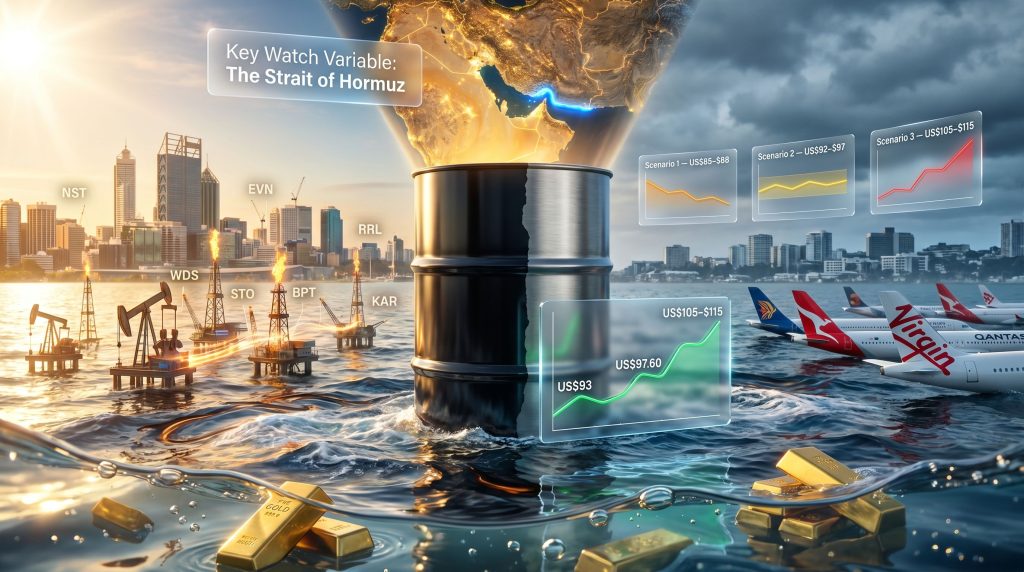
Key Watch Variable: The Strait of Hormuz is the single most consequential geopolitical indicator for oil price sustainability in this conflict cycle. Any credible threat to shipping access through this corridor would fundamentally alter the duration and magnitude of the current price move.
The Strait of Hormuz: The Chokepoint That Controls the Global Energy System
To understand why the Iran-Israel escalation sends oil above US$95 with such immediacy, it is essential to understand the physical geography underpinning the fear. The Strait of Hormuz — the narrow waterway between Iran and Oman — carries approximately 20% of the world's traded oil and an even higher proportion of global liquefied natural gas (LNG) exports. Consequently, there is no alternative pipeline or shipping route capable of absorbing that volume.
Furthermore, the oil market impacts from this escalation operate through two conditional scenarios that now govern the oil price trajectory:
Scenario A — Hormuz Remains Open: The geopolitical risk premium gradually compresses as diplomatic channels operate and physical supply flows remain uninterrupted. Oil retreats toward pre-escalation levels, and the current price spike is retrospectively classified as a transient fear trade.
Scenario B — Hormuz Access Is Threatened: The price floor for crude shifts materially higher, potentially into territory not seen since 2022's post-invasion spike. This is not a marginal adjustment. It represents a structural supply shock that would reverberate through inflation data, central bank policy, and equity valuations globally.
Iran has historically used the Strait of Hormuz as leverage in geopolitical standoffs, having threatened closure during previous periods of maximum pressure. Whether that leverage is exercised in this cycle depends on escalation dynamics that no market participant can predict with precision.
How the ASX Is Structurally Split by a Geopolitical Oil Shock
The defining feature of a fear-driven oil shock is the way it cleaves equity markets into two structurally distinct camps. Unlike broad macro events that lift or depress nearly all sectors uniformly, an oil spike creates genuine winners and genuine losers operating in opposite directions simultaneously.
For Australian investors, this bifurcation is particularly pronounced because the ASX commodity pressure is felt across meaningful exposure to both commodity producers who benefit from higher prices and cost-sensitive sectors that absorb the damage.
| ASX Sector | Directional Impact | Key Driver | Durability of Move |
|---|---|---|---|
| Oil & Gas Producers | Strongly Positive | Higher realised commodity prices | Conditional on conflict duration |
| Defence Technology | Positive | Escalation narrative, procurement thesis | Medium-term structural |
| Gold Producers | Mixed / Conditionally Positive | Safe-haven demand vs. rate expectations | Highly variable |
| Airlines & Transport | Negative | Jet fuel cost inflation | Immediate and direct |
| Rate-Sensitive Sectors | Negative | Inflation re-acceleration risk | Policy-dependent |
| Broader ASX 200 | Net Negative | Risk-off sentiment, Wall Street lead | Short-to-medium term |
Adding a further complication for Australian investors is the timing asymmetry created by the King's Birthday public holiday. With the ASX closed on Monday, Tuesday's open must simultaneously absorb the weekend's geopolitical developments and the residual weight of the prior Friday's 0.7% decline. Compressed reaction windows of this kind tend to amplify market volatility in both directions, as participants attempt to reprice multiple layers of news within a single session.
Three Scenario Pathways: Mapping Where Oil Goes From Here
Rather than committing to a single directional view, a scenario-conditional framework provides a more robust analytical structure for navigating the current environment.
Scenario 1: Rapid De-escalation and Ceasefire Restoration
If diplomatic channels produce credible ceasefire signals and no further military exchanges occur, the geopolitical risk premium deflates rapidly. Historical precedent from the April 2024 Iran-Israel exchange suggests Brent could retreat toward the US$85 to US$88 range as the fear trade unwinds. Energy stocks surrender a portion of their gains, airlines and rate-sensitive names recover, and gold loses its safe-haven support.
Scenario 2: Sustained Conflict Without Hormuz Disruption
A prolonged conflict that remains contained within the existing geographic and tactical boundaries maintains an elevated but range-bound oil premium. Brent consolidates in the US$92 to US$97 corridor, providing sustained earnings uplift for oil and gas producers across multiple quarters. In addition, inflation re-acceleration becomes a live concern for the Reserve Bank of Australia.
Scenario 3: Hormuz Access Disruption or Significant Escalation
If conflict escalates to the point of threatening maritime traffic through the Strait of Hormuz, oil price mechanics shift from fear-based to supply-shock-based — a fundamentally different and far more durable dynamic. Under this scenario, Brent could move toward the US$105 to US$115 range, stagflationary pressures emerge across developed economies, and central banks face the most difficult policy environment since 2022.
Analytical Note: Investors should size positions and calibrate monitoring triggers around which scenario is unfolding in real time, rather than making binary directional bets. The Strait of Hormuz status and ceasefire signal credibility are the two primary leading indicators that determine scenario transitions.
ASX Energy Stocks: Understanding Revenue Leverage in an Oil Spike
The mechanism through which higher crude prices translate into ASX energy stock outperformance is more nuanced than simple correlation. Oil and gas producers generate revenue as a function of production volume multiplied by the realised commodity price. When crude prices move significantly higher, that revenue uplift flows directly to earnings before any operating cost increase, creating powerful operating leverage.
The key distinction within the ASX energy sector lies between large integrated producers and smaller pure-play operators:
- Large integrated producers such as Woodside Energy (ASX: WDS) and Santos (ASX: STO) have diversified revenue streams, active hedging programmes, and long-term LNG contracts that dampen their sensitivity to spot crude price movements. Their earnings uplift from a fear-driven spike is real but moderated.
- Pure-play operators such as Beach Energy (ASX: BPT) and Karoon Energy (ASX: KAR) have revenue streams far more directly correlated to spot benchmarks. Their earnings are less insulated by contract structures or downstream diversification, meaning they exhibit higher beta to crude price movements in both directions.
This creates a spectrum of risk-return profiles within a single sector. During a geopolitical spike, pure-play producers typically generate the largest share price moves, but they also carry the greatest exposure to a rapid reversal if the risk premium deflates.
A further consideration is the "fear premium decay" dynamic observable across historical geopolitical oil cycles. When physical supply is not actually disrupted, the phantom barrel premium tends to mean-revert as the immediacy of the threat diminishes — often within days to weeks of the initial spike. The oil price rally observed in prior geopolitical cycles reinforces this point. Investors positioned in energy stocks should therefore distinguish between a tactical momentum trade and a structural re-rating, which requires conflict to persist long enough to materially alter production outlooks or forward contract pricing.
The next major ASX story will hit our subscribers first
The Defence Sector: Separating Sentiment from Structural Demand
Counter-drone and advanced weapons technology companies represent the other clear beneficiary segment within the current escalation context. The operational use of ballistic missiles and the demonstrated effectiveness of drone-based systems in recent Middle East engagements has reinforced the procurement case for counter-drone and directed-energy defence technologies globally.
ASX-listed names including DroneShield (ASX: DRO) and Electro Optic Systems (ASX: EOS) operate within this thematic. The important analytical distinction is between the immediate sentiment-driven price reaction and the longer-term fundamentals case.
Defence technology stocks can sustain gains even after geopolitical tensions ease, but only when they have confirmed order pipelines, government contract visibility, and demonstrated export market traction. Without those fundamentals anchors, the initial sentiment spike tends to fade alongside the geopolitical headlines.
Investors evaluating defence sector exposure should examine:
- Order backlog depth and the proportion of confirmed versus pipeline contracts
- Contract duration and the extent to which revenue is locked in versus discretionary
- Export market exposure and the diversification of the customer base beyond domestic procurement
Gold's Conflicted Position: Two Forces Pulling in Opposite Directions
Gold's response to the Iran-Israel escalation is not the straightforward safe-haven play that surface-level analysis might suggest. The metal faces two competing forces that operate simultaneously, creating a genuinely non-linear outcome.
Force 1: Safe-Haven Demand. Geopolitical uncertainty historically drives capital toward gold as a store of value and portfolio hedge. Furthermore, gold safe-haven demand having declined approximately 4% in the week prior to the escalation means the metal entered the conflict with meaningful technical downside momentum already in place, providing a natural rebound catalyst.
Force 2: The Inflation and Rate Expectations Headwind. Higher oil prices feed directly into headline inflation metrics. Elevated inflation reduces the probability of near-term Federal Reserve rate cuts, which in turn increases the opportunity cost of holding gold — a non-yielding asset. This is the structural ceiling that complicates gold's upside during oil shocks.
The net outcome depends on which force dominates:
- If safe-haven demand outpaces the rate headwind, gold producers including Northern Star Resources (ASX: NST), Evolution Mining (ASX: EVN), and Regis Resources (ASX: RRL) see meaningful earnings uplift.
- If inflation expectations dominate and the Federal Reserve signals a "higher-for-longer" posture, gold's safe-haven rally remains capped.
Within the ASX gold producer universe, the companies that capture the most earnings leverage from any gold price move are those with low all-in sustaining costs (AISC) and minimal hedging ratios. Unhedged producers with AISC profiles well below the spot gold price benefit disproportionately from price elevation, while heavily hedged books limit both upside and downside exposure.
The Inflation Transmission Pathway and What It Means for the RBA
The connection between crude oil prices and Australian consumer inflation operates through a multi-stage transmission mechanism that investors in rate-sensitive sectors need to understand clearly:
- Crude price increase generates higher wholesale petroleum costs at the refinery gate
- Wholesale fuel cost increases flow into transport and logistics pricing across supply chains
- Higher transport costs embed themselves into goods pricing at the retail level
- Broader goods price inflation feeds into the Consumer Price Index, putting upward pressure on headline and core inflation measures
This transmission is neither immediate nor uniform, but at an oil price level of approximately US$95 sustained over several months, the inflationary signal becomes sufficiently material to influence central bank thinking. Indeed, rising oil prices from this conflict could slow global growth and delay rate cuts, adding further complexity for the RBA.
The RBA enters this period with its cash rate already at 4.35% following three hikes in the current cycle — the most recent delivered in May — with the next decision meeting scheduled for 15 to 16 June. The policy dilemma is structurally challenging: supply-side inflation driven by an oil shock is not effectively addressed through rate hikes, yet persistent inflation prevents the rate cuts that would relieve pressure on mortgage holders and rate-sensitive sectors.
This stagflationary trap dynamic creates particular pressure for ASX real estate investment trusts (REITs), infrastructure stocks, and growth-oriented technology companies — all of which carry elevated sensitivity to interest rate expectations. Airlines represent the most direct and immediate casualty, with jet fuel comprising a substantial portion of total operating costs for carriers such as Qantas (ASX: QAN). Fuel hedging programmes provide partial protection but cannot fully absorb sustained crude price elevation beyond hedged volumes and timeframes.
Portfolio Positioning Framework: Scenario-Conditional Decision Architecture
| Investment Thesis | Scenario Dependency | Primary Risk Factor |
|---|---|---|
| Overweight ASX energy producers | Scenarios 2 and 3 | Rapid ceasefire deflates gains quickly |
| Tactical defence technology exposure | All scenarios, varying magnitude | Sentiment reversal on de-escalation |
| Conditional gold producer exposure | Scenario 3 primarily | Rate headwind limits upside in Scenarios 1 and 2 |
| Underweight airlines and transport | All scenarios | Fuel cost relief only materialises in Scenario 1 |
| Reduce rate-sensitive sector exposure | Scenarios 2 and 3 | RBA policy response adds uncertainty |
Geopolitical trades carry asymmetric risk profiles that demand disciplined position sizing. The upside from an energy or defence spike can be compelling, but the reversal when fear premiums deflate is frequently swift and disorderly, leaving investors who over-concentrated at peak sentiment with significant drawdown exposure.
The two primary monitoring triggers that should drive position reassessment are:
- Strait of Hormuz shipping status: Confirmed disruption escalates the trade decisively; confirmed safety provides the fastest pathway to premium deflation
- Ceasefire signal credibility: Substantive diplomatic progress is historically the most powerful deflator of geopolitical risk premiums in oil markets
Frequently Asked Questions
Why did oil prices surge above US$95 following the Iran-Israel escalation?
The price move reflects a geopolitical risk premium embedded by markets in response to direct military exchanges between Iran and Israel. Brent crude rose approximately 5% to around US$97.60, while WTI crossed above US$93. The spike represents precautionary pricing for potential disruption to Middle Eastern oil supply, particularly through the Strait of Hormuz, rather than a change in underlying consumption levels.
How does oil above US$95 affect Australian inflation?
Higher crude prices feed into wholesale fuel costs, which then propagate through transport and logistics networks into broader goods pricing, ultimately lifting the Australian CPI. With the RBA's cash rate at 4.35% and the June 15 to 16 meeting approaching, sustained oil prices at this level complicate the path toward rate cuts by maintaining upward pressure on inflation.
Which ASX sectors benefit most from sharply higher oil prices?
- Oil and gas producers with direct spot price exposure, particularly pure-play operators
- Defence technology companies leveraged to escalation-driven procurement cycles
- Gold producers, conditionally, if safe-haven demand outweighs the interest rate headwind
Which ASX sectors face the most pressure?
- Airlines and transport companies absorbing direct fuel cost inflation
- Rate-sensitive sectors including REITs, infrastructure, and growth technology
- The broader ASX 200 through risk-off sentiment and negative Wall Street lead-through
How long do geopolitical oil price spikes typically last?
Historical precedent suggests most geopolitical risk premiums mean-revert within weeks to a few months when physical supply is not actually disrupted. The April 2024 Iran-Israel exchange produced a spike that largely unwound within approximately two weeks once it became clear that supply flows remained intact. Premium duration extends materially only when conflict produces tangible supply consequences.
What is the Strait of Hormuz and why does it matter for oil prices?
The Strait of Hormuz is a narrow waterway between Iran and Oman through which approximately 20% of the world's seaborne oil trade passes. It is the most concentrated single chokepoint in global energy logistics, with no viable alternative routing for equivalent volumes. Any credible threat to transit through the strait immediately reprices oil higher, making it the primary geopolitical monitoring variable in the current conflict cycle.
Separating a Durable Rally From a Fleeting Spike
The core analytical insight that should guide ASX investors through this period is deceptively simple: the Iran-Israel escalation sends oil above US$95 through fear, not through a genuine change in the global supply-demand balance. That distinction determines everything about how investors should engage with the resulting market moves.
Fear-driven premiums produce real and tradeable price moves. The gains in energy and defence names that follow geopolitical escalation are not illusory. However, they are conditional in a way that demand-driven price moves are not. A ceasefire, a diplomatic statement, or a credible signal that the Strait of Hormuz will remain open can deflate the premium within hours.
The conditions under which the current move becomes a structural re-rating rather than a tactical spike are specific and demanding: sustained conflict that materially elevates insurance costs for Middle Eastern oil logistics, confirmed disruption to production or transit, or a prolonged period during which supply uncertainty embeds itself into forward pricing curves. Absent those conditions, the historical pattern points toward premium compression as the dominant medium-term outcome.
Investors who size positions to reflect this uncertainty — rather than committing to a single scenario with high conviction — are better positioned to capture the upside while managing the considerable downside risk embedded in a trade built primarily on geopolitical anxiety.
This article is intended for general informational purposes only and does not constitute financial advice. Past market behaviour during geopolitical events does not guarantee future outcomes. Investors should conduct their own independent research and consider seeking professional financial advice before making investment decisions.
Want to Stay Ahead of the Next Major ASX Mineral Discovery?
While geopolitical risk premiums reshape commodity markets, Discovery Alert's proprietary Discovery IQ model scans ASX announcements in real time, instantly identifying significant mineral discoveries across more than 30 commodities — delivering actionable insights to subscribers before the broader market reacts. Explore historic discovery returns on Discovery Alert's discoveries page and begin your 14-day free trial to position yourself ahead of the market.