July 17, 2026
The Enrichment Gap America Can No Longer Ignore
For decades, the United States quietly offshored one of the most strategically sensitive steps in the nuclear fuel cycle: uranium enrichment. What began as a post-Cold War rationalisation of industrial capacity gradually became a structural vulnerability. Today, with electricity demand surging from data centre expansion, decarbonisation mandates tightening, and geopolitical fault lines sharpening, that vulnerability has moved to the centre of U.S. energy security discussions. The Orano Project Ike enrichment facility, planned for a site near Oak Ridge, Tennessee, represents one of the most consequential responses to that vulnerability in a generation.
Understanding why Project Ike matters requires stepping back from the project itself and looking at the fuel cycle architecture it is designed to fix.
When big ASX news breaks, our subscribers know first
Why the U.S. Enrichment Gap Is a National Security Problem
Uranium enrichment sits at a critical juncture in the nuclear fuel chain, positioned between the conversion of mined uranium into uranium hexafluoride (UF₆) and the fabrication of finished fuel assemblies for reactors. Without sufficient domestic enrichment capacity, even a robust upstream mining and conversion sector cannot independently fuel the existing U.S. reactor fleet.
That is precisely the situation the United States currently faces. Over roughly three decades, domestic enrichment infrastructure contracted sharply as utilities shifted to cheaper foreign providers, many of them state-subsidised operators in Europe and Russia. The geopolitical risks embedded in that dependency were largely theoretical until sanctions regimes, supply chain shocks, and rising strategic competition with Russia made them acutely practical. Legislative actions, including the US ban on Russian uranium, have since accelerated the urgency of rebuilding domestic capacity.
The demand picture compounds the supply problem. Nuclear power is experiencing a structural renaissance driven by:
- Hyperscale technology companies seeking firm, carbon-free electricity for AI and data infrastructure
- National decarbonisation commitments requiring dispatchable, low-emission baseload power
- A wave of advanced reactor designs entering the licensing pipeline, many requiring specialised fuel grades
- Policy momentum at both federal and state levels favouring domestic nuclear fuel cycle investment
Against this backdrop, the Orano Project Ike enrichment facility is not simply one industrial project. It is a targeted intervention in a supply chain that currently lacks the domestic depth to meet projected demand.
Project Ike: Site, Scale, and Technical Architecture
The Oak Ridge Location and Its Historical Significance
The planned facility sits on approximately 624 acres near Oak Ridge, Tennessee, on land formerly classified as Department of Energy Self-Sufficiency Parcel 2 (SSP-2). The site was recently transferred from the DOE to Oak Ridge's Industrial Development Board, making it available for commercial industrial development. The East Tennessee Technology Park corridor, within which this parcel sits, traces its origins directly to the Manhattan Project and the earliest industrial-scale uranium enrichment operations in American history.
Returning enrichment activity to this corridor carries both practical and symbolic weight. The existing regional workforce, infrastructure, and institutional knowledge base in Oak Ridge represent genuine enabling assets. This is not a greenfield site in an unfamiliar industrial landscape. It is the cradle of American enrichment, being repurposed for a new chapter in U.S. nuclear reindustrialisation.
Facility Specifications at a Glance
| Specification | Detail |
|---|---|
| Total Facility Size | ~750,000 square feet |
| Site Area | ~624 acres |
| Enrichment Technology | Gas centrifuge |
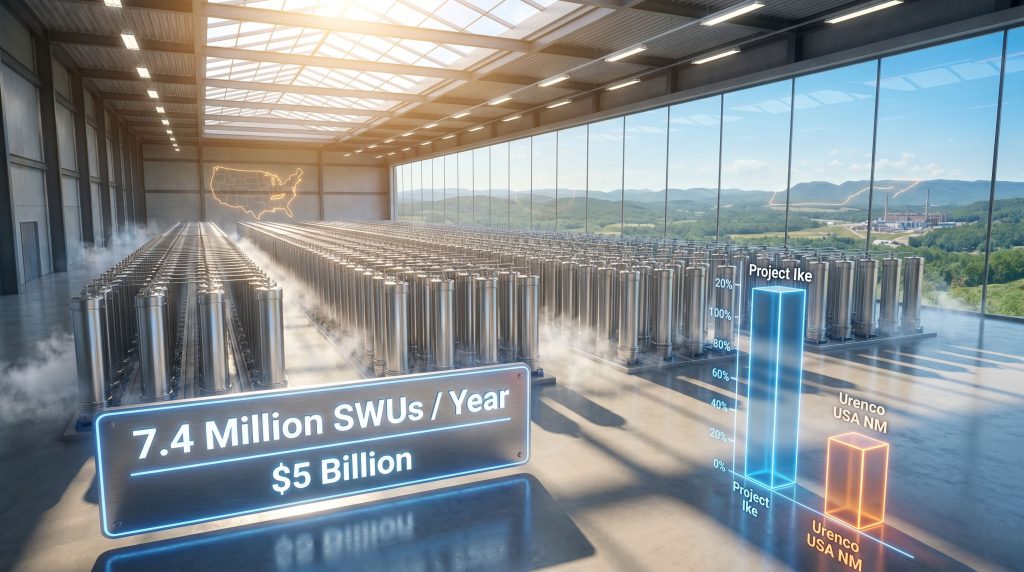
| Annual Production Capacity | ~7.4 million SWUs/year |
| Maximum Enrichment Level | Up to 10% uranium-235 (LEU) |
| Estimated Total Project Cost | $5 billion |
| DOE Financial Award | $900 million |
| Additional State Support | Tennessee Nuclear Energy Fund |
| Target Operational Start | Early 2030s (subject to licensing) |
| Construction-Phase Jobs | 1,000+ |
| Permanent Operational Roles | ~300 |
How Gas Centrifuge Enrichment Works
Natural uranium consists predominantly of uranium-238, with only about 0.7% of the fissile isotope uranium-235. Reactor fuel typically requires uranium-235 concentrations between 3% and 5% for conventional light-water reactors, and up to 20% for certain advanced designs — the threshold below which material is classified as low-enriched uranium, or LEU.
Gas centrifuge technology achieves isotopic separation by spinning UF₆ gas at extremely high rotational speeds. The heavier U-238 molecules migrate toward the outer wall of the centrifuge, while the lighter U-235 molecules concentrate toward the centre. Cascades of thousands of centrifuges working in sequence progressively raise the U-235 concentration to the desired assay level.
The standard industry metric for enrichment output is the separative work unit (SWU). One SWU quantifies the amount of separation work required to produce a given quantity of enriched uranium at a specified assay. At 7.4 million SWUs per year, Project Ike would rank among the largest enrichment operations in North America, with the capacity to supply fuel for a substantial portion of the U.S. commercial reactor fleet.
A single 1,000 MWe light-water reactor typically requires between 100,000 and 150,000 SWUs per year of enrichment services. At 7.4 million SWUs annually, Project Ike's output could theoretically fuel roughly 50 to 70 conventional reactors, depending on fuel specifications and reload cycles.
Project Ike's design ceiling of 10% U-235 is strategically significant. It covers standard LEU for conventional reactors while also reaching the lower boundary of what the industry classifies as high-assay low-enriched uranium (HALEU) territory. HALEU is required for many next-generation reactor designs currently in development, and domestic HALEU production capacity is presently extremely limited. This positions the Orano Project Ike enrichment facility as relevant not only to today's fleet but to the advanced reactor pipeline being built for the 2030s and beyond.
Navigating the NRC Regulatory Process
From Application to Environmental Review
Orano submitted its formal license application to the Nuclear Regulatory Commission in March 2026. The NRC responded in May 2026 by announcing an accelerated 12-month review schedule, an unusually compressed timeline for a facility of this scale and complexity.
On June 11, 2026, the NRC published its Notice of Intent in the Federal Register (Docket ID NRC-2026-2906), formally opening the Environmental Impact Statement scoping process. Public written comments are accepted until July 13, 2026, via the federal rulemaking portal at regulations.gov.
The EIS Process: Step by Step
The Environmental Impact Statement is a federal requirement under the National Environmental Policy Act (NEPA) for major infrastructure projects. It assesses the full range of potential environmental consequences associated with constructing and operating the facility, including ecological impacts, water use, radiation exposure modelling, waste management, land use changes, and air quality effects.
For Project Ike, the NRC's EIS will be prepared in cooperation with the DOE's Oak Ridge Office of Environmental Management. The process follows this structured sequence:
- Notice of Intent Published — Federal Register notice opens the formal scoping window (June 11, 2026)
- Public Scoping Period — Written comments identify significant environmental issues for in-depth analysis (deadline: July 13, 2026)
- Scoping Summary Compiled — NRC consolidates input to define the boundaries and focus of the full EIS
- Draft EIS Prepared — Full environmental analysis drafted, incorporating scoping comments and DOE Oak Ridge OEM input
- Draft EIS Public Comment Period — Second round of public review; dates to be announced via Federal Register
- Final EIS Issued — NRC publishes its final environmental conclusions
- Licensing Decision — NRC uses the completed EIS as a foundational input to its overall licensing determination
Stakeholder Note: The NRC has confirmed it will not hold a public meeting during the current scoping phase. All participation at this stage must be submitted in written form via regulations.gov using Docket ID NRC-2026-2906.
What the Accelerated 12-Month Timeline Actually Signals
Standard NRC licensing reviews for major nuclear fuel cycle facilities have historically taken multiple years, sometimes exceeding five years from application to determination. The 12-month accelerated schedule announced in May 2026 is, however, a meaningful departure from historical norms.
It is important to understand what acceleration means in regulatory terms. A compressed timeline does not reduce the substantive requirements of the review. All statutory environmental and safety analysis obligations remain fully intact. What changes is the administrative prioritisation, resource allocation, and scheduling coordination applied to the review. The signal is one of institutional commitment and regulatory alignment with energy security objectives, not a circumvention of process.
Economic Impact: Beyond the Construction Phase
Direct and Indirect Employment
| Economic Metric | Projected Figure |
|---|---|
| Construction-Phase Employment | 1,000+ jobs |
| Permanent Operational Positions | ~300 full-time roles |
| Total Capital Investment | $5 billion |
| Federal DOE Award | $900 million |
| State Support Mechanism | Tennessee Nuclear Energy Fund |
| Target Operational Date | Early 2030s |
The direct employment figures, while significant, represent only a fraction of the project's total economic footprint. Industrial capital projects of this scale generate substantial indirect and induced economic activity through supply chain procurement, professional services, and the long-term tax base expansion they create for host communities. Roane County and surrounding areas stand to benefit from infrastructure investment effects that persist well beyond the construction phase.
Oak Ridge's existing nuclear industrial ecosystem is a genuine advantage here. The workforce pipeline for a facility requiring nuclear engineering, precision manufacturing, and high-security operational expertise is more readily accessible in this corridor than it would be in most other locations in the country. That existing capability concentration reduces both the lead time and the risk associated with staffing a facility of this technical complexity.
Tennessee's Nuclear Energy Fund and State-Level Policy Alignment
Tennessee's financial participation in Project Ike through its Nuclear Energy Fund reflects a broader pattern of state-level nuclear energy policy activation occurring across the United States. Furthermore, state governments are increasingly positioning nuclear industrial development as both an economic growth strategy and an energy security priority. The interaction between state-level financial support mechanisms and federal DOE awards helps de-risk large capital commitments, consequently reducing financing costs for projects that would otherwise face substantial private capital uncertainty.
Benchmarking Project Ike Against the U.S. Enrichment Landscape
How Does Project Ike Compare to Urenco USA's New Mexico Expansion?
The most direct point of comparison within the current domestic expansion landscape is Urenco USA's announced capacity addition at its National Enrichment Facility in Eunice, New Mexico. Urenco announced in June 2026 that it will add approximately 2.1 million SWUs of annual enrichment capacity, representing close to a 50% increase over its current output. For broader context, shifting uranium market dynamics are driving both investments simultaneously.
| Dimension | Project Ike (Orano) | Urenco USA (NM Expansion) |
|---|---|---|
| Location | Oak Ridge, Tennessee | Eunice, New Mexico |
| Capacity Addition | ~7.4 million SWUs/year | ~2.1 million SWUs/year |
| Technology | Gas centrifuge | Gas centrifuge |
| Status (mid-2026) | NRC licensing underway | Expansion announced |
| Federal Support | $900M DOE award | To be confirmed |
| Operational Timeline | Early 2030s (est.) | To be confirmed |
Even accounting for Urenco's expansion, the combined additions to U.S. domestic enrichment capacity represent a substantial structural shift in the domestic-versus-imported enrichment ratio. Project Ike alone would contribute more than three times the SWU capacity of the Urenco New Mexico addition, making it the dominant single capacity increment in the domestic enrichment sector.
The Chicken-and-Egg Problem in Nuclear Fuel Supply
A dynamic that frequently goes unexamined in coverage of nuclear capacity expansion is the interdependency between fuel supply investment and reactor build commitments. Utilities require fuel supply confidence before committing to new reactor construction. Enrichment developers, in turn, require utility offtake commitments before committing capital to new facilities.
This circular dependency has historically slowed both sides of the equation. Federal financial participation in projects like Project Ike is designed in part to break this cycle by reducing the private capital risk to a level at which commercial offtake negotiations can proceed constructively. In addition, tracking uranium investment trends reveals that institutional confidence in domestic enrichment is gradually strengthening as federal commitments firm up.
The next major ASX story will hit our subscribers first
Geopolitical Context: Why Domestic Enrichment Is a Strategic Imperative
The Concentration Risk in Global Enrichment Markets
Global uranium enrichment capacity is highly concentrated among a small number of state-affiliated operators. Prior to the current domestic rebuilding effort, the United States relied heavily on enrichment services from suppliers whose strategic alignment with U.S. interests is, at best, contingent and, at worst, adversarial.
Trade restrictions and sanctions implemented in the wake of geopolitical tensions have exposed the fragility of this dependency, triggering genuine supply security concerns for U.S. utilities. The divergence between spot vs term uranium prices in recent years further reflects the market uncertainty created by these geopolitical pressures.
The legislative and policy response has been substantial. Federal restrictions on certain foreign enrichment imports, combined with the DOE's domestic nuclear fuel supply chain investment programme, have created a framework in which projects like the Orano Project Ike enrichment facility can attract both federal capital and commercial interest simultaneously.
The Manhattan Project Legacy Revisited
There is a dimension to the Oak Ridge site selection that extends beyond logistics and land availability. The East Tennessee Technology Park occupies land where the United States first demonstrated the industrial-scale separation of uranium isotopes during the Manhattan Project. The K-25 gaseous diffusion plant at Oak Ridge was, at the time of its construction, the largest building in the world by floor area, purpose-built for uranium enrichment.
Reactivating this same corridor for commercial centrifuge enrichment in the 2020s carries a narrative weight that is not lost on the nuclear policy community. It represents a deliberate return to first principles: rebuilding the domestic industrial capability that once made the United States the world's dominant nuclear technology power. Meanwhile, the broader US uranium production rebound signals that upstream parts of the fuel cycle are also recovering in parallel.
Frequently Asked Questions About Project Ike
What Is Orano's Project Ike?
Project Ike is a proposed commercial uranium enrichment facility planned for a site near Oak Ridge, Tennessee. Developed by Orano Enrichment USA LLC, it will use gas centrifuge technology to produce low-enriched uranium for U.S. nuclear reactors, targeting approximately 7.4 million SWUs of annual output.
How Much Will It Cost and Who Is Funding It?
Total project investment is estimated at $5 billion. Orano has secured a $900 million award from the U.S. Department of Energy, with additional financial participation from Tennessee's Nuclear Energy Fund.
Where Exactly Is Project Ike Located?
The facility is planned for a roughly 624-acre parcel near Oak Ridge in the Oak Ridge and Roane County, Tennessee area, on former DOE-held land recently transferred to Oak Ridge's Industrial Development Board.
What Is the Current Regulatory Status?
Orano submitted its NRC license application in March 2026. The NRC announced an accelerated 12-month review in May 2026 and initiated the EIS scoping process in June 2026, with public written comments accepted until July 13, 2026.
When Could Operations Begin?
Subject to successful licensing and construction, operations could potentially commence in the early 2030s.
What Enrichment Level Will the Facility Produce?
The facility is designed to enrich uranium to a maximum of 10% uranium-235, covering standard LEU for conventional reactors and the lower boundary of HALEU territory relevant to advanced reactor designs.
How Can the Public Participate in the Environmental Review?
Written comments on the EIS scope can be submitted at regulations.gov using Docket ID NRC-2026-2906. The scoping comment period closes July 13, 2026. The NRC will not hold a public meeting during this phase.
What Happens Next: The Road from Licensing to First Enrichment
Near-Term Milestones
- July 13, 2026: Close of EIS scoping public comment period
- Late 2026: NRC preparation of Draft EIS (timeline subject to Federal Register notice)
- 2026–2027: Draft EIS public comment period (dates to be announced)
- Within 12-month accelerated window: Final EIS publication and NRC licensing determination
Medium-Term Development Phase
Following a licensing approval, the project would move into procurement, site preparation, and construction sequencing. Gas centrifuge facilities involve the manufacture and installation of thousands of precision centrifuge units in cascades, a process that typically spans several years from groundbreaking to operational readiness. Workforce recruitment and training pipeline development would run concurrently with physical construction.
Long-Term Outlook
At full operational capacity in the early 2030s, Project Ike would represent the most significant single addition to U.S. domestic uranium enrichment capacity in decades. Its output would be integrated into utility fuel procurement contracts, contributing to a domestic enrichment base capable of meaningfully reducing U.S. dependence on foreign enrichment services for the first time since the contraction of American enrichment infrastructure began in the 1990s.
If the Orano Project Ike enrichment facility proceeds on its current trajectory, it could fundamentally alter the domestic-versus-imported enrichment ratio for U.S. utilities, with long-term implications for fuel price stability, supply security, and the commercial competitiveness of American nuclear energy on the global stage.
This article contains forward-looking statements regarding project timelines, capacity projections, and regulatory outcomes. All such statements are subject to material risks and uncertainties, including regulatory determinations, construction execution, and market conditions. Nothing in this article constitutes investment advice. Readers should conduct their own independent research before making any investment or commercial decisions.
Want to Track the ASX Uranium Stocks Positioned to Benefit From the Nuclear Fuel Revival?
Discovery Alert's proprietary Discovery IQ model delivers real-time alerts the moment significant uranium and nuclear fuel-related discoveries are announced on the ASX, transforming complex mineral data into clear, actionable opportunities — explore historic examples of major discovery returns on the dedicated discoveries page, and begin your 14-day free trial at Discovery Alert to position yourself ahead of the market.