May 20, 2026
The Hidden Architecture of a New Energy Order
The history of commodity trade is ultimately a history of power. For centuries, whoever controlled the flow of fuel controlled the pace of civilisation itself. Today, a new chapter is being written not through military conquest but through pipeline diplomacy, currency negotiations, and the patient arithmetic of supply and demand. The Russia-China energy relationship sits at the centre of this transformation, and its resolution, or continued ambiguity, will shape the structure of global markets for decades.
Understanding what is genuinely at stake in the current Putin China oil and gas deal negotiations requires moving past the headline spectacle and examining the underlying mechanics: who needs this deal more urgently, what each side refuses to concede, and why previous announcements of historic agreements have so often evaporated into prolonged implementation uncertainty.
When big ASX news breaks, our subscribers know first
Why the Timing of These Negotiations Is Unusually Significant
Putin's arrival in Beijing follows almost immediately after US President Donald Trump completed his own visit to China, a sequence that places Beijing in an unusually powerful diplomatic position. Both Washington and Moscow are simultaneously seeking economic concessions from the same counterparty, and China's leadership is well aware of the leverage this creates.
Trump's visit produced considerably less than anticipated. Despite optimistic framing from the US side, the large-scale purchasing commitments many observers expected did not materialise. Putin arrives in that same atmosphere, where Chinese negotiators have already demonstrated their willingness to disappoint powerful suitors rather than accept unfavourable terms. These US-China trade war impacts have, furthermore, shaped the broader backdrop against which these energy discussions are taking place.
China's status as the world's largest energy importer gives it an asymmetric advantage in these negotiations. When two major powers are competing for preferential access simultaneously, the buyer's leverage multiplies substantially.
This dynamic is not incidental. It reflects a structural shift in how global energy trade operates since 2022, when Europe's accelerated withdrawal from Russian energy supplies forced Moscow to redirect its entire export strategy toward Asia. Russia did not choose China as its primary market from a position of strength. It arrived there from necessity.
Russia's Economic Imperative: Why Moscow Cannot Afford to Walk Away
The Revenue Gap Moscow Must Fill
Before 2022, Russian gas exports to Europe represented one of the most lucrative commodity relationships in the world. European buyers paid hub-linked prices that were meaningfully higher than what Asian customers typically negotiate. The severance of that relationship, driven by sanctions and deliberate European energy policy, left Gazprom and the Russian federal budget with a structural revenue shortfall that domestic consumption cannot compensate for.
War financing has compounded this urgency considerably. Russia's fiscal requirements have expanded at precisely the moment its most profitable export market closed. This creates a negotiating posture that is fundamentally reactive, where Moscow genuinely needs a deal more than Beijing does, and Chinese negotiators understand this completely.
Power of Siberia 2: Russia's Centrepiece Proposal
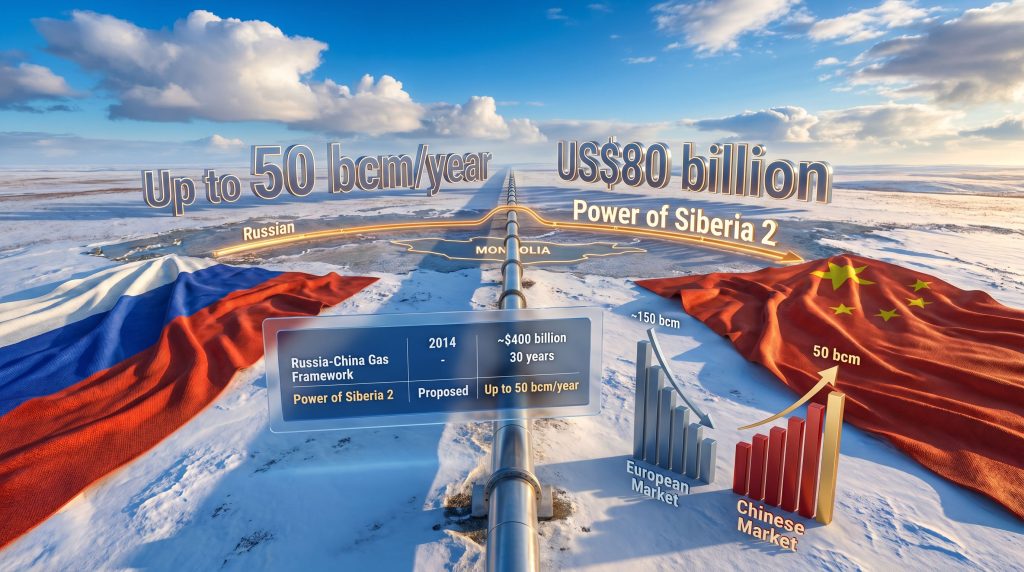
The anchor proposal in current negotiations is the Power of Siberia 2 pipeline, a proposed route running from Russian gas fields through Mongolia and into China. Its projected capacity reaches up to 50 billion cubic meters (bcm) of gas per year, which would make it one of the largest bilateral pipeline infrastructure projects in history.
For context, the original Power of Siberia pipeline became operational in 2019 and represents a significantly smaller throughput commitment. Power of Siberia 2 is categorically different in scale, complexity, and the financing structures required to bring it into operation.
Gazprom has reportedly announced a legally binding agreement related to this pipeline, but analysts consistently note that legally binding framework agreements and operational pipeline contracts are not the same instrument. The gap between announcement and first gas delivery involves years of construction, substantial capital commitments, transit negotiations with Mongolia as a sovereign intermediary, and ongoing uncertainty about sanctions compliance for participating financial institutions.
The Oil Track: A Parallel and Structurally Simpler Negotiation
Running alongside the pipeline gas negotiations is a reported 10-year, US$80 billion oil supply agreement, a deal that is structurally more straightforward to execute because existing pipeline and port infrastructure already connects Russian oil fields to Chinese refiners. Oil agreements do not require new multi-billion dollar construction projects before the first barrel flows.
The historical precedent for this scale of ambition is the 2014 30-year, $400 billion gas framework agreement, which established the template for long-term Sino-Russian energy contracts. That agreement also took years to translate into operational reality, a pattern that shapes how informed analysts interpret current announcements.
| Deal | Year | Value or Volume | Term | Current Status |
|---|---|---|---|---|
| Russia-China Gas Framework | 2014 | ~$400 billion | 30 years | Active (partial delivery) |
| Power of Siberia Pipeline | 2019 | Multi-bcm annual supply | Long-term | Operational |
| Oil Supply Agreement | Recent | ~$80 billion | 10 years | Reported/Active |
| Power of Siberia 2 | Proposed | Up to 50 bcm/year | Long-term | Under negotiation |
What Beijing Actually Wants: Three Non-Negotiable Priorities
Energy Diversification as Strategic Doctrine
China's energy security framework has long prioritised source diversification above pure cost optimisation. Beijing deliberately maintains supply relationships across multiple corridors including Central Asian pipelines, LNG terminals receiving cargoes from Australia, Qatar, and the United States, and growing domestic production capacity. Allowing any single supplier to dominate its import mix creates dependency risk that Chinese policymakers have historically been unwilling to accept.
This means that even deeply discounted Russian gas does not automatically translate into large volume commitments. Beijing wants access to Russian supply without becoming structurally reliant on it, a subtle but important distinction that shapes every aspect of the negotiations.
Yuan Settlement and the De-Dollarisation Objective
China's push to settle energy transactions in Chinese yuan rather than US dollars is not merely a financial preference. It serves a broader macro-strategic objective of internationalising the renminbi and reducing China's exposure to dollar-denominated financial infrastructure that Washington controls.
Russia, for its part, has strong incentives to accept yuan settlement given its restricted access to Western financial systems following sanctions. This alignment of interests on currency is one of the genuinely convergent points in an otherwise asymmetric negotiation. Furthermore, the weakening trust in the US dollar as the dominant global reserve currency is accelerating the appeal of alternative settlement arrangements for both parties.
The long-term implications for global commodity markets are significant. If large-scale energy transactions between two major economies become routinely settled in yuan, it contributes to a gradual normalisation of non-dollar energy pricing that other emerging market buyers may eventually follow.
Pricing Discipline: China's Track Record of Extracting Concessions
Chinese energy buyers have consistently secured below-market pricing from Russian suppliers across previous agreements. This is not a coincidence. It reflects a deliberate negotiating methodology that combines extended timelines, the implicit threat of redirecting demand to alternative suppliers, and the leverage inherent in being the buyer rather than the seller in a constrained market.
Every month that Power of Siberia 2 negotiations remain unresolved costs Russia more than it costs China. Chinese LNG imports from Australia, the United States, and Qatar continue flowing regardless of whether a Russian pipeline deal is signed. Russian gas fields, by contrast, have limited alternative destinations at scale.
The Obstacles That Could Prevent a Deal From Materialising
Infrastructure Reality: Construction Timelines and Transit Complexity
Even in an optimistic scenario where final agreements are signed in the near term, Power of Siberia 2 would not deliver first gas for several years. The engineering requirements of a trans-Mongolian corridor are substantial, and Mongolia's role as a transit nation introduces sovereign risk, transit fee negotiations, and geopolitical variables that bilateral Russia-China agreements cannot resolve unilaterally.
US Secondary Sanctions and Chinese Corporate Exposure
One of the most consequential and underappreciated obstacles is the compliance risk that US secondary sanctions create for Chinese financial institutions. Major Chinese state-owned banks have previously adjusted their behaviour in response to US sanctions pressure, reducing participation in Russian transactions despite official government support for the broader relationship.
The current posture of the Trump administration on sanctions enforcement introduces additional uncertainty. Chinese corporate legal departments are acutely aware that participation in large-scale Russian energy financing carries potential dollar-clearing exposure, and that risk has a measurable chilling effect on deal execution regardless of political signals from Beijing. These geopolitical trade tensions consequently add another layer of complexity to what is already a highly intricate negotiation.
Ukrainian Drone Strikes on Russian Infrastructure
Ukraine's long-range drone capability has matured significantly and has been used against Russian energy infrastructure including oil facilities and pipeline compression stations. This creates a bankability problem for new Russian energy projects: insurance underwriters, project financiers, and Chinese risk analysts must factor in the possibility of supply disruption from a nation engaged in active armed conflict.
The Iran Variable and Its Complicated Logic
The US-Israel military campaign against Iran has disrupted Middle Eastern energy flows in ways that theoretically create demand space for Russian energy in Chinese import portfolios. However, analysts consistently caution that this does not translate automatically into Russian supply gains. China maintains diversified relationships across multiple sanctioned and non-sanctioned suppliers simultaneously, and an Iranian supply disruption is as likely to increase Chinese LNG spot purchases as it is to accelerate Russian pipeline commitments.
Can China Replace Europe as Russia's Gas Market?
The Volume Mathematics Do Not Favour Moscow
Before 2022, Russian gas exports to Europe reached approximately 150 bcm annually. Even a fully operational Power of Siberia 2 delivering at maximum capacity would supply up to 50 bcm per year, representing roughly one-third of the lost European volume. The structural ceiling on Russian gas export revenue, even in an optimistic China scenario, is significantly lower than the pre-sanctions baseline.
| Metric | European Market Pre-2022 | Chinese Market Projected |
|---|---|---|
| Annual Volume | ~150 bcm | Up to 50 bcm via PoS2 |
| Pricing Basis | European hub-linked | Negotiated discount |
| Settlement Currency | EUR and USD | Yuan (proposed) |
| Contract Structure | Mixed spot and long-term | Long-term preferred |
| Geopolitical Risk | Sanctions-driven exit | Secondary sanctions friction |
The pricing differential compounds this volume gap. European buyers historically paid premiums linked to continental hub benchmarks. Chinese buyers negotiate discounted rates, meaning the revenue implications of replacing European volumes with Chinese volumes are doubly unfavourable for Gazprom and the Russian federal budget.
The next major ASX story will hit our subscribers first
Broader Market Implications: A Bifurcating Global Energy System
What a Completed Deal Means for LNG Exporters
A locked-in Russia-China pipeline relationship would reshape competitive dynamics for Australian, Qatari, and US LNG exporters competing for Chinese market share. The displacement effect would not be immediate given construction timelines, but a signed and credible Power of Siberia 2 agreement would introduce long-term demand uncertainty into investment decisions for export-oriented LNG projects. In addition, the global commodity market tariffs already reshaping trade flows would interact with this new energy architecture in ways that are difficult to fully anticipate.
The Emergence of a Non-Western Energy Trading Architecture
The Russia-China energy axis is one component of a broader structural shift toward bifurcated global commodity markets. Yuan settlement, alternative payment rails, and non-dollar pricing benchmarks are gradually establishing the infrastructure of a parallel trading system that operates outside Western financial architecture. These developments, furthermore, reflect global monetary system shifts that extend well beyond any single bilateral energy agreement.
This does not represent an imminent collapse of dollar-denominated commodity markets. It does represent a slow-moving but material change in how a growing share of global energy volume is priced and settled. Analysts at OilPrice.com have observed that a completed Putin China oil and gas deal could effectively seal a new gas world order, with implications stretching far beyond Moscow and Beijing.
Leading Western policy institutions have observed that pipeline deal announcements in the Sino-Russian context frequently serve as diplomatic signals of political alignment, while the operational and financial specifics remain unresolved for years following the initial announcement.
Frequently Asked Questions
What is Power of Siberia 2 and why does it matter?
Power of Siberia 2 is a proposed natural gas pipeline running from Russian production fields through Mongolia into China, with a projected capacity of up to 50 bcm annually. It represents Russia's most ambitious attempt to redirect its gas export strategy toward Asia following the loss of European markets, though it remains under negotiation and is years from any potential operational status.
Has Russia and China signed a final gas deal?
As of the current negotiating round, what has been announced involves framework and reported legally binding preliminary agreements rather than full construction and supply contracts. The distinction matters considerably. Framework agreements establish intent and parameters; operational contracts require resolved financing, construction timelines, and transit arrangements.
Why does China want yuan settlement for energy deals?
Yuan-denominated energy contracts serve two parallel objectives for Beijing. They advance the internationalisation of the renminbi as a global reserve and trade currency, and they reduce China's exposure to US dollar-clearing infrastructure that Washington can restrict. For Russia, yuan settlement provides a workable alternative to dollar and euro systems it can no longer access freely.
Could US sanctions derail the deal?
Secondary sanctions risk is a genuine friction point. Chinese financial institutions have demonstrated willingness to reduce Russian deal participation under previous sanctions pressure, and the compliance calculus for large-scale energy financing remains complex regardless of official Chinese government policy positions.
The Strategic Scorecard: Key Takeaways
- Russia's urgency is driven by fiscal pressure, lost European revenue, and limited alternative markets at the scale required to compensate
- China's patience is a deliberate strategic posture backed by diversified supply options and structural leverage as the world's largest energy importer
- Power of Siberia 2 remains a multi-year construction project even if agreements are formalised in the near term
- Yuan settlement represents a convergence point but also a signal of broader shifts in global commodity pricing architecture
- Secondary sanctions create real friction for Chinese financial participation that political statements alone cannot resolve
- The most probable near-term outcome is a deepened framework agreement with extended implementation timelines, consistent with the entire pattern of Sino-Russian energy negotiations stretching back to the 2014 gas framework
This article contains analysis of geopolitical negotiations and energy market dynamics. Forecasts, projections, and negotiation outcome assessments represent analytical perspectives based on publicly available information and should not be construed as financial advice. Energy deal timelines and market impact assessments are subject to significant uncertainty.
Want to Track the Commodity Market Shifts Reshaping ASX Investment Opportunities?
As the Russia-China energy axis accelerates the bifurcation of global commodity markets, the ripple effects on ASX-listed miners and explorers are substantial — and Discovery Alert's proprietary Discovery IQ model instantly identifies significant ASX mineral discoveries as they are announced, translating complex commodity data into actionable investment insights. Explore historic discoveries and their market returns, then begin your 14-day free trial to position yourself ahead of the next major market-moving announcement.