July 30, 2026
The Hidden Cost of a Flat Price: What the Seaborne Sulphur Market Is Really Telling You
When commodity prices appear stable on paper, the real story is often buried in the layers beneath the headline number. Freight costs, insurance surcharges, geopolitical bottlenecks, and simultaneous supply shocks can collectively transform a flat benchmark into a functionally higher delivered price — without a single dollar of movement at the point of origin. That is precisely the dynamic playing out across the global seaborne sulphur market right now, and understanding it requires looking beyond the FOB price and into the full cost structure that buyers actually face.
When big ASX news breaks, our subscribers know first
Understanding the Qatar Sulphur Price and Why It Drives Global Markets
The QatarEnergy August sulphur price, published monthly by QatarEnergy Marketing, serves as a foundational reference point for seaborne sulphur trade across Asia, South Asia, and parts of Africa. Unlike many commodity benchmarks that emerge from aggregated trading activity, the QSP is a producer-set price — established by a state-owned entity with direct control over one of the world's largest sulphur export terminals at Ras Laffan and Mesaieed on the Qatari coast.
This structure gives the QSP an unusual degree of market authority. Because Qatar produces sulphur as a byproduct of natural gas processing — particularly from its vast North Field operations — it is a cost-competitive, high-volume supplier with significant pricing influence. Buyers in China, India, Brazil, and Indonesia treat the QSP as a directional signal, with contract negotiations and spot transactions frequently anchored relative to it.
The term FOB (free on board) refers to the price at which the seller's obligation ends at the loading port. Once cargo leaves Ras Laffan or Mesaieed, freight, insurance, and port handling costs transfer to the buyer. In tightening freight markets or elevated geopolitical risk environments, the gap between FOB and CFR (cost and freight) can widen substantially — which is exactly what is happening in August 2026.
QatarEnergy August Sulphur Price: Key Data at a Glance
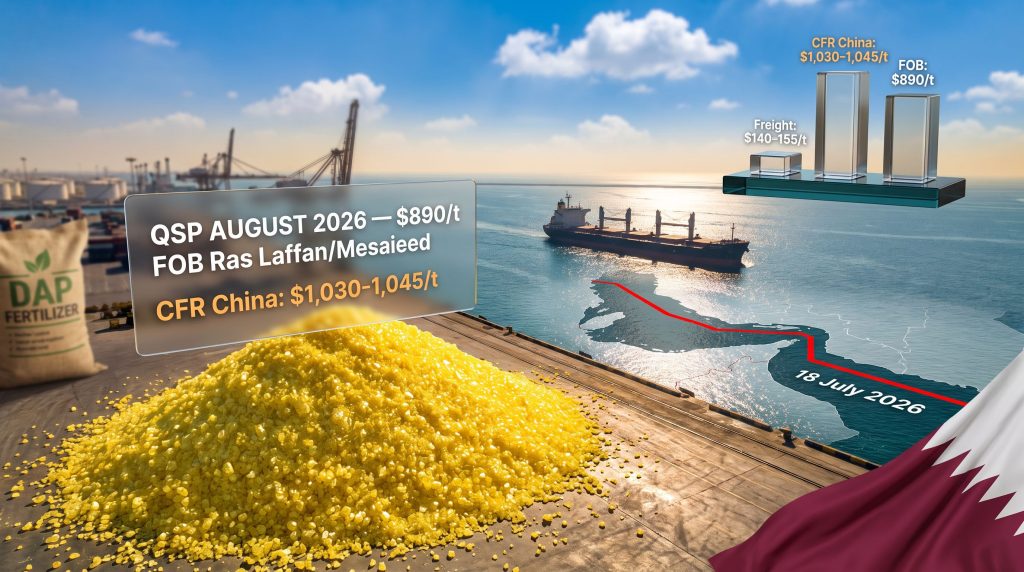
QatarEnergy Marketing held the August Qatar Sulphur Price at $890/t FOB Ras Laffan/Mesaieed, matching the July level exactly. On the surface, this looks like market stability. In practice, the delivered cost picture has shifted considerably.
| Metric | July 2026 | August 2026 |
|---|---|---|
| QSP (FOB Ras Laffan/Mesaieed) | $890/t | $890/t (unchanged) |
| Freight to Chinese Ports (30,000–35,000t shipment) | Lower | $140–155/t |
| Implied CFR China (Delivered Cost) | Lower | $1,030–1,045/t |
| Net Change (FOB) | — | $0/t (rolled) |
When a producer holds a price constant from one month to the next in commodity markets, the practice is commonly referred to as rolling the price. A rolled price is neither a reduction nor an increase — it is a deliberate decision to maintain the existing benchmark, often used to signal market positioning or manage buyer relationships during periods of uncertainty.
Key Insight: A flat FOB price does not mean a flat delivered cost. With freight adding $140–155/t and insurance premiums layering further on top, buyers are experiencing a de-facto price increase of well over $150/t relative to pre-disruption baselines — even as the headline QSP remains unchanged.
How the Strait of Hormuz Disruption Is Reshaping Global Sulphur Supply
The single most consequential factor compressing global sulphur availability in mid-2026 is the effective closure of the Strait of Hormuz to commercial sulphur cargo movements. Vessel traffic through the strait has been severely suppressed since conflict resumed, with no sulphur cargoes confirmed exiting the waterway since 18 July 2026, according to market data reported by Argus Media.
The geopolitical significance of this bottleneck cannot be overstated. Qatar, Iran, and the UAE collectively account for a dominant share of global seaborne sulphur exports. When the strait closes — even informally, through risk-driven vessel avoidance rather than a formal blockade — a substantial portion of the world's exportable sulphur volume is effectively locked behind an impassable maritime chokepoint. This is a defining example of energy market disruption reshaping commodity flows at a global scale.
The supply impact compounds in several ways:
- Physical cargo availability is reduced as vessels avoid the strait entirely
- War risk insurance premiums spike, adding material costs on top of already elevated base freight rates
- Vessel operators demand higher freight rates to compensate for rerouting or waiting, pushing the $140–155/t range to Chinese ports
- Buyers in Asia and South Asia face growing uncertainty about supply continuity, which itself can trigger precautionary purchasing behaviour or demand deferral
What makes the current situation particularly difficult to model is the open-ended nature of the disruption. Unlike a short-term weather event or a scheduled maintenance shutdown, geopolitical strait closures can persist for months. The longer the de-facto closure extends, the more buyers exhaust working inventories and the more acute the eventual supply pressure becomes.
Scenario Modelling: How Long Can the Market Absorb a Sustained Hormuz Closure?
Sulphur buyers typically carry limited inventory buffers relative to their production needs, particularly in the fertilizer sector where just-in-time procurement has become standard. If the Hormuz disruption extends through the third quarter of 2026 without resolution, downstream phosphate producers face the prospect of input cost inflation that cannot be easily absorbed or passed through in all markets.
Furthermore, from a structural perspective, there is no immediately scalable alternative to Middle Eastern sulphur exports. Canada and Kazakhstan export elemental sulphur, but neither possesses the logistical infrastructure to rapidly redirect sufficient volumes to replace Middle Eastern supply gaps in Asian import markets. These crude oil logistics risks parallel the supply-side vulnerabilities now confronting the sulphur trade, creating a genuine constraint that the flat QSP does not fully communicate.
India's Sulphur Export Suspension: A Secondary Supply Shock
Arriving on top of the Hormuz disruption, India's decision to halt sulphur exports has removed an additional buffer that several import markets had grown to rely upon. The sequence of events is important context.
India exported 356,900 tonnes of sulphur across January to April 2026, according to Global Trade Tracker data, before export activity effectively ceased from May onward. The two primary destinations were China, which received 142,900t, and Brazil, which took 110,000t, with the remainder directed to Indonesia.
The suspension is understood to primarily affect Reliance Industries, India's dominant private-sector refiner and its most significant sulphur exporter, with cargoes historically loading from Bedi port on India's west coast. The decision to restrict exports appears to have originated from domestic supply concern, with the Gujarat Chamber of Commerce and Industry having called for a minimum six-month export ban earlier in 2026, citing fertilizer production risks.
What makes India's situation structurally paradoxical is the simultaneous nature of its import dependency and export restriction:
- India imported 2.25 million tonnes of sulphur in 2025, with approximately 84% sourced from the Middle East
- Imports fell 26% year-on-year to 698,200t across January to May 2026 following the outbreak of the US-Iran conflict
- India is simultaneously restricting sulphur exports to protect domestic fertilizer production while its own Middle Eastern import supply has been severely curtailed
This creates a structural squeeze on India's own fertilizer manufacturing base, with ripple effects for domestic food production economics. An additional concern emerging among market participants is whether the government might extend export restrictions to sulphuric acid — a processed derivative used extensively in phosphate fertilizer production. As of late July 2026, no official notice or formal proposal on sulphuric acid restrictions has been published, but the possibility is being actively discussed by industry participants.
How Tight Is the Global Sulphur Market Right Now? A Multi-Factor Supply Assessment
Stacking the concurrent disruptions reveals a supply constraint picture that is more severe than any single headline captures:
| Supply Disruption | Estimated Volume Impact | Primary Affected Markets |
|---|---|---|
| Strait of Hormuz de-facto closure | Significant — ongoing | Asia, East Africa, South Asia |
| India sulphur export suspension | ~356,900t annualised run-rate | China, Brazil, Indonesia |
| Elevated freight rates ($140–155/t) | Cost inflation, not volume loss | All seaborne buyers |
| Insurance premium surcharges | Delivered cost uplift | Risk-sensitive buyers |
The fertilizer sector sits at the end of this supply chain with limited ability to substitute inputs. Sulphur is a primary feedstock for sulphuric acid production, and sulphuric acid is the key processing chemical for converting phosphate rock into the diammonium phosphate (DAP) and monoammonium phosphate (MAP) that farmers apply to crops globally. A disruption in sulphur supply is therefore not an abstract commodity market event — it translates directly into phosphate fertilizer production economics and, ultimately, agricultural input costs. The pressure on global phosphate reserves is consequently intensifying as upstream input costs rise.
The next major ASX story will hit our subscribers first
Regional Demand Dynamics: Who Feels the August QSP Most Acutely?
China: Absorbing Elevated CFR Costs at Scale
As the world's largest sulphur importer, China faces the full weight of the current disruption. The implied delivered cost of Qatari sulphur to Chinese ports now sits at $1,030–1,045/t CFR, before insurance premiums are applied. Chinese buyers must make difficult near-term purchasing decisions: accept elevated costs and maintain production schedules, or defer purchases and wait for supply conditions to normalise — a bet that carries its own inventory and production risks.
South Asia: India and Pakistan Under Compounding Pressure
Pakistan's DAP market provides a particularly clear illustration of how sulphur cost pressure cascades downstream. Pakistani DAP inventories rose to 268,000 tonnes in June 2026, representing the strongest month-on-month inventory build since January, yet domestic demand simultaneously fell to its lowest level since January — 48,000 tonnes in June against a five-year June average of 122,000 tonnes.
This apparent paradox reflects demand destruction rather than market health: inventories are rising because farmers are pricing themselves out of the market, not because supply is abundant. Moreover, commodity market volatility driven by geopolitical factors is amplifying the difficulty of procurement planning across the entire value chain. Indeed, commodity market volatility of this nature makes hedging strategies increasingly complex for downstream buyers.
Ex-Karachi prices have remained above Rs15,000 per 50kg bag, a threshold identified by importers as the level beyond which farmers substitute cheaper alternatives including single superphosphate (SSP) and lower-grade nitrophos products. The market consensus among Pakistani suppliers is that total 2026 DAP demand will likely fall below 1 million tonnes — approximately 35% below the five-year average — with the heaviest cuts falling in the fourth-quarter high season.
Brazil and Indonesia: Losing Indian Export Volumes
Both Brazil and Indonesia had established supply relationships with Indian sulphur exporters that are now effectively suspended. Brazil received 110,000 tonnes of Indian sulphur in the January to April 2026 window, making it the second-largest destination. Finding alternative supply in a market where Middle Eastern exports are simultaneously constrained presents a significant procurement challenge for Brazilian sulphuric acid and fertilizer producers.
Turkish Domestic Sulphur Prices: A Regional Market Running Hot
An important cross-reference point for gauging actual market tightness is the Turkish domestic sulphur tender awarded by refiner Tupras in late July 2026. The results reveal a market priced well above the QSP benchmark:
| Tupras Facility | Total Volume | August Award Price (fca) | Prior June Award Price (fca) | Price Change |
|---|---|---|---|---|
| Izmir | 3,850t | $909–912/t | ~$675/t floor | +~$234/t |
| Izmit | 16,000t | $849–852/t | $650–804/t | +~$153.50/t avg |
| Kirikkale | 2,600t | $876–882/t | — | Significant uplift |
The average price increase of approximately $153.50/t across Tupras facilities since the June tender reflects the tightening Mediterranean and European sulphur supply environment. The term fca (free carrier) means the price includes delivery to a named location at the seller's premises, distinguishing it from the FOB pricing used in the QSP. Despite this definitional difference, the directional signal is clear: sulphur prices at the regional level are rising sharply, with Turkish domestic awards trading at a premium to the Qatari FOB benchmark.
Is the Flat August QSP a Stabilising Signal or a Deferred Price Adjustment?
There are two credible interpretations of QatarEnergy's decision to roll the August QSP rather than increase it.
The first is a market share argument: by holding price flat while freight costs inflate delivered costs for buyers, QatarEnergy maintains its nominal price competitiveness relative to alternative suppliers and avoids triggering demand destruction or cargo deferral among its key customers.
The second interpretation is more forward-looking: a flat FOB price in the current environment may simply reflect the one-month lag in how state producers update benchmarks. With structural supply tightness intensifying — Hormuz closure ongoing, Indian exports suspended, freight elevated — the conditions for an upward FOB price adjustment in September appear to be building. Historically, prolonged periods of rolled prices in tightening supply environments tend to precede catch-up increases once the directional pressure becomes undeniable.
Strategic Consideration: Buyers who defer sulphur purchases anticipating a price correction may find themselves entering a tighter market rather than a softer one. With no confirmed resumption of Hormuz cargo flows and Indian export restrictions still in place, the near-term probability of supply normalisation appears low.
Sulphur's Role in the Broader Phosphate Fertilizer Value Chain
It is worth tracing the full production pathway to understand why sulphur pricing matters so broadly. Elemental sulphur is burned to produce sulphur dioxide, which is then converted to sulphur trioxide and absorbed in water to create sulphuric acid. That sulphuric acid reacts with phosphate rock to produce phosphoric acid, which is then neutralised with ammonia to produce DAP and MAP — the two most widely traded phosphate fertilizers globally.
This means a sustained sulphur supply shock carries amplified consequences:
- Sulphur price increases flow directly into sulphuric acid production costs
- Higher sulphuric acid costs raise phosphoric acid production costs
- Elevated phosphoric acid costs push up DAP and MAP prices
- Higher DAP and MAP prices reduce fertilizer affordability for farmers in price-sensitive markets
- Reduced fertilizer application over growing seasons can affect crop yields and, ultimately, food security metrics
The longer-term question — relevant primarily beyond the current disruption cycle — concerns whether the structural role of sulphur in fertilizer production will be affected by the energy transition. Green transition pressures on fossil fuel processing could, over time, reduce the volume of sulphur recovered as a byproduct from gas processing. This could gradually tighten the supply side of the elemental sulphur market on a structural basis, independent of any geopolitical disruption.
Frequently Asked Questions: QatarEnergy August Sulphur Price
What is the QatarEnergy August 2026 sulphur price?
QatarEnergy Marketing set its QatarEnergy August sulphur price at $890/t FOB Ras Laffan/Mesaieed, unchanged from the July 2026 level.
What does the QSP mean for delivered sulphur costs to China?
With freight rates running at $140–155/t for a 30,000–35,000 tonne shipment to Chinese ports, the implied delivered cost for August sulphur rises to approximately $1,030–1,045/t CFR, before additional insurance premiums are applied.
Why is global sulphur supply so tight in mid-2026?
Two overlapping disruptions are constraining seaborne sulphur availability: the de-facto closure of the Strait of Hormuz, with no confirmed sulphur cargo exits since 18 July 2026, and India's suspension of sulphur exports, which had been running at approximately 356,900 tonnes in the January to April period.
How does the QSP differ from Turkish domestic sulphur prices?
Turkish refiner Tupras awarded its August domestic sulphur tender at $849–912/t fca depending on facility and lot size, representing average price increases of approximately $153.50/t compared with its prior June tender.
What downstream fertilizer markets are most exposed to sulphur supply disruptions?
Phosphate fertilizer producers reliant on sulphuric acid as a processing input face the most direct exposure. South Asian markets — particularly India and Pakistan — face compounding pressure given their simultaneous import dependency and the broader tightening of Middle Eastern supply availability.
Key Takeaways for Market Participants
- The flat FOB price masks a materially higher effective delivered cost driven by freight and insurance cost inflation
- Geopolitical disruption at the Strait of Hormuz has effectively removed a significant volume of Middle Eastern sulphur from seaborne circulation since 18 July 2026
- India's export suspension removes an additional supply buffer that China, Brazil, and Indonesia had relied upon, with the annualised run-rate impact approaching 356,900 tonnes
- Downstream fertilizer markets — particularly phosphates — face compounding input cost pressure heading into the second half of 2026
- Turkish domestic sulphur prices awarded at $849–912/t fca signal that regional markets are already pricing in the structural tightness that the QSP headline does not yet fully reflect
- Price stability at the FOB level may be temporary, with structural supply tightness creating conditions for upward adjustments in the months ahead
This article draws on price data and market reporting published by Argus Media. Readers seeking additional context on global sulphur and fertilizer market dynamics are encouraged to review commodity price reporting at argusmedia.com. This article contains forward-looking analysis and scenario projections based on available data as of late July 2026. It should not be construed as financial or investment advice. Commodity markets are subject to rapid change, and actual outcomes may differ materially from those described.
Want to Stay Ahead of the Next Major ASX Mineral Discovery Before the Market Moves?
While geopolitical disruptions reshape global commodity supply chains — from sulphur to phosphates — the downstream pressure on critical mineral sectors creates a compelling backdrop for identifying high-potential ASX exploration opportunities. Discovery Alert's proprietary Discovery IQ model scans ASX announcements in real time, delivering actionable insights across more than 30 commodities so investors can act decisively the moment a significant discovery is announced. Explore historic examples of major mineral discoveries and their market returns, then begin a 14-day free trial to gain a market-leading edge before the broader market catches on.