May 19, 2026
The Quiluma gas field project Angola represents a groundbreaking development in natural gas processing systems, requiring sophisticated integration of separation, compression, and transport technologies across offshore and onshore environments. The technical sophistication demanded by standalone gas field developments often determines their commercial viability over decades-long operational lifespans. Angola's hydrocarbon sector has historically focused on crude oil extraction, but recent technical advances in non-associated gas processing are reshaping the country's energy landscape through projects that demonstrate how specialized infrastructure can unlock previously stranded resources. Furthermore, these developments are occurring alongside broader energy transition challenges affecting global hydrocarbon markets.
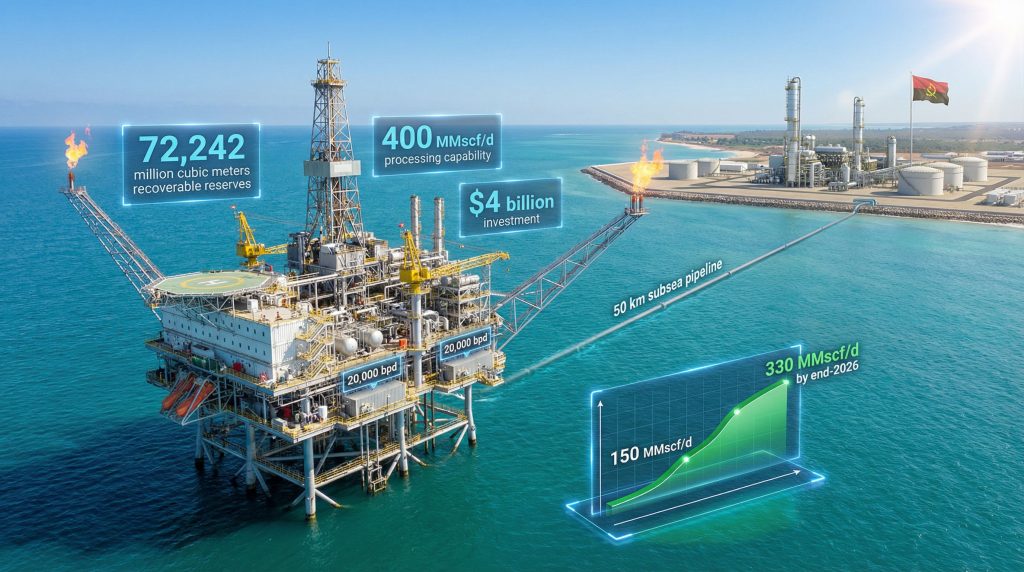
The Quiluma gas field project Angola exemplifies this technological evolution, representing the nation's inaugural commercial non-associated gas development with processing capabilities designed for 400 million standard cubic feet per day (MMscf/d) throughput. This technical milestone required overcoming engineering challenges specific to gas-only reservoir systems, including advanced dehydration protocols, specialized compression configurations, and integrated offshore-to-onshore transport solutions spanning 50 kilometers of submarine pipeline infrastructure.
Technical Foundation of Angola's First Non-Associated Gas Development
The Quiluma gas field project Angola encompasses proven recoverable reserves totaling 72.24 billion cubic meters distributed across two distinct geological formations discovered in different decades. The Quiluma accumulation, identified in 1970, remained undeveloped for 56 years due to market conditions and infrastructure constraints rather than technical limitations. The Maboqueiro field, discovered in 1995, faced a 31-year development gap before commercial production began.
This extended timeline reflects Angola's historical energy policy priorities, which emphasised crude oil development over natural gas commercialisation. According to the U.S. Energy Information Administration, Angola's crude oil production declined from approximately 1.8 million barrels per day in 2008 to around 1.1 million barrels per day by 2024, creating strategic incentives for gas development as a portfolio diversification strategy.
Geological Characteristics and Resource Classification
The project's reservoir systems exist within Block 2's shallow-water offshore environment, characterised by Tertiary-age sandstone and shale formations typical of Angola's lower Congo Basin. These geological structures contain standalone gas accumulations without associated crude oil, distinguishing them from Angola's traditional associated gas production linked to oil extraction operations.
Key reservoir parameters include:
• Proven recoverable reserves: 72.24 billion cubic meters combined
• Water depth classification: Shallow water (typically less than 500 metres)
• Formation type: Non-associated gas in Tertiary sedimentary sequences
• Annual production plateau design: 3.41 billion cubic metres
Non-associated gas formations require enhanced separation technologies because they lack the dissolved hydrocarbons present in associated gas streams. This necessitates specialised dehydration systems to remove water vapour, which forms hydrate plugs in pipelines at high pressures, along with acid gas treating and compression stages optimised specifically for gas-only service applications.
Production Scaling Methodology and Performance Metrics
The development strategy implements a phased production ramp-up beginning at 150 MMscf/d initial capacity from the Quiluma field, with planned acceleration to 330 MMscf/d by year-end 2026. This represents a 120% production increase within nine months, following standard industry protocols that allow for equipment commissioning, system optimisation, and market demand alignment.
The project achieved first gas production on March 17, 2026, demonstrating execution efficiency through completion six months ahead of original schedule targets. This performance indicator reflects comprehensive project management across offshore platform installation, subsea pipeline commissioning, and onshore processing facility integration. In addition, these achievements align with broader industry innovation trends transforming the energy sector.
Production timeline milestones:
• Final Investment Decision: July 2022
• Construction phase: 2022-2025 accelerated development
• First gas achievement: March 17, 2026
• Initial production rate: 150 MMscf/d
• End-2026 target: 330 MMscf/d
• Full field development: Integration of both Quiluma and Maboqueiro fields
When big ASX news breaks, our subscribers know first
Offshore Platform Engineering and Subsea Infrastructure Design
The Quiluma gas field project Angola employs dual offshore wellhead platforms serving the Quiluma and Maboqueiro accumulations through fixed steel jacket installations optimised for shallow-water environments. These platforms utilise multi-well configurations designed to maximise individual field recovery rates while minimising capital expenditure through standardised equipment specifications.
Fixed platforms prove cost-effective for well-defined reserves with 20-30 year production lifecycles, contrasting with deeper-water floating production facilities required for ultra-deepwater developments. The shallow-water positioning reduces operational complexity while enabling direct pipeline connections to onshore processing infrastructure without intermediate floating storage systems.
Advanced Safety Systems and Operational Protocols
Modern offshore platform design incorporates redundant Blow Out Preventer (BOP) stacks with multiple annular BOPs and ram BOPs, dual control systems engineered to fail-safe closed positions, and automatic shutdown triggers linked to surface and subsea monitoring networks. Angola's regulatory framework, overseen by the Agência Nacional de Petróleo, Gás e Biocombustíveis (ANPG), enforces International Maritime Organization and American Petroleum Institute standards for offshore safety equipment.
The platforms integrate comprehensive surveillance systems including:
• Real-time wellhead pressure and temperature monitoring
• Emergency shutdown valve networks with automatic activation
• Fire and gas detection systems with platform evacuation protocols
• Subsea blowout preventer stacks with dual control systems
• Platform structural integrity monitoring through accelerometer networks
Submarine Pipeline Engineering and Flow Assurance
The 50-kilometre submarine pipeline system transporting 400 MMscf/d from offshore platforms to the Soyo onshore facility represents significant engineering complexity. This throughput, equivalent to approximately 11.3 million cubic metres per day or 11,300 metric tonnes daily at standard conditions, requires specialised pipeline design parameters. Moreover, data-driven operations are increasingly crucial for monitoring such complex pipeline systems.
Technical pipeline specifications typically include:
• Diameter sizing: 20-24 inch diameter carbon steel (508-610 mm)
• Pressure rating: 70-100 bar design pressure (1,000-1,450 psi)
• Material grade: X65-X80 yield strength steel with impact testing
• Thermal protection: Polyurethane foam jacketing for temperature maintenance
Natural gas hydrate formation presents significant operational risks when gas, water, and pressure combine at low temperatures encountered in submarine environments. Prevention strategies include thermal insulation systems, chemical inhibition through methanol or glycol injection at wellheads, and gas dehydration to less than 5 parts per million water content before pipeline entry.
The pipeline employs distributed temperature sensing (DTS), fibre-optic pressure monitoring, and acoustic detection systems for real-time integrity management. These technologies identify wall thickness corrosion, temperature anomalies indicating leaks, pressure changes reflecting blockages, and vibration signatures from external interference.
Onshore Gas Processing Technology and Integration Systems
The Soyo onshore processing facility processes the 400 MMscf/d gas stream through multi-stage separation, dehydration, and compression systems designed for direct integration with Angola LNG plant infrastructure. This facility represents Angola's first dedicated non-associated gas processing installation, requiring specialised equipment configurations distinct from associated gas handling systems.
Processing Train Technology and Equipment Configuration
The processing sequence begins with three-phase separation units operating at 40-70 bar pressure and 30-50°C temperature to remove bulk liquid and solid contaminants from the inlet gas stream. Subsequent dehydration units employ triethylene glycol (TEG) contacting towers reducing water content from 100-200 parts per million to less than 5 ppm, preventing hydrate formation in downstream compression equipment.
Primary processing stages include:
• Three-phase inlet separation for contaminant removal
• Glycol dehydration systems achieving <5 ppm water content
• Condensate stabilisation through flash separation
• Multi-stage centrifugal compression (typically 2-3 stages)
• Final gas conditioning for LNG plant feed requirements
The facility achieves 20,000 barrels per day condensate recovery from the gas stream, indicating a gas condensate ratio of approximately 50 barrels per million standard cubic feet. This ratio suggests the gas contains light hydrocarbons (ethane, propane, butane) that separate as liquid condensate during processing, providing additional revenue streams beyond the primary gas sales.
Angola LNG Integration and Market Access
Direct connection to the Angola LNG facility provides established export infrastructure with 5.2 million tonnes per annum liquefaction capacity. This integration eliminates the need for separate gas marketing infrastructure while ensuring reliable offtake for the Quiluma gas field project Angola production volumes. Furthermore, this positioning benefits from favourable US natural gas prices that enhance export competitiveness.
The processing facility serves dual purposes through gas supply for domestic industrial applications including petrochemicals, ammonia, and urea production, while simultaneously feeding export LNG production. This market diversification reduces commercial risk through multiple revenue streams and demand sources.
Compression systems raise gas pressure from pipeline inlet conditions (approximately 50-70 bar) to final outlet specifications matching Angola LNG inlet requirements. Multi-stage centrifugal compressors provide operational flexibility for varying inlet conditions while maintaining consistent delivery pressure and flow rates.
Joint Venture Structure and Risk Management Framework
The Quiluma gas field project Angola operates through the New Gas Consortium (NGC) partnership structure distributing technical expertise, financial investment, and operational responsibilities across multiple stakeholders. Azule Energy, a 50:50 joint venture between bp and Eni, holds 37.4% operating stake and provides technical leadership for field development and production operations.
Partnership composition includes:
• Azule Energy: 37.4% (bp-Eni joint venture, operator)
• Cabinda Gulf Oil Company: 31% partnership interest
• Sonangol E&P: 19.8% national oil company participation
• TotalEnergies: 11.8% international major involvement
• ANPG: National concessionaire regulatory oversight
This structure combines international technical expertise from major oil companies with national operator participation ensuring knowledge transfer and local capacity development. The partnership distributes technical risks across operators with extensive offshore and gas development experience while maintaining regulatory compliance through national agency oversight.
Technology Transfer and Capability Enhancement
The multi-partner structure facilitates technology transfer from international operators (bp, Eni, TotalEnergies) to national entities (Sonangol E&P) through shared operational responsibilities. This knowledge sharing encompasses advanced offshore platform design, subsea pipeline engineering, gas processing optimisation, and integrated project management methodologies.
Gordon Birrell, bp's Executive Vice President for Production & Operations, emphasised that the project demonstrates effective collaboration delivering strategic progress for Angola's energy system while strengthening the country's diversified energy portfolio. This partnership model provides templates for future gas developments requiring similar technical complexity and financial scale.
The joint venture structure enables risk distribution across multiple technical domains including reservoir management, offshore operations, pipeline integrity, processing optimisation, and regulatory compliance. Each partner contributes specialised expertise while sharing financial exposure across the $4 billion total capital expenditure.
Economic Impact and Strategic Energy Positioning
The Quiluma gas field project Angola generates significant macroeconomic implications beyond direct hydrocarbon production through energy security enhancement, industrial development catalysis, and export revenue generation. The project establishes Angola's first dedicated non-associated gas infrastructure, creating foundations for additional gas field developments and regional energy hub positioning.
Energy Security and Industrial Development
Domestic gas supply diversification reduces Angola's historical dependence on oil-associated gas production, which fluctuates with crude oil extraction rates. Dedicated gas infrastructure provides reliable feedstock for electricity generation, petrochemical production, and fertiliser manufacturing independent of oil market conditions.
The project supports Angola's energy transition positioning through natural gas as a bridge fuel offering approximately 50% lower carbon intensity compared to oil-based energy sources. This environmental advantage aligns with international climate commitments while maintaining hydrocarbon revenue generation during renewable energy infrastructure development. Consequently, understanding decarbonisation benefits becomes crucial for long-term strategic planning.
Strategic development benefits include:
• Reduced dependence on oil-associated gas production
• Reliable power generation feedstock availability
• Industrial development through petrochemical and fertiliser feedstock
• Export revenue generation via LNG sales
• Infrastructure foundation for future gas field developments
Regional Market Dynamics and Competitive Positioning
West Africa's natural gas market development creates opportunities for cross-border supply arrangements and regional energy security enhancement. The Quiluma gas field project Angola demonstrates commercial viability of non-associated gas development, potentially accelerating exploration and development of similar accumulations throughout the region.
LNG export capabilities provide access to Asian and European gas demand centres, diversifying Angola's energy export portfolio beyond traditional crude oil markets. Non-associated gas production offers cost structure advantages compared to associated gas processing, improving competitiveness in international LNG markets.
The project's technical success establishes operational benchmarks for future developments while creating skilled workforce capabilities and regulatory frameworks applicable to additional gas projects. Infrastructure expansion potential includes additional field tie-ins to existing processing facilities, optimising capital efficiency for subsequent developments.
Advanced Technology Implementation and Operational Excellence
The project incorporates comprehensive digital operations integration through real-time monitoring systems, predictive maintenance protocols, and advanced process control optimisation. These technologies maximise operational efficiency while ensuring environmental compliance and safety management across offshore and onshore facilities.
Digital Operations and Monitoring Systems
Integrated surveillance networks provide continuous facility and pipeline monitoring through distributed sensor arrays, automated data collection, and centralised control systems. Artificial intelligence-driven analytics enable predictive maintenance scheduling, equipment optimisation, and failure prevention protocols reducing operational downtime.
Key technology implementations include:
• Real-time pressure, temperature, and flow monitoring
• Predictive maintenance through AI-driven equipment analysis
• Advanced process control for production optimisation
• Integrated safety systems ensuring operational integrity
• Environmental monitoring and compliance management
Production optimisation systems employ advanced process control maintaining maximum output efficiency while operating within design parameters for equipment longevity. These systems automatically adjust separation pressures, compression settings, and dehydration parameters responding to varying inlet gas conditions and market demand requirements.
Environmental Compliance and Sustainability Measures
The project implements comprehensive environmental management through emissions monitoring, waste minimisation, and resource utilisation optimisation. Condensate recovery systems maximise hydrocarbon resource extraction while gas processing equipment incorporates low-emission design principles.
Environmental monitoring encompasses marine ecosystem impact assessment, onshore facility emissions tracking, and regulatory compliance verification exceeding national and international environmental standards. These protocols ensure long-term operational sustainability while maintaining community and regulatory support.
Sustainability framework components:
• Low-carbon gas processing and transport systems
• Condensate recovery maximising resource utilisation
• Comprehensive marine and onshore environmental monitoring
• Emissions management exceeding regulatory requirements
• Waste minimisation through process optimisation
The next major ASX story will hit our subscribers first
Project Execution Excellence and Performance Benchmarks
The project achieved first gas production six months ahead of original schedule targets, demonstrating exceptional project management across complex offshore and onshore infrastructure development. This performance reflects comprehensive planning, execution efficiency, and risk mitigation throughout the $4 billion capital investment program.
Schedule acceleration required coordinated execution across multiple technical domains including offshore platform fabrication and installation, submarine pipeline construction and commissioning, onshore processing facility construction, and integrated system testing. The early completion provides additional revenue generation while establishing operational reliability benchmarks for future developments. According to Offshore Energy, this milestone represents a significant achievement for Angola's energy sector.
Quality Assurance and Long-term Reliability
International standards compliance ensures equipment reliability and operational longevity through rigorous quality control protocols during construction and commissioning phases. Materials selection, welding procedures, pressure testing, and system integration follow American Petroleum Institute, American Society of Mechanical Engineers, and Det Norske Veritas specifications for offshore and gas processing applications.
Comprehensive contingency planning and risk mitigation protocols addressed potential challenges including weather delays, equipment delivery schedules, regulatory approvals, and market conditions. These preparations enabled schedule acceleration while maintaining safety and quality standards throughout project execution.
Industry analysts from Energy Capital & Power highlighted that the successful startup represents a transformative milestone in Angola's energy sector evolution.
"The successful startup of the Quiluma gas field project represents a transformative milestone in Angola's energy sector evolution, demonstrating how advanced processing technology and strategic partnerships can unlock previously stranded hydrocarbon resources while supporting national economic diversification objectives."
Project Performance Metrics:
| Metric Category | Specification | Performance Indicator |
|---|---|---|
| Reserve Base | 72.24 billion cubic metres | Proven recoverable reserves |
| Processing Capacity | 400 MMscf/d | Design throughput capability |
| Condensate Recovery | 20,000 bpd | Liquid hydrocarbon extraction |
| Production Ramp-up | 150-330 MMscf/d | 2026 scaling trajectory |
| Investment Scale | $4 billion | Total project capital expenditure |
| Schedule Performance | 6 months early | Completion ahead of target |
The Quiluma gas field project Angola establishes technical and commercial precedents for non-associated gas development throughout West Africa, creating frameworks for future projects while contributing to Angola's energy security and economic diversification strategies. The project's integration of advanced processing technology, strategic partnerships, and operational excellence provides models for sustainable hydrocarbon development in emerging energy markets.
This analysis reflects publicly available information as of March 2026. Energy sector investments involve significant technical, commercial, and regulatory risks. Readers should conduct independent research and consult qualified advisors before making investment decisions.
Looking to Capitalise on Energy Sector Opportunities?
Discovery Alert's proprietary Discovery IQ model delivers real-time alerts on significant mineral discoveries across the ASX, helping investors identify actionable opportunities in the energy transition and mining sectors before the broader market. With major discoveries historically generating substantial returns, explore Discovery Alert's dedicated discoveries page to understand the potential of early-stage identification and begin your 14-day free trial today to secure your market-leading advantage.