Modern mining operations face mounting pressure to reduce emissions while maintaining profitability, creating demand for innovative haulage solutions that can deliver both environmental benefits and economic returns. Underground mines traditionally rely on diesel-powered trucks for ore transport, generating significant ventilation requirements and operational costs that extend throughout project lifecycles. The technical complexity of underground material handling systems involves intricate relationships between power generation, atmospheric control, and infrastructure development that determine long-term project economics.
Electric haulage technologies represent a fundamental shift in underground mining operations, eliminating combustion-based power systems while introducing automated control capabilities that reshape operational workflows and safety protocols. Furthermore, these electric haulage innovations are becoming integral to modern mining sustainability trends that prioritise environmental responsibility.
Understanding Railveyor Technology Architecture
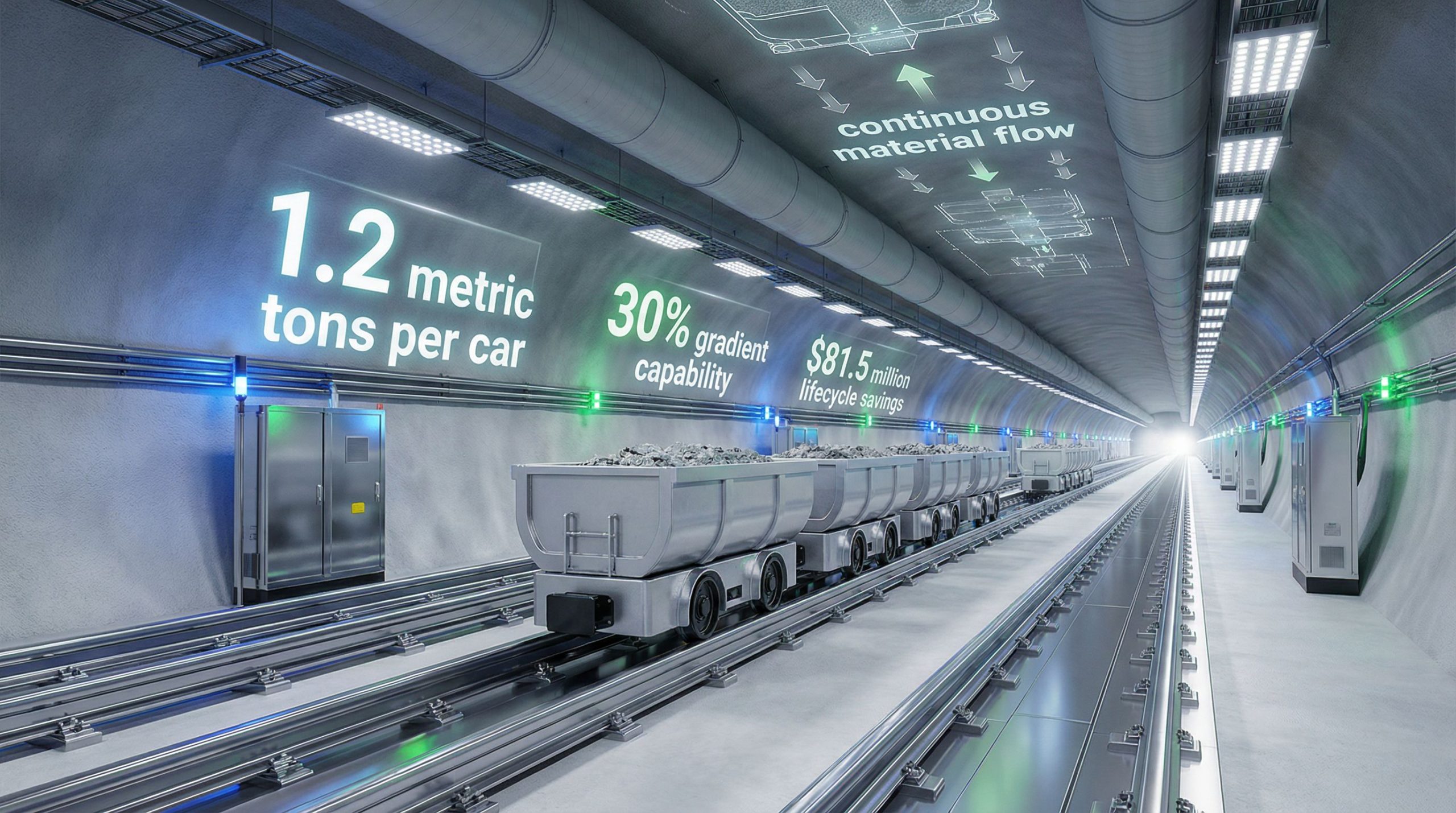
The Railveyor ore haulage system employs a narrow-gauge electric rail infrastructure with modular track sections designed for underground deployment in constrained spaces. The system utilises continuous trains of U-shaped steel cars capable of navigating tight curves and steep grades along specialised light rail installations, providing operational flexibility that accommodates complex underground mine layouts.
Core technical specifications include:
• Individual car capacity of 1.2 metric tons per unit for optimised material flow
• Maximum gradient handling capability up to 30% inclines for steep underground access
• Minimum turning radius of 20-30 metres enabling navigation in tight underground spaces
• Distributed electric drive stations positioned strategically along transport routes
• Surface-based control systems enabling remote operational oversight
The modular design philosophy enables underground operators to expand or modify haulage routes without the fixed limitations of traditional conveyors or the ventilation demands of diesel trucking fleets. According to Railveyor Technologies Global CEO Tas Mohamed, this flexibility allows mines to adapt material transport systems as mining activities progress to new areas without complete infrastructure replacement.
Electric Drive Distribution and Control Architecture
Rather than centralised power generation, the Railveyor ore haulage system employs distributed electric drive stations positioned strategically along transport routes. This distributed architecture reduces power transmission losses and provides operational flexibility compared to centralised drive systems typically found in conventional conveyor installations.
Surface-based control systems eliminate the requirement for underground operators to accompany material transport operations, reducing personnel exposure while enabling continuous monitoring of system performance through integrated sensor networks and automated reporting protocols.
What Are the Primary Operational Advantages Over Traditional Haulage Methods?
Electric rail-based haulage systems eliminate diesel exhaust and combustion heat generation underground, dramatically reducing ventilation infrastructure requirements compared to truck-based operations. However, Mining Plus analysis demonstrates that diesel-truck-equipped mining operations require a secondary surface ventilation rise beginning in year six of project operations, whereas Railveyor-equipped mines maintain regulatory-compliant airflow with a single ventilation rise throughout the entire mine lifecycle.
Primary operational benefits include:
• Zero direct underground emissions from material transport operations
• 39% mine-wide emission reduction compared to diesel truck operations
• Extended single-rise ventilation capability throughout multi-decade mine lifecycles
• Continuous operation potential independent of shift changes and crew rotations
• Enhanced predictability in material transport scheduling for coordinated underground activities
Underground diesel equipment generates both heat and exhaust products requiring continuous airflow replacement to maintain regulatory-compliant atmospheric conditions. In addition, electric systems operating underground eliminate heat generation from combustion processes and eliminate exhaust byproducts, substantially reducing required volumetric airflow rates that drive ventilation infrastructure costs.
Labour and Safety Operational Integration
Remote operation capabilities reduce underground personnel exposure to moving haulage equipment while enabling automated material handling that minimises manual intervention in loading and unloading operations. The elimination of diesel engine maintenance requirements in hazardous underground environments reduces technician exposure while simplifying mechanical maintenance protocols compared to internal combustion engine systems.
Continuous operation removes shift-change constraints that typically limit material transport frequency in traditional truck-based operations, theoretically increasing annual haulage tonnage per unit infrastructure investment while maintaining consistent production flow rates.
How Do Railveyor Systems Compare Financially to Conventional Haulage?
Independent financial analysis by Mining Plus reveals significant lifecycle cost advantages for electric rail haulage compared to conventional diesel truck operations. The comprehensive study examined a 24-year mine operational period using an 8% discounted cash flow methodology, calculating total lifecycle savings of $81.5 million for Railveyor implementation versus diesel truck haulage systems.
| Financial Parameter | Diesel Truck Operations | Railveyor Electric System |
|---|---|---|
| Ventilation Infrastructure | Secondary rise required Year 6 | Single rise for full lifecycle |
| Fuel/Energy Costs | Continuous diesel consumption | Electric power consumption |
| Maintenance Requirements | Engine overhauls and parts | Simplified mechanical systems |
| Personnel Requirements | Underground operators | Remote surface operators |
| Emission Compliance | Ongoing monitoring costs | Zero underground emissions |
The Mining Plus analysis demonstrates that comparing only initial capital expenditure for haulage equipment obscures the full financial impact. For instance, when ventilation infrastructure requirements are incorporated into lifecycle cost modelling, alternative haulage systems become economically dominant compared to diesel trucking despite potentially higher initial capital requirements for rail-based systems.
Ventilation Infrastructure as Primary Cost Driver
Underground ventilation infrastructure represents one of the largest ongoing operational expenditures in mining operations. The study found that ventilation cost reduction serves as the primary financial driver, with diesel-equipped operations requiring multiple secondary ventilation shafts and associated mechanical systems that Railveyor installations can eliminate entirely.
Capital investment categories include:
• Narrow-gauge rail track installation with modular sections
• Distributed electric drive station installation and integration
• Surface-based control system and monitoring equipment
• Integration infrastructure with existing mine loading and discharge facilities
• Personnel training and operational transition management
• Emergency system redundancy and backup operational protocols
According to CEO Tas Mohamed, the financial analysis indicates that installing an electric haulage system like Railveyor does not require an ESG premium but instead delivers measurable financial returns while supporting net-zero emissions commitments aligned with Paris Agreement goals.
What Implementation Challenges Must Operators Consider?
Underground mine integration requires comprehensive planning to optimise track routing through existing infrastructure while accommodating future mining area expansion. The narrow-gauge rail system demands detailed underground surveying to identify optimal routing paths that maintain the required 30% maximum gradient compliance and 20-30 metre minimum turning radius specifications.
Critical implementation considerations include:
• Track routing optimisation through existing underground layouts and future mining zones
• Grade and curve limitations affecting transport route planning and operational efficiency
• Integration points with loading facilities at ore extraction sites and discharge points at processing facilities
• Emergency access considerations ensuring rail infrastructure does not impede evacuation pathways
• Expansion capability planning for phased installation as mining activities progress to new areas
Operational Transition Management
Converting existing diesel haulage operations to electric rail systems requires sophisticated transition management addressing equipment phase-out strategies, personnel retraining protocols, and maintenance procedure development for electric rail systems. Performance monitoring and optimisation procedures must be established alongside backup system planning for operational continuity during equipment maintenance or emergency situations.
The modular design enables operators to adapt haulage routes to evolving mine geometries, but this flexibility requires advanced underground planning to coordinate with existing infrastructure constraints while maintaining operational efficiency throughout the transition period.
Which Mining Operations Benefit Most from Railveyor Implementation?
Underground mining operations with specific operational characteristics realise maximum benefit from electric rail haulage implementation. Consequently, analysis of successful deployments demonstrates optimal performance in mines requiring long-distance haulage (exceeding 2 kilometres), high-tonnage continuous production operations, and challenging ventilation environments with steep gradient transport requirements.
Documented deployment case studies include:
• Harmony Gold (South Africa) – Pioneer deployment operational since 2007
• Vale Copper Cliff Mine (Canada) – Large-scale underground application
• NioCorp Elk Creek Project – Modern sustainable mining integration
• Doe Run Casteel Mine (USA) – First commercial U.S. deployment
• Ivanhoe Electric Santa Cruz – Copper project automation integration
Surface Application Considerations
Beyond underground deployment, Railveyor systems demonstrate effectiveness in surface applications including bulk material handling between processing stages, environmental emission reduction in remote locations with reliable power availability, and continuous operation scheduling in processing facilities requiring consistent material flow rates.
Operations planning multi-decade lifecycles with expansion into new mining areas benefit from modular track systems that enable phased installation as activities expand, avoiding complete infrastructure replacement while accommodating changing operational requirements. Furthermore, data-driven mining operations are increasingly incorporating these systems for enhanced operational efficiency.
How Does Railveyor Support Environmental and ESG Objectives?
Electric rail haulage systems eliminate direct underground emissions from material transport while enabling integration with renewable energy sources for comprehensive carbon footprint reduction. The 39% mine-wide emission reduction achieved through diesel elimination supports corporate sustainability commitments while delivering concurrent financial benefits through reduced operational costs.
Environmental benefits quantification:
• Complete elimination of diesel exhaust from primary haulage operations
• Zero direct underground emissions from material transport systems
• Renewable energy integration potential for carbon-neutral operations
• Reduced surface equipment requirements minimising environmental footprint
• Lower noise generation compared to diesel trucking operations
ESG Investment Alignment
The financial returns concurrent with environmental benefits eliminate the traditional ESG premium typically associated with sustainable mining technologies. However, mining operations pursuing net-zero operational pathways by 2050 can implement electric haulage systems while achieving positive financial returns rather than accepting reduced profitability for environmental compliance.
Worker safety improvements through automation and remote operation capabilities enhance social governance metrics while community impact reduction through lower emissions and noise supports stakeholder relationship management and regulatory compliance in environmentally sensitive jurisdictions.
What Technical Specifications Define System Performance?
Engineering performance metrics demonstrate the operational capabilities and limitations of electric rail haulage systems in underground mining environments. The 1.2-metric-ton individual car capacity optimises continuous flow rates while maintaining compatibility with standard underground loading equipment and material handling protocols.
Performance specification summary:
| Technical Parameter | Specification | Operational Impact |
|---|---|---|
| Car Capacity | 1.2 metric tons | Continuous flow optimisation |
| Maximum Gradient | 30% | Steep underground access capability |
| Turning Radius | 20-30 metres | Tight space navigation |
| Power Source | Electric distributed drives | Zero underground emissions |
| Control Method | Remote surface operation | Enhanced safety protocols |
| Track Gauge | Narrow-gauge light rail | Constrained space installation |
Maintenance and Reliability Framework
Simplified mechanical systems reduce breakdown frequency compared to internal combustion engines while enabling predictive maintenance capabilities through integrated monitoring systems. Modular component replacement minimises operational downtime by allowing localised repairs without complete system shutdown, while remote diagnostics enable proactive maintenance scheduling that prevents unexpected equipment failures.
The distributed electric drive architecture provides operational redundancy, allowing continued operation at reduced capacity during individual drive station maintenance or repair activities.
How Do Operators Evaluate Railveyor ROI for Specific Projects?
Financial modelling frameworks for electric rail haulage evaluation must incorporate lifecycle cost analysis encompassing all operational phases, ventilation infrastructure savings quantification, and labour cost reduction calculations over complete project timelines. Environmental compliance cost avoidance through emission elimination and production efficiency improvements from continuous operation contribute additional value beyond direct operational cost comparisons.
ROI evaluation components:
• Ventilation infrastructure capital avoidance and ongoing energy cost reduction
• Diesel fuel elimination and associated price volatility risk mitigation
• Maintenance cost reduction through simplified mechanical systems
• Labour cost optimisation through remote operation and automation
• Environmental compliance cost avoidance and carbon offset value
• Production efficiency gains from continuous material flow capability
Risk Assessment and Market Considerations
Technology adoption risks must be balanced against proven operational benefits demonstrated in existing installations, while integration complexity with established mine systems requires comprehensive planning and phased implementation strategies. Operational learning curves during transition periods affect short-term productivity but typically resolve within 6-12 months of full system deployment.
Market acceptance factors influence equipment resale values and financing availability, though increasing focus on ESG compliance and emission reduction mandates support growing market demand for electric mining technologies.
What Future Developments Are Shaping Railveyor Technology?
Advanced automation integration with mine-wide control systems represents the next evolution in electric rail haulage technology, enabling coordinated material flow management across all mining operations. Predictive analytics for optimal routing and scheduling will optimise system performance while reducing energy consumption and extending equipment lifecycles through intelligent operational management.
Technology enhancement directions include:
• IoT sensor integration for enhanced monitoring capabilities and predictive maintenance
• Modular expansion systems enabling rapid deployment scaling for growing operations
• Integration with renewable energy microgrids for complete sustainability
• Advanced automation coordination with autonomous loading and processing equipment
• Machine learning algorithms for optimal routing and energy efficiency optimisation
Industry Trend Alignment
Mining electrification acceleration across global operations drives demand for proven electric haulage solutions, while autonomous operation expansion reduces human underground presence in hazardous environments. For instance, ESG investment requirements increasingly mandate emission reduction technologies, creating market conditions favouring electric rail haulage adoption over traditional diesel-based systems.
Operational efficiency mandates in competitive commodity markets support technologies that deliver concurrent cost reduction and environmental benefits, positioning electric rail haulage systems as strategic investments rather than compliance expenses. Consequently, mining industry innovation continues to focus on these sustainable technologies, while digital automation in mining supports the broader transformation.
The Railveyor ore haulage system represents a significant advancement in underground material handling technology. According to recent analysis by Mining Journal, these systems are increasingly being recognised for their ability to enhance mining project efficiency while reducing environmental impact.
Disclaimer: Financial projections and performance estimates are based on specific operational scenarios and may vary significantly based on mine geometry, production rates, local energy costs, and regulatory requirements. Operators should conduct site-specific engineering and financial analysis before implementation decisions.
Are You Interested in Mining Companies Adopting Electric Haulage Technologies?
Discovery Alert's proprietary Discovery IQ model delivers real-time notifications on significant ASX mineral discoveries, instantly identifying mining companies implementing sustainable technologies and operational innovations. Explore historic examples of how major mining discoveries have generated substantial returns by visiting Discovery Alert's dedicated discoveries page, then begin your 30-day free trial today to position yourself ahead of the market.