August 24, 2026
Europe's Cobalt Supply Chain Has a Geography Problem
Roughly 70% of the world's mined cobalt originates from a single country: the Democratic Republic of Congo. For European battery manufacturers, electric vehicle producers, and energy storage developers, that concentration represents a structural vulnerability that has become increasingly difficult to ignore. The EU's Critical Raw Materials Act, which entered into force in 2024, sets a target of sourcing at least 10% of annual critical mineral consumption from domestic extraction by 2030. The gap between that ambition and current European cobalt production reality is enormous.
Against that backdrop, the Goldsky and Ocean Partners MoU on Rajapalot cobalt investigation takes on a significance that extends well beyond a single exploration-stage agreement. It signals something broader: that European-domiciled cobalt assets are beginning to attract the kind of serious commercial attention that moves projects from drill core to flowsheet design.
When big ASX news breaks, our subscribers know first
What the Rajapalot Project Actually Holds
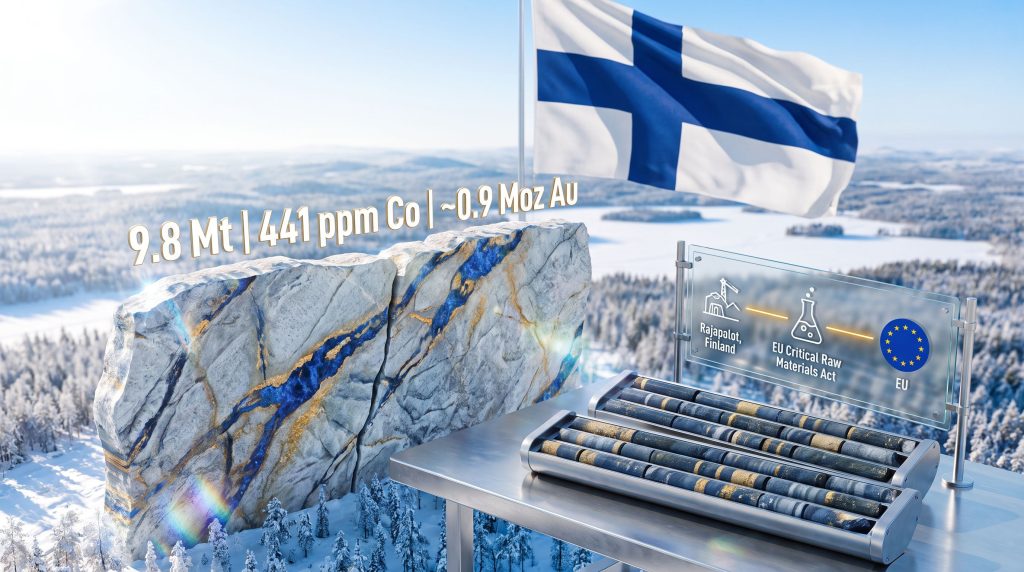
Located in northern Finland, the Rompas-Rajapalot land package covers approximately 11,000 hectares of prospective terrain. The project's appeal stems from a relatively unusual characteristic in modern mineral exploration: it hosts meaningful quantities of two commodities simultaneously, with gold and cobalt occurring within the same land package. Furthermore, the gold-cobalt project in Finland sits within a geologically significant region with a track record of producing economic deposits.
The current Inferred Resource estimate for the project captures the scale of what has been delineated through systematic drilling:
| Resource Parameter | Reported Figure |
|---|---|
| Total Inferred Resource | 9.8 million tonnes |
| Cobalt Grade | 441 ppm (parts per million) |
| Contained Cobalt | ~4,311 tonnes |
| Gold Endowment | ~0.9 million ounces |
| Land Package Size | 11,000 hectares |
Putting 441 ppm Cobalt in Commercial Context
For readers unfamiliar with cobalt deposit economics, grade is only part of the story. Cobalt grades are typically expressed in parts per million rather than percentages, which can make comparisons with other commodities counterintuitive. At 441 ppm, the Rajapalot resource sits within the range commonly associated with sediment-hosted and metamorphic cobalt systems found in Scandinavia and parts of central Europe, as distinct from the higher-grade but geopolitically complex sulphide and laterite deposits of the DRC.
What matters most in evaluating contained cobalt inventories is the combination of grade, tonnage, and metallurgical recoverability. A contained figure of approximately 4,311 tonnes of cobalt within a European jurisdiction carries meaningful weight when assessed against the EU's domestic sourcing targets. To put that in perspective, the European Battery Alliance has identified cobalt as one of the materials most exposed to import dependency risk, and even modest volumes of domestically recoverable cobalt contribute to reducing that exposure.
The Dual-Commodity Advantage
Single-commodity exploration projects carry a specific kind of price risk: when the target metal underperforms, there is no economic buffer. Rajapalot's dual gold-cobalt endowment changes that calculus meaningfully. The gold component, estimated at approximately 0.9 million ounces, provides a potential revenue offset during periods of cobalt price weakness, while also offering separate optionality to gold-focused capital.
This structural feature is not common among early-stage European critical mineral projects, and it is likely one of the factors that attracted Ocean Partners to the commercial conversation. In addition, the project's location within a stable, EU-member jurisdiction adds further appeal for partners conscious of supply chain traceability requirements.
The MoU Framework: Structure and Commercial Intent
The Goldsky and Ocean Partners MoU on Rajapalot cobalt investigation was formalised in July 2026. The agreement establishes a collaborative framework to assess whether cobalt recovery from Rajapalot's mineralised material is technically achievable and economically viable at commercial scale. Goldsky's announcement via Global Mining Review provides further detail on the agreement's scope and intent.
The four primary workstreams under investigation are:
- Metallurgical flowsheet design for cobalt extraction from the mineralised material
- Cobalt concentrate production pathways that could support downstream offtake
- Offtake and marketing structure development for the eventual concentrate product
- Concentrate blending strategies to optimise value capture for a junior producer
What Ocean Partners Brings to the Table
Ocean Partners is a specialist in metals marketing, concentrate logistics, and offtake structuring for base and critical metals. These capabilities are not generic. Cobalt concentrate marketing requires deep familiarity with battery supply chain procurement dynamics, spot and contract pricing mechanisms, and the technical specifications demanded by downstream refiners and precursor manufacturers.
For a junior explorer, securing a commercially experienced partner at the pre-feasibility stage delivers several advantages. It introduces market discipline into flowsheet design decisions, ensures that concentrate specifications are shaped around what buyers actually require rather than what is metallurgically convenient, and opens the door to potential project development financing from a partner with commercial skin in the game.
Important Clarification: The MoU signed between Goldsky Resources and Ocean Partners is a non-binding cooperation framework. It facilitates technical collaboration and information sharing but does not represent a committed obligation by either party to proceed with project construction, formal financing, or binding offtake arrangements.
How MoU Frameworks Function in Critical Minerals Development
Understanding where an MoU sits within the spectrum of commercial agreements helps contextualise what has been announced. In the critical minerals sector, commercial arrangements typically evolve through a defined sequence:
- Memorandum of Understanding (MoU): Non-binding, establishes intent to cooperate and defines workstreams
- Heads of Agreement (HoA): Semi-binding, captures commercial terms agreed in principle
- Binding Offtake Agreement: Legally enforceable, locks in volumes, pricing mechanisms, and delivery obligations
The Rajapalot MoU sits at the first stage of this progression. Its value lies in structuring the investigative work rather than committing either party to a commercial outcome. This is considered best practice for managing early-stage risk in critical mineral projects, particularly when metallurgical data is still being generated.
Phase 1: How the Cobalt Investigation Will Unfold
The structured approach to Phase 1 reflects a rigorous, data-first methodology. The steps are sequential and designed to generate defensible technical information before any commercial decisions are made:
- Representative Sample Collection from the Rajapalot project area, ensuring the material tested reflects the actual orebody characteristics
- Logistics and Transport of mineralised samples to accredited metallurgical laboratories capable of performing cobalt recovery testwork
- Metallurgical Testwork covering cobalt extraction rates, concentrate grades achievable, and flowsheet pathway options
- Quality Assurance and Oversight protocols to ensure data integrity throughout the laboratory programme
- Cost Sharing between Goldsky Resources and Ocean Partners, distributing the financial burden of Phase 1 across both parties
Hydrometallurgy vs. Pyrometallurgy: The Processing Decision That Shapes Everything
One of the most consequential technical decisions to emerge from Phase 1 will be the metallurgical processing pathway. Two broad options exist for cobalt recovery:
Hydrometallurgical processing involves leaching cobalt from mineralised material using acidic or alkaline solutions, followed by solvent extraction and electrowinning to produce cobalt sulphate or cobalt metal. This pathway is well-suited to cobalt mineralisation hosted in oxide or mixed sulphide-oxide systems and is increasingly preferred by battery-grade supply chains due to the purity of the output product.
Pyrometallurgical processing involves smelting and converting at high temperatures to produce a cobalt-bearing alloy or matte, which is then further refined. This pathway suits primary sulphide mineralisation but generates a less pure intermediate product, typically requiring additional refining steps before battery-grade specifications are met.
The mineralogical character of Rajapalot's cobalt-bearing material will be the determining factor. Cobalt in Scandinavian metamorphic terrains often occurs in arsenide and sulpharsenide mineral phases, such as cobaltite, which respond differently to hydrometallurgical leaching than oxide-hosted cobalt. Consequently, Phase 1 testwork will be critical in establishing which pathway maximises recovery efficiency and produces a concentrate specification that is commercially marketable.
Finland as a Mining Jurisdiction: Why Location Matters
Finland consistently ranks among the world's most mining-friendly jurisdictions. The Fraser Institute's annual survey of mining investment attractiveness has placed Finland in the top tier of global destinations for exploration and development capital, reflecting its combination of geological endowment, transparent regulatory frameworks, and political stability.
Northern Finland, where Rajapalot is located, sits within the Fennoscandian Shield, one of the most geologically significant cratonic terrains in Europe. The shield hosts a range of critical and battery metal mineralisation styles, including cobalt, nickel, lithium, and various platinum group elements. The geological setting at Rajapalot is consistent with the regional metallogeny that has produced economic deposits elsewhere along the shield. Furthermore, considerations around European critical raw materials supply make Finnish projects particularly relevant to EU policy goals.
Jurisdictional Note: Finland's membership in the European Union means that projects developed within its borders are directly relevant to EU domestic sourcing targets under the Critical Raw Materials Act. However, policy alignment at a national or continental level does not automatically translate into project-specific regulatory support or permitting acceleration. Each project's regulatory pathway is assessed independently through Finland's national permitting framework.
Europe's Cobalt Supply Vulnerability in Numbers
The structural argument for European cobalt development becomes sharper when the supply chain data is examined directly. The DRC cobalt supply risks are well documented and continue to shape procurement strategies across the European battery sector.
| Supply Chain Factor | Current Reality |
|---|---|
| EU Domestic Cobalt Production | Minimal, heavily import-dependent |
| Primary Global Cobalt Source | DRC (~70% of global mined supply) |
| EU Critical Raw Materials Act Target | 10% of annual consumption from domestic extraction by 2030 |
| Battery Sector Cobalt Demand Trajectory | Rising with EV adoption growth across European markets |
| Strategic Role of Projects Like Rajapalot | Diversification of geographic concentration risk within EU supply chains |
The EU's dependency on DRC cobalt is not merely a price-risk issue. It incorporates supply chain traceability concerns, artisanal and small-scale mining governance challenges, and geopolitical exposure. European regulators and corporate procurement teams are increasingly required to demonstrate responsible sourcing under the EU Battery Regulation, which mandates due diligence and traceability for battery materials sold in European markets. A domestically produced, traceable cobalt concentrate from a Finnish operation would, in principle, meet those requirements more readily than imported material.
The next major ASX story will hit our subscribers first
Goldsky's Exploration Investment and the Shift Toward Feasibility
The decision to pursue a cobalt commercialisation investigation does not occur in isolation. It follows 31 completed drill holes at Rajapalot as of mid-2026, representing a sustained and capital-intensive programme of systematic exploration. Progressing from raw exploration to metallurgical testwork and commercial partner engagement marks a meaningful shift in project maturity.
Broader trends in global cobalt production are reshaping where capital flows within the sector, and European assets are increasingly attracting serious attention. For a gold-focused explorer to pivot toward dual-commodity production positioning, particularly in a critical metals category attracting growing institutional and industrial interest, signals an evolving corporate development strategy.
The Goldsky and Ocean Partners MoU on Rajapalot cobalt investigation is a visible expression of that strategic evolution: a deliberate move to assess whether the cobalt endowment within an existing gold exploration project can be developed into a commercial asset in its own right. Moreover, the cobalt demand outlook suggests that timing such a move ahead of a demand uplift cycle could prove strategically astute.
Frequently Asked Questions
What is the Rajapalot project?
Rajapalot is a gold-cobalt exploration project in northern Finland, part of the broader Rompas-Rajapalot land package covering approximately 11,000 hectares. It hosts an Inferred Resource of 9.8 million tonnes at 441 ppm cobalt, containing an estimated 4,311 tonnes of cobalt alongside approximately 0.9 million ounces of gold.
What does the MoU between Goldsky and Ocean Partners involve?
The MoU, signed in July 2026, establishes a framework for investigating the technical and economic feasibility of recovering cobalt from Rajapalot's mineralised material, covering metallurgical flowsheet development, offtake structuring, concentrate marketing, and cost-sharing for Phase 1 testwork. Further details on the MoU are available via the Australian mining press coverage of the announcement.
Is the MoU legally binding?
No. The MoU is a non-binding cooperation agreement enabling technical collaboration and information exchange. It does not create legal obligations to proceed with construction, financing, or formal offtake commitments.
Why is cobalt recovery at Rajapalot strategically important?
Cobalt is classified as a strategic raw material under EU frameworks. A domestic European cobalt source addresses the bloc's significant dependence on imports from geopolitically sensitive regions and aligns with the EU Critical Raw Materials Act's domestic extraction targets.
What happens after Phase 1?
Phase 1 metallurgical testwork results, covering recovery rates, flowsheet options, and preliminary concentrate specifications, will determine whether both parties choose to advance toward binding commercial arrangements, including potential offtake agreements or project development financing participation.
Key Takeaways for Investors and Industry Observers
- The Goldsky and Ocean Partners MoU on Rajapalot cobalt investigation represents a structured, evidence-based approach to unlocking critical metal value from an exploration-stage asset
- Finland's geological setting and stable regulatory environment strengthen the strategic positioning of Rajapalot within Europe's evolving critical minerals landscape
- The non-binding MoU structure reflects industry-standard risk management practice, preserving optionality while generating the technical data needed for informed commercial decisions
- Phase 1 metallurgical testwork is the pivotal catalyst that will determine whether Rajapalot progresses toward a commercial cobalt production profile
- The dual gold-cobalt commodity structure provides economic resilience that single-commodity critical mineral projects typically lack
This article contains forward-looking statements and references to exploration-stage resource estimates. Inferred Resources carry inherent geological uncertainty and should not be interpreted as a guarantee of economic viability. Readers should conduct independent due diligence before making any investment decisions. For additional context on the EU Critical Raw Materials Act and European critical mineral development, visit geodrillinginternational.com.
Want to Stay Ahead of the Next Major Critical Mineral Discovery on the ASX?
Discovery Alert's proprietary Discovery IQ model delivers real-time alerts on significant ASX mineral discoveries across cobalt, gold, and more than 30 other commodities — instantly translating complex data into actionable investment insights for both short-term traders and long-term investors. Explore historic discoveries and their exceptional returns on Discovery Alert's dedicated discoveries page, and begin your 14-day free trial today to position yourself ahead of the broader market.