May 20, 2026
India's Critical Mineral Ambitions and the States That Will Define Them
Global competition for critical mineral supply chains has intensified at a pace few analysts predicted even five years ago. As the energy transition accelerates and defence technology grows more sophisticated, the geographic lottery of mineral endowment has taken on renewed strategic weight. Within India, this dynamic is converging on a single northwestern state that is quietly repositioning itself at the centre of the country's resource future.
Rajasthan mining sector reforms have moved well beyond routine administrative updates. What is unfolding across the state combines policy architecture, digital governance, geological exploration, and industrial strategy into a reform package that deserves serious analytical attention from investors, supply chain planners, and policymakers alike.
When big ASX news breaks, our subscribers know first
The Geological Case: Why Rajasthan's Mineral Wealth Is Still Largely Untapped
Most discussions of Indian mining concentrate on the eastern mineral belt spanning Odisha, Jharkhand, and Chhattisgarh. Rajasthan's mineral story, by contrast, is less widely understood despite compelling fundamentals.
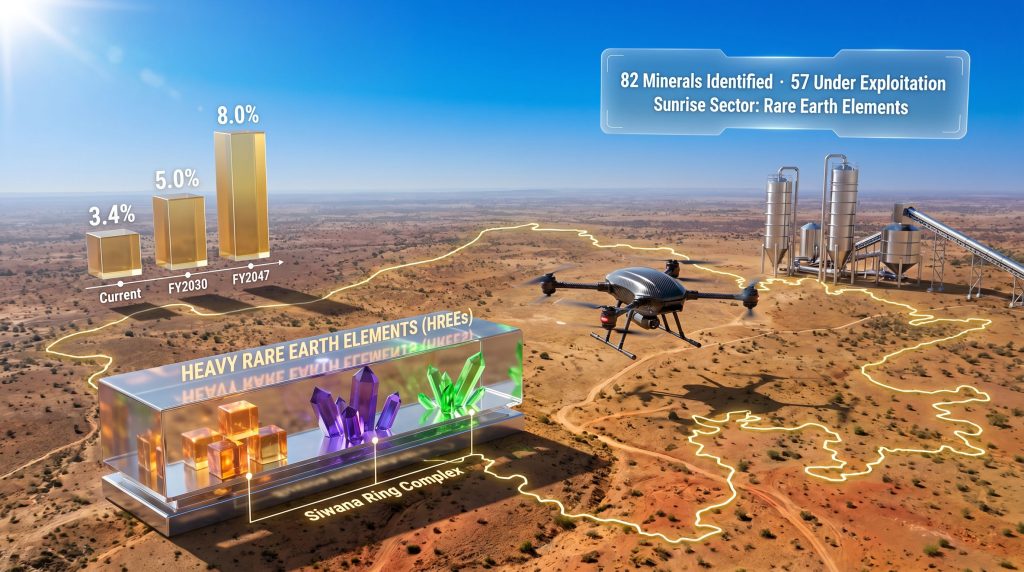
The state hosts 82 identified mineral types, yet only 57 of those are currently under active commercial extraction. That gap between known endowment and operational production is not merely a statistical curiosity. It represents a structural opportunity that the state government is now explicitly targeting through coordinated policy reform.
The mineral portfolio spans considerable breadth:
- Industrial minerals and construction aggregates with near-term commercial demand
- Base metals supporting manufacturing and infrastructure sectors
- Phosphate and gypsum serving India's enormous agricultural input requirements
- Silica and related materials relevant to domestic solar manufacturing
- Rare earth elements (REEs) and heavy rare earth elements (HREEs), which represent the highest-value frontier of the state's resource potential
The last category deserves particular focus. Heavy rare earth elements such as dysprosium and terbium are not interchangeable commodities. They are precision inputs for permanent magnets used in electric vehicle drivetrains, offshore wind turbines, and advanced defence guidance systems. Global supply of HREEs is heavily concentrated, with China controlling an estimated 60 to 70 percent of refined production according to the United States Geological Survey. Any credible alternative source carries genuine strategic value. Furthermore, China's rare earth restrictions have intensified the urgency for nations to develop domestic and allied sources of supply.
The Siwana Ring Complex: India's Most Significant HREE Formation
Within this context, the Siwana Ring Complex commands attention. Spanning the Barmer and Balotra districts of western Rajasthan, this alkaline igneous ring complex is geologically analogous to formations in southern Africa and Scandinavia that have hosted world-class rare earth deposits.
Ring complexes of this type form through deep-seated magmatic intrusion processes and are known for concentrating heavy rare earth elements at grades that differ significantly from the light-REE-dominant laterite deposits more commonly associated with Chinese production. The distinction matters for processing strategy: HREEs require different separation and refining pathways, and their end-use applications command considerably higher market prices per tonne.
The Rajasthan state government has directed the appointment of a dedicated nodal officer to accelerate implementation activities at Siwana, reflecting recognition that this particular formation warrants prioritised oversight rather than standard bureaucratic processing.
Rajasthan's geographic position in northwestern India also provides a natural logistics corridor connecting mineral production zones to manufacturing clusters in Gujarat, Maharashtra, and Delhi-NCR, reducing the infrastructure disadvantage that affects more remote eastern mineral provinces.
Policy Architecture Driving the Reform Wave
Understanding the reform agenda requires examining its structural components, not just headline announcements. Three interconnected policy instruments form the foundation of Rajasthan's repositioning.
Mineral Policy 2024 and M-Sand Policy 2024
The Mineral Policy 2024 introduces updated governance principles emphasising sustainable extraction practices, improved regulatory coordination, and a more investor-friendly approvals architecture. Importantly, it incorporates explicit provisions for mine reclamation obligations and waste management standards, addressing the environmental governance gaps that have historically created community resistance to mining expansion.
The M-Sand Policy 2024 targets a specific market failure in the construction sector. India's rapid urbanisation has created sustained demand for sand aggregates while river sand extraction has become increasingly restricted for environmental reasons. Manufactured sand, produced through controlled crushing of rock, offers a regulated alternative. By formalising this market, Rajasthan reduces a bottleneck in its own construction pipeline while creating a new category of licensed mining activity. You can review the Rajasthan Mineral Policy 2024 document directly for the full scope of its provisions.
RIPS 2024: Structured Investment Incentives for Mining
The Rajasthan Investment Promotion Scheme 2024 has formally expanded its priority sector classifications to include metals and mining. Rare earth element projects receive sunrise sector designation, which unlocks a tiered incentive structure including:
- Capital subsidy provisions for qualifying investments
- Preferential land allocation arrangements
- Expedited regulatory clearance pathways
- Access to industrial zone infrastructure
This classification reflects a deliberate choice to compete aggressively for investment in a sector where multiple Indian states and international jurisdictions are vying for the same pool of capital. In addition, India's critical minerals mission provides overarching national policy support that reinforces state-level initiatives such as RIPS 2024.
GDP Contribution Targets: The Growth Roadmap
The state has established explicit production growth targets that provide investors with a planning horizon:
| Timeframe | Mining's Target Contribution to Rajasthan GDP |
|---|---|
| Current Baseline | ~3.4% |
| FY2030 Target | 5.0% |
| FY2047 Target | 8.0% |
Reaching the FY2047 target would require not only expanded extraction volumes but the development of downstream processing, smelting, refining, and advanced materials manufacturing within the state. This is where the most substantial value creation would occur, and where the investment opportunity extends well beyond primary mining operators.
Solving the Clearance Bottleneck: The Pre-Embedded Approval Model
Among all the reforms under discussion, the shift toward pre-clearance auction architecture may prove the most consequential for investor behaviour. Under conventional practice across Indian states, environmental and regulatory approvals are pursued after a block is auctioned to a successful bidder. This sequencing creates a prolonged and uncertain lag between capital commitment and production commencement, sometimes stretching to several years.
The pre-clearance model inverts this logic. By securing environmental approvals before a block reaches auction, the winning bidder acquires not just a mineral right but a substantially de-risked development pathway. The commercial implications are significant:
- Reduced financing risk: Lenders gain greater certainty around project timelines and cashflow commencement.
- Improved auction competition: More bidders can participate when regulatory uncertainty is reduced, improving price discovery.
- Faster production ramp-up: Post-auction development timelines compress when clearances are already in place.
- Stronger investor confidence: Particularly relevant for foreign capital that carries higher political and regulatory risk sensitivity.
Complementing this, state leadership has directed officials to accelerate coordination with the Geological Survey of India (GSI), ensuring that centrally-gathered exploration data is actively shared with state authorities for land management and conservation planning. This data-sharing initiative reduces the information asymmetry that has historically disadvantaged smaller investors unfamiliar with local geology. For context, mining exploration licences in comparable reform-focused jurisdictions demonstrate how streamlined approvals can attract capital at scale.
Technology as a Governance Multiplier
Policy reform without enforcement infrastructure tends to produce uneven outcomes. Rajasthan's approach incorporates technology-enabled governance tools that address this implementation gap.
Drone Surveillance for Extraction Verification
The state government plans to deploy drone-based monitoring technology to cross-verify actual extraction volumes against officially reported production data. This is a direct response to a well-documented problem in Indian mining: systematic under-reporting of production volumes, which suppresses royalty revenues and distorts the resource accounts that inform planning decisions.
The drone monitoring approach creates a verifiable audit trail that operates independently of self-reported operator data. For investors, this matters because:
- It reduces the governance risk premium embedded in Indian mining valuations
- It strengthens the state's royalty revenue base, improving fiscal sustainability of the incentive framework
- It creates reputational differentiation for compliant operators relative to those relying on opacity
Digital Auction Platforms and Real-Time Dashboards
Alongside physical monitoring, a transition toward online bidding platforms and digital production monitoring dashboards is underway. These tools improve price discovery, reduce rent-seeking opportunities in block allocation, and provide institutional investors and offtakers with the governance visibility that long-term capital commitment requires.
For institutional investors evaluating Indian mining assets, verifiable digital governance infrastructure directly reduces the due diligence burden and lowers the threshold for capital deployment.
How Rajasthan's Mineral Base Addresses India's Strategic Industrial Needs
The investment case for Rajasthan's mineral sector cannot be fully evaluated without understanding the demand architecture it serves. India's industrial transition is generating simultaneous demand spikes across multiple mineral categories.
| Sector | Relevant Minerals | Strategic Driver |
|---|---|---|
| Defence and Aerospace | Heavy rare earths, titanium | Indigenisation of advanced weapons and guidance systems |
| Solar Energy Manufacturing | Silica, rare earths | Domestic panel and component production capacity |
| Electric Vehicles | REEs for permanent magnets, phosphate | EV drivetrain and battery supply chain localisation |
| Agriculture | Phosphate, gypsum | Fertiliser input security and import substitution |
| Automobiles and Components | Industrial minerals, base metals | Manufacturing ecosystem development |
India's dependence on imported critical mineral inputs, particularly those processed through Chinese facilities, represents a structural vulnerability that policymakers are actively working to reduce. Consequently, Rajasthan's mineral endowment positions it as a meaningful domestic supply-side contributor across several of these categories simultaneously. Indeed, broader rare earth supply chains are under acute pressure globally, making domestic alternatives all the more strategically valuable.
Union Minister G Kishan Reddy, present at a recent high-level state-centre coordination meeting in Jaipur, emphasised that Rajasthan is emerging as a significant hub for critical minerals with the capacity to meet growing demand across defence, energy, agriculture, solar, and automobile sectors. This acknowledgement from the central government level signals that Rajasthan's mineral ambitions are regarded as nationally relevant, not merely a state-level economic development initiative.
The next major ASX story will hit our subscribers first
Environmental and Community Governance: The Social Licence Dimension
Any serious analysis of Rajasthan mining sector reforms must address the environmental and community dimensions that will determine whether production growth is sustainable over the long term.
District Mineral Foundation (DMF) funds were specifically discussed at the recent inter-governmental meeting. These levies, collected from mining operators and directed toward affected communities, provide healthcare, education, infrastructure, and livelihood support in mining-impacted districts. Effective DMF deployment is increasingly understood as a prerequisite for maintaining the social licence to operate that determines whether communities support or resist mining activity.
The Mineral Policy 2024 framework incorporates:
- Eco-friendly extraction standards with binding environmental compliance requirements
- Mine reclamation obligations triggered at closure or cessation of production
- Waste management protocols designed to prevent tailings contamination
- Community welfare objectives framed as co-equal priorities alongside production targets
This represents a genuine evolution in mining governance philosophy. The traditional model optimised purely for extraction volume; the emerging framework recognises that community opposition and environmental litigation are the most frequent causes of project delays and asset impairment in Indian mining.
Comparing Rajasthan's Reform Trajectory to National and State-Level Peers
At the national level, successive amendments to the Mines and Minerals (Development and Regulation) Act have progressively expanded competitive auction processes, introduced Exploration Licences to attract private risk capital into early-stage geological work, and created pathways for composite licences that allow seamless transition from exploration to production. These national reforms create a framework that state-level policy either amplifies or undermines. A broader overview of India's mining sector reforms provides useful context for understanding where Rajasthan's initiatives sit within the national picture.
Rajasthan sits firmly in the amplification category. When benchmarked against peer mineral-rich states, several differentiating factors emerge:
- Pre-clearance auction architecture: Few Indian states have adopted this model comprehensively, giving Rajasthan a first-mover advantage in investor perception
- Sunrise sector designation for REEs: The explicit RIPS 2024 classification for rare earth projects is more targeted than incentive frameworks in Odisha or Madhya Pradesh, which skew toward conventional bulk minerals
- Centre-state data sharing on GSI exploration sites: Active coordination on exploration intelligence reduces information asymmetry in ways that benefit investors across the experience spectrum
- Drone-based enforcement: Digital governance tools are being deployed ahead of most comparable states
Investment Landscape: Opportunities Across the Development Timeline
The reform architecture creates differentiated opportunities depending on investor risk appetite and time horizon.
Near-term (0 to 3 years):
- Acquisition of pre-cleared auctioned mineral blocks by experienced mining operators
- Investment in mineral processing and beneficiation infrastructure as extraction volumes ramp up
- Manufactured sand operations benefiting from M-Sand Policy 2024 formalisation
Medium-term (3 to 7 years):
- Development of the Siwana Ring Complex and other REE-bearing formations, contingent on exploration completion and definitive feasibility studies
- Downstream rare earth separation and processing facilities seeking to capture value above primary extraction
- Logistics and infrastructure investments serving expanding production regions
Long-term structural (7 years and beyond):
- Advanced materials manufacturing leveraging processed rare earth outputs
- Integration into global EV and clean energy supply chains as Indian domestic content requirements tighten
- Potential for Rajasthan-based REE processing to serve export markets if production scale justifies it
Execution Risks That Investors Must Assess Honestly
Disclaimer: The following analysis involves forward-looking assessments and should not be construed as financial advice. All investment decisions carry inherent risks and should be made with appropriate professional guidance.
The gap between policy announcement and operational delivery is the defining risk variable in Indian state-level mining reform. Several structural constraints warrant honest assessment:
- Environmental clearance timelines remain partially subject to central regulatory processes that state governments cannot fully control, even under an accelerated framework
- Water availability in arid western Rajasthan presents genuine operational constraints for mineral processing operations that require significant water inputs
- Workforce and technical capability gaps in remote districts require sustained investment in training and infrastructure that policy reform alone cannot provide
- Geological uncertainty at formations like Siwana remains until systematic drilling and resource estimation work is completed to international standards
Balanced against these risks, the combination of explicit GDP targets, digital governance investment, centre-state coordination at ministerial level, and sunrise sector incentives creates a reform momentum that is more durable than most previous state-level mining initiatives in India. However, investors should monitor implementation milestones carefully to distinguish genuine progress from policy intent.
Frequently Asked Questions: Rajasthan Mining Sector Reforms
How many minerals are found in Rajasthan?
Rajasthan contains 82 identified mineral types, of which 57 are currently under active commercial exploitation. The remaining 25 types, including several critical and rare earth minerals, represent the primary focus of the state's next-phase resource development agenda.
What makes the Siwana Ring Complex geologically significant?
The Siwana Ring Complex spans the Barmer and Balotra districts of western Rajasthan and is notable for concentrations of rare earth and heavy rare earth elements. Its alkaline igneous ring complex geology is associated globally with HREE-enriched systems, distinguishing it from the light-REE laterite deposits that dominate Chinese production.
What is the pre-clearance auction model?
Under this approach, environmental and regulatory approvals are secured before a mineral block is offered at auction, rather than being pursued by the winning bidder afterward. This reduces the regulatory lag between block allocation and production commencement, making investments more commercially predictable.
What does RIPS 2024 offer mining investors?
The Rajasthan Investment Promotion Scheme 2024 has expanded its priority sector framework to include metals and mining. Rare earth element projects receive sunrise sector status, providing capital subsidies, land allocation preferences, and access to expedited clearance pathways.
How is Rajasthan addressing illegal mining and under-reporting?
The state plans to deploy drone surveillance technology to compare actual extraction volumes against reported production data, creating a verifiable audit mechanism that reduces under-reporting and protects royalty revenue without requiring proportionate increases in physical inspection capacity.
What is Rajasthan's target for mining's contribution to state GDP?
The state aims to increase mining's share of Rajasthan GDP from approximately 3.4% currently to 5% by FY2030, with a longer-term target of 8% by FY2047, requiring both expanded extraction and downstream processing development.
Want to Stay Ahead of the Next Major Critical Mineral Discovery?
Discovery Alert's proprietary Discovery IQ model delivers real-time alerts on significant ASX mineral discoveries — cutting through complex data across 30-plus commodities to surface actionable opportunities the moment they emerge. Explore historic examples of what major mineral discoveries can return and begin your 14-day free trial today to position yourself ahead of the market.