June 14, 2026
The Geopolitical Scramble Reshaping Global Rare Earth Supply Chains
Few resource competitions in modern history have escalated as rapidly as the contest now unfolding across Central Asia. Russia US EU rare earth activity in Central Asia has become one of the defining strategic fault lines of the current decade, driven by the convergence of Western industrial policy, Chinese supply chain dominance, and Russia's deepening anxiety about its regional influence. Furthermore, understanding these rare earth supply chains requires looking beyond the immediate headlines and examining the structural forces that make this region simultaneously so valuable and so difficult to integrate into alternative supply chains.
When big ASX news breaks, our subscribers know first
Why Central Asia's Mineral Geography Creates a Unique Strategic Opportunity
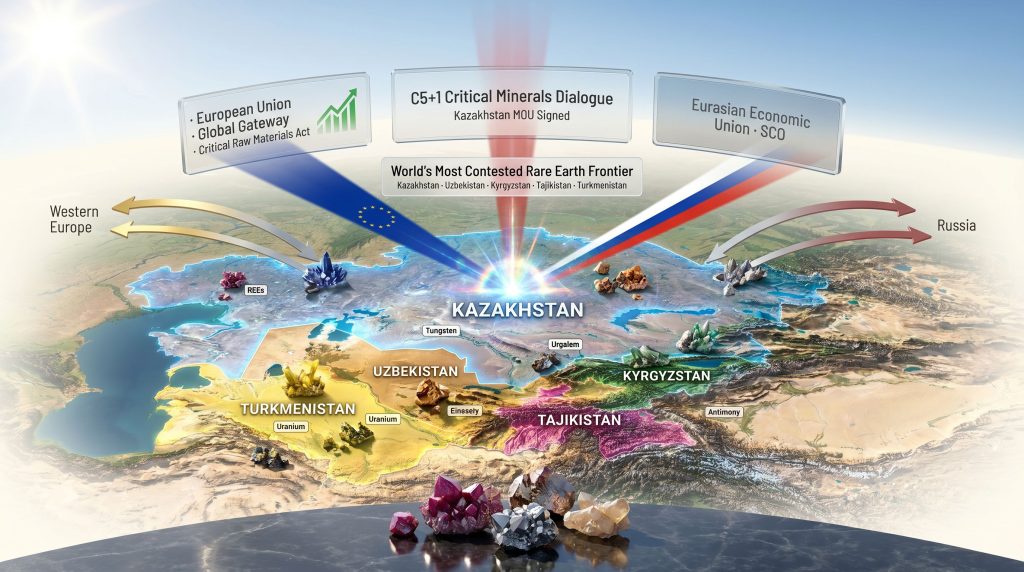
The five nations of Central Asia collectively hold some of the most significant underdeveloped rare earth element (REE) occurrences anywhere outside of China. Kazakhstan alone hosts the region's largest concentration of known REE deposits alongside substantial uranium and tungsten reserves. Uzbekistan is advancing a multi-billion-dollar programme targeting dozens of rare metal projects.
The smaller nations of Kyrgyzstan and Tajikistan hold meaningful gold, antimony, and REE endowments that remain largely untouched by international capital. Consequently, Central Asia's emerging role in global mineral supply chains has attracted intensifying attention from all major powers.
| Country | Key Critical Minerals | Strategic Status |
|---|---|---|
| Kazakhstan | REEs, uranium, tungsten, chromium | Regional leader; most developed mining sector |
| Uzbekistan | REEs, rare metals, gold | Multi-billion-dollar rare metals expansion underway |
| Kyrgyzstan | REEs, gold, antimony | Resource-rich but infrastructure-constrained |
| Tajikistan | REEs, silver, antimony | Early-stage Western engagement |
| Turkmenistan | Natural gas, select critical minerals | Least integrated into Western supply chains |
What makes Central Asia particularly compelling is not just the geology, but the gap between what exists in the ground and what can currently be extracted, processed, and exported. The region lacks the downstream refining and processing infrastructure necessary to convert raw mineral output into the specification materials that Western manufacturers require.
Critically, most of the region's existing export infrastructure either routes through Russian-controlled corridors or relies on Chinese commercial networks for downstream processing. This transit and processing dependency is precisely the leverage point that Western powers are now attempting to erode through targeted investment and diplomatic engagement.
China's Dominance as the Catalyst for Western Policy Realignment
To understand the current scramble, it is necessary to first understand what is driving it. China controls an estimated 60% or more of global rare earth mining output and an even larger share of the downstream processing and refining capacity that transforms raw ore into usable materials. The EU has historically sourced the overwhelming majority of its rare earth supply from China, while the United States has similarly relied on Chinese-processed materials across critical technology sectors.
This concentration carries consequences that extend well beyond standard trade risk. The rare earth elements at stake are not optional inputs that can be substituted or stockpiled indefinitely. They are structurally embedded in the most strategically important technologies of the current era:
- Electric vehicle motors require neodymium, praseodymium, dysprosium, and terbium for permanent magnet systems
- Offshore and onshore wind turbines depend on high-performance REE-based permanent magnets
- Radar systems, missile guidance, and advanced communications technology rely on REE-based components
- The importance of critical minerals for semiconductors and electronics manufacturing spans a broad range of minerals found across the Central Asian region
Key Insight: The strategic imperative behind Western engagement in Central Asia is not simply about finding alternative mining sources. It is fundamentally about controlling the processing and refining stages where the greatest value and supply chain leverage actually reside. Upstream mining access, without a solution to the midstream processing gap, does not solve the Western dependency problem.
A nuance that is often overlooked in public discourse is the distinction between light rare earth elements (LREEs) such as cerium and lanthanum, which are relatively abundant, and heavy rare earth elements (HREEs) such as dysprosium, terbium, and holmium, which are far scarcer and disproportionately concentrated in Chinese-controlled deposits and processing circuits.
The United States Engagement Architecture in Central Asia
Washington's approach to Central Asia has evolved from periodic diplomatic engagement into a structured, multi-layered strategy anchored around the C5+1 Critical Minerals Dialogue, a framework that connects the United States simultaneously with all five Central Asian governments. This architecture serves a dual purpose: it builds regional supply chain integration while presenting a unified Western economic alternative to the Eurasian institutional networks that Russia and China have cultivated over decades.
The financial instruments deployed alongside this diplomatic framework are substantial:
| Agency | Role in Central Asia Engagement |
|---|---|
| U.S. International Development Finance Corporation (DFC) | Project financing for critical mineral extraction and infrastructure |
| Export-Import Bank (EXIM) | Trade finance support for U.S. companies entering the region |
| USAID | Technical assistance and governance reform support |
Kazakhstan has emerged as the primary bilateral anchor for U.S. engagement. A formal Memorandum of Understanding on critical minerals signed between Washington and Astana represents the most concrete formal commitment to date. U.S. financing interest has been specifically linked to Kazakhstan's significant tungsten deposit, a mineral of growing strategic importance for defence manufacturing.
When U.S. President Donald Trump hosted the leaders of all five Central Asian nations at the White House, he framed critical minerals as a top-tier administration priority. The symbolism of that meeting was deliberate and significant: it signalled that Washington now views Central Asian mineral access as a supply chain security matter, not merely a trade policy question.
The European Union's Strategy and Its Execution Gap
The EU's Central Asian engagement operates through two primary policy instruments working in combination. The Global Gateway infrastructure initiative provides the investment financing framework, while the Critical Raw Materials Act creates the regulatory and industrial cooperation architecture designed to integrate Central Asian supply chains into European manufacturing networks. In addition, European critical raw materials policy has been evolving rapidly in response to supply chain vulnerabilities exposed in recent years.
In practice, the EU has made meaningful diplomatic progress:
- Strategic memoranda signed with Kazakhstan covering raw materials, processing cooperation, and renewable energy
- Active partnership agreements with Uzbekistan on critical raw materials and circular economy initiatives
- Growing project-level interest in Tajikistan and early-stage dialogue across the broader region
However, a persistent and structurally important gap exists between the EU's stated investment commitments and the actual capital deployed at the project level. Diplomatic momentum has consistently outpaced commercial execution. This matters because the window for establishing first-mover infrastructure relationships in Central Asia is not unlimited.
Russian and Chinese networks are already embedded, and the Central Asian governments themselves are actively managing relationships with all major powers simultaneously to maximise their own leverage. If EU capital deployment does not accelerate to match diplomatic ambitions, the competitive advantage created by the current wave of partnership agreements risks eroding before permanent supply chain ties are established.
Russia's Position: Institutional Leverage and Strategic Alarm
Russia's concern about intensifying Russia US EU rare earth activity in Central Asia is not simply a reaction to losing commercial market share. It reflects a deeper anxiety about the erosion of institutionally embedded influence that has taken decades to build. Moscow's presence in the region is anchored not just by historical relationships, but by the Eurasian Economic Union (EEU), the Shanghai Cooperation Organisation (SCO), and a web of industrial, logistical, and workforce linkages that Western MOUs cannot easily replicate.
Russia's embedded structural interests in the region include:
- A dominant position in Kazakhstan's uranium sector and the export logistics infrastructure surrounding it
- Control over key transit corridors that Central Asian mineral exports depend upon for reaching international markets
- Legacy industrial relationships with mining equipment suppliers and technical workforce pipelines built over the Soviet period
- Institutional influence through multilateral frameworks that shape the legal and economic governance of the region
Russia's Deputy Foreign Minister Mikhail Galuzin characterised Western critical minerals activity in Central Asia as representing far more than standard economic competition. In his framing, U.S. and EU engagement constitutes a deliberate attempt to displace Russian influence and construct Western-controlled infrastructure networks directly on Russia's borders — language that frames mineral diplomacy explicitly as a national security matter.
What makes Russia's concern particularly credible from a strategic standpoint is that permanent Western-aligned supply chain infrastructure in Central Asia would not merely divert some mineral trade flows. It would create lasting institutional ties between Central Asian governments and Western financial and regulatory systems, progressively reducing the economic dependence that underpins Russian leverage in the region.
The next major ASX story will hit our subscribers first
Three-Way Competition: A Comparative Strategic Assessment
| Dimension | Russia | United States | European Union |
|---|---|---|---|
| Primary Engagement Tool | Legacy institutional ties, transit control | Diplomatic frameworks, development finance | Investment treaties, Global Gateway |
| Key Multilateral Vehicle | EEU, SCO | C5+1 Critical Minerals Dialogue | Critical Raw Materials Act, Global Gateway |
| Strongest Bilateral Relationship | Kazakhstan (uranium/logistics) | Kazakhstan (MOU signed) | Kazakhstan + Uzbekistan (strategic MOUs) |
| Processing/Refining Capability | Moderate domestic capacity | Limited in-region | Limited in-region |
| Primary Strategic Vulnerability | Declining economic attractiveness vs. Western capital | Late engagement; limited on-ground presence | Execution gap between commitments and deployed capital |
| Stance on Chinese Dominance | Cooperative/complementary | Explicitly competitive | Explicitly competitive |
China's position in this equation deserves separate emphasis. Despite the three-way framing that dominates current geopolitical commentary, China remains the dominant force in actual rare earth refining and much of the existing mineral trade flowing out of Central Asia. Furthermore, the rare earth geopolitical impact extends well beyond the region itself, shaping technology supply chains, defence procurement, and energy transition timelines globally.
Western diversification efforts must therefore displace established Chinese commercial relationships rather than simply entering a vacant market, which is a meaningfully harder task than the diplomatic narrative often implies. China's rare earth strategy has been deliberately constructed to make such displacement as difficult as possible, leveraging processing dominance rather than mining volume alone.
The Five Structural Barriers That Could Undermine Western Ambitions
Even with significant diplomatic momentum, Western actors face five structural challenges that could undermine their Central Asian critical minerals strategy:
1. Processing Infrastructure Gap
Central Asian nations lack the downstream refining capacity to produce the specification materials Western manufacturers need. Closing this gap requires long-term capital, technology transfer agreements, and workforce development that go well beyond diplomatic frameworks.
2. Russian and Chinese Transit Leverage
Much of the region's export infrastructure routes through Russian or Chinese-controlled corridors. Building alternative transit routes such as the Middle Corridor through the Caspian Sea carries significant capital costs and geopolitical complexity of its own.
3. Multi-Vector Foreign Policy Dynamics
Central Asian governments have deliberately maintained relationships with all major powers simultaneously. Kazakhstan's multi-vector foreign policy is perhaps the most sophisticated example: Astana has signed mineral MOUs with Washington while maintaining deep economic and institutional ties to both Moscow and Beijing.
4. EU Capital Deployment Gap
European investment commitments have consistently exceeded actual capital flows to the project level. Without closing this execution gap, the EU risks ceding first-mover advantages to competitors who move more quickly.
5. ESG Standards as a Competitive Disadvantage
Western financing institutions apply environmental, social, and governance standards that can materially slow project timelines compared to Russian or Chinese capital. In fast-moving resource development environments, this creates a structural speed disadvantage that is difficult to overcome through diplomatic goodwill alone.
Scenario Analysis: Three Trajectories Through 2030
Which Scenario Is Most Likely?
Scenario A: Western Breakthrough
Sustained U.S. and EU investment successfully builds processing infrastructure in Kazakhstan and Uzbekistan. Central Asian REE supply begins flowing into Western manufacturing networks by the late 2020s, materially reducing Chinese midstream dominance for specific supply chains.
Scenario B: Fragmented Multipolarity
Central Asian nations successfully distribute mineral supply across Russian, Chinese, U.S., and EU networks simultaneously. No single power achieves dominant supply chain control, producing a more fragmented but potentially more resilient global REE market architecture.
Scenario C: Russian-Chinese Consolidation
Western execution gaps allow existing Eurasian infrastructure and processing networks to deepen before alternatives mature. Central Asian nations remain primarily integrated into Russian and Chinese economic frameworks, delaying Western diversification by a decade or more.
Analytical Assessment: Current evidence most closely supports Scenario B as the near-term trajectory, with selective Scenario A elements emerging in Kazakhstan and Uzbekistan where Western engagement is most advanced. Scenario C remains a credible risk if EU capital deployment does not accelerate substantially in the next two to three years.
Disclaimer: Scenario projections and forward-looking assessments in this article are analytical in nature and do not constitute investment advice. Geopolitical and commodity market outcomes involve material uncertainty and may differ substantially from projected trajectories.
Frequently Asked Questions
Why is Russia concerned about US and EU rare earth activity in Central Asia?
Russia interprets Western critical minerals engagement as a strategic threat to its institutionally embedded regional influence, not merely economic competition. Moscow's concern centres on the risk that permanent Western-aligned supply chain infrastructure would reduce Central Asian economic dependence on Russian transit networks and erode Russia's structural leverage in what it considers its most immediate strategic buffer zone.
Which Central Asian country has the most rare earth potential?
Kazakhstan holds the largest concentration of known REE occurrences in the region and operates its most developed mining sector. Uzbekistan is emerging rapidly as a secondary player through a multi-billion-dollar rare metals development programme. Both nations are currently the primary focus of Western diplomatic and financial engagement.
How does the US fund its critical minerals engagement in Central Asia?
Washington deploys a combination of diplomatic architecture through the C5+1 Critical Minerals Dialogue alongside financial instruments including the Development Finance Corporation, Export-Import Bank, and USAID, covering project financing, trade finance, and technical assistance respectively.
What is the EU's strategy for securing Central Asian rare earths?
The EU combines the Global Gateway infrastructure initiative with the Critical Raw Materials Act framework to pursue investment financing and strategic partnership agreements. Formal memoranda have been signed with both Kazakhstan and Uzbekistan, though actual capital deployment has lagged behind stated commitments.
Does China still dominate Central Asia's rare earth sector?
Despite growing Western engagement, China remains deeply embedded in Central Asian rare earth trade and processing networks. Western diversification efforts must displace established Chinese commercial relationships, which represents a harder and longer-term challenge. For further context, the Atlantic Council's analysis of how Central Asia might break China's rare earth dominance provides additional strategic perspective on the obstacles involved.
Want to Track the Next Major Rare Earth Discovery Before the Market Does?
Discovery Alert's proprietary Discovery IQ model delivers real-time alerts the moment significant ASX mineral discoveries are announced — including critical and rare earth minerals at the centre of today's global supply chain reshaping — turning complex geological data into clear, actionable insights for investors at every level. Explore how historic mineral discoveries have generated extraordinary returns and begin your 14-day free trial today to position yourself ahead of the market.