Enova Mining Ltd
- ASX Code: ENV
- Market Cap: $3,961,218
Enova Mining Confirms High-Grade Rare Earth Hits at Charley Creek as Saprolite Becomes the Key Target
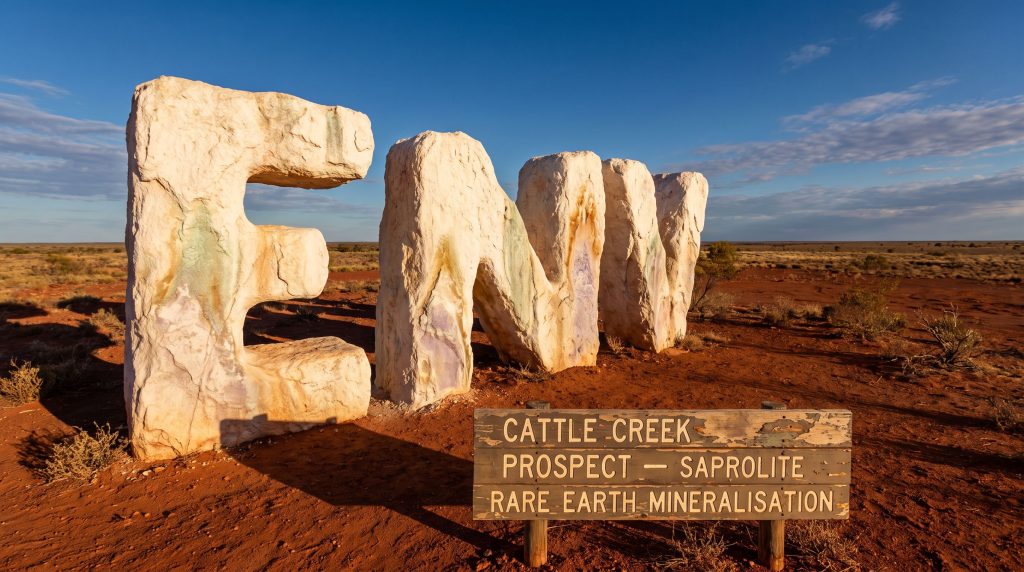
Enova Mining Limited (ASX: ENV) has reported thick, shallow rare earth intercepts from the Cattle Creek Prospect within its Charley Creek Rare Earth Project in the Northern Territory, with the latest drilling indicating that the main mineralised horizon sits within soft saprolite rather than the fresh basement rock below. According to the ASX announcement, the program returned assays of up to 8,218ppm TREO and consistently strong NdPr ratios, helping refine where future exploration and metallurgical work should focus.
The result matters because the drilling appears to narrow the geological model. In the update, Enova stated that the saprolite profile is the principal host of rare earth element mineralisation in the area drilled, while the fresh gneissic rock beneath it is not interpreted to host REE mineralisation within the current drill area. For investors, that points attention toward a shallower, softer target zone that may be easier to assess for future extraction methods.
When big ASX news breaks, our subscribers know first
Drilling Results Point Clearly to Saprolite-Hosted REE Mineralisation
The latest campaign at Cattle Creek comprised seven holes for 422 metres of air-core drilling and 27.1 metres of diamond coring. The program was designed to test both the weathered profile and the fresh rock beneath it.
According to the drilling update, multiple broad intervals were intersected within saprolite, with several holes returning grades above 1,000ppm TREO. NdPr percentages were also consistently elevated, which is relevant because neodymium and praseodymium are among the higher-value rare earths used in permanent magnets.
Key reported intercepts included:
| Hole ID | Reported interval | TREO | NdPr | From |
|---|---|---|---|---|
| CCC0007 | 12m | 1,400ppm | 22.0% | 32m |
| CCC0008 | 18m | 1,072ppm | 19.9% | 42m |
| CCC0001 | 14m | 750ppm | 19.4% | 49m |
| CCC0002 | 25m | 661ppm | 21.3% | 39m |
| CCC0011 | 12m | 1,519ppm | 25.2% | 36m |
| CCC0004 | 25.6m | 1,583ppm | 17.5% | 39m |
Within those broader zones, the highest-grade sections were reported from CCC0004 and CCC0011:
- CCC0011 included 5m @ 2,436ppm TREO from 43m
- The same hole also included 3m @ 3,013ppm TREO from 44m
- CCC0004 included 6m @ 4,684ppm TREO from 43m
- The peak single assay was 8,218ppm TREO @ 21% NdPr from 45m to 46m in CCC0004
- Additional peak results in CCC0004 included 5,562ppm TREO from 46m to 47m and 5,468ppm TREO from 44m to 45m
These results were presented alongside historic drilling from the project, including 11m @ 7,199ppm TREO from 34m in CCA0121, which included 5m @ 11,350ppm TREO from 37m. In the announcement, Enova said the new drilling validates those earlier high-grade intersections.
What Did the CEO Say About These Results?
"The results from our latest drilling program confirm saprolite zones within the Cattle Creek paleochannel can contain anomalously high rare earth grades, while the underlying basement rock does not warrant further drilling.
Particularly encouraging were the exceptional results from holes CCC0004 and CCC0011, which returned peak grades of up to 8,218ppm TREO and further demonstrate the continuity of rare earth mineralisation within the saprolite.
The next step is to undertake mineralogical characterisation to determine whether the mineralisation is amenable to concentration by gravity separation or flotation."
Eric Vesel, CEO / Executive Director, Enova Mining
Why the Host Rock Matters for Investors
High grades are only part of the story in an exploration update. Just as important is identifying exactly where those grades sit.
In this case, Enova's report indicates that the mineralisation is concentrated in saprolite, which is the deeply weathered version of the original rock. Saprolite is typically soft, clay-rich and sits above harder basement rock. At Cattle Creek, drilling passed through alluvial sands and weathered material before reaching fresh gneiss.
That distinction has practical implications:
- Shallow position: mineralisation was intersected from around 32m to 49m
- Soft material: saprolite is generally easier to dig than fresh hard rock
- Focused exploration model: the current drill area does not appear to justify more drilling into the fresh basement
- Potential processing relevance: the next work phase will test whether the REE-bearing minerals can be concentrated using conventional physical methods
In the ASX announcement, Enova also noted that the mineralisation occurs in free-dig material beneath the alluvial profile, which management said may complement future extraction concepts. That remains a forward-looking statement and will depend on mineralogical and metallurgical outcomes.
What Is Saprolite-Hosted Rare Earth Mineralisation?
For readers less familiar with rare earth geology, saprolite-hosted mineralisation refers to rare earths that occur within weathered rock close to surface rather than in fresh, hard bedrock.
Saprolite forms when original rocks such as granite or gneiss are altered over long periods by weathering. The rock breaks down chemically and physically, leaving behind a soft layer that can still preserve the original rock texture but behaves more like clay-rich soil. In some systems, rare earth-bearing minerals such as monazite and xenotime become concentrated in this weathered zone.
Why Does This Matter Practically?
- Lower mining intensity: soft material may reduce the need for blasting
- Potentially lower comminution needs: less hard rock crushing may be required, depending on flowsheet design
- Near-surface geometry: shallower targets can be cheaper to drill and define
- Metallurgical options: if the rare earths occur in recoverable heavy minerals, techniques such as gravity separation or flotation may be tested
That said, geology alone does not determine project value. Investors typically look for three things next: continuity, mineralogy, and metallurgical response. Enova's next steps are aimed directly at those questions.
Quick Glossary
| Term | Meaning |
|---|---|
| TREO | Total Rare Earth Oxide, including yttrium oxide, used as the standard reported REE grade |
| NdPr | Neodymium and praseodymium, key magnet rare earths |
| Saprolite | Soft, weathered rock that remains in place above fresh bedrock |
| Saprock | Partly weathered rock between saprolite and fresh rock |
| Gneiss | Hard metamorphic basement rock |
| Air-core drilling | A drilling method commonly used in shallow, weathered ground |
| Diamond tail | A short diamond core extension used to test harder rock below an initial hole |
Fresh Rock Result Narrows the Next Exploration Phase
One of the more useful outcomes from the drilling update is what was not found. The company reported that fresh gneissic rock immediately beneath the saprolite is not interpreted to host REE mineralisation in the current drilled area.
That does not rule out fresh rock potential across the broader project, but it does reduce the need to keep pursuing deeper drilling in this specific zone. For investors, that can be relevant because exploration dollars may now be directed more efficiently toward the weathered horizon that has already returned stronger results.
Furthermore, the report noted that core recovery in fresh rock was lower than expected, and the program ended earlier than planned. Even so, the drilling appears to have achieved its main geological objective by testing whether the basement was a likely host. According to the update, it was not.
Charley Creek Extends Beyond Cattle Creek
The current drilling sits within EL25230, part of Enova's broader Charley Creek Group of Projects covering 515.03km² in the Northern Territory.
| Tenement | Name | Area |
|---|---|---|
| EL 24281 | Charley Creek | 116.60km² |
| EL 25230 | Cockroach Dam | 289.00km² |
| EL 27358 | Hamilton Downs | 25.17km² |
| EL 31947 | Cloughs Dam | 59.57km² |
| EL 28434 | Hamilton Homestead | 12.08km² |
| EL 29789 | Mulga Bore | 12.61km² |
| Total | 515.03km² |
According to the tenement schedule in the announcement, these holdings are owned through Enova subsidiaries Crossland Nickel Pty Ltd (CNPL) and Essential Mining Resources Pty Ltd (EMR).
The company also reported ongoing work at Milton Park, around 30km south, where it is targeting recovery of monazite and xenotime from a 250km² outwash area using wet heavy mineral concentration. Follow-up processing test work completed by IHC Brisbane in 2025 recommended further work on particle size control and fine material recovery, including possible assessment of a high-g centrifugal concentrator.
What Comes Next After the Drilling Update?
In the report, Enova outlined a practical next-step programme built around understanding the mineral form of the rare earths and whether they can be concentrated.
The near-term roadmap includes:
- Mineralogical characterisation of saprolite samples grading above 1,500ppm TREO
- Potential sighter metallurgical test work on selected Charley Creek samples if mineral characterisation is favourable
- Ongoing geological model review to identify continuous higher-grade zones
- Continued assessment of broader project geology, including potential fresh rock sources outside the current drilled area
- Further Milton Park metallurgical work later in 2026, subject to sample preparation and laboratory availability
- Preparation of representative sub-samples from Milton Park bulk material already transferred to Enova's Altona warehouse
These steps are material because they move the project from pure exploration results toward the first practical questions of recoverability. A high-grade assay is useful, but mineralogy and metallurgy often determine whether a deposit can progress.
The next major ASX story will hit our subscribers first
Why Investors May Keep Tracking Enova
Several features of the Charley Creek update may keep Enova on investor watchlists.
First, the drilling appears to have improved the geological understanding of the project. The company is not only reporting high assays, it is also reporting that the saprolite horizon is the main host in the current area. That kind of geological clarity can be valuable at an early exploration stage.
Second, the NdPr ratios are relatively strong across several intercepts, ranging from 17.5% to 25.2% in the highlighted results. NdPr is a key value component of many rare earth deposits because of its role in permanent magnet demand.
Third, the mineralisation is described in the report as shallow and within free-dig material. While that does not establish economic viability, it can be relevant when investors compare different deposit styles.
Finally, Charley Creek sits within a larger Northern Territory land package, while Enova also has other critical minerals exposure across Brazil. According to the company's project summary, these include the Coda Group, East Salinas Group, Poços de Caldas, and the Lithium Valley Projects.
Key Takeaway
Enova's latest Charley Creek drilling update indicates that high-grade rare earth mineralisation at Cattle Creek is concentrated in shallow saprolite, with peak assays of 8,218ppm TREO and broad intercepts carrying strong NdPr content. The fresh basement rock tested in the current area does not appear to be the host, which helps narrow the exploration model. Attention now shifts to mineral characterisation and metallurgical test work, which are likely to be the next important markers for assessing the project's development potential.
Want to Know When the Next Major ASX Rare Earth Discovery Hits the Market?
Discovery Alert's proprietary Discovery IQ model scans ASX announcements in real time, instantly identifying significant mineral discoveries — including rare earths — and translating complex data into actionable insights for investors at every level. Explore how historic discoveries have generated substantial returns on Discovery Alert's dedicated discoveries page, and begin your 14-day free trial today to position yourself ahead of the broader market.