Magnum Mining and Exploration Ltd
- ASX Code: MGU
- Market Cap: $17,671,704
Magnum Mining Drills Into a Potential Rare Earth Giant — 85km² IAC System Takes Shape in Brazil
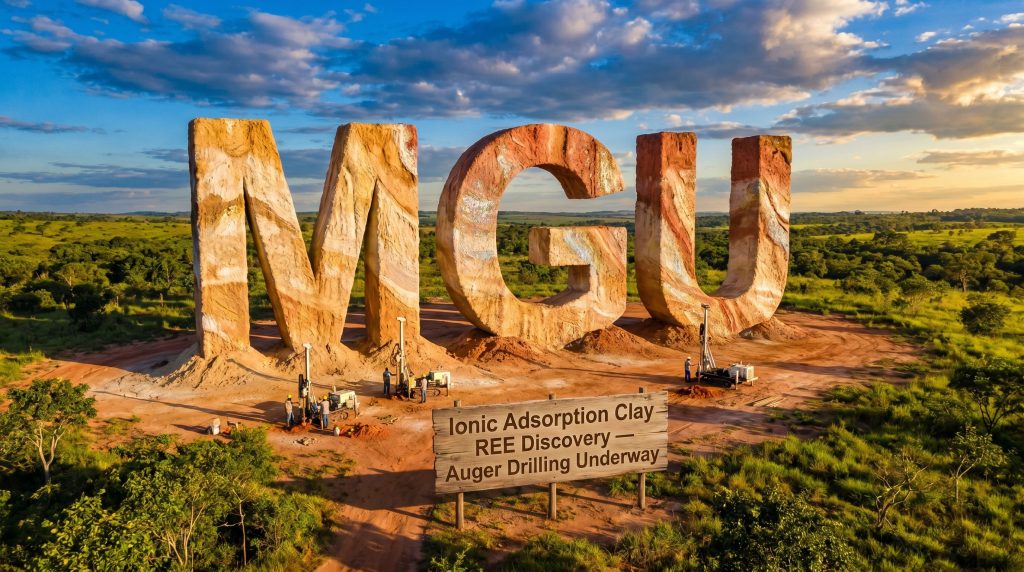
Magnum Mining and Exploration (ASX: MGU, OTCQB: MGUFF) is making rapid strides at its wholly-owned Azimuth REE Project in Brazil, where a systematic auger drilling campaign is steadily building the case for what could be a globally significant ionic adsorption clay (IAC) rare earth discovery. With 161 holes and 1,607 metres completed across a 7.4km² priority area, the company is on a clear trajectory toward an Exploration Target by September 2026 and a JORC Mineral Resource Estimate by November 2026.
This update arrives at an increasingly important moment for rare earth development in the Western world, and the numbers coming out of Piracanjuba are drawing serious attention.
When big ASX news breaks, our subscribers know first
Drilling Progress at a Glance
The report confirms that as of 26 May 2026, the drilling campaign has achieved significant operational milestones. The table below summarises where the campaign currently stands:
| Metric | Status |
|---|---|
| Auger holes completed | 161 |
| Total metres drilled | 1,607 m |
| Approximate area tested | 7.4 km² |
| Sample batches submitted | 14 |
| Geophysical footprint | 85 km² |
| Planned total drill programme | 810 holes |
| Laboratory workstream | Total REE assay + ammonium sulphate desorption screening |
The programme remains on track, with drilling and sample dispatch continuing across all three Piracanjuba targets. Furthermore, drilling has now extended beyond the initial PN-04 follow-up footprint, testing whether shallow REE responses can be repeated across broader weathering domains.
"Whilst exploration remains at an early stage, the 85km² geophysical anomaly at Piracanjuba supports the potential for a globally significant REE IAC system." — Antonio Vitor, Managing Director, Magnum Mining and Exploration
What Makes the Early Results So Compelling?
Although no new assay or desorption results are reported in this announcement, the foundation for the current 810-hole programme rests on a highly encouraging body of prior data. The key reasons the Magnum Mining and Exploration Brazil rare earth drilling at the Azimuth REE Project has accelerated into this systematic campaign include:
- Exceptional first assay results of up to 3,971 ppm TREO and 1,360 ppm MREO from previously drilled holes
- Desorption recoveries of up to 75% TREO and 94% MREO under mild leaching conditions, confirming the amenability of mineralisation to low-impact extraction
- All 13 first-pass auger holes intersected near-surface REE mineralisation and terminated within REE mineralisation — a 100% hit rate even at wide spacings of up to 5km
- The 85km² geophysical anomaly at Piracanjuba North remains largely untested, representing enormous potential for lateral continuity
- The project sits within the Azimuth 125° Lineament, a prominent crustal-scale structural feature, located just ~50km from CMOC's Catalão Project, one of Brazil's highest-grade niobium mines
The combination of scale, grade, and recovery potential places Piracanjuba in a compelling tier for an early-stage rare earth discovery.
Understanding Ionic Adsorption Clay REE Deposits — Why This Geology Matters
What Is an IAC Deposit?
Ionic adsorption clay (IAC) deposits are a specific type of rare earth occurrence formed when rare earth elements leach from granitic parent rock over millions of years and become adsorbed — loosely attached — to clay minerals in the weathered regolith. This is the layer of chemically broken-down rock and soil near the surface.
Why Does It Matter to Investors?
IAC deposits are highly prized in the REE sector for two critical reasons:
1. Shallow, low-cost mining: Because mineralisation sits in soft, near-surface clay rather than hard rock, extraction typically requires simple mechanical digging rather than blasting. This approach dramatically reduces both capital and operating costs.
2. Simple, low-impact processing: REEs hosted in IAC systems can often be recovered using mild leaching agents like ammonium sulphate, rather than harsh, energy-intensive circuits. Magnum's desorption results of up to 94% MREO recovery under these conditions strongly underscore this advantage.
IAC deposits are, moreover, the dominant source of heavy rare earths and magnet rare earths globally — elements in intense demand for electric vehicle motors, wind turbines, and defence applications.
Key Terms Explained
| Term | Definition |
|---|---|
| TREO | Total Rare Earth Oxide — the combined concentration of all rare earth oxides in a sample |
| MREO | Magnet Rare Earth Oxide — the subset of REOs critical for permanent magnets (Nd, Pr, Dy, Tb) |
| ppm | Parts per million — the standard unit of grade measurement in REE exploration |
| Desorption | The process of removing adsorbed REEs from clay minerals, typically using a mild leaching solution |
| Regolith | Weathered surface material above fresh rock, the host zone for IAC mineralisation |
| Saprolite | A partially weathered rock layer within the regolith profile, also often mineralised in IAC systems |
| JORC | Joint Ore Reserves Committee — the Australian standard for reporting mineral resources |
| MRE | Mineral Resource Estimate — a formal, JORC-compliant estimate of in-ground mineralisation |
| Exploration Target | A preliminary, non-JORC estimate of potential mineralisation scale used to guide further work |
The Two-Track Drill Programme — Building Toward JORC
According to the presentation, Magnum's 810-hole auger programme is structured as two concurrent and complementary workstreams.
1. Regional 1,000m × 1,000m Grid Drilling
- Purpose: Test the lateral extent of REE mineralisation across the full Piracanjuba prospect
- Target outcome: Support definition of a JORC Exploration Target (expected September 2026)
2. Infill 200m × 200m Grid Drilling
- Purpose: Focused drilling centred on previously reported high-grade REE intercepts
- Target outcome: Progress toward a JORC-compliant Mineral Resource Estimate (expected November 2026)
This dual-track design allows the Magnum Mining and Exploration Brazil rare earth drilling at Azimuth REE Project to simultaneously chase scale and tighten confidence on the highest-priority zones, representing an efficient use of field resources.
Key Milestones on the Horizon
Investors should be tracking the following upcoming catalysts closely:
| Milestone | Expected Timing |
|---|---|
| Batched assay and desorption results (ongoing) | Commencing shortly, rolling through programme |
| Full 810-hole programme completion | Progressive through 2026 |
| JORC Exploration Target | September 2026 |
| JORC Mineral Resource Estimate | November 2026 |
The pipeline of batched results flowing from 14 sample batches already submitted means that newsflow from Piracanjuba is expected to be both regular and substantive in the months ahead. Each batch will be evaluated across multiple technical criteria, including lateral repeatability, grade-thickness relationships, TREO versus desorbable TREO ratios, magnet REE distribution, and geological consistency.
Why Piracanjuba Is Worth Watching
Several features set the Piracanjuba project apart from the broader population of early-stage REE projects.
Scale of the Opportunity
The 85km² geophysical footprint is a standout figure. Most IAC discoveries that have reached significant resource status have operated across areas of this scale or smaller. The fact that first-pass holes with up to 5km spacing all intersected mineralisation suggests the anomaly could be broadly and continuously mineralised.
Grade Quality
The previously reported peak grades of 3,971 ppm TREO and 1,360 ppm MREO are strong for an IAC-style system. Critically, the high proportion of magnet REEs within the overall REE suite is commercially significant. These are among the highest-value elements in the rare earth basket, commanding premium pricing driven by EV and clean energy demand.
Recoveries That Support Low-Cost Processing
Desorption recoveries of up to 94% MREO under mild ammonium sulphate leaching conditions are commercially relevant data points. In IAC projects globally, high desorption recovery is a major de-risking factor, as it points toward a simpler, lower-cost flowsheet at the processing stage.
Location in a Proven REE and Critical Minerals Corridor
The Magnum Mining and Exploration Brazil rare earth drilling at Azimuth REE Project is located within the State of Goiás — a jurisdiction with established mining infrastructure and an active critical minerals sector. Its proximity of approximately 50km to CMOC's Catalão operation reflects the strong geological prospectivity of the broader region.
100% Ownership
The report confirms that Magnum holds a 100% interest in the Azimuth REE Project, meaning shareholders retain full exposure to any value created as the project advances.
The next major ASX story will hit our subscribers first
Investment Thesis — Why Investors Should Be Following MGU
The building blocks of a significant discovery are clearly visible at Piracanjuba, even at this early stage. However, the story is only just beginning to unfold. In summary, the key reasons to watch MGU include:
- A 100% hit rate from first-pass drilling across a wide-spaced grid, indicating broad, consistent mineralisation
- High-grade, high-value MREO results with strong desorption recovery pointing to processing simplicity
- An 85km² geophysical footprint that has barely been tested, with the current 810-hole programme designed to change that
- A defined, time-bound path to JORC-standard resource reporting, with an Exploration Target due in September and an MRE due in November
- Regular assay newsflow expected imminently as batched results begin returning from the laboratory
The rare earth sector is experiencing structural demand growth driven by the global energy transition and increasing attention on supply chain security for magnet REEs. Projects that can demonstrate scale, grade, and processing amenability — as Piracanjuba is beginning to do — occupy an increasingly valuable position in the global resource landscape.
Key Takeaway: Magnum Mining and Exploration has established what could be a laterally extensive ionic adsorption clay rare earth system at Piracanjuba, underpinned by a 100% first-pass drilling hit rate, grades of up to 3,971 ppm TREO, and desorption recoveries of up to 94% MREO. With a structured 810-hole programme underway, batched assay results imminent, and firm timelines pointing to a JORC Resource by November 2026, the Magnum Mining and Exploration Brazil rare earth drilling at Azimuth REE Project represents one of the more consequential rare earth development stories to watch on the ASX in the second half of 2026.
Want to Be First When the Next Major REE Discovery Hits the ASX?
Discovery Alert's proprietary Discovery IQ model delivers real-time alerts the moment significant mineral discoveries — including rare earth projects like those emerging from Brazil's IAC systems — are announced on the ASX, instantly translating complex data into actionable opportunities. Explore historic discovery returns on Discovery Alert's dedicated discoveries page to understand what early positioning in transformative finds can mean for a portfolio, and begin your 14-day free trial today to ensure you're never behind the market on the next major find.