
June 5, 2026
The Structural Vulnerability That One Mine Exposes
The entire rare earth permanent magnet supply chain feeding into American electric vehicles, defence electronics, and wind turbines currently rests on a single domestic mining operation. That concentration of geological and operational risk at one node, MP Materials' Mountain Pass facility in California's Mojave Desert, represents one of the most discussed structural vulnerabilities in Western critical minerals strategy. When analysts map the geography of potential solutions, the carbonatite-bearing terrain immediately surrounding Mountain Pass consistently draws attention. It is within this context that the Locksley El Campo rare earth mineralisation results carry significance well beyond their modest scale as an early-stage exploration programme in California.
Understanding what the El Campo data actually means, both geologically and strategically, requires looking beneath the headline intercept figures to the underlying mineralogy, the structural controls on grade distribution, and the geological model that could either confirm or challenge the hypothesis of a Mountain Pass-style system at depth.
When big ASX news breaks, our subscribers know first
Why Carbonatite Geology Is the Right Starting Point
Not all rare earth deposits are created equal, and the host rock type fundamentally shapes both the grade distribution and the extractive economics of any REE project. Carbonatite-hosted deposits, which are igneous rocks composed of more than 50% carbonate minerals formed from mantle-derived magmatic systems, represent the dominant source of light rare earth elements in global production. Mountain Pass itself is a carbonatite-hosted deposit, and the geological rationale for investigating the terrain surrounding it is grounded in the recognition that carbonatite magmatic events rarely produce isolated intrusions.
How Sheared Carbonatite Structures Concentrate REEs
Within carbonatite systems, the highest REE grades typically occur not in the primary intrusive body itself but along shear zones and structural corridors where hydrothermal fluids have remobilised and concentrated rare earth minerals over geological time. At El Campo, the mineralisation appears to be associated with sheared carbonatite structures, a textbook setting for elevated light rare earth element (LREE) grades. This structural control is significant because it means mineralisation geometry is governed by fault architecture as much as by primary magmatic emplacement, which has direct implications for how drill targeting should be designed and interpreted.
NdPr: The Fraction That Actually Drives Commercial Value
Of the 17 rare earth elements, neodymium and praseodymium, collectively abbreviated as NdPr, command the highest commercial attention in the context of permanent magnet manufacturing. NdFeB magnets, which rely on neodymium-iron-boron alloy compositions, are the highest-performance permanent magnets currently available and are essential to the traction motors in electric vehicles and the direct-drive generators in offshore wind turbines. The proportion of NdPr within a deposit's total rare earth oxide content is therefore a more commercially meaningful metric than total grade alone.
At El Campo, NdPr oxides account for approximately 25% of TREO in key drill intercepts. This ratio sits at the commercially relevant threshold for light rare earth carbonatite systems. By comparison, some ionic clay REE deposits in southern China can carry NdPr proportions in a similar range, but those systems typically require large-scale in-situ leaching operations across extensive areas. A carbonatite-hosted system delivering equivalent NdPr fractions from hard-rock mineralisation at near-surface depths presents a different set of metallurgical and extraction pathways.
"The proportion of magnet rare earth oxides within total TREO content is increasingly recognised as the defining commercial quality metric for REE exploration projects. A deposit carrying 25% NdPr against TREO signals relevance to the permanent magnet supply chain, not merely to the broader rare earths market."
Breaking Down the El Campo Assay Data
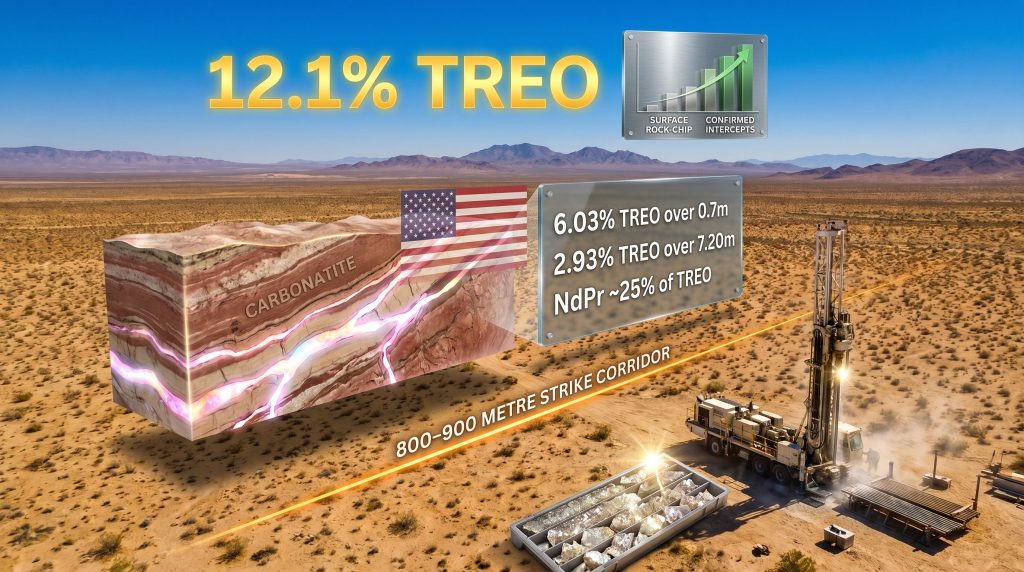
The initial diamond drilling programme at the Locksley El Campo rare earth mineralisation prospect returned results that are consistent with, and in some cases exceed, the grades indicated by historical surface sampling. The assay data is summarised below:
| Metric | El Campo Result | Context |
|---|---|---|
| Peak intercept (ECDD0002) | 6.03% TREO over 0.7m | High-grade for carbonatite-hosted systems |
| Broad intercept (ECDD0002) | 2.93% TREO over 7.20m | Demonstrates meaningful width potential |
| Higher-grade sub-interval | 4.45% TREO over 3.75m | Consistent with surface sampling trends |
| Drill-hole ECDD0004 | 1.09% TREO over 0.90m | Confirms lateral mineralisation extent |
| NdPr proportion of TREO | ~25% | Commercially significant magnet REE fraction |
| Historical surface rock-chip peak | Up to 12.1% TREO | Indicates high-grade surface exposure |
| Earlier rock-chip range | 3.74% to 9.49% TREO | Strong pre-drill surface validation |
| Interpreted mineralised strike | ~800 to 900 metres | Suggests system-scale potential |
What the Intercept Geometry Tells Experienced Geologists
The 7.20m interval at 2.93% TREO in ECDD0002 is the result that deserves particular analytical attention. While the peak value of 6.03% over 0.7m grabs attention, width is operationally critical. A deposit that delivers grades above 2% TREO across multiple metres of continuous mineralisation indicates that the system is not simply producing narrow high-grade veins surrounded by barren host rock. The 3.75m sub-interval at 4.45% TREO within that broader intersection reinforces the interpretation that grade is not randomly distributed but correlates with specific structural or lithological zones.
What Open at Depth and Along Strike Actually Means
The phrase that mineralisation remains open both at depth and along strike is commonly used in exploration announcements, but its significance is frequently underappreciated by non-technical readers. In practical terms, it means that none of the drill holes terminated in barren rock after passing through mineralisation. The mineralised intervals simply continued beyond the tested intervals. Combined with an interpreted strike corridor of 800 to 900 metres, this implies that the total mineralised volume drilled to date represents only a fraction of the system's potential extent.
"When drill holes confirm that mineralisation persists beyond tested intervals in multiple directions simultaneously, the geological hypothesis undergoes a fundamental scale revision. The tested surface expressions may represent only the uppermost portions of a much larger magmatic-carbonatite system extending to depth."
Is There a Mountain Pass-Style System at Depth?
The Geological Analogy and Its Implications
Mountain Pass is one of the world's highest-grade rare earth deposits, hosted within a Proterozoic carbonatite intrusion that has been dated to approximately 1.4 billion years. The ore mineralogy is dominated by bastnäsite, a fluorocarbonate mineral that carries high concentrations of light rare earth elements and is relatively amenable to processing compared to some alternative REE minerals. The spatial proximity of El Campo at approximately 5.5 kilometres south-east of Mountain Pass is geologically meaningful, not merely geographically coincidental, given that carbonatite magmatic events in Precambrian cratons often produce clusters of related intrusions across spatial scales of several kilometres to tens of kilometres.
The exploration team's evolving interpretation is that El Campo may represent a surface expression of a deeper Mountain Pass-style magmatic carbonatite system. This remains a hypothesis requiring systematic testing, but it is a hypothesis supported by the carbonatite host rock type, the structural shearing that has concentrated LREE mineralisation, the NdPr-dominant geochemical signature, and now the drill confirmation that grades identified at surface persist into the subsurface.
Radiometric Data and Scintillometer Surveys as the Next Analytical Layer
The planned high-resolution ground scintillometer survey across the entire El Campo permit footprint represents the logical next step in testing this deeper system hypothesis. Scintillometers measure gamma radiation intensity at surface, and because rare earth elements, particularly those hosted in bastnäsite and monazite, are weakly radioactive, scintillometer anomalies can trace the footprint of REE mineralisation beneath shallow cover. When integrated with the recently acquired airborne radiometric data, a systematic ground-level survey should allow the exploration team to prioritise the drill targets most likely to intersect the deeper portions of the carbonatite system. Furthermore, the rare earth processing challenges associated with carbonatite-hosted systems underscore why understanding the full mineralised footprint is so critical at this stage.
The Multi-Commodity Dimension: Desert Antimony Mine Results
The Mojave Project is not a single-commodity REE exploration programme. The Desert Antimony Mine component of the project returned results from its maiden drilling programme that confirm the stibnite mineralisation previously accessed through historical underground workings extends further than previously mapped.
| Drill Hole | Peak Antimony Grade | Interval |
|---|---|---|
| DADD0007 | 6.44% antimony | 0.3m |
| DADD0007 | 2.90% antimony | 0.3m |
Antimony is classified as a critical mineral by multiple Western governments due to its antimony critical mineral uses in flame retardants, ammunition, and semiconductor manufacturing. The confirmation that stibnite mineralisation continues to the south of historical workings adds a second potential value stream to the broader Mojave Project, which is important context for understanding the project's risk-adjusted exploration thesis. In addition, the antimony shortage risks facing Western defence and industrial sectors make this discovery particularly well-timed.
Understanding the U.S. Domestic REE Supply Gap
The Single-Node Risk
Mountain Pass currently operates as the only active rare earth mine in the United States. All domestic production of rare earth concentrate flows through that single operation. The structural risk this creates is significant: any disruption, whether operational, geological, or related to the concentrate offtake arrangements with downstream processors, leaves U.S. rare earth supply with no domestic fallback. The majority of rare earth separation and processing for Western consumption still occurs in China, meaning that even material mined at Mountain Pass typically travels through Chinese processing infrastructure before returning as separated oxides or finished magnets.
Consequently, the rare earth geopolitical impact of this dependence on Chinese processing has elevated projects like El Campo to a level of strategic scrutiny far beyond what their exploration stage would typically warrant.
Where El Campo Fits Into the Broader Pipeline
Projects like the Locksley El Campo rare earth mineralisation programme are best understood as part of a pipeline, not as near-term production solutions. The pathway from confirmed drill intercepts to a JORC or NI 43-101 compliant mineral resource estimate, through to prefeasibility study, permitting, and eventual production, is measured in years to decades. However, the pipeline must be populated with projects demonstrating genuine geological merit at the exploration stage for future production capacity to materialise at all.
El Campo, sitting within the same mineralised carbonatite corridor as Mountain Pass and now carrying drill-confirmed subsurface grades above 2% TREO across meaningful widths, represents a genuine addition to that pipeline. The broader rare earth supply chain debate makes this kind of domestic exploration result increasingly consequential for Western policymakers and investors alike.
The next major ASX story will hit our subscribers first
What Investors Should Understand Before Evaluating El Campo
The Hierarchy of Exploration Evidence
Evaluating any early-stage REE project requires clarity about where drill intercepts sit in the hierarchy of exploration evidence:
-
Rock-chip surface sampling establishes that mineralisation exists at surface and provides initial grade indications, but is highly selective and cannot be used for resource estimation.
-
Drill intercepts confirm that mineralisation extends into the subsurface and provide grade and width data across defined intervals, but do not yet constitute a mineral resource.
-
Mineral resource estimates (JORC, NI 43-101, or SAMREC compliant) require sufficient drill data to define mineralisation geometry in three dimensions with a defined confidence level.
-
Ore reserve estimates require resource estimates plus engineering, metallurgical, and economic studies confirming extractive viability.
El Campo currently sits between stages one and two. The drill results are genuinely encouraging, but prospective investors should understand that a significant programme of additional drilling, assaying, and geological modelling lies between the current data set and a formal resource estimate.
Why NdPr Proportion Matters More Than Headline Grade
A common error in evaluating REE exploration results is anchoring on total TREO grade without considering the distribution of individual elements within that total. A deposit carrying 3% TREO dominated by cerium and lanthanum has fundamentally different commercial characteristics from a deposit carrying 2% TREO where NdPr represents 25% of the total. Cerium and lanthanum, while included in TREO calculations, currently command significantly lower market prices than NdPr oxides, which are tied to permanent magnet demand. The NdPr fraction at El Campo therefore represents the commercially critical portion of the mineralisation profile.
Disclaimer: This article contains forward-looking analysis and discussion of exploration-stage results. Drill intercepts and surface sampling data do not constitute a mineral resource estimate. Investors should conduct independent due diligence and consider the full range of exploration, development, and market risks before making investment decisions.
Frequently Asked Questions: El Campo Rare Earth Mineralisation
What is the El Campo prospect and where is it located?
El Campo is a rare earth element exploration prospect forming part of Locksley Resources' Mojave Project in California, located approximately 5.5 kilometres south-east of Mountain Pass, the only active rare earth mine currently operating in the United States.
What rare earth elements have been confirmed at El Campo?
Drilling has confirmed the presence of light rare earth element mineralisation, with neodymium and praseodymium oxides accounting for approximately 25% of TREO content in key intercepts. The broader TREO suite is consistent with a carbonatite-hosted light rare earth element system.
How do El Campo's drill results compare to other REE exploration projects?
Peak intercepts of 6.03% TREO over 0.7m and broader intervals of 2.93% TREO over 7.20m place El Campo among the higher-grade carbonatite-hosted REE targets in active North American exploration. For context, many carbonatite REE projects operate at grades between 1% and 3% TREO in their resource estimates.
What is the significance of NdPr making up 25% of the TREO at El Campo?
NdPr oxides are the primary input material for NdFeB permanent magnet manufacturing, which underpins electric vehicle motors and wind turbine generators. A 25% NdPr proportion within TREO indicates that the deposit's rare earth content is weighted toward the most commercially valuable and strategically important fraction of the rare earth element suite.
What exploration work is planned following the initial drilling programme?
The next phase of exploration will focus on a high-resolution ground scintillometer survey across the full permit footprint to guide drill targeting, combined with evaluation of the lithostructural controls governing REE distribution at depth and integration of recently acquired airborne radiometric data.
Why is proximity to Mountain Pass considered geologically significant?
Mountain Pass is hosted within a Proterozoic carbonatite intrusion, and carbonatite magmatic events in ancient cratonic terranes frequently produce spatially clustered intrusion complexes. The proximity of El Campo to Mountain Pass raises the possibility that both targets share a common deep magmatic origin, a hypothesis now receiving its first systematic drill-based testing.
Key Takeaways: El Campo's Position in the REE Development Landscape
-
Diamond drilling at the Locksley El Campo rare earth mineralisation in California has confirmed that high-grade REE mineralisation identified at surface extends into the subsurface, with the system remaining open both at depth and along strike
-
NdPr oxides account for approximately 25% of TREO in key intercepts, placing the deposit's rare earth profile squarely within the commercially relevant range for permanent magnet supply chain applications
-
Peak drill intercepts of 6.03% TREO over 0.7m and broader intervals of 2.93% TREO over 7.20m are consistent with historical surface rock-chip results reaching up to 12.1% TREO, demonstrating surface-to-subsurface grade continuity
-
An interpreted 800 to 900 metre mineralised strike corridor suggests the known system extends well beyond the intervals tested in the initial programme
-
The geological interpretation supports a hypothesis of a deeper Mountain Pass-style magmatic carbonatite system, a proposition that the planned scintillometer survey and subsequent drill targeting will begin to test systematically
-
The Desert Antimony Mine component of the Mojave Project adds a second mineralised commodity stream to the broader exploration programme, with stibnite mineralisation confirmed to extend beyond historical underground workings
Want to Track the Next Major ASX Mineral Discovery in Real Time?
Discovery Alert's proprietary Discovery IQ model instantly identifies significant ASX mineral discoveries across more than 30 commodities — including rare earths and critical minerals like antimony — delivering actionable alerts to subscribers before the broader market has time to react. Explore historic discoveries and their returns to understand what early-stage positioning in transformative finds has meant for investors, and begin your 14-day free trial at Discovery Alert to secure your market-leading edge.