August 14, 2026
The Invisible Backbone of the Modern Economy
Most investors can name a handful of commodities that matter: oil, gold, copper, lithium. What rarely makes that list is a group of 17 chemically similar elements that quietly enable almost every technology shaping the 21st century. Rare earth elements (REEs) sit inside the motors of electric vehicles, the guidance systems of precision missiles, the cooling infrastructure of AI data centres, and the screens of billions of smartphones. Their absence would not slow down the modern economy. It would stop it entirely.
Understanding this context is essential before evaluating any investment vehicle built around rare earth exposure, including the Sprott Rare Earth X China ETF (ticker: REXC), which launched in April 2026 as the only ETF globally designed to deliver pure-play rare earth exposure entirely outside of Chinese-domiciled companies.
When big ASX news breaks, our subscribers know first
What Rare Earth Elements Actually Are (And Why "Rare" Is Misleading)
The 17 elements classified as rare earths are not geologically scarce in absolute terms. They exist throughout the Earth's crust in measurable concentrations. The challenge is that they are almost never found in deposits concentrated enough to make mining economically viable. This geological reality, combined with the complex and chemically intensive separation process required to isolate individual elements, creates the effective scarcity that drives their strategic importance.
Applications That Define Their Strategic Value
The range of industries relying on rare earth elements is broader than most investors realise:
| End-Use Sector | Rare Earth Application | Strategic Importance |
|---|---|---|
| Defence and Security | Missile guidance, radar systems | Critical / Non-substitutable |
| AI and Data Centres | Cooling motors, optics | High / Growing |
| Consumer Electronics | Display screens, vibration motors | High / Pervasive |
| Clean Energy | Wind turbine generators | High / Scaling |
| Electric Vehicles | EV drive motors | Very High / Accelerating |
| Robotics | Precision motors, sensors | Emerging / Strategic |
Consider what this means in practical terms. The screen displaying content on a smartphone relies on rare earth elements for its colour rendering. The vibration that signals an incoming call is produced by a rare earth magnet. The motor inside an EV that converts electrical energy into forward motion depends on high-performance permanent magnets containing neodymium, praseodymium, dysprosium, and terbium. These are not interchangeable components. In most applications, there are no commercially viable substitutes.
This is what distinguishes rare earths from other commodities: demand is not cyclical in the traditional sense. It is structural, embedded in the physical architecture of technologies that are accelerating in adoption globally. Furthermore, the rare earth supply chain underpinning these technologies has become one of the most strategically consequential systems in the global economy.
How China Came to Control the Global Rare Earth Supply Chain
The concentration of rare earth processing in China did not happen overnight. It was the result of roughly three decades of deliberate industrial policy, cheap labour, and a willingness to absorb the significant environmental costs associated with rare earth separation and refining.
Through the early and mid-1990s, the United States was the world's leading producer of rare earth elements, with the Mountain Pass mine in California serving as a globally significant source. Over the following decades, Chinese producers, supported by domestic industrial incentives and economies of scale, progressively undercut global competitors on price. The economics became untenable for Western producers, and one by one, mines and processing facilities outside China were shuttered.
The result of this consolidation is stark:
- China controls approximately 69% of global rare earth mining output
- China controls more than 90% of global refining and magnet production capacity
- Western nations have almost no domestic rare earth processing infrastructure comparable in scale
This level of supply concentration in a single jurisdiction, for materials deemed non-substitutable in defence and advanced technology applications, represents one of the most significant strategic vulnerabilities in the global industrial system.
The Export Control Signal: What Dysprosium's Price Surge Reveals
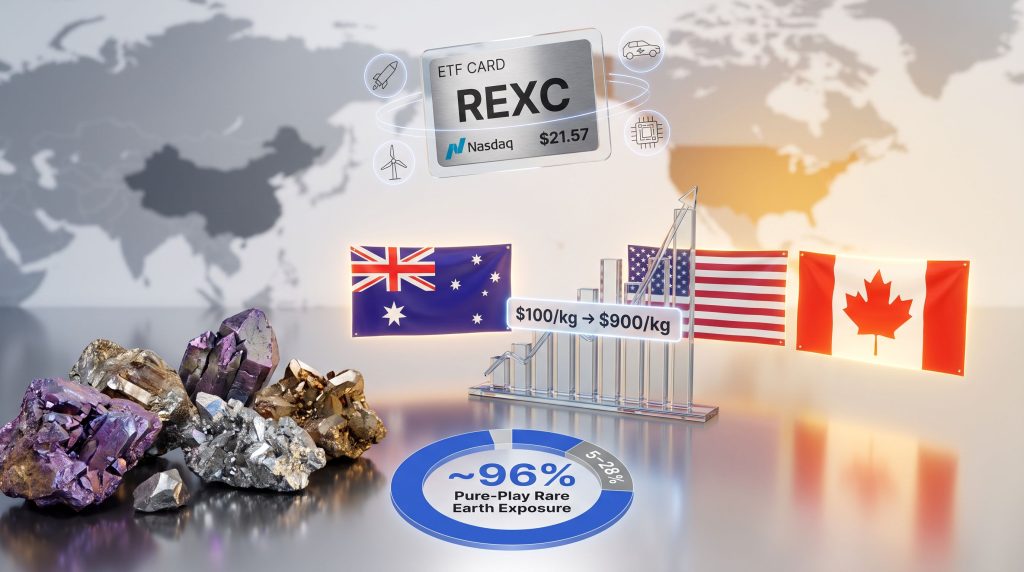
The clearest evidence of what this dependency costs came when China began imposing export controls on rare earth materials. China's export restrictions sent immediate and severe shockwaves through global markets. Dysprosium (often referenced alongside terbium as Dy-Tb), a rare earth element critical to high-temperature permanent magnets used in EV motors and defence systems, surged from approximately $100 per kilogram to $900 per kilogram following the imposition of these controls. That is an 800% price increase, triggered not by a shift in underlying geology or a demand collapse, but by a policy decision made in Beijing.
This is not a hypothetical risk. It is a documented price dislocation with real consequences for manufacturers, defence contractors, and technology companies that depend on stable rare earth supply chains. Consequently, the broader implications of rare earth geopolitics have moved from academic discussion to boardroom priority across Western governments and industries alike.
Introducing the Sprott Rare Earth X China ETF (REXC)
The Sprott Rare Earth X China ETF was designed to give investors direct, concentrated exposure to the companies building the rare earth supply chain outside of China. It launched on Nasdaq in mid-April 2026 and trades under the ticker REXC. Investors can explore the full fund details at Sprott's website to review holdings, performance data, and educational resources.
Fund Snapshot
| Attribute | Detail |
|---|---|
| Ticker | REXC (Nasdaq) |
| Inception Date | April 14–15, 2026 |
| NAV (as of April 29, 2026) | $21.57 |
| Index Tracked | Nasdaq Sprott Rare Earths Ex-China Index (NSREXC) |
| Minimum Asset Allocation | 80% or more of assets in Index securities |
| Revenue Eligibility Threshold | 50% or more of revenue or assets from rare earth activities |
| China Exclusion Scope | Excludes companies domiciled, incorporated, or primarily operating in China, including Hong Kong and Taiwan |
| Number of Current Holdings | 34 companies |
| Constituent Range | 21 to 50 companies, free-float adjusted market cap-weighted |
The Pure-Play Screening Process
What separates REXC from broadly marketed critical materials funds is the rigorous eligibility methodology underpinning the index it tracks. Sprott reviews approximately 1,000 mining companies twice per year, examining financial disclosures and operational data to identify businesses where at least 50% of revenue or assets are directly tied to rare earth activities. Those activities include mining, smelting, separation, refining, or the production of rare earth materials.
Any company domiciled, incorporated, or determined to conduct its primary operations in China (including Hong Kong and Taiwan under the fund's exclusion criteria) is ineligible regardless of its operational profile.
The result of this screening is a fund with approximately 96% pure-play rare earth exposure, a figure that stands in sharp contrast to competing ETFs that market themselves as rare earth investment vehicles but carry between 5% and 28% actual rare earth exposure when their underlying holdings are examined closely.
Geographic and Market Cap Breakdown
Country Allocation
| Country | Approximate Allocation |
|---|---|
| Australia | ~48% |
| United States | ~40% |
| Canada | ~8% |
| Other | ~4% |
Market Capitalisation Distribution
| Market Cap Tier | Approximate Allocation |
|---|---|
| Large Cap | ~38% |
| Mid Cap | ~16% |
| Small Cap | ~46% |
Why the Australia-US-Canada Axis Is Significant
Australia's dominant weighting within the fund reflects its geological endowment and the maturity of its rare earth development pipeline. Projects in Western Australia in particular have attracted significant investment as the country positions itself as a reliable supplier to allied nations. The United States weighting reflects both the ongoing renaissance of America's rare earth supply chain and the presence of large-cap companies involved in magnet manufacturing and processing. Canada contributes a smaller but meaningful allocation, primarily through junior and mid-tier mining companies advancing rare earth deposits in geopolitically stable jurisdictions.
Together, these three countries account for roughly 95–96% of REXC's geographic exposure, creating a fund that is as much a bet on allied-nation supply chain development as it is on the underlying commodity.
How REXC Compares to Competing Products
| Feature | REXC | Typical Broad Rare Earth ETF |
|---|---|---|
| Pure Rare Earth Exposure | ~96% | 5–28% |
| China Exclusion | Yes (complete) | No |
| Investment Focus | Rare earth only | Multi-metal or diversified |
| Geographic Bias | Australia, US, Canada | Global including China |
| Constituent Count | ~34 companies | Varies widely |
The distinction between REXC and alternatives is not merely branding. Most ETFs that use the term "rare earth" in their name or marketing allocate only a fraction of their holdings to actual rare earth companies. The remainder is distributed across diversified mining conglomerates, battery metal producers, or other critical mineral companies. For investors who want targeted thematic exposure rather than a broadly diversified mining fund under a different label, this structural distinction carries real portfolio implications.
The next major ASX story will hit our subscribers first
Key Investment Risks Every Investor Should Assess
No thematic ETF is without risk, and the Sprott Rare Earth X China ETF carries several that investors must evaluate with clear eyes.
REXC launched in April 2026 and carries a limited operating history. Investors should carefully assess liquidity, tracking error relative to the NSREXC Index, and the inherent volatility associated with small-cap and junior mining company exposure before allocating capital.
Primary Risk Factors
-
Limited operating history. As a newly launched fund, REXC has not yet been tested across a full commodity cycle or through extended periods of market stress. Tracking error, bid-ask spreads, and liquidity dynamics should be monitored carefully.
-
Small and mid-cap concentration. With approximately 46% of assets in small-cap companies and 16% in mid-cap, a significant portion of the fund is exposed to companies that may have limited cash flow, early-stage projects, or restricted access to capital markets.
-
Commodity price volatility. Rare earth equity prices are correlated to, but not perfectly predictive of, underlying rare earth element prices. A normalisation of prices, for instance if Chinese export restrictions were eased, could compress valuations across the fund's holdings.
-
Geopolitical risk operates in both directions. Escalating export controls can be a tailwind for non-Chinese producers, but abrupt policy reversals, trade negotiations, or diplomatic agreements between major powers could alter the investment thesis rapidly.
Scenario Analysis: What Happens If China Escalates?
| Scenario | Likely Market Impact | REXC Positioning |
|---|---|---|
| Moderate export restriction expansion | Rare earth prices rise; non-Chinese producers benefit | Positive |
| Full rare earth export embargo | Severe short-term supply shock; accelerated Western investment | Strongly positive long-term |
| China eases restrictions | Price normalisation; reduced urgency for alternatives | Neutral to mildly negative |
| Western governments increase production subsidies | Faster project ramp-up; improved unit economics for constituents | Positive |
The scenario matrix above illustrates that REXC's investment thesis is asymmetrically positioned toward continued or escalating supply chain tension. In a scenario where geopolitical pressures normalise and Chinese export restrictions are eased, the fund's near-term performance could face headwinds as the price premium commanded by non-Chinese supply erodes.
Who Should Consider REXC as a Portfolio Allocation?
REXC is unlikely to serve as a core holding for most investors. It is a thematic instrument, purpose-built for a specific investment thesis. Investors who may find it most relevant include:
- Investors seeking targeted exposure to the critical minerals supply chain diversification trend
- Thematic investors aligned with defence modernisation, clean energy infrastructure, and AI hardware build-out
- Portfolio managers looking to hedge against further escalation of Chinese rare earth export controls
- Long-term investors with conviction in the Western rare earth production build-out over a multi-year horizon
The fund is best evaluated not as a standalone position but as a component within a broader thematic or critical materials allocation framework. In addition, those interested in the broader context of rare earth exploration will find that understanding the upstream pipeline helps contextualise the companies held within REXC.
Frequently Asked Questions About REXC
What does REXC stand for and where is it listed?
REXC is the ticker symbol for the Sprott Rare Earth Ex-China ETF, listed on the Nasdaq stock exchange. The fund is informally referred to as "Rexy" by Sprott's team.
How is REXC different from other rare earth ETFs such as REMX?
The core differentiator is exposure purity and the China exclusion policy. REXC maintains approximately 96% exposure to pure-play rare earth companies, while funds like REMX allocate across diversified critical materials and include Chinese-domiciled companies. A detailed breakdown of REXC's portfolio is available through Morningstar for investors wishing to examine individual holdings.
Does REXC hold any Chinese companies?
No. The fund explicitly excludes companies domiciled, incorporated, or primarily operating in China, including entities based in Hong Kong and Taiwan.
What is the minimum revenue threshold for index inclusion?
Companies must derive at least 50% of their revenue or have at least 50% of their assets tied to rare earth-related activities, including mining, smelting, separation, refining, or production.
How often is the index reconstituted?
The underlying index is reviewed twice annually, with Sprott screening approximately 1,000 mining companies during each review cycle.
Where can investors learn more?
Investors can access fund details, monthly commentaries, and educational video content at sprottetfs.com, where Sprott publishes ongoing analysis covering rare earths, critical materials, and precious metals.
The Long-Term Structural Case for Non-Chinese Rare Earth Production
The investment thesis underlying the Sprott Rare Earth X China ETF is ultimately not a trade on short-term price dislocations. It is a multi-year structural repositioning thesis built on the premise that Western governments and allied nations will continue investing in the development of rare earth supply chains outside of China's sphere of control.
The dysprosium price shock is a useful case study in how quickly market conditions can shift when a single supplier leverages its market power. An 800% price increase over a relatively short period is not an anomaly in the rare earth market. It is a preview of what continued concentration risk looks like when transformed from theoretical to actual.
Australia, the United States, and Canada each bring complementary strengths to the reshoring effort: geological endowment, processing know-how, capital market depth, and alignment with allied-nation supply chain objectives. The heavy weighting of REXC toward these three jurisdictions reflects both where the geology is and where the investment capital is flowing.
For investors willing to accept the volatility and early-stage risk inherent in a market still building its non-Chinese infrastructure, the Sprott Rare Earth X China ETF offers something that has not previously existed in structured fund form: a focused, screened, and China-excluded rare earth portfolio designed to capture a generational supply chain transition as it unfolds.
This article is intended for informational and educational purposes only and does not constitute financial or investment advice. Investing in ETFs and mining equities involves risk, including the possible loss of principal. Past performance is not indicative of future results. Investors should conduct their own due diligence and consult a licensed financial adviser before making investment decisions.
Want to Know When the Next Major Rare Earth Discovery Hits the ASX?
Discovery Alert's proprietary Discovery IQ model scans ASX announcements in real time, instantly identifying significant mineral discoveries — including rare earth finds — and delivering actionable alerts before the broader market reacts; explore historic examples of major discovery returns to understand the opportunity, then begin your 14-day free trial at Discovery Alert to position yourself at the forefront of the next critical minerals breakthrough.