August 5, 2026
The Refining Bottleneck That Explains Everything About Global Supply Chain Fragility
Most commodity crises look like supply shocks on the surface. Prices spike, headlines follow, and governments scramble to announce diversification strategies. However, the structural fault line running beneath the current critical minerals crisis is different in character. It is not primarily about how much of a given material exists in the ground. It is about who controls the industrial infrastructure to transform raw ore into commercially usable inputs, and how that concentration becomes leverage in an era of intensifying great-power competition.
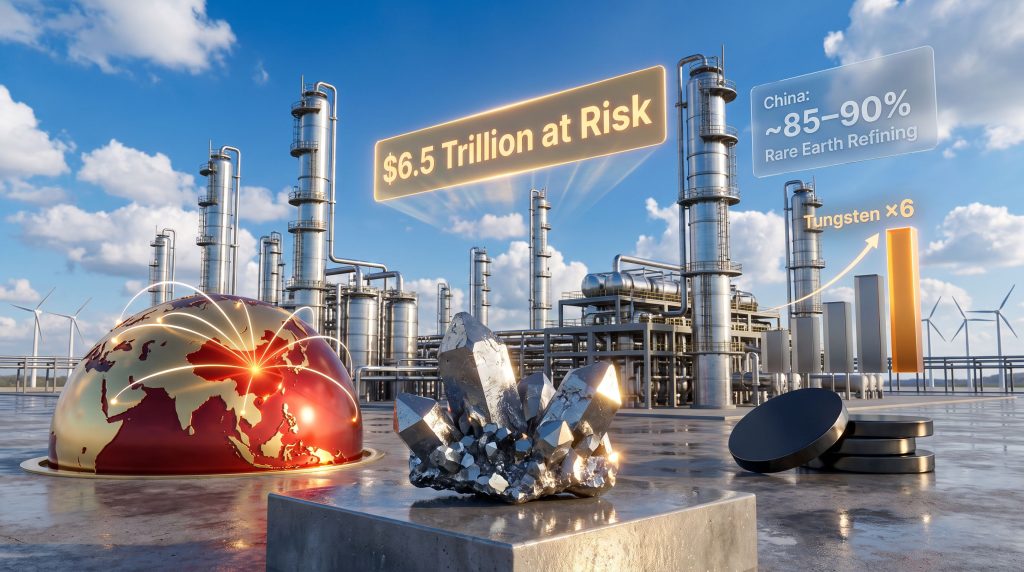
This distinction, between geological endowment and processing capability, is the key to understanding why China's rare earth export curbs have created a ripple effect touching an estimated $6.5 trillion per year in downstream production outside China, according to the International Energy Agency's Global Critical Minerals Outlook 2026.
When big ASX news breaks, our subscribers know first
What Makes Rare Earths Strategically Irreplaceable
Rare earth elements occupy a peculiar position in materials science. Despite the name, most of them are not particularly scarce in the earth's crust. Cerium, for example, is more abundant than copper. The strategic scarcity is manufactured, not geological. It derives from the extraordinary complexity and capital intensity of processing rare earth ores into purified oxides, metals, and alloy inputs that downstream industries can actually use.
Processing rare earths involves a sequence of chemical separation steps, including solvent extraction, precipitation, and calcination, that require significant technical expertise accumulated over decades. China developed this expertise systematically from the 1980s onward, deliberately investing in the full processing chain while other nations focused on lower-value extraction activities or exited the sector entirely when Chinese pricing pressure made domestic operations economically unviable.
The result is a market structure where China controls roughly 85 to 90 percent of global rare earth refining capacity, and where the average market share of the single largest refining nation across key energy minerals broadly sits at approximately 72 percent, according to IEA data. This is not a market imbalance that can be corrected quickly. It reflects decades of accumulated industrial capability that cannot be replicated through policy announcements alone. Furthermore, the rare earth processing challenges involved make rapid diversification structurally difficult for any nation attempting to build capability from scratch.
Critical Insight: The processing complexity of rare earths is deliberately underappreciated in public debate. Separating heavy rare earths like dysprosium and terbium from mixed oxide concentrates requires proprietary solvent extraction chemistry that many Western chemical engineers have never worked with at commercial scale. This knowledge gap is as significant a barrier to supply diversification as capital cost.
A Policy Escalation That Did Not Happen Overnight
Understanding the current exposure requires tracing how China's export control architecture evolved in stages, each building on the last.
April 2025 marked the first formal escalation, with Beijing introducing export licensing requirements covering seven heavy rare earth elements and permanent magnet materials. The China rare earth export restrictions introduced at this stage sent immediate shockwaves through global procurement pipelines. Automakers reported disrupted supply, approval backlogs created shipment delays, and some manufacturers reduced factory utilisation rates or temporarily suspended production lines while awaiting licensed supply.
October 2025 introduced a qualitatively different dimension. Controls were extended to five additional rare earth elements, but more significantly, they were extended extraterritorially. Foreign-manufactured goods that contained Chinese rare earth inputs, regardless of where those goods were produced, became subject to licensing review if the rare earth content exceeded a 0.1 percent value threshold. This rule, on its face, appears narrow. Its practical implications are sweeping.
A Japanese automaker assembling electric vehicles in Mexico, using permanent magnets processed in China, could find its export activities subject to Chinese regulatory jurisdiction under this framework. The same logic applies to German industrial equipment manufacturers, South Korean electronics producers, and American defence contractors. The extraterritorial reach of the 0.1 percent threshold transformed what appeared to be a bilateral trade instrument into a multilateral supply chain governance mechanism.
November 2025 brought a partial pause. A U.S.-China trade truce resulted in the suspension of the expanded October measures through November 2026. Critically, the original April 2025 licensing requirements remained fully active throughout this period. The suspension created breathing room, not structural resolution.
June 2026 introduced a further dimension: targeted entity list additions covering U.S. rare earth processing firms and defence-linked companies. This move signalled a transition from broad market instruments toward selective pressure against specific actors, a more surgical and arguably more durable form of economic leverage.
Policy Escalation Timeline
| Date | Action | Scope | Current Status |
|---|---|---|---|
| April 2025 | Export licensing introduced | 7 heavy rare earths + magnets | Active |
| October 2025 | Expanded controls + 0.1% threshold rule | 5 additional elements + foreign-made goods | Suspended to Nov 2026 |
| November 2025 | U.S.-China trade truce pause | October measures only | Suspension expires Nov 2026 |
| June 2026 | Entity list additions | U.S. defence and rare earth firms | Active |
The $6.5 Trillion Figure Deserves Careful Interpretation
The IEA's $6.5 trillion annual exposure figure is frequently cited but rarely unpacked. It is important to be precise about what it represents. This is not a projection of economic losses that will materialise under current conditions. It is an assessment of the total downstream production value that is structurally dependent on Chinese rare earth supply chains, and would therefore be at risk under full implementation of the export control regime.
The sectors driving this figure span the entire industrial economy:
- Automotive manufacturing: Rare earth permanent magnets are central components in EV traction motors and regenerative braking systems. The neodymium-iron-boron magnets used in high-efficiency motors contain neodymium, praseodymium, dysprosium, and terbium, all subject to licensing controls.
- Defence and aerospace: Heavy rare earths underpin guided munition fin actuators, radar phased array systems, sonar transducers, and jet engine alloy components. Military hardware qualification cycles are long, making rapid substitution structurally difficult.
- Clean energy infrastructure: Direct-drive wind turbine generators require rare earth magnet assemblies. A single large offshore turbine can contain several tonnes of rare earth magnet material, making the wind energy sector one of the most structurally exposed.
- Semiconductor and AI hardware manufacturing: Rare earth elements are embedded in deposition processes for advanced chip fabrication, not merely in finished device components. The October 2025 enhanced end-use review for AI-related hardware directly targets one of the most strategically contested technology sectors.
Investor Alert: The $6.5 trillion exposure figure represents current structural dependency, not a hypothetical worst case. It reflects the IEA's assessment of existing supply chain architecture. Investors assessing exposure in automotive, defence, or clean energy equities should treat this as a baseline vulnerability metric, not an outlier scenario.
Why the Refining Gap Cannot Be Closed by Mining Alone
One of the most persistent misconceptions in critical minerals policy discourse is that identifying mineral reserves is equivalent to securing supply. It is not. The IEA's 2026 outlook made this point explicitly: project pipelines outside dominant supplier regions are heavily weighted toward mining development, with refining and downstream processing capacity lagging significantly behind.
This imbalance matters because the commercially critical transformation happens at the refinery, not the mine. Rare earth concentrate extracted from a mine in Australia or the United States must still be chemically processed into separated oxides, then converted into metals or alloys, before it can be used in magnet manufacturing. Each of these stages requires dedicated industrial infrastructure and technical expertise that takes years to develop even with adequate capital. In addition, critical minerals demand from the energy transition continues to grow faster than alternative processing capacity can be established.
Processing Concentration by Mineral Category (2025)
| Mineral Category | Largest Single Refiner Share | Dominant Country |
|---|---|---|
| Rare Earth Elements (processing) | ~85-90% | China |
| Nickel refining | Dominant | Indonesia |
| Key energy minerals (average excl. rare earths) | ~72% | China |
| Battery cathode materials | Highly concentrated | China |
The economics compound the problem. A rare earth separation facility capable of handling commercial-scale volumes requires not only capital investment in the hundreds of millions of dollars but also long-term offtake agreements to justify that capital deployment. Without committed downstream buyers willing to pay a processing premium over Chinese-refined material, project economics remain challenged.
Lesser-Known Dynamic: The solvent extraction chemistry used in rare earth separation generates significant volumes of chemical waste, including radioactive thorium and uranium byproducts that co-occur in many rare earth ore bodies. Regulatory compliance costs for waste management in Western jurisdictions add materially to processing economics, creating a structural cost disadvantage versus Chinese facilities operating under different environmental frameworks. This is rarely factored into simplistic cost comparisons.
Critical Mineral Prices: What the 2025-2026 Recovery Signals
Price movements across the critical minerals complex in 2025 and early 2026 were exceptional in both magnitude and breadth, suggesting systemic rather than isolated market forces. Consequently, green transition materials have become a focal point for both policy makers and investors seeking to understand long-term structural risk.
- Base metals (copper, aluminium, tin): Prices rose approximately one-third between January 2025 and April 2026, reflecting tightening supply conditions and accelerating demand from electrification programs.
- Lithium: After a prolonged period of price depression that began in late 2022 and suppressed investment through 2024, lithium prices more than doubled, driven by recovering demand from energy storage applications and the drawdown of inventory that had accumulated during the oversupply period.
- Tungsten: The standout performer. Prices surged approximately sixfold, a re-rating that reflects several converging pressures. China dominates tungsten production and processing. Demand from defence manufacturing, cutting tools for aerospace machining, and high-temperature semiconductor manufacturing applications all accelerated simultaneously. Tungsten's unique properties, specifically its extreme density and melting point, mean there are no near-term substitutes for many applications.
Speculative Perspective: The tungsten price move may have further to run. Most Western nations hold minimal strategic reserves of tungsten, and the combination of defence demand growth with constrained Chinese export availability creates conditions for continued price elevation. Some industry participants have suggested the 2025-2026 price level may represent a structural re-rating rather than a cyclical spike, though this view is not universally held and warrants investor caution.
The simultaneity of these price movements across multiple mineral categories is itself analytically significant. When copper, lithium, and tungsten all experience sharp price increases within the same 15-month window, it suggests a common underlying driver rather than independent commodity-specific dynamics. As noted by Reuters, China's rare earth curbs endanger an estimated $6.5 trillion in Western industry, reinforcing the view that geopolitically motivated supply restriction is the dominant factor.
The next major ASX story will hit our subscribers first
The Investment Contraction That Defies Simple Narratives
Against the backdrop of rising prices, supply disruption, and intensifying geopolitical urgency, the IEA's finding that global critical mineral investment fell 9 percent in 2025 is counterintuitive and strategically concerning. Capital expenditure in battery metals declined by more than 20 percent in the same year.
Several factors explain this apparent paradox:
- Permitting timelines in Western jurisdictions extend to 7-15 years for major mining projects, making near-term investment decisions disconnected from near-term price signals.
- Financing risk remains elevated for projects in jurisdictions without established mining infrastructure and long-term policy frameworks, creating a capital availability gap even where project economics are viable.
- Downstream offtake uncertainty means that processing facilities cannot secure the long-term purchase agreements needed to justify investment without committed end-users, creating a chicken-and-egg dynamic.
- Price memory from the 2022-2024 lithium price collapse conditioned institutional investors toward caution in battery metal allocations, even as fundamentals recovered.
The IEA noted that diversification-related cost increases would have limited pass-through effects on consumer prices for end products, since critical minerals typically represent a small fraction of final goods costs. This finding is significant for policy design: the cost argument against supply diversification is substantially weaker than it is often presented.
Strategic Stockpiles: The Most Underutilised Risk Management Tool
The IEA identified strategic stockpiling as the most cost-effective near-term instrument for managing supply disruption risk. Its analysis estimated that maintaining stockpiles of 11 high-risk critical materials for countries outside dominant supplier regions would cost less than $900 million per year in net annual terms.
To contextualise this figure: $900 million represents a fraction of a single large defence procurement contract. Against $6.5 trillion in at-risk downstream production value, it constitutes an insurance premium of approximately 0.014 percent of the exposure it protects against. The cost-benefit calculus is compelling. Furthermore, as the CSIS analysis of China's export restrictions highlights, the consequences of inaction extend well beyond commodity markets into national security and industrial policy.
Priority materials for strategic reserve consideration include:
- Dysprosium and terbium, the heavy rare earths used to maintain magnet coercivity at elevated temperatures in EV motors and wind turbines
- Tungsten, given its defence and semiconductor manufacturing criticality and extreme supply concentration
- Battery-critical materials including lithium compounds, cobalt, and nickel intermediates where refining concentration is highest
- Materials without near-term substitution pathways at commercial scale
The November 2026 Cliff Edge and What Comes After
The suspension of the October 2025 expanded controls expires in November 2026, creating a defined decision point for supply chain planners. The underlying policy architecture, the licensing framework, entity list mechanisms, and extraterritorial content rules, remains fully intact. When the suspension expires, the expanded controls can be reinstated without additional legislative process.
The geopolitical conditions that motivated China's rare earth export curbs have not materially improved. U.S.-China technology competition has intensified, particularly in semiconductor manufacturing and AI hardware. The trajectory of export control escalation across multiple domains suggests these instruments are becoming permanent features of the trade relationship rather than temporary bargaining chips.
Building genuine supply chain resilience in this environment requires a coordinated framework spanning multiple time horizons:
- Immediate term: Strategic stockpile programs to create disruption buffers while longer-term capacity develops
- Medium term: Investment in refining and downstream processing capacity in non-dominant supplier regions, backed by long-term policy certainty and offtake frameworks
- Long term: Rare earth recycling infrastructure to progressively reduce primary supply dependency as end-of-life magnet volumes grow
- Structural: Market transparency improvements to enable better price discovery and reduce information asymmetry that currently advantages dominant suppliers
Closing Perspective: The $6.5 trillion exposure figure from the IEA's 2026 outlook should be read not as an alarm but as a baseline measurement of structural dependency. The path to reducing that exposure runs through refining investment, not just mining, through stockpile programs that cost far less than the disruptions they prevent, and through a clear-eyed recognition that the November 2026 suspension expiry is a milestone, not a resolution. The underlying architecture of China's rare earth export curbs has not changed. Only the clock has.
This article draws on publicly available data from the IEA's Global Critical Minerals Outlook 2026. All financial figures, price movements, and policy timelines are sourced from that report or publicly available trade announcements. This article does not constitute financial or investment advice. Readers should conduct independent analysis before making investment decisions. Forecasts and market projections involve inherent uncertainty.
Want To Know When Major Mineral Discoveries Hit The ASX?
Discovery Alert's proprietary Discovery IQ model delivers real-time alerts the moment significant mineral discoveries are announced on the ASX, cutting through the complexity of critical minerals markets to surface actionable opportunities for both traders and long-term investors. Explore Discovery Alert's discoveries page to understand why major finds can generate exceptional returns, and begin your 14-day free trial today to position yourself ahead of the broader market.