June 11, 2026
The Hidden Mineral Wealth Sitting Inside India's Coal Waste
For decades, the global rare earth element industry operated as a quiet monopoly. One country controlled the chemistry, the processing infrastructure, and ultimately the pricing power behind technologies the rest of the world depended upon. Nations that built electric vehicles, wind turbines, precision-guided missiles, and consumer electronics did so using materials they could not reliably source at home. The strategic implications of this dependency were understood but largely tolerated, until geopolitical friction made the vulnerability impossible to ignore.
India now finds itself at an inflection point. Its ambitions in electric mobility, defence self-reliance, and clean energy manufacturing all converge on a single chokepoint: access to rare earth elements that it currently imports at near-total dependency rates. The formal partnership between NLC India Limited (NLCIL) and CSIR-Central Electrochemical Research Institute (CSIR-CECRI), formalised through a memorandum of understanding signed in June 2026, represents one of the most structurally logical responses to this problem. It is also far more technically layered than a simple research agreement, and understanding why requires examining both the minerals in question and the unusual feedstock being proposed to recover them.
When big ASX news breaks, our subscribers know first
Why China's Dominance Over Rare Earths Is More Than a Trade Issue
China currently controls an estimated 60 to 70% of global rare earth mining output, and its share of downstream refining and processing capacity is even more concentrated, approaching 85 to 90% of global separation and alloying capacity. This means that even countries with identified rare earth deposits often ship their ore concentrates to China for processing, effectively ceding value-add and strategic leverage at every step of the supply chain.
For India, the implications are acute. The country imports more than 90% of its requirements for most critical rare earth compounds, with China serving as the dominant source. India's consumption of rare earth compounds for industrial applications has grown significantly as domestic manufacturing scales, placing increasing pressure on import budgets and supply chain resilience. The dependency extends well beyond magnets and batteries into defence electronics, where samarium-cobalt and neodymium-iron-boron magnets are integral to radar systems, targeting platforms, and precision munitions.
The 2020 border tensions in the Galwan Valley served as a practical demonstration of how supply chain leverage can translate into strategic pressure. Delays reported by Indian defence contractors in receiving rare earth shipments during that period forced a recalibration of how policymakers viewed mineral dependency, accelerating the development of frameworks like the National Critical Mineral Mission (NCMM). Furthermore, China's rare earth restrictions have since intensified the urgency with which nations like India are pursuing domestic alternatives.
The strategic lesson from global supply chain disruptions is consistent: nations that control the processing step, not just the mining step, hold the decisive advantage. India's challenge is not merely finding the minerals; it is developing the industrial infrastructure to turn them into usable compounds domestically.
What the National Critical Mineral Mission Actually Requires
The NCMM identifies more than 30 minerals as strategically critical, spanning lithium, cobalt, nickel, graphite, titanium, and a full suite of rare earth elements. Critically, the mission's framework does not limit its focus to greenfield exploration and primary mining. It explicitly recognises secondary mineral sources as a priority recovery pathway, acknowledging that new mines take years to develop while existing waste streams can potentially be monetised far more quickly.
This secondary-source emphasis is where the NLCIL-CSIR-CECRI collaboration sits. The mission calls on public sector enterprises with existing mining operations to evaluate whether their overburden stockpiles, tailings deposits, and other residual materials contain recoverable concentrations of critical minerals. For NLCIL, which operates large-scale lignite mining at Neyveli in Tamil Nadu, this translates into a direct mandate to characterise and potentially monetise materials that have historically been treated as waste liabilities.
The mission's operational logic is cost-efficiency: developing recovery processes for materials already extracted and stockpiled requires no new land acquisition, no new environmental impact assessments for mining activity, and no new drilling campaigns. The infrastructure already exists. The question is whether the chemistry can be made to work economically at the concentrations present. The broader landscape of critical minerals demand reinforces precisely why this kind of domestic initiative is gaining momentum.
Who Is Involved and What the MoU Actually Establishes
NLC India Limited: The Industrial Partner
NLCIL is a Government of India enterprise with more than seven decades of operational history in lignite mining and thermal power generation, headquartered in Neyveli, Tamil Nadu. It operates some of India's largest open-cast lignite mines, generating substantial volumes of overburden material in the process of accessing coal seams. The company's mine sites represent both the feedstock source and the operational infrastructure for this initiative.
Importantly, NLCIL has already undertaken internal studies to evaluate the recovery potential of critical minerals from its secondary sources before formalising this external partnership. The MoU with CSIR-CECRI represents the next phase: bringing specialised research capability to bear on problems that require advanced electrochemical and materials science expertise beyond NLCIL's core competency.
CSIR-CECRI: The Technical Partner
The CSIR-Central Electrochemical Research Institute, based in Karaikudi, Tamil Nadu, is one of India's premier national laboratories under the Council of Scientific and Industrial Research. Its specialisation encompasses electrochemical science, hydrometallurgy, materials processing, and mineral beneficiation research, making it uniquely suited to the challenge of extracting trace minerals from complex low-grade secondary feedstocks. The institute's published research portfolio reflects decades of applied electrochemical expertise directly relevant to this initiative.
The geographic alignment of both institutions within Tamil Nadu creates practical logistical advantages for sample transport, on-site testing, and collaborative research workflows. The institutional chemistry also benefits from both organisations having served the nation for more than seven decades, creating a shared institutional culture and understanding of public-sector research objectives.
The Formal Structure of the Agreement
The MoU was signed by IS Jasper Rose, Executive Director (Mines and Land) at NLCIL, and K. Ramesha, Director of CSIR-CECRI. Senior NLCIL leadership present at the signing included the Chairman and Managing Director, Director (Mines), Director (HR), and Director (Planning and Projects). This level of executive representation signals that the initiative carries genuine organisational priority rather than being a peripheral research exercise.
The agreement establishes a framework for joint research, technology development, and feasibility assessment. It is not a commercial transaction and does not presuppose any specific outcome. Its scope covers the Neyveli mines as the primary study site, with provisions to extend the methodology to other NLCIL mining and exploration projects across India if initial findings justify expansion.
Understanding the Feedstock: Overburden, Tailings, and Why They Matter
The technical foundation of this partnership rests on a concept that is not yet widely understood outside specialist geology and mining circles: that the waste materials from conventional mining operations can contain economically meaningful concentrations of entirely different minerals that were never the target of the original operation.
| Material Type | Definition | REE Recovery Relevance |
|---|---|---|
| Overburden | Rock, soil, and sediment removed to access the target ore or coal seam | May contain REE-bearing clay minerals and lanthanide-enriched sedimentary layers |
| Tailings | Residual material after primary mineral processing | Can retain significant REE concentrations not captured in primary extraction |
| Lignite-associated clays | Clay minerals co-deposited with lignite in sedimentary basins | Ion-adsorption clays are among the most economically promising REE hosts globally |
| Secondary resources | Broad category including mine effluents, slag, and waste rock | Increasingly viable low-cost feedstocks for critical mineral recovery |
Why Lignite Geology Is Particularly Relevant to REE Presence
Lignite deposits form in sedimentary basins over geological timescales, frequently in association with clay-rich sequences that have well-documented affinities for adsorbing lanthanide-group elements. The Neyveli lignite basin in Tamil Nadu is a Tertiary-age sedimentary sequence, and Tertiary sedimentary environments globally are associated with elevated REE concentrations in both the coal itself and the surrounding geological sequences.
This geological context matters because it establishes a credible scientific hypothesis for why REEs might be present at Neyveli, even before a single sample has been formally characterised for this purpose. Global precedents are instructive:
-
United States: The Department of Energy has funded active pilot programmes recovering cerium, lanthanum, and neodymium from coal mine refuse and power plant fly ash, with concentrations in some Appalachian coal measures reaching several hundred parts per million for total rare earth elements.
-
China: Ion-adsorption clay deposits in southern China represent the world's primary source of heavy rare earth elements. These are fundamentally similar in geological character to clay-rich lignite overburden sequences, suggesting analogous mineralogy may exist in Indian lignite basins.
-
Eastern Europe: Czech and Polish lignite operations have identified lanthanide-enriched horizons within overburden sequences, demonstrating that European Tertiary lignite basins share geological characteristics relevant to REE occurrence.
A critical distinction for the Neyveli programme: the economic viability of REE recovery from secondary sources depends heavily on whether the REEs are hosted in ion-adsorption clay phases, which respond well to mild acid leaching, or in resistant minerals like monazite and xenotime, which require far more aggressive processing. CSIR-CECRI's characterisation work will need to resolve this mineralogical question early in the research programme.
The Two-Stage Technical Process: Beneficiation and Extraction Explained
Understanding what NLC India CSIR-CECRI critical mineral extraction technologies will actually involve requires separating the process into its two fundamental stages, each with distinct technical challenges and cost implications.
Stage One: Beneficiation
Beneficiation refers to the physical and chemical concentration of target minerals from a bulk feedstock. For REE recovery from overburden or tailings, this typically involves a sequence of steps designed to progressively increase the REE grade while reducing the mass of material requiring downstream processing:
-
Crushing and sizing to liberate REE-bearing minerals from host rock matrices
-
Gravity separation to concentrate denser mineral phases where REEs are hosted
-
Magnetic separation to remove magnetically susceptible gangue minerals
-
Froth flotation using selective reagents to separate REE-bearing minerals by surface chemistry
-
Selective leaching with dilute acids to preferentially dissolve REE phases from clay matrices
The economics of beneficiation are highly sensitive to the mineralogical form of the REEs. Ion-adsorption hosted REEs can be leached directly with dilute ammonium sulfate solutions at ambient temperature, a relatively inexpensive process. Mineral-hosted REEs in phases like monazite require roasting at high temperatures followed by aggressive acid digestion, a far more capital and energy-intensive operation.
Stage Two: Extraction and Refining
Once a concentrate has been produced by beneficiation, metallurgical extraction converts the REE-bearing material into purified oxides or compounds suitable for industrial use:
-
Solvent extraction uses organic solvents to selectively partition individual REE ions from solution, exploiting subtle differences in their chemical behaviour
-
Ion exchange chromatography achieves high-purity separation of individual elements, particularly important for separating adjacent lanthanides with similar properties
-
Electrochemical methods, the core competency of CSIR-CECRI, offer potential advantages in selectivity and reduced reagent consumption compared to conventional solvent extraction
-
Precipitation converts dissolved REE compounds into solid oxalate or carbonate precursors that can be calcined to produce final oxide products
The electrochemical expertise that CSIR-CECRI brings is particularly valuable at the extraction stage. Electrochemical processing can selectively reduce or oxidise specific REE species to facilitate separation, potentially offering lower energy consumption and reduced chemical waste generation compared to conventional solvent extraction circuits. This technology alignment is a key reason why CSIR-CECRI represents an ideal research partner for this specific application.
The next major ASX story will hit our subscribers first
Target Minerals: What Neyveli's Geology Might Yield
The specific REE composition at Neyveli will not be confirmed until CSIR-CECRI completes its geochemical characterisation programme. However, geological analogues allow for an informed assessment of probable targets.
Light Rare Earth Elements (higher probability based on lignite basin analogues):
-
Cerium (Ce): The most abundant REE in the Earth's crust, commonly enriched in sedimentary sequences; used in catalytic converters, glass polishing, and phosphors
-
Lanthanum (La): Frequently co-occurring with cerium; used in battery electrodes, optical glass, and petroleum refining catalysts
-
Neodymium (Nd): The strategically critical magnet metal essential for EV traction motors and wind turbine generators; global demand is projected to significantly outpace supply within this decade
-
Praseodymium (Pr): Co-extracted with neodymium and used in high-strength alloys and permanent magnets; often processed as a mixed praseodymium-neodymium compound
Heavy Rare Earth Elements (lower probability but significantly higher strategic value):
-
Dysprosium (Dy): Used to enhance the high-temperature performance of neodymium-iron-boron magnets; supply is exceptionally concentrated in Chinese ion-adsorption clay deposits, making domestic sources of any scale highly valuable
-
Terbium (Tb): Used in solid-state devices, green phosphors, and as a performance additive to permanent magnets; commands among the highest per-kilogram prices of any REE
The economic calculus of REE recovery from secondary sources is heavily influenced by which specific elements are present. A deposit rich in light REEs like cerium and lanthanum generates lower revenue per tonne processed than one containing meaningful concentrations of neodymium and dysprosium. The grade and mineralogical distribution of REEs across the Neyveli overburden sequence will ultimately determine whether commercial-scale recovery is economically justified.
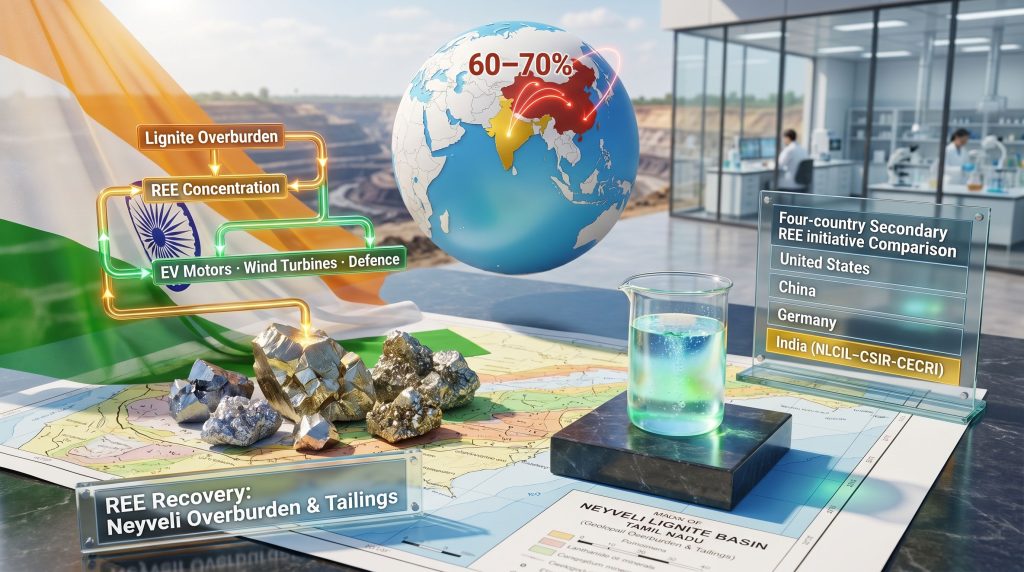
India's Approach Compared: A Global Secondary REE Recovery Landscape
| Country | Secondary REE Source | Programme Type | Current Status |
|---|---|---|---|
| United States | Coal mine refuse, fly ash, acid mine drainage | Department of Energy-funded R&D and pilot operations | Active commercial pilots underway |
| China | Ion-adsorption clays and tailings from primary operations | State-directed and commercially operated | Mature industrial operations |
| Germany | Industrial slag, bauxite residue, e-waste streams | EU Critical Raw Materials Act-funded research | Early-stage research |
| Australia | Mineral sands tailings and phosphate processing residues | Industry-led with government co-funding | Pilot to demonstration stage |
| India (NLCIL-CSIR-CECRI) | Lignite overburden and mine tailings at Neyveli | Public sector MoU-based research programme | Initiation phase |
India's programme is at the earliest stage among comparable initiatives, but it enters a field where the technical groundwork has already been established by programmes in the United States and China. This means CSIR-CECRI can draw on an established body of international research rather than developing core methodologies from scratch, potentially accelerating the timeline from characterisation to process design. In addition, strengthening rare earth supply chains domestically aligns directly with India's broader industrial sovereignty goals.
What This Means for NLCIL's Long-Term Business Strategy
The strategic logic of NLCIL's participation in this programme extends well beyond responding to government policy directives. The company faces structural headwinds in its core lignite and thermal power business as India accelerates its transition toward renewable energy. Coal-fired power generation faces increasing regulatory, financial, and reputational pressure, and the long-term revenue trajectory of NLCIL's traditional business model is under meaningful question.
Critical mineral recovery from existing mine infrastructure represents a genuine diversification pathway that leverages assets NLCIL already owns and operates. The overburden being generated daily at Neyveli is currently a waste management cost. If even a fraction of that material contains economically recoverable REE concentrations, it transforms from a liability into a revenue-generating resource stream without requiring new land acquisition or new mine development.
NLCIL's operational advantages in this programme are significant:
-
Zero additional feedstock cost: Overburden is already being generated and stockpiled as part of normal mining operations
-
Existing infrastructure: Roads, power, water supply, and site security are all already in place at Neyveli
-
Institutional access: As a Government of India enterprise, NLCIL can coordinate across ministries and access policy frameworks that support public sector-led critical mineral development
-
Tamil Nadu geographic advantage: Both NLCIL and CSIR-CECRI are anchored in Tamil Nadu, creating logistical efficiency for sample transport and collaborative site visits
The risks, however, are equally real and should be understood clearly. Furthermore, India's critical minerals strategy more broadly illustrates just how challenging it can be to translate policy ambition into operational supply chain outcomes:
-
Geochemical viability is unconfirmed: REE concentrations at Neyveli may fall below economic recovery thresholds, which typically require total rare earth oxide grades above 500 to 1,000 parts per million for secondary source processing to be economically viable
-
Technology readiness: Sustainable low-impact extraction methods for secondary sources remain under development globally; CSIR-CECRI will need to innovate rather than simply replicate existing processes
-
Commercialisation timeline: Research-stage MoUs typically precede commercial deployment by five to ten years, depending on what the geochemical and processing studies reveal
-
Radioactivity management: Many REE-bearing minerals, particularly monazite, contain elevated concentrations of thorium and uranium. Processing these materials generates radioactive waste streams requiring specialised management, which introduces regulatory complexity that purely clay-hosted REE deposits avoid
Frequently Asked Questions
What is the NLC India and CSIR-CECRI MoU about?
The agreement creates a joint research framework to study and develop NLC India CSIR-CECRI critical mineral extraction technologies for recovering rare earth elements and other critical minerals from overburden and tailings at NLCIL's Neyveli lignite mines in Tamil Nadu, with provisions to extend the scope to other NLCIL projects if initial findings are promising.
What specific minerals are being targeted?
The partnership focuses on rare earth elements and other trace critical minerals within secondary mining residues. Neodymium, cerium, lanthanum, and praseodymium are the most geologically probable targets based on lignite basin analogues, with heavy rare earth elements like dysprosium representing higher-value but lower-probability targets pending formal characterisation.
What makes CSIR-CECRI the right research partner for this work?
CSIR-CECRI's specialisation in electrochemical processing, hydrometallurgy, and mineral beneficiation directly addresses the technical challenges of recovering REEs from low-grade secondary sources, where conventional extraction methods developed for primary ores are often unsuitable. Consequently, China's rare earth strategy has further demonstrated globally why nations must cultivate independent technical capabilities rather than relying on foreign processing infrastructure.
Could this lead to commercial rare earth production in India?
No commercial timeline has been announced or confirmed. The current phase involves pre-commercial feasibility research. Commercial-scale operations, if the geochemical and processing studies justify them, would require a multi-year development and investment pathway beyond the current research programme.
How does this initiative relate to India's National Critical Mineral Mission?
The NCMM explicitly identifies secondary mining sources as a priority pathway for domestic REE supply development. The NLCIL-CSIR-CECRI collaboration directly operationalises this policy objective by deploying public sector research and industrial infrastructure toward NLC India CSIR-CECRI critical mineral extraction technologies applied to existing mine waste streams.
This article contains forward-looking analysis regarding India's critical mineral policy landscape, REE recovery technologies, and the potential outcomes of the NLCIL-CSIR-CECRI research programme. All assessments regarding geochemical viability, commercial timelines, and economic potential are speculative and based on geological analogues and publicly available research. No commercial outcomes have been confirmed by either institution. This content does not constitute financial or investment advice. Readers seeking additional context on India's critical mineral policy landscape may find relevant reporting at ET EnergyWorld (energy.economictimes.indiatimes.com).
Want to Stay Ahead of the Next Major Critical Minerals Discovery on the ASX?
Discovery Alert's proprietary Discovery IQ model delivers real-time alerts the moment significant mineral discoveries — including rare earth and critical mineral plays — are announced on the ASX, transforming complex geological data into clear, actionable investment insights. Explore how historic discoveries have generated extraordinary returns on Discovery Alert's dedicated discoveries page, and begin your 14-day free trial today to position yourself ahead of the broader market.