July 19, 2026
The Technology Gap at the Heart of Global Rare Earth Magnet Supply Chains
Permanent magnet technology sits at an unusual intersection in modern industrial strategy: it is simultaneously mundane in its physical form and extraordinary in its strategic consequence. A sintered neodymium-iron-boron (NdFeB) magnet is a dense, brittle, unremarkable-looking block of material. Yet without it, electric vehicle traction motors lose their performance edge, wind turbines cannot generate power efficiently, and precision defence guidance systems become significantly less capable. The nations that control the ability to produce these components at scale hold a quietly enormous structural advantage across multiple high-growth industries simultaneously.
For India, this reality has crystallised into one of the most consequential industrial policy questions of the current decade: how does a country with meaningful rare earth mineral reserves, a rapidly expanding electric vehicle sector, and ambitious clean energy targets continue to import between 80 and 90 percent of its rare earth magnets and related materials from external sources without accepting serious long-term strategic risk?
The answer, increasingly, is that it cannot. Furthermore, a combination of government capital allocation, domestic enterprise activity, and international technical collaboration is beginning to reshape that reality. Rare earth supply chains remain a central concern for policymakers navigating this challenge.
When big ASX news breaks, our subscribers know first
Understanding Why Sintered NdFeB Magnets Are Irreplaceable
Not all permanent magnets are equal in performance. Sintered NdFeB magnets occupy the top tier of the commercial magnet hierarchy, delivering the highest energy density of any permanent magnet material available at industrial scale. Their ability to generate intense magnetic fields from a compact form factor makes them the material of choice wherever size, weight, and performance constraints intersect.
The industries that depend most heavily on sintered NdFeB magnets include:
-
Electric vehicles: Traction motors in battery electric vehicles rely on NdFeB magnets to deliver the torque density and efficiency that make EVs commercially viable. Each vehicle can contain between one and three kilograms of sintered magnets depending on motor design.
-
Wind energy: Direct-drive wind turbine generators, particularly offshore designs, use NdFeB magnets in quantities measured in tonnes per unit. A single large offshore turbine can require two to three tonnes of sintered magnets.
-
Defence and aerospace: Guided munitions, radar systems, sonar arrays, and aerospace actuators all depend on high-coercivity NdFeB grades whose performance under temperature extremes cannot be replicated by lower-grade alternatives.
-
Industrial automation and robotics: Servo motors, CNC machinery drives, and collaborative robotics platforms are embedded consumers of NdFeB magnets that rarely appear in demand forecasts but represent a structurally growing segment.
What makes substitution difficult is not merely performance. It is the combination of performance, commercial availability, and cost. Samarium-cobalt magnets offer comparable temperature performance in some applications but at significantly higher material cost. Ferrite magnets are cheap and abundant but cannot match the energy density required for EV traction or direct-drive wind applications. Sintered NdFeB remains the only material that satisfies all three criteria simultaneously across the broadest range of high-growth end uses.
The Full Production Chain: Where Complexity Lives
The path from raw rare earth oxide to a finished, application-ready sintered NdFeB magnet involves more than a dozen distinct process stages, each requiring specialised equipment, controlled environments, and deep operational expertise. This is precisely why China's dominance of the magnet supply chain is not simply a function of mineral resource control. It reflects decades of accumulated process knowledge across every stage of that chain.
| Production Stage | Technical Requirement | India's Current Capability Status |
|---|---|---|
| Alloy Preparation | Controlled atmosphere melting | Limited commercial scale |
| Strip Casting | Rapid solidification technology | Early-stage |
| Hydrogen Decrepitation | Hydrogen-safe processing infrastructure | Nascent |
| Jet Milling | Inert atmosphere fine milling | Emerging |
| Magnetic Field Alignment | Precision field application during pressing | Very limited |
| Vacuum Sintering | High-vacuum furnace systems | Very limited |
| Heat Treatment | Controlled thermal cycling | Partial capability |
| Coating and Magnetisation | Surface treatment and field application | Partial capability |
| Quality Testing | Magnetic characterisation and dimensional inspection | Developing |
The Critical Sintering Window
Among all these stages, vacuum sintering and the subsequent heat treatment cycle are particularly unforgiving. The sintering process involves pressing magnetically aligned powder compacts into a furnace at temperatures approaching 1,000 to 1,100 degrees Celsius under high vacuum. The thermal profile during this stage determines the final microstructure of the magnet, which in turn dictates its coercivity, remanence, and maximum energy product.
A subtle deviation in sintering temperature, atmosphere purity, or cooling rate can produce magnets that appear visually identical to specification but fail under operational thermal cycling. For EV and aerospace applications where magnets may experience sustained temperatures above 150 degrees Celsius, this quality consistency is not a preference. It is a safety and reliability requirement.
The Role of Heavy Rare Earths: A Constraint That Persists
A dimension of the NdFeB supply challenge that receives less attention in mainstream coverage is the role of heavy rare earth elements, specifically dysprosium (Dy) and terbium (Tb), in high-performance magnet grades. These elements are added during alloy preparation using a technique called grain boundary diffusion to enhance coercivity, allowing magnets to resist demagnetisation at elevated temperatures.
The challenge for India is that even a fully domestic NdFeB magnet production chain may remain dependent on imported dysprosium and terbium. These heavy rare earths are geographically concentrated to a degree that exceeds even the concentration of neodymium and praseodymium supply. Myanmar has emerged as a significant source in recent years, however overall supply remains tight and geopolitically fragile. Any nation building a domestic magnet industry that does not also address heavy rare earth sourcing has solved only part of the strategic dependency problem. Rare earth processing challenges of this kind are among the most difficult to resolve through policy alone.
India's Policy Response: Architecture of the ₹7,280 Crore Scheme
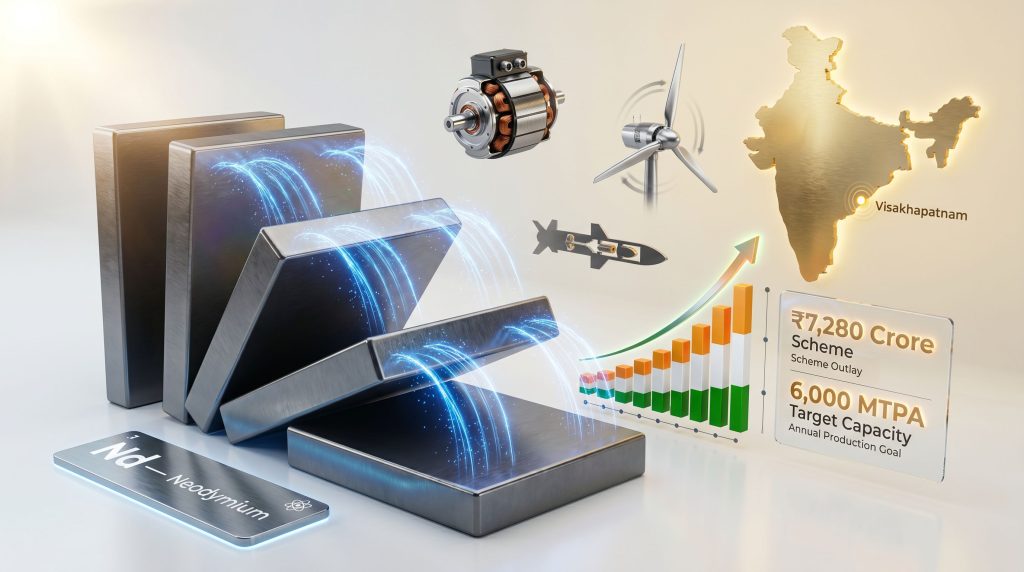
The scale of India's ambition in rare earth magnet manufacturing in India is most clearly visible in the Union Cabinet's approval of a ₹7,280 crore incentive scheme targeting the creation of an integrated sintered rare earth permanent magnet manufacturing ecosystem within the country.
The scheme's architecture reflects several deliberate design choices:
-
Capacity target: A total of 6,000 metric tonnes per annum (MTPA) of sintered NdFeB magnet production, distributed across five selected beneficiaries each allocated up to 1,200 MTPA.
-
Selection mechanism: Global competitive bidding, designed to attract technically qualified international and domestic partners rather than defaulting to incumbents.
-
Value chain scope: Coverage of the full conversion chain from rare earth oxides through to finished sintered magnets, explicitly targeting vertical integration rather than assembly-only operations.
-
End-use focus: Electric vehicles, defence, aerospace, renewable energy, and electronics represent the primary intended demand sinks for domestically produced output.
The structural philosophy of this scheme bears strong resemblance to India's Production Linked Incentive (PLI) approach applied to semiconductors and solar PV manufacturing, where demand-side signals are used to derisk supply-side capital investment in strategically important industries.
This broader critical minerals strategy reflects a growing recognition that energy transition minerals must be secured through integrated domestic production rather than continued import reliance. Parallel to the central scheme, Indian Rare Earths Limited (IREL) is advancing its own rare earth permanent magnet manufacturing plant in Visakhapatnam under an indigenously developed technology framework. The significance of the Visakhapatnam location extends beyond logistics. It positions IREL's magnet manufacturing within an industrial geography that includes existing rare earth processing infrastructure and port access critical for both feedstock receipt and finished product distribution.
International Collaboration: The Mecwin-Fraunhofer IWKS Partnership
Among the private sector developments shaping India's emerging magnet ecosystem, the Memorandum of Understanding signed between Mecwin Technologies India Pvt. Ltd. and Germany's Fraunhofer IWKS represents a technically substantive step forward. The collaboration is structured around the full NdFeB value chain, from alloy development through to commercial production readiness, and includes process optimisation, technical training, and commissioning support as integral components of the arrangement.
Fraunhofer IWKS occupies a distinctive institutional position in the global rare earth materials landscape. As part of Germany's Fraunhofer-Gesellschaft applied research network, it focuses specifically on resource efficiency and functional materials, with established expertise in rare earth processing and magnet technology that bridges academic research and industrial application.
The non-exclusive structure of the MoU is worth noting. Both organisations retain the ability to pursue other partnerships independently, which signals that this collaboration is designed as a capability-building mechanism rather than an exclusive commercial arrangement. For India's broader magnet ecosystem, this openness matters. It suggests that the architecture being assembled is intended to attract multiple technical partners across different nodes of the value chain rather than concentrating dependency in a single bilateral relationship.
Japanese industrial interest in India's magnet manufacturing sector adds another dimension to the emerging landscape. Reports of Proterial, one of Japan's most established magnet producers historically connected to Hitachi Metals, evaluating manufacturing operations in India suggest that international producers are beginning to treat India as a credible production location rather than simply a consumer market. If this interest translates into active investment, it would introduce globally competitive quality benchmarking into the Indian ecosystem at an early stage of its development.
Demand Drivers Across Sectors: Why Timing Matters
The urgency of building domestic rare earth magnet manufacturing in India is inseparable from the demand trajectories of the sectors it serves.
India's EV adoption is accelerating across two-wheelers, three-wheelers, and increasingly passenger cars. Each percentage point of fleet electrification translates directly into magnet demand that currently flows almost entirely through import channels. As volumes grow, the foreign exchange exposure and supply chain vulnerability grow proportionally unless domestic production capacity develops in parallel. Critical minerals demand projections for EVs alone underscore how significant this gap will become.
In renewable energy, India's installation targets for wind capacity represent a substantial embedded demand for NdFeB magnets that has not yet been fully internalised in domestic industrial planning. Direct-drive turbine designs, which are gaining share over geared alternatives for their reliability advantages in offshore environments, are among the most magnet-intensive manufactured products in existence.
Defence represents a different demand dynamic. The volumes are smaller than commercial sectors, but the requirement for assured supply under any geopolitical conditions makes domestic production a sovereign capability question that commercial cost calculations cannot resolve. Guided systems, radar, sonar, and aerospace actuation platforms all embed NdFeB magnets in configurations where import disruption would have direct operational consequences.
The next major ASX story will hit our subscribers first
How India's Approach Compares Globally
| Country | Strategic Approach | Estimated Government Support | Current Status |
|---|---|---|---|
| India | Incentive scheme, state enterprise (IREL), international R&D partnerships | ₹7,280 crore scheme | Early scale-up phase |
| USA | DoD funding, IRA incentives, allied nation sourcing | Multi-billion dollar commitments | Mid-stage development |
| Europe | EU Critical Raw Materials Act, Fraunhofer research ecosystem | Strategic autonomy framework | Advanced pilot to early commercial |
| Japan | Established industry (Proterial, TDK), overseas resource partnerships | Stable policy environment | Mature, globally competitive |
| Australia | Resource extraction focus, emerging processing ambitions | Critical minerals strategy | Processing capability nascent |
What this comparison reveals is that India is entering the magnet manufacturing race at a moment when most developed economies have already committed significant capital and are progressing through mid-stage development. This creates a window of urgency but also an opportunity to learn from the approaches, mistakes, and technology choices made elsewhere.
Structural Challenges That Policy Alone Cannot Resolve
The honest assessment of India's rare earth magnet manufacturing ambitions must grapple with constraints that incentive schemes and MOUs cannot directly address.
Talent scarcity is perhaps the most underappreciated obstacle. Rare earth magnet process engineers and metallurgists with hands-on sintering and alloy preparation expertise represent a genuinely thin global talent pool. China has built this human capital over decades through sustained industrial activity. Replicating it in India requires not just training programmes but industrial throughput that generates the practical experience from which process expertise is actually built.
Infrastructure intensity adds capital pressure beyond what equipment procurement alone conveys. Hydrogen-safe processing facilities for decrepitation, inert atmosphere environments for jet milling, high-vacuum furnace systems for sintering, and precision coating lines all require purpose-built industrial infrastructure that cannot be rapidly retrofitted from general manufacturing environments.
The heavy rare earth constraint noted earlier creates a persistent import dependency even in a fully domestically integrated scenario. Until India secures either domestic heavy rare earth production or stable long-term supply agreements for dysprosium and terbium, the strategic vulnerability of its magnet supply chain remains partially intact even after domestic sintering capacity is established.
A Realistic Development Roadmap
Near-Term Priorities (2025 to 2027)
- Pilot-scale facility commissioning under scheme beneficiaries
- IREL Visakhapatnam plant becoming operational
- First commercial production runs from Indo-German and comparable technical collaborations
- Establishment of quality certification and testing infrastructure aligned with EV and aerospace specifications
Medium-Term Buildout (2027 to 2030)
- Scale-up toward meaningful MTPA levels across multiple facilities
- Development of domestic NdFeB alloy supply to reduce dependence on imported alloy feedstock
- Integration into EV original equipment manufacturer and wind turbine supply chains
- Emergence of India-specific magnet grades optimised for tropical thermal environments
Long-Term Vision (Beyond 2030)
- India positioned as a net exporter of sintered NdFeB magnets to regional markets
- Full value chain integration from rare earth concentrate to application-specific finished magnets
- Active domestic R&D programmes developing grain boundary diffusion techniques and heavy-rare-earth-lean magnet grades
The fundamental tension in India's rare earth magnet strategy is that strategic urgency operates on a policy timeline while technical capability development operates on an industrial learning timeline. Compressing the gap between those two timelines is the central challenge that international partnerships, capital incentives, and sustained institutional commitment must collectively address.
Frequently Asked Questions: Rare Earth Magnet Manufacturing in India
What distinguishes sintered NdFeB magnets from other permanent magnet types?
Sintered NdFeB magnets deliver the highest energy product of any commercially available permanent magnet material, making them the only viable option for high-performance EV traction motors, direct-drive wind generators, and precision defence applications where size, weight, and field strength all carry design constraints.
Why does India import most of its rare earth magnets despite having rare earth reserves?
Possessing rare earth mineral deposits and having the industrial capability to convert them into sintered magnets are entirely different propositions. The processing chain requires specialised infrastructure, process expertise, and controlled manufacturing environments that take years to develop. India currently lacks commercial-scale capability across most stages of that chain.
What is the significance of the ₹7,280 crore government scheme?
The scheme targets 6,000 MTPA of sintered rare earth permanent magnet production capacity across five beneficiaries, using a competitive selection process to attract technically capable partners. It represents one of India's most substantial industrial policy interventions in the critical minerals manufacturing space. India's broader rare earth production targets are closely aligned with the scheme's ambitions.
What role do dysprosium and terbium play in magnet performance?
These heavy rare earth elements are added to NdFeB alloys to enhance coercivity, enabling magnets to maintain performance at elevated operating temperatures. They are critical for EV and aerospace-grade magnets but are geographically concentrated in supply, creating a constraint that extends beyond neodymium and praseodymium sourcing.
How does the Mecwin-Fraunhofer IWKS partnership contribute to India's magnet ecosystem?
The collaboration covers the full NdFeB production chain from alloy development to commercial deployment, including process optimisation, technical training, and commissioning support. The non-exclusive MoU structure allows both parties to maintain additional partnerships, supporting an open ecosystem architecture rather than a single bilateral dependency.
Which sector represents the largest near-term demand driver for domestically produced magnets?
Electric vehicles represent the highest-volume near-term demand segment, driven by India's accelerating EV adoption trajectory. Wind energy follows as a high-intensity demand source, while defence and aerospace create a strategic demand floor that justifies domestic production independently of commercial economics.
This article contains forward-looking analysis regarding industrial development timelines, policy outcomes, and demand projections. Such projections involve inherent uncertainty and should not be interpreted as investment advice. Readers should conduct independent research before making any investment or commercial decisions related to the rare earth or critical minerals sectors.
Want to Track ASX Discoveries in the Critical Minerals Space?
Discovery Alert's proprietary Discovery IQ model delivers real-time alerts on significant ASX mineral discoveries — including rare earths and other critical minerals driving the energy transition — instantly translating complex data into actionable opportunities for traders and investors alike. Explore historic discoveries and their returns or start your 14-day free trial today to position yourself ahead of the market.