
July 11, 2026
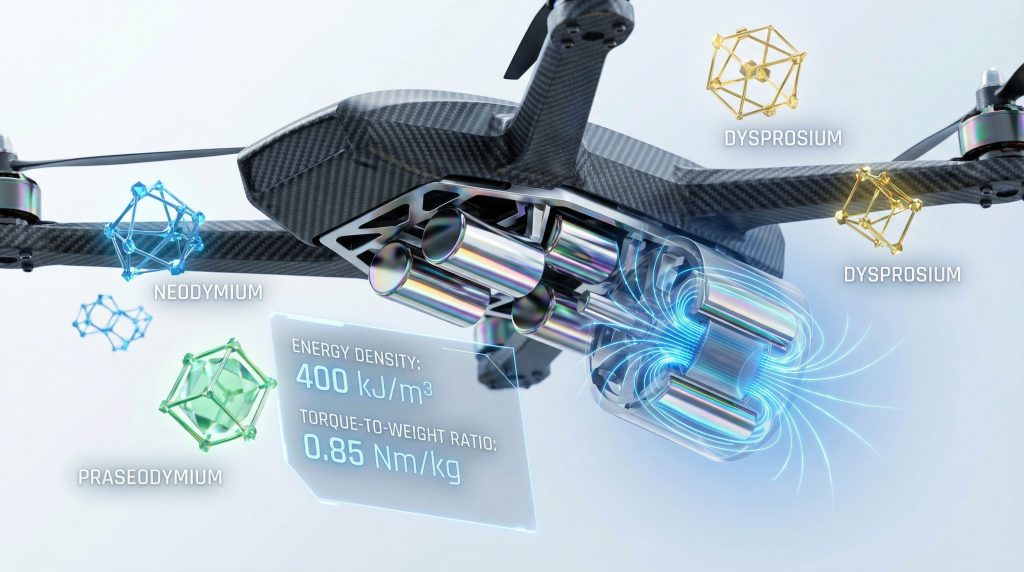
The global aerospace and defense industry currently operates under a precarious dependency that few recognize. While military strategists focus on conventional threats and supply chain resilience, a fundamental vulnerability exists within the microscopic components that power modern warfare systems. The permanent magnets required for motor functionality in unmanned aerial vehicles represent a technological chokepoint that could determine the outcome of future conflicts, particularly as the rare earth supply chain becomes increasingly strained.
What Makes Rare Earth Elements Critical for Drone Motor Performance?
The Physics Behind Magnetic Motor Efficiency
Drones and rare earth magnets share an inseparable relationship rooted in electromagnetic physics. Every brushless DC motor powering military and commercial UAVs requires permanent magnets to generate the magnetic fields necessary for rotation. These magnets must deliver exceptional energy density while maintaining structural integrity under extreme operational conditions.
The torque-to-weight ratio becomes critical in aerospace applications where every gram affects flight duration and payload capacity. Rare earth permanent magnets offer magnetic energy products exceeding 400 kilojoules per cubic meter, significantly outperforming traditional ferrite alternatives that typically achieve only 30-40 kilojoules per cubic meter.
Temperature stability presents another engineering challenge. Military drones and rare earth magnets must function across temperature ranges from arctic conditions to desert operations, often exceeding 150 degrees Celsius in engine compartments. Standard permanent magnets lose magnetic strength rapidly at elevated temperatures, while rare earth compositions maintain performance integrity.
Elemental Composition of High-Performance Magnets
Neodymium-iron-boron (NdFeB) alloys form the foundation of modern drone motor magnets, with neodymium providing base magnetic strength and iron contributing structural stability. The typical composition includes approximately 30% neodymium, 65% iron, and 5% boron, though precise ratios vary based on performance requirements.
Praseodymium often substitutes for portions of neodymium content, offering similar magnetic properties at potentially lower costs depending on market conditions. This substitution capability provides supply chain flexibility while maintaining motor performance specifications.
Heavy rare earth additions prove essential for extreme-duty applications. Dysprosium and terbium additions, typically 2-8% by weight, dramatically improve coercivity and thermal stability. These elements enable magnets to resist demagnetization under high temperatures and opposing magnetic fields encountered in military operations.
Current military drone operations demonstrate staggering scale and dependency. Ukraine deployed approximately 9,000 drones per day throughout 2024, with total annual production reaching 1.2 million units. Each drone requires multiple rare earth magnets for motor operation, navigation systems, and payload mechanisms, highlighting how crucial AI mining efficiency has become for meeting these demands.
When big ASX news breaks, our subscribers know first
Which Drone Applications Demand the Highest Magnet Specifications?
Military UAV Requirements
Defense applications impose the most stringent magnetic performance standards due to operational environments and mission criticality. Military drones must operate reliably across temperature ranges from -40°C to +85°C, withstand vibration exceeding 20G acceleration, and maintain performance at altitudes up to 50,000 feet.
Payload capacity constraints drive motor efficiency requirements to maximum levels. A 10% reduction in motor efficiency directly translates to reduced flight time or decreased payload capacity, potentially compromising mission effectiveness. This constraint makes high-performance rare earth magnets non-negotiable for military UAV applications.
Key military specifications include:
- Operating temperature range: -55°C to +125°C continuous operation
- Magnetic flux density: Minimum 1.3 Tesla remanence (Br)
- Coercivity requirements: Exceeding 900 kA/m intrinsic coercivity (Hci)
- Corrosion resistance: Military-standard coating specifications
- Vibration tolerance: MIL-STD-810G compliance for mechanical shock
Environmental operating conditions extend beyond temperature extremes. Maritime operations expose components to salt spray corrosion, requiring specialized nickel-copper-nickel coating systems. High-altitude operations create pressure differentials that can cause outgassing from standard epoxy coatings, necessitating specialized sealant systems.
Commercial Drone Motor Specifications
Commercial applications span a broad performance spectrum, from consumer recreational drones to industrial heavy-lift platforms. Agricultural spraying systems represent among the most demanding commercial applications, requiring motors capable of sustained operation under full payload conditions.
Surveillance and mapping platforms demand different optimization parameters, prioritising flight duration over lifting capacity. These applications typically utilise moderate-grade rare earth magnets optimised for efficiency rather than maximum power density.
Commercial performance tiers include:
- Consumer grade: N35-N42 NdFeB magnets, basic nickel coating
- Professional grade: N42-N48 NdFeB magnets, enhanced corrosion protection
- Industrial grade: N48-N52 NdFeB magnets with heavy rare earth additions
- Agricultural grade: Specialised high-temperature formulations for extended duty cycles
Market demand projections indicate exponential growth across all commercial segments. Morgan Stanley projects magnet demand increasing 3-5 times over the coming decade, driven by electric vehicles, grid infrastructure, defense platforms, and emerging robotics sectors. Under high-adoption scenarios, demand could increase 40-50 times over coming decades.
How Do Rare Earth Magnets Compare to Alternative Technologies?
Performance Benchmarking Analysis
Direct performance comparisons reveal the technological superiority of rare earth permanent magnets over conventional alternatives. Energy density measurements provide the most relevant metric for aerospace applications where weight constraints dominate design decisions.
| Magnet Type | Energy Product (kJ/m³) | Operating Temperature (°C) | Relative Cost |
|---|---|---|---|
| Ferrite | 30-40 | 250 | 1.0x |
| Alnico | 40-80 | 540 | 3.0x |
| SmCo (1:5) | 120-200 | 300 | 15.0x |
| SmCo (2:17) | 200-240 | 350 | 20.0x |
| NdFeB | 240-400 | 150-200 | 8.0x |
Samarium-cobalt magnets offer superior temperature performance compared to neodymium-based alternatives, maintaining magnetic properties at temperatures exceeding 300°C. However, cobalt supply chain vulnerabilities and significantly higher costs limit widespread adoption except in specialised high-temperature applications.
Cost-performance analysis reveals why neodymium-iron-boron dominates drone applications despite temperature limitations. The combination of high magnetic energy product and moderate cost creates an optimal solution for most UAV requirements.
Emerging Alternatives and Limitations
Research into rare-earth-free motor designs continues across multiple technological approaches, though none have achieved commercial viability for demanding aerospace applications. Permanent magnet-free motors including switched reluctance and induction designs suffer from significantly lower power density and efficiency.
Advanced electromagnet systems could theoretically replace permanent magnets but require continuous electrical power to maintain magnetic fields. This approach creates unacceptable weight penalties and power consumption for battery-powered drone applications.
Current technological barriers include:
- Power density: Rare-earth-free designs achieve only 60-70% of NdFeB motor performance
- Efficiency losses: Typically 5-10% reduction in energy conversion efficiency
- Control complexity: Advanced motor controllers increase system cost and complexity
- Reliability concerns: Moving parts in electromagnet systems reduce operational lifespan
Recycled rare earth magnets present a partial solution to supply chain concerns while maintaining performance characteristics. However, recycling processes currently recover only 30-40% of original magnetic strength, limiting applications to less demanding commercial uses.
What Are the Global Supply Chain Vulnerabilities for Drone Magnets?
Processing Concentration Analysis
China controls approximately 90-95% of global rare earth processing, creating an unprecedented concentration of critical material supply. This dominance extends beyond raw material extraction to encompass every stage of rare earth oxide separation, metal production, and magnet manufacturing.
The vulnerability extends deeper than simple geographic concentration. China maintains tight control through monthly export licensing systems that permit Beijing to restrict supply to any nation without warning. Recent geopolitical tensions have demonstrated this leverage repeatedly, particularly following Trump's critical minerals order.
When President Trump threatened 100% tariffs on Chinese goods, Beijing's immediate counter-threat involved rare earth export restrictions. Trump backed down quickly, revealing the true balance of economic power in critical materials supply chains.
Processing capacity outside China remains severely limited:
- North America: Less than 2% of global separation capacity
- Europe: Approximately 1% of global processing capability
- Japan: Maintains domestic processing but relies on Chinese feedstock
- Australia: Raw material extraction only, no separation facilities
Technical barriers to rare earth processing explain this concentration. Converting raw rare earth minerals into usable metals requires separating 17 individual elements through multi-stage solvent extraction processes operating at temperatures exceeding 1,200 degrees Celsius. The Center for Strategic and International Studies identifies this metallisation step as the least developed and most difficult capability to rebuild outside China.
Strategic Stockpiling and Supply Security
National stockpiling strategies reveal dramatic differences in supply chain preparedness among allied nations. Japan maintains strategic reserves covering several months of domestic demand, with individual companies maintaining additional private stockpiles.
Current strategic reserve positions:
- United States: Zero strategic stockpile of processed rare earths
- European Union: Zero strategic stockpile of processed rare earths
- Japan: Multi-month strategic reserves plus private company stocks
- South Korea: Limited government reserves, primarily private stocks
The entire Western defense industrial base operates on just-in-time supply chains for these critical materials. This approach works effectively for non-critical commodities but creates catastrophic vulnerability when applied to materials controlled by potential adversaries.
Ukraine's drone production exemplifies this vulnerability. A country fighting for survival against a Chinese ally remains entirely dependent on Chinese-manufactured components to power defensive systems. If China restricted rare earth exports tomorrow, Ukraine's drone production would likely halt within weeks.
Supply disruption scenarios range from targeted export restrictions to broader trade conflicts. Even temporary disruptions could cascade through defense manufacturing systems, potentially grounding entire drone fleets pending component availability.
How Are Different Countries Securing Drone Magnet Supply Chains?
North American Supply Chain Development
United States defense procurement rules effective January 1, 2027, will ban Chinese-origin rare earth materials from American weapons systems. This regulatory shift creates unprecedented demand for domestically-sourced alternatives while establishing hard deadlines for supply chain compliance.
Processing facility development faces significant technical and financial challenges. The Saskatchewan Research Council has developed an AI-driven separation system requiring only six operators compared to approximately 80 workers needed for comparable Chinese facilities. This AI system processes 5,000 data points per millisecond, producing higher-purity metals with greater efficiency than conventional methods.
Investment flows into domestic processing have accelerated dramatically. The U.S. Export-Import Bank issued a $200 million letter of intent supporting supply chain development, while defense contractors seek long-term offtake agreements to secure compliant material sources.
Furthermore, the development of a strategic minerals reserve has become crucial for maintaining supply security.
Current North American capabilities include:
- REalloys Euclid facility: Only proven commercial-scale heavy rare earth processing in North America
- SRC Saskatoon plant: Targeting first commercial production by early 2027
- Planned Phase 1 output: 525 tonnes neodymium-praseodymium metal, 30 tonnes dysprosium oxide, 15 tonnes terbium oxide annually
European and Asian Supply Diversification Strategies
European Critical Raw Materials Act implementation focuses on reducing single-source dependencies while building strategic partnerships with allied nations. However, actual processing capacity development lags significantly behind policy objectives, with limited European processing capacity currently available.
Japan's strategic approach emphasises both stockpiling and technology development. The Japan Organisation for Metals and Energy Security (JOGMEC) has established partnerships with North American processing companies, combining Japanese financial resources with Western processing expertise.
Alternative sourcing partnerships extend beyond traditional allies. Brazil, Kazakhstan, and Greenland possess significant rare earth deposits, though processing capabilities remain limited. These partnerships could provide feedstock security while processing capacity develops in allied nations.
Regional diversification initiatives:
- European Union: €3 billion allocated for critical materials independence by 2030
- Japan-Australia partnership: Joint development of rare earth processing capabilities
- Canada-U.S. cooperation: Integrated North American supply chain development
- Nordic cooperation: Greenland exploration with Danish and American involvement
What Technical Challenges Exist in Rare Earth Magnet Manufacturing?
Metallisation and Alloy Production Complexities
Converting rare earth oxides into metallic form presents extraordinary technical challenges requiring precise control across thousands of process variables. Oxide-to-metal conversion occurs through molten salt electrolysis at temperatures exceeding 1,200°C, demanding specialised equipment and extensive technical expertise.
Precision alloying requires exact control of elemental compositions to achieve specified magnetic properties. Variations of even 0.1% in dysprosium content can significantly affect coercivity and thermal performance. This precision demands analytical equipment capable of detecting trace elemental variations and process control systems maintaining consistent conditions.
Quality control extends throughout the manufacturing process, from raw material purity verification through final magnet testing. Magnetic property measurements must verify remanence, coercivity, and energy product values while thermal cycling tests confirm temperature stability specifications.
Critical process parameters include:
- Electrolysis temperature: ±5°C precision control at 1,200°C operating temperature
- Atmospheric control: Inert gas purities exceeding 99.95% to prevent oxidation
- Cooling rates: Controlled solidification to achieve optimal microstructure
- Pressing pressures: Multi-ton hydraulic systems for powder compaction
Equipment and Technology Dependencies
Specialised equipment requirements create hidden supply chain vulnerabilities throughout rare earth processing systems. Graphite anodes represent a critical consumable requiring replacement multiple times weekly, with supplies coming almost exclusively from China.
Many companies claiming Chinese-independent supply chains maintain quiet dependencies on Chinese technology and consumables. Equipment purchased from Chinese suppliers often requires ongoing technical support, spare parts, and consumable materials available only from original manufacturers.
The principle that 1% reliance on China equals 100% reliance on China reflects the interconnected nature of rare earth processing systems. Complete supply chain independence requires domestic alternatives for every component, consumable, and technical service.
Technology dependency categories:
- Primary equipment: Furnaces, separation columns, electrolysis cells
- Consumables: Graphite anodes, specialty chemicals, filtration media
- Technical services: Process optimisation, equipment maintenance, troubleshooting support
- Spare parts: Specialised components with long lead times and single-source suppliers
The next major ASX story will hit our subscribers first
How Is Drone Magnet Demand Expected to Evolve?
Military Procurement Trends
NATO defense procurement demonstrates unprecedented investment in unmanned systems across all military branches. Drone technology has evolved from specialised reconnaissance platforms to primary engagement systems, fundamentally altering military equipment requirements.
Swarm technology development creates exponential demand growth for miniaturised high-performance magnets. Each swarm unit requires multiple permanent magnets while collective swarm operations could deploy hundreds of units simultaneously.
Defense budget allocations reflect this shift:
- U.S. defense drone spending: Projected to exceed $15 billion annually by 2028
- NATO collective investment: Over €50 billion committed for unmanned systems development
- Individual unit requirements: Each military drone contains 4-8 high-performance magnets
- Scaling projections: Military drone fleets expected to grow 300-500% by 2030
Long-term military requirements extend beyond current platforms to encompass autonomous logistics systems, robotic ground vehicles, and space-based applications. Each system requires specialised magnetic components optimised for specific operational environments.
Commercial Market Growth Projections
Industrial automation drives the largest commercial demand growth, with drone-based inspection systems replacing human workers in hazardous environments. Power line inspection, pipeline monitoring, and infrastructure assessment applications require specialised high-reliability magnetic components.
Agricultural applications continue expanding beyond traditional crop spraying to encompass precision planting, targeted fertiliser application, and automated harvesting systems. These applications demand sustained operation under full payload conditions, requiring optimised magnetic designs.
Commercial growth sectors include:
- Delivery services: Last-mile logistics automation driving urban drone deployment
- Environmental monitoring: Air quality assessment and wildlife tracking applications
- Emergency services: Search and rescue operations, medical delivery systems
- Entertainment industry: Professional filming and event coverage applications
Delivery and logistics drone deployment faces regulatory constraints but demonstrates strong underlying demand. Major logistics companies have committed billions in drone infrastructure development, creating substantial future demand for high-performance magnets.
What Investment Opportunities Exist in the Drone Magnet Supply Chain?
Processing Facility Development
Rare earth processing facility investments require substantial capital commitments with extended development timelines. Separation plants demand $200-500 million initial investment with 3-5 year construction periods, though potential returns justify these commitments given supply shortage projections.
Regulatory approval processes add complexity and timeline uncertainty to facility development. Environmental permitting, safety certifications, and defense security clearances can extend project timelines while adding compliance costs.
Revenue potential from defense contracts provides stable long-term cash flows once facilities achieve operational status. Defense procurement typically involves multi-year contracts with built-in price escalation clauses, reducing market volatility risks.
Investment parameters include:
- Capital requirements: $200-500 million for commercial-scale separation facilities
- Development timeline: 36-60 months from permitting to first production
- Revenue projections: $100-200 million annually at full capacity operation
- Payback periods: 8-12 years including development phase costs
Technology and Equipment Suppliers
Specialised manufacturing equipment demand creates significant opportunities for technology suppliers capable of developing Chinese-independent alternatives. AI-driven process control systems offer efficiency advantages while reducing labour requirements.
Automation systems development addresses both efficiency and supply chain security concerns. Domestic equipment suppliers with clearance for defense applications command premium pricing while building long-term customer relationships.
Technology investment opportunities:
- Process control systems: AI-driven optimisation platforms for separation processes
- Specialised furnace design: High-temperature electrolysis equipment for metal production
- Quality control instruments: Advanced analytical equipment for purity verification
- Automation solutions: Robotic systems reducing manual labour requirements
Recycling and recovery technology development offers additional investment potential as rare earth prices continue rising. Advanced recycling processes could recover 80-90% of original magnetic strength while reducing primary mining requirements.
Frequently Asked Questions About Drones and Rare Earth Magnets
Technical Specifications
What magnet grades are used in different drone motor types?
Consumer drones typically utilise N35-N42 grade neodymium magnets offering adequate performance for recreational applications. Professional systems employ N42-N48 grades for improved efficiency and extended operational life. Military applications demand N48-N52 grades with heavy rare earth additions for maximum performance and thermal stability.
How do temperature variations affect magnet performance?
Neodymium magnets lose approximately 0.08-0.12% of magnetic strength per degree Celsius temperature increase. Heavy rare earth additions significantly improve thermal coefficient performance, reducing strength loss to 0.02-0.05% per degree Celsius. Operating temperatures exceeding 150°C require specialised alloy compositions or alternative magnet technologies.
What are typical magnet replacement intervals?
Commercial drone motors typically require magnet replacement every 500-1,000 operating hours depending on duty cycle and environmental conditions. Military systems undergo preventive maintenance at 300-500 hour intervals to ensure mission readiness. Corrosive environments can reduce replacement intervals by 30-50%.
Supply Chain and Sourcing
How can manufacturers verify rare earth magnet origins?
Material traceability requires documentation throughout the supply chain from mine to finished magnet. Analytical testing can identify elemental signatures characteristic of specific ore deposits, though sophisticated testing equipment and expertise are required. Third-party certification services provide independent verification for defense applications.
What are lead times for custom magnet specifications?
Standard commercial magnets typically require 6-12 weeks delivery from established suppliers. Custom specifications can extend lead times to 16-24 weeks for development and qualification. Defense applications with security clearance requirements may require 6-12 months for complete qualification processes.
Which countries offer the most reliable supply alternatives?
Currently, no country outside China offers complete rare earth processing capabilities at commercial scale. North American facilities under development could provide alternatives by 2027-2028, while recycled material sources offer limited near-term supply options. Japan maintains the most secure supply position through strategic stockpiling and private reserves.
Future Outlook: The Strategic Importance of Magnet Supply Security
Technological Development Trajectories
Motor efficiency improvements continue advancing through optimised magnetic circuit designs and advanced control systems. Next-generation brushless motors could achieve 95-98% efficiency compared to current 85-92% performance levels, reducing power consumption and extending flight times.
Integration with AI and autonomous flight systems creates new requirements for magnetic sensing components beyond motor applications. Navigation systems, obstacle avoidance sensors, and payload stabilisation systems all require specialised magnetic components optimised for specific functions.
Emerging technology requirements:
- Magnetic levitation systems: Contactless bearing designs for extended operational life
- Wireless power transmission: Inductive charging systems for autonomous operation
- Advanced navigation: Magnetometer arrays for GPS-independent positioning
- Sensor integration: Miniaturised magnetic sensors for enhanced autonomy
Scaling requirements for mass drone deployment could create demand increases of 10-20 times current levels within a decade. Swarm applications could deploy hundreds of units per mission, multiplying individual platform requirements exponentially.
Geopolitical Implications
National security considerations increasingly drive supply chain planning as drones and rare earth magnets become recognised as critical defense technologies. Countries dependent on Chinese rare earth processing face fundamental strategic vulnerabilities that extend far beyond economic concerns.
International cooperation frameworks for critical materials are expanding through allied partnerships and strategic agreements. However, these frameworks require substantial time and investment to develop meaningful production capabilities.
Long-term strategic competition dynamics suggest continued bifurcation between Chinese and Western supply chains. Nations aligning with either bloc will likely develop exclusive supply relationships, creating parallel but incompatible technological ecosystems.
As analysis from OilPrice.com suggests, controlling magnet supply chains could determine the balance of power in modern warfare.
Investment in domestic rare earth processing capabilities represents more than economic opportunity; it constitutes essential national defense infrastructure for the age of unmanned warfare. As drone technology reshapes military capabilities worldwide, the nations controlling magnet supply chains may ultimately control the balance of power in 21st-century conflicts.
Disclaimer: This analysis involves forward-looking projections and emerging market assessments. Rare earth markets remain highly volatile and subject to geopolitical disruptions. Investment decisions should incorporate comprehensive due diligence and professional financial advice. Supply chain developments may face technical, regulatory, or economic obstacles that could affect projected timelines and outcomes.
Could Your Portfolio Benefit From the Drone Revolution's Critical Dependency?
The unprecedented demand surge in defence and commercial drone applications creates exceptional investment opportunities in rare earth magnet supply chains. Discovery Alert's proprietary Discovery IQ model delivers real-time notifications on significant ASX mineral discoveries, particularly targeting critical materials positioning investors to capitalise on these strategic supply chain shifts before broader market recognition.