Locksley Resources Ltd
- ASX Code: LKY
- Market Cap: $61,875,538
Locksley Resources Partners with Columbia University to Unlock Rare Earth Processing Potential at Mojave Project
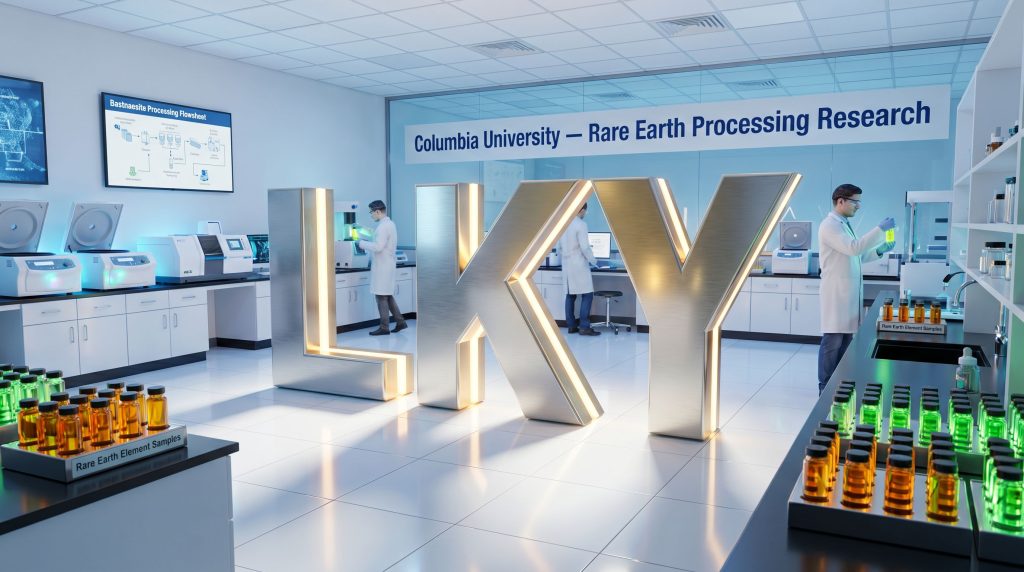
Locksley Resources Limited (ASX: LKY) has announced significant progress in its rare earth development strategy, revealing substantial advancement from its ongoing research collaboration with Columbia University. The Locksley Resources rare earth processing collaboration with Columbia University for the Mojave Project is focused on developing and refining processing pathways for rare earth elements (REEs) at the Company's El Campo project within the broader Mojave Project in California, with the work now transitioning to project-specific optimisation using actual Locksley samples.
When big ASX news breaks, our subscribers know first
A University Collaboration Delivering Serious Technical Progress
The collaboration operates under the leadership of Professor Greeshma Gadikota within Columbia University's Department of Earth and Environmental Engineering and Columbia Climate School. This represents research-grade expertise being applied to one of the most complex challenges in critical minerals processing.
The programme structure encompasses three interconnected workstreams:
- Ore Characterisation – Analysing the mineralogy, composition, and morphology of the carbonatite and bastnaesite-style mineralisation at El Campo
- Processing Development – Designing and testing technologies for REE and critical metal recovery, separation, and metallisation
- Deployment and Assessment – Evaluating the economic and environmental considerations of proposed flowsheets
What distinguishes this collaboration is its parallel execution with Locksley's maiden exploration programme at El Campo. Rather than waiting until a resource is established to begin processing research, Locksley is building processing knowledge now. This integrated approach could, furthermore, compress the project development timeline if exploration results prove successful.
What Has the Research Delivered So Far?
"Locksley's collaboration with Columbia University is providing us with access to advanced research into rare earth recovery, separation and metallisation pathways. The work completed to date is supporting our understanding of potential processing routes for our carbonatite-related mineral systems. We look forward to the next phase of optimisation using Locksley samples and to assessing the implications of these results for future development studies."
— Kerrie Matthews, Managing Director & CEO, Locksley Resources
Technical Achievements Delivered Across Key Workstreams
Progress across the three workstreams has been substantial, with several technically significant advances reported in the announcement.
Ore Characterisation
Columbia has developed a spectroscopic approach for rapid detection and spatial determination of REEs in carbonatite material. This method is now being refined using samples provided directly from Locksley, marking a key transition from generalised research to project-specific application.
Processing Pathways
Experimental protocols have been established for pre-concentration techniques aimed at increasing REE concentrations in the leachate. Selective leaching approaches are being developed to simplify downstream processing steps. These protocols are now being optimised using Locksley's carbonatite ores from the El Campo site.
Flowsheet Development
Conceptual flowsheets have been proposed for bastnaesite-rich ores from El Campo, covering multiple leaching modes, co-recovery of associated metals, REE separation techniques, and electrified metallisation pathways.
Downstream Processing
Progress has been made in molten salt electrolysis for REE metallisation, combined with salt recovery within the process loop. This approach is being evaluated as a potential alternative to conventional carbon-based thermal reduction, a method that carries both cost and environmental considerations in traditional rare earth processing.
Understanding Bastnaesite and the Processing Challenge
What Is Bastnaesite?
Bastnaesite represents one of the world's most important rare earth-bearing minerals and the primary ore mineral at major REE deposits globally. It is a carbonate-fluoride mineral that contains light rare earth elements including cerium, lanthanum, neodymium, and praseodymium. These elements serve as critical inputs for electric vehicles, wind turbines, defence systems, and advanced electronics.
Why Does Processing Complexity Matter to Investors?
Rare earth projects extend far beyond simple mining operations. The processing challenge often determines where projects succeed or fail commercially. Converting ore in the ground into separated rare earth oxides, and ultimately metals, involves multiple complex steps: cracking the ore, leaching, separating individual elements (which possess very similar chemical properties), and then reducing oxides to metals. Each step adds cost, time, and technical risk.
Projects that can demonstrate simpler, lower-cost, or more environmentally friendly flowsheets carry a meaningful competitive advantage. This represents precisely what the Locksley Resources rare earth processing collaboration with Columbia University for the Mojave Project is designed to investigate for El Campo mineralisation.
| Key Term | Definition |
|---|---|
| Bastnaesite | A rare earth carbonate-fluoride mineral; one of the primary ore minerals for light REEs |
| Carbonatite | An igneous rock composed predominantly of carbonate minerals; commonly host to REE mineralisation |
| Leaching | A chemical process used to dissolve and extract target metals from ore material |
| Pre-concentration | Increasing the grade or proportion of target metals prior to full processing, reducing downstream complexity |
| Molten salt electrolysis | An electrochemical method to produce metals directly from their compounds using a molten salt medium |
| Metallisation | The conversion of rare earth oxides or compounds into usable metal form |
| Flowsheet | A diagrammatic representation of the complete processing sequence from ore to final product |
Strategic Logic: Processing Intelligence Alongside Exploration
One of the more compelling aspects of Locksley's approach is the deliberate parallelism between exploration and processing research. Many junior resource companies develop processing knowledge only after a resource is defined, often years into a project's lifecycle. Locksley, however, is building that knowledge base now.
This approach matters for several reasons:
- Faster decision-making: If exploration at El Campo delivers positive results, Locksley will already possess a working understanding of which processing routes may be viable
- Informed economic analysis: Early-stage flowsheet development allows the Company to begin assessing the economic implications of different processing approaches before committing to expensive feasibility studies
- Reduced technical risk: Understanding the ore's processing behaviour from the outset helps avoid the costly surprises that often emerge when processing studies are conducted later in development
- Pilot-scale readiness: The programme is explicitly aimed at evaluating potential pilot-scale pathways, meaning the work could eventually transition from laboratory to demonstration scale
Forward Programme and Development Milestones
The collaboration continues with a clear set of priorities, each aimed at moving from generalised experimental protocols toward project-specific, decision-ready data.
| Next Step | Description |
|---|---|
| Locksley sample optimisation | Refine processing protocols specifically using El Campo ore samples |
| Recovery and separation evaluation | Further assess techniques for selective REE recovery and efficient separation |
| Development study implications | Evaluate how processing insights translate into future technical and economic studies |
| Pilot-scale pathway assessment | Assess feasibility of progressing toward pilot-scale evaluation |
| Integration with exploration | Incorporate processing knowledge with ongoing exploration results at El Campo |
The Locksley Resources rare earth processing collaboration with Columbia University for the Mojave Project adds technical credibility to Locksley's REE strategy, whilst the parallel execution of exploration and processing research represents a sophisticated approach that could, consequently, create value by shortening the timeline between exploration success and development studies.
The next major ASX story will hit our subscribers first
Why Does Locksley Resources Warrant Investor Attention?
Locksley's investment thesis centres around a dual-track critical minerals strategy in the United States. The Company targets rare earth elements at the Mojave Project and antimony under a mine-to-market strategy, at a time when domestic U.S. critical mineral supply chains are attracting increasing industry focus.
The Locksley Resources rare earth processing collaboration with Columbia University for the Mojave Project adds several elements that distinguish Locksley's approach:
- Elite research partnership: Columbia University's involvement through Professor Gadikota's group represents genuine scientific capability being applied to Locksley's specific mineralisation type
- Project-specific transition underway: The shift to using actual Locksley samples for protocol optimisation marks a meaningful step from theoretical research to applied project work
- Differentiated processing approach: Molten salt electrolysis as an alternative to conventional thermal reduction could represent a cleaner and potentially more economical processing route
- Integrated development model: The parallel execution of exploration and processing research could compress development timelines if exploration proves successful
- Broad market access: Locksley trades on the ASX (LKY), OTCQX (LKYRF), Frankfurt Stock Exchange (X5L), and via ADR (LKYLY), providing comprehensive investor accessibility
The Company's approach reflects an understanding that rare earth development success requires more than simply finding mineralisation. Processing pathways, environmental considerations, and technical feasibility ultimately determine commercial viability.
By building processing knowledge in parallel with exploration rather than sequentially, Locksley is positioning itself to move faster through the development lifecycle should the geology continue to support the project's potential. For investors focused on critical minerals exposure in the United States, Locksley Resources represents a methodical and strategically intelligent approach to rare earth development, with project-specific sample optimisation now firmly underway.
Want to Learn More About Locksley Resources and the Mojave Project?
Locksley Resources (ASX: LKY) is taking a strategically differentiated approach to rare earth development in the United States, combining elite university research with active exploration at its El Campo project. With Columbia University's processing expertise now being applied directly to Locksley's own ore samples, the Company is building meaningful technical foundations that could accelerate its path from exploration to development. Investors seeking critical minerals exposure with a methodical, research-driven edge may find Locksley's dual-track strategy worth a closer look. Visit locksleyresources.com.au to find out more about the Company and its projects.