June 10, 2026
The Hidden Complexity Behind America's Rare Earth Processing Gap
Most discussions about rare earth supply chains focus on mining volumes, trade flows, and geopolitical risk. Far less attention is directed at the processing bottleneck that sits between ore in the ground and usable material in a factory. The United States has substantial rare earth mineral endowment, but transforming that endowment into separated, high-purity oxides suitable for permanent magnet manufacturing requires a processing infrastructure that largely does not yet exist domestically. That gap is precisely what makes the Rare Element Resources Bear Lodge permit timeline and demo plant delays so consequential for anyone tracking the evolution of North American critical mineral self-sufficiency.
Understanding what Bear Lodge is attempting to achieve, and why its current schedule matters, requires examining the technical, regulatory, and strategic dimensions of the project together rather than in isolation.
When big ASX news breaks, our subscribers know first
Why NdPr Oxide Is the Critical Bottleneck in Clean Energy Supply Chains
Neodymium-praseodymium oxide, commonly abbreviated as NdPr, sits at the centre of one of the most strategically sensitive supply chains in modern industry. It is the primary feedstock for neodymium-iron-boron (NdFeB) permanent magnets, which are essential components in the traction motors that power electric vehicles and in the direct-drive generators used in wind turbines.
The scale of anticipated NdPr demand is significant, particularly given the critical minerals demand surge now reshaping global supply strategies:
- A single electric vehicle traction motor typically requires between 1 and 2 kilograms of NdFeB magnet material.
- Offshore wind turbines using direct-drive configurations can require 600 kilograms or more of rare earth magnets per megawatt of generating capacity.
- Global NdPr demand is projected to more than double by 2035 as EV and wind energy deployment accelerates.
China currently accounts for roughly 85 to 90 percent of global rare earth separation capacity. That concentration creates a structural vulnerability for Western clean energy and defence manufacturing that has become increasingly difficult for policymakers to ignore. Against this backdrop, any project that credibly targets domestic NdPr separation capacity commands attention well beyond the resource sector.
Bear Lodge's Geological Position and Technological Ambition
The Bear Lodge deposit in northeastern Wyoming represents one of the most geologically significant rare earth accumulations in the continental United States. The deposit is characterised by elevated concentrations of the magnet-relevant rare earths, particularly neodymium and praseodymium, which distinguish it from carbonatite deposits with heavier skews toward lighter, lower-value rare earths like cerium and lanthanum.
What separates the Bear Lodge development model from a straightforward mining proposition is its vertical integration ambition. Rather than simply extracting ore and shipping concentrate offshore for separation, Rare Element Resources has developed a proprietary separation technology specifically designed to produce high-purity separated NdPr oxide as a domestic end product.
This distinction matters for several reasons:
- Value capture: Separated NdPr oxide commands a substantially higher price than mixed rare earth concentrate.
- Supply chain positioning: A domestic separation facility would serve US magnet manufacturers without dependence on Chinese processing infrastructure.
- Technical defensibility: Proprietary process technology creates barriers to replication and supports stronger commercial and financing negotiations.
The development model follows a deliberate two-stage sequence: operate a demonstration plant to validate the process at meaningful scale, then use that operational dataset to design and finance a full commercial separation facility. The rare earth processing challenges inherent to this approach are considerable, however, and have directly influenced the project's current schedule.
FAST-41 Designation and the Bear Lodge Permit Timeline
One of the most structurally important recent developments for the project is its formal designation as a covered project under the FAST-41 federal permitting framework. FAST-41, derived from the Fixing America's Surface Transportation Act of 2015, established the Federal Permitting Improvement Steering Council (FPISC) with a mandate to coordinate and streamline environmental reviews for large infrastructure and resource projects across multiple federal agencies.
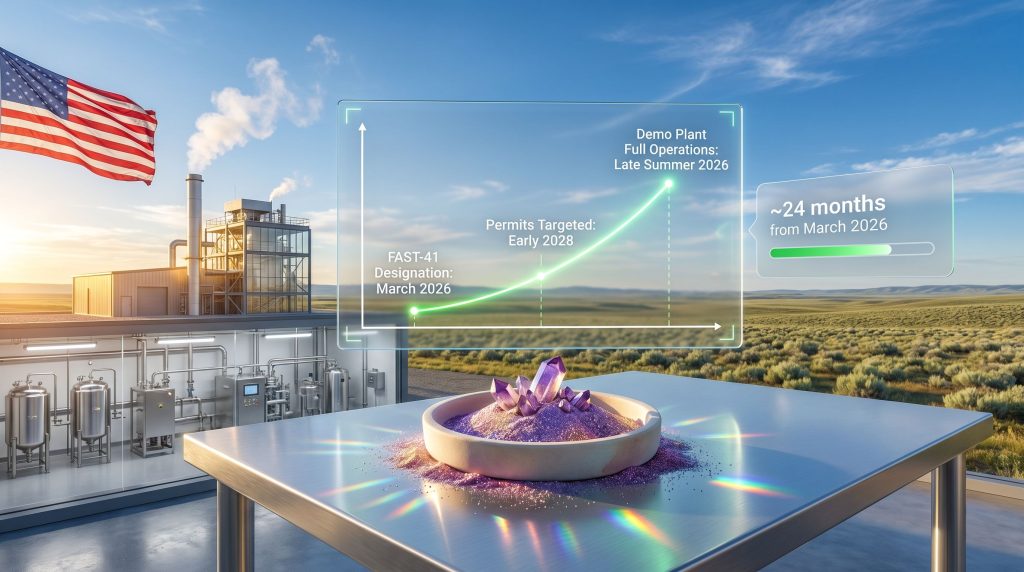
Bear Lodge received its FAST-41 covered project designation in March 2026. The practical consequences of this designation are meaningful:
- A comprehensive permitting schedule must be published within 60 days of designation.
- Federal agencies are required to coordinate reviews concurrently rather than sequentially.
- The permitting schedule becomes publicly trackable through the FPISC dashboard, creating accountability and transparency.
- The US Department of Agriculture and US Forest Service serve as lead coordinating agencies for the Bear Lodge NEPA review.
Rare Element Resources confirmed that the required permitting schedule was completed within the 60-day window, with the US Forest Service leading the National Environmental Policy Act review process that governs the project's federal approval pathway.
Bear Lodge Permit Milestone Summary
| Milestone | Target Date |
|---|---|
| FAST-41 Covered Project Designation | March 2026 |
| Permitting Schedule Published | Within 60 days (May 2026) |
| NEPA Review Commencement | 2026 (ongoing) |
| All Federal and State Permits Targeted | Early 2028 (~March) |
| Total Permitting Duration | ~24 months from designation |
The approximately 24-month permitting window is considerably compressed relative to historical norms. Traditional multi-agency NEPA reviews for projects of comparable complexity on federally managed land have frequently extended to four to seven years without the coordination mechanisms that FAST-41 provides. Furthermore, the structured parallel review process does not guarantee approval, but it substantially reduces the risk of indefinite open-ended delays that have historically derailed mining project timelines.
This progress also reflects the broader US critical minerals push under current federal policy, which has prioritised domestic resource development as a matter of national security.
It is important to note that FAST-41 designation provides procedural coordination and schedule accountability. It does not constitute project approval, government funding, or a commitment to any specific regulatory outcome. Investors should treat the permitting timeline as a target framework, not a guarantee.
Demonstration Plant Delays: A Technical Autopsy
While the permitting track has progressed in an orderly fashion, the Bear Lodge demonstration plant in Upton, Wyoming has experienced a more complicated journey. Understanding the nature of these delays requires some familiarity with how rare earth processing circuits are structured.
A rare earth processing facility typically operates as a series of interconnected stages:
- Primary circuit: Ore is crushed, leached, and subjected to physical and chemical separation to produce a total rare earth concentrate.
- Secondary processing: The concentrate is further refined and prepared as feed for the separation stage.
- Separation circuits: Individual rare earth elements are isolated using solvent extraction or ion exchange techniques to produce separated, high-purity oxides.
The critical dependency in this architecture is that the separation circuits cannot operate effectively unless they receive a consistent, high-quality feed from the primary circuit. Variability or inefficiency at the front end cascades through the entire process, making primary circuit optimisation a non-negotiable prerequisite for meaningful end-to-end testing.
Demonstration Plant Timeline: Schedule Progression
| Period | Status |
|---|---|
| 2024 | NRC and DOE clearances obtained; balance of plant commissioned |
| April 2025 | Operational review identifies required modifications; startup delayed by several months |
| Late 2025 | Equipment upgrades and rework confirmed; shake-down targeted for year-end |
| Q1 2026 | Full operations expected following shake-down completion |
| Mid-2026 | Full end-to-end operations now targeted for late summer 2026 |
The specific technical challenge identified is filtration inefficiency within the primary processing circuit. Filtration at this stage is responsible for separating solid material from pregnant leach solutions that carry dissolved rare earth content. Poor filtration performance can manifest as reduced throughput, inconsistent concentrate grades, and contamination of downstream circuits, all of which compromise the quality and reliability of the feed entering the separation stage.
Resolving these inefficiencies has required equipment changes and operational modifications that take time to implement, test, and validate. The balance of plant systems were successfully commissioned, confirming that the back-end infrastructure is functional. The outstanding work, however, remains concentrated in front-end circuit optimisation.
Rare Element Resources has provided detailed updates on these challenges, noting that resolving filtration issues at demonstration scale is the technically correct and commercially prudent approach before committing capital to a full commercial facility.
From a technical risk management perspective, identifying and fixing these problems at demonstration scale is the correct approach. The cost of resolving a filtration inefficiency on a small-scale circuit is orders of magnitude lower than discovering the same problem after committing capital to a commercial facility.
The Strategic Sequencing Logic: Why Both Tracks Must Converge
The relationship between the Rare Element Resources Bear Lodge permit timeline and demo plant delays is not coincidental. The two tracks are designed to converge at a point where the company holds both a validated process design and the regulatory approvals needed to build the commercial facility.
In the base case scenario, the sequencing works as follows:
- Late summer 2026: Full end-to-end demonstration plant operations commence.
- Mid-to-late 2027: Approximately 12 months of operational, economic, and engineering data collection concludes.
- Early 2028: Federal and state permits targeted for completion.
This creates a strategic buffer of roughly six to nine months between the completion of the demonstration dataset and the expected permitting milestone. That buffer is valuable because it allows the company to begin commercial facility engineering and financing discussions with a validated process design in hand before final permits are secured.
Scenario Analysis: Impact of Further Demo Plant Delays
| Scenario | Demo Start | Data Collection End | Permit Target | Strategic Buffer |
|---|---|---|---|---|
| Base Case | Late Summer 2026 | Mid-2027 | Early 2028 | 6-9 months |
| Moderate Delay | Q4 2026 | Late 2027 | Early 2028 | 2-4 months |
| Extended Delay | Q1 2027 | Q1 2028 | Early 2028 | Minimal |
| Severe Delay | Mid-2027 | Mid-2028 | Early 2028 | Negative overlap |
The scenario analysis highlights that the project retains meaningful strategic flexibility in moderate delay scenarios, but that flexibility erodes rapidly if demo plant operations are pushed into 2027. Consequently, investors and analysts should monitor quarterly operational updates closely for any signals of further front-end circuit complications.
The next major ASX story will hit our subscribers first
What the Demonstration Plant Must Deliver Before Commercial Scale-Up
The 12-month operational window is not simply a trial run. It serves as the primary technical and commercial de-risking instrument for everything that follows. The dataset generated during this period is expected to underpin three critical outputs:
- Bankable feasibility study inputs: Reagent consumption rates, energy costs per tonne of product, and processing yields at scale are essential for building a credible financial model for a commercial facility.
- Engineering design parameters: Equipment sizing, circuit configuration, and infrastructure requirements for the commercial plant cannot be responsibly specified without empirical data from sustained operations at the demonstration scale.
- Process reliability evidence: Continuous operation over a 12-month period provides the statistical basis for asserting that the proprietary separation technology performs consistently, not just episodically.
Lenders and equity investors in critical mineral projects increasingly require demonstration-scale validation before committing capital to commercial construction. A fully operational demonstration plant with a robust 12-month dataset materially reduces the risk premium applied to project finance, which in turn improves the commercial viability of the full-scale facility.
Broader Context: Bear Lodge Within the North American Rare Earth Landscape
The United States currently has no meaningful domestic rare earth separation capacity operating at commercial scale. The MP Materials facility at Mountain Pass, California produces rare earth concentrate but ships a significant portion of its output to China for separation. Lynas Rare Earths is constructing a separation facility in Texas under a US Department of Defense contract, but it is not yet operational at full scale.
America's rare earth supply chain remains heavily exposed to foreign processing dependency, which is precisely why the Bear Lodge development model carries such strategic weight. The project occupies a distinct position in this landscape because of its fully integrated ambition, combining resource extraction with domestic separation using proprietary technology.
If the demonstration plant successfully validates the process and the commercial facility proceeds, it would represent one of the first genuinely end-to-end domestic rare earth oxide production operations in the modern era. The Rare Element Resources Bear Lodge permit timeline and demo plant delays are, therefore, not merely a project-level story but a meaningful data point in the broader effort to establish resilient Western rare earth supply infrastructure.
That ambition carries commensurate risk. The history of rare earth project development in Western countries is populated with technically credible projects that encountered financing barriers, processing challenges, or market timing difficulties. Bear Lodge is at a stage where execution on the demonstration plant and permitting tracks will be the primary determinants of whether the commercial vision progresses on schedule. Project tracking details are publicly available through the FPISC dashboard for those monitoring progress.
Disclaimer: This article is intended for informational purposes only and does not constitute financial or investment advice. Statements relating to project timelines, permitting outcomes, and commercial development are forward-looking in nature and subject to material risks and uncertainties. Readers should conduct independent research and consult qualified advisers before making investment decisions. Further information on FAST-41 permitting processes is publicly available through the Federal Permitting Improvement Steering Council at permits.performance.gov.
Want to Capitalise on the Next Major Critical Minerals Discovery Before the Market Catches On?
Discovery Alert's proprietary Discovery IQ model delivers real-time alerts on significant ASX mineral discoveries — instantly transforming complex critical minerals data into actionable investment insights for both short-term traders and long-term investors. Explore historic discoveries that have generated exceptional returns and begin your 14-day free trial at Discovery Alert to position yourself ahead of the market.