June 15, 2026
When Borrowing Costs and Barrel Prices Collide: Understanding Australia's Inflation Dilemma
Supply-side energy shocks have historically placed central banks in an impossible position. Raise rates too aggressively and you strangle an economy already reeling from higher input costs. Hold rates steady and risk becoming a passive spectator as inflation expectations become unanchored. This tension, familiar from the stagflationary episodes of the 1970s and the post-pandemic tightening cycles of 2022 and 2023, has returned to Australia in 2026 in a particularly concentrated form.
The convergence of a geopolitical disruption to one of the world's most critical maritime chokepoints and a domestic monetary cycle that is still digesting the consequences of 2025 easing has produced a macro environment where no single policy lever resolves the problem. The RBA 4.35% rate hike and oil price inflation dynamic sits at the centre of this challenge, and understanding where it leads is critical for households, investors, and policymakers navigating 2026.
When big ASX news breaks, our subscribers know first
The Strait of Hormuz Closure and Its Inflationary Transmission Into Australia
How a Shipping Chokepoint Becomes a Household Budget Problem
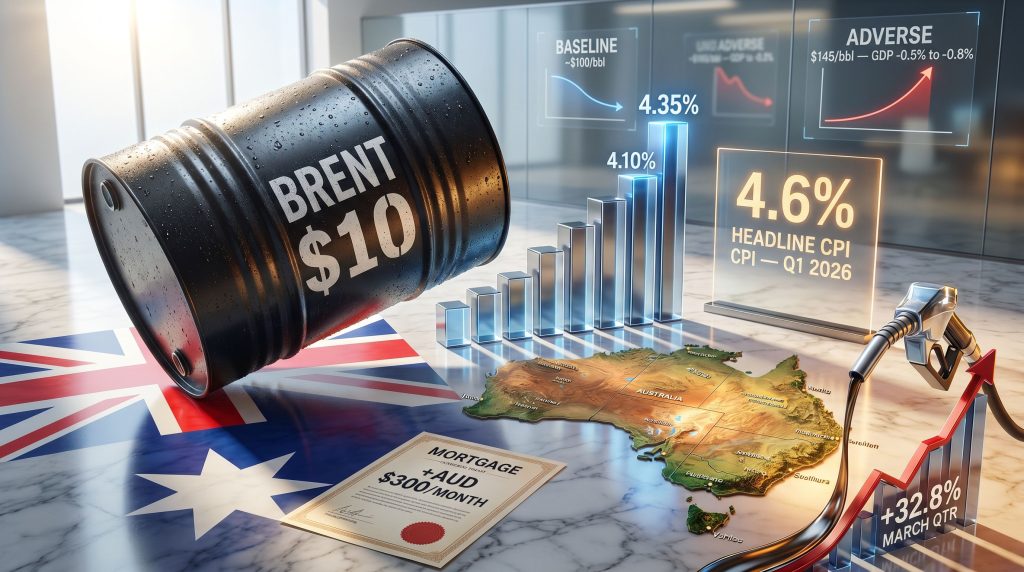
The Strait of Hormuz handles roughly one fifth of all globally traded seaborne oil. When access to that corridor was effectively suspended, the volume of supply removed from international markets was comparable in scale to the disruption caused by the 1973 OPEC embargo, one of the most economically damaging supply shocks of the twentieth century. The oil price rally that followed was immediate and severe, with Brent crude surging above USD $100 per barrel and hitting an intraday high above USD $126.
For Australia, a net oil importer with a large and geographically dispersed population highly dependent on road transport, the transmission from global crude prices to domestic household costs is direct and rapid. Fuel prices rose by 32.8% in the March 2026 quarter alone, representing the single largest quarterly transport cost increase in the country's recent economic history. The federal government's decision to halve fuel excise duties provided partial relief, but the magnitude of the underlying crude price shock ensured that significant cost pass-through reached consumers regardless.
Why the RBA Cannot Print More Oil
A point that deserves emphasis for anyone trying to interpret the RBA's response is that monetary policy operates entirely on the demand side of the economy. The Reserve Bank holds no mechanism to reopen shipping lanes, increase global crude production, or reduce the price of energy flowing into domestic supply chains. Its only available instrument, the cash rate, works by making borrowing more expensive, which suppresses spending and investment, consequently reducing demand-pull inflationary pressure.
The critical limitation here is that Australia's 2026 inflation problem is primarily supply-push in origin, not demand-pull. Rate hikes can compress consumer spending, but they cannot lower the price of a barrel of Brent crude. Furthermore, historical cycles reinforce this constraint: during both the 1973 to 1974 oil crisis and the 2021 to 2022 pandemic-era energy surge, central banks that tightened aggressively succeeded in suppressing growth but achieved only partial and delayed success in bringing energy-driven inflation under control.
When inflation is predominantly supply-driven, rate hikes function as a tool for managing expectations and protecting central bank credibility rather than as a direct mechanism for solving the root price problem. The RBA is defending its inflation anchor, not curing an oil supply shortage.
Decoding the May 2026 Rate Decision: What the Numbers Actually Show
The Statistical Snapshot Behind the 4.35% Decision
On May 5, 2026, the RBA's board voted 8 to 1 in favour of raising the cash rate by 25 basis points to 4.35%. The decision was widely anticipated: 30 of the 33 economists surveyed by Reuters had forecast the outcome, meaning the hike carried effectively zero surprise premium in either bond or currency markets. According to the ABC, the decision reflected mounting pressure from energy-driven price growth across key consumer categories.
The data driving the decision was stark. Q1 2026 headline CPI reached 4.6%, its highest reading since 2023, with transport costs rising 8.9% across the quarter and housing-related components adding a further 6.5%. The fuel price surge of 32.8% in a single quarter represented the energy shock's most visible transmission mechanism, but its effects rippled across virtually every goods and services category through elevated logistics and production costs.
| Metric | Pre-Hike | Post-Hike (May 2026) |
|---|---|---|
| RBA Cash Rate | 4.10% | 4.35% |
| Q1 2026 Headline CPI | Prior quarter | 4.6% |
| Housing CPI Component | Elevated | +6.5% |
| Transport Cost Growth (Q1) | Moderate | +8.9% |
| Fuel Price Surge (March Quarter) | Pre-shock | +32.8% |
| RBA Inflation Peak Forecast | ~4.2% | ~4.8% to 5.0% (mid-2026) |
| Core Inflation Forecast (Year-End) | Below target | ~3.5% |
| GDP Growth Forecast | 1.8% | 1.3% |
| RBA Board Vote | N/A | 8 to 1 in favour |
The Feedback Loop That Committed the Board to Act
Beyond the raw CPI data, the RBA was responding to an institutional credibility problem created by its own 2025 policy decisions. When the bank eased rates during 2025, underlying inflation re-accelerated almost immediately, a feedback loop that Westpac's chief economist identified as the primary driver of the board's shift toward a higher-for-longer posture. Household short-term inflation expectations had risen sharply in RBA survey data by the time the May 2026 meeting convened.
With the prior easing cycle already demonstrating that premature rate cuts reignite price pressures, the board had limited justification to hold. The May 2026 hike effectively reset the policy clock entirely, reversing every rate reduction delivered during the 2025 easing cycle. The RBA's projected terminal rate sits near 4.7% by end-2026, with restrictive settings expected to persist well into 2028 under the baseline scenario.
Australia's Dual Compression Problem: Above-Target Inflation and Below-Trend Growth
Defining the Stagflationary Pressure
The word stagflation is often used loosely, but Australia's 2026 macro configuration meets the technical criteria with uncomfortable precision. The RBA's own revised forecasts model GDP growth of 1.3%, comfortably below trend, alongside an inflation peak approaching 4.8% to 5.0%, well above the 2% to 3% target band. These two conditions coexisting eliminate the standard policy trade-off that central banks rely upon.
In a normal inflationary environment, the RBA raises rates to cool demand, GDP growth slows toward trend, and inflation moderates. However, in a stagflationary environment, tightening accelerates the growth contraction without fully neutralising the supply-side inflation driver. The bank cannot ease to support growth without risking a repeat of the 2025 re-acceleration episode, leaving a policy framework with no clean exit. These global recession risks are increasingly relevant to how Australian policymakers frame their forward guidance.
The Compounding Squeeze on Australian Households
For the average Australian household, the 2026 environment layers multiple simultaneous cost pressures:
- Mortgage repayments on a standard AUD $600,000 variable-rate loan have increased by approximately AUD $300 per month since January 2026
- Average 2026 inflation running at 3.8% against a pre-conflict baseline of 3.1% is eroding real purchasing power across all spending categories
- Unemployment is projected to peak at 4.7% under the baseline scenario, adding income insecurity to cost pressure
- Fuel costs, grocery bills, and utility charges are rising simultaneously, concentrating financial stress on lower and middle-income households with limited buffer savings
A household carrying a $600,000 mortgage, a fuel-dependent commute, and no inflation-protected income is simultaneously absorbing higher interest payments, higher pump prices, and higher grocery costs. No single policy response provides relief across all three pressure points at once.
Treasurer Jim Chalmers publicly attributed the household cost burden to the geopolitical conflict's economic spillover, framing the fuel excise reduction as a targeted offset rather than a structural solution. That framing is technically accurate: without resolution of the underlying supply disruption, fiscal measures can soften the blow at the margin but cannot reverse the inflationary trajectory.
Two Scenarios, Two Entirely Different Economies: The Brent Crude Threshold Framework
Baseline Scenario: Strait Reopens, Brent Stabilises Near $100
The RBA's baseline assumptions rest on a relatively prompt resolution of the Strait of Hormuz disruption and Brent crude stabilising near USD $100 per barrel. Under these conditions:
- Inflation peaks at approximately 4.8% around June 2026 before beginning a gradual decline
- GDP contracts modestly but avoids the technical definition of recession
- Unemployment rises to 4.7% and stabilises without broader consumer confidence collapse
- The RBA holds the cash rate in the 4.35% to 4.60% range through year-end before reassessing in early 2027
- CPI returns to the 2% to 3% target band by mid-2027
Adverse Scenario: Disruption Extends to Q1 2027, Brent Reaches $145
If the closure extends materially beyond current timelines and crude prices sustain above $100, the economic calculus changes fundamentally. For instance:
- GDP contracts 0.5% to 0.8%, meeting the technical definition of recession
- Unemployment climbs to 5.1%, triggering broader consumer confidence deterioration and reinforcing the demand contraction
- Inflation remains structurally elevated, forcing the RBA to maintain or extend its tightening cycle beyond current consensus forecasts
- Household consumption collapses as debt servicing costs and energy prices simultaneously peak
- Corporate earnings revisions accelerate across consumer-facing and capital-intensive sectors
The Trigger Variables Every Investor Should Track
| Trigger Variable | Baseline Threshold | Adverse Threshold | Monitoring Frequency |
|---|---|---|---|
| Brent Crude Futures | ~$100 per barrel | Sustained above $100, peak $145 | Daily |
| Melbourne Institute Inflation Expectations | Stable or declining | Rising sharply | Monthly |
| RBA Cash Rate | Hold at 4.35% | Rise to 4.60% or above | Per board meeting |
| Strait of Hormuz Status | Reopened by Q3 2026 | Closure extends to Q1 2027 | Weekly |
| Australian Unemployment Rate | Peak 4.7% | Rise to 5.1% | Monthly via ABS |
Warning: As of early May 2026, Brent was already trading near USD $110, above the $100 baseline threshold. This means the adverse scenario's inflation projection was already under pressure before Q2 CPI data was published. Monitoring crude oil trends in real time is therefore essential for any investor seeking to interpret the RBA's next move accurately.
Portfolio Stress-Testing in a Rate-Elevated, Inflation-Persistent Environment
The Two Highest-Risk Exposure Categories
1. Consumer Discretionary Holdings
Real household income compression from 3.8% average 2026 inflation combined with rising unemployment creates a dual headwind for consumer-facing businesses: lower purchasing volume and weaker pricing power for non-essential goods and services. Companies operating in retail, travel, hospitality, and entertainment face margin compression as input costs rise while consumer spending capacity contracts.
The earnings recovery timeline for these businesses extends materially if rates remain at 4.35% to 4.85% through year-end, and any modelling that assumes cuts arriving before early 2027 is currently unsupported by consensus data. The impact on investment markets from sustained energy-driven inflation adds further complexity to sector allocation decisions.
2. Variable-Rate Debt Maturing Within 12 Months
Any business or investment vehicle carrying variable-rate debt due for refinancing in the next 12 months faces a stress-test ceiling at Westpac's terminal rate forecast of 4.85%. The operative question for each position is whether the business can sustain margin and service debt obligations at current or higher rates through December 2026 without any assumption of rate cuts. Where that answer requires cuts to materialise, the current data environment does not support that assumption.
Why Rate Peak Timing Is Not an Actionable Trading Signal
Of the 31 economists surveyed by Reuters on May 5, 2026, 18 forecast a hold at 4.35% while more than one-third projected rates reaching at least 4.60% by end of Q3 2026. This split consensus makes binary positioning against a specific rate peak date statistically unreliable. The distribution of outcomes is wide enough that directional bets on peak timing carry significant probability-weighted downside on either side.
Holding cash in anticipation of 2026 rate cuts that may not materialise also carries its own opportunity cost in an inflationary environment where 3.8% average inflation is actively eroding real cash returns. The more durable approach combines:
- Inflation-linked instruments: Australian Government Treasury Indexed Bonds provide direct protection against CPI overshoot scenarios without requiring a directional view on rate timing
- Commodity-correlated positions: Energy and materials exposures that benefit from elevated crude prices can partially offset the portfolio drag from rate-sensitive holdings in the baseline scenario
- Duration management: Shortening fixed-income duration reduces mark-to-market sensitivity if the RBA extends its tightening cycle beyond current consensus, which remains a plausible outcome if Brent sustains above $100
Furthermore, the market volatility reset seen across bond and equity markets in early 2026 reinforces the case for a diversified, inflation-aware positioning strategy rather than concentrated rate-directional bets.
The next major ASX story will hit our subscribers first
The 2026 Energy Shock in Global Context: Why Australia Is Not an Isolated Case
How the Same Supply Shock Is Pressuring Central Banks Worldwide
The Strait of Hormuz disruption is a globally symmetric supply shock. Every oil-importing economy simultaneously faces the same energy cost pass-through problem, which creates a coordinated inflationary impulse that individual central banks cannot escape through domestic policy alone. The Eurozone faces CPI risks above 3% if the disruption extends, which would complicate or reverse any easing the European Central Bank had planned for the second half of 2026.
The US Federal Reserve and Bank of Canada face analogous pressure: if Brent sustains above $100, the case for holding rates elevated strengthens regardless of domestic demand conditions. Asia-Pacific importers including Japan, South Korea, and India face compounded pressure given their elevated energy import dependency relative to GDP. AMP's chief economist has noted that coordinated global tightening in response to the same supply shock risks amplifying the growth contraction beyond what any single central bank intends.
What Makes 2026 Structurally Different From 2022
| Dimension | 2022 Energy Shock | 2026 Energy Shock |
|---|---|---|
| Primary Cause | Russia-Ukraine conflict | Middle East and Strait of Hormuz closure |
| Supply Removed | Approximately 10 to 12% of global gas supply | Approximately 20% of global oil supply |
| Duration | Multi-year but partial disruption | Acute but potentially shorter |
| Central Bank Starting Point | Near-zero policy rates | Already elevated post-2022 tightening |
| Inflation Starting Point | Emerging from pandemic stimulus | Partially re-accelerating from 2025 easing |
| Fiscal Response | Large-scale energy subsidies | Targeted excise relief in Australia |
The structural difference that matters most for Australia is the starting rate level. In 2022, the RBA and its global peers were cutting from near zero, which gave them significant tightening runway before real household stress became severe. In 2026, every additional 25 basis point increase operates from a base of 4.35%, meaning the debt-servicing burden on each increment is materially higher for households and businesses than the equivalent move was four years ago.
Frequently Asked Questions: RBA 4.35% Rate Hike and Oil Price Inflation
Why did the RBA raise rates to 4.35% in May 2026?
The RBA raised its cash rate by 25 basis points to 4.35% on May 5, 2026, following Q1 2026 headline CPI reaching 4.6%, its highest reading since 2023. The primary driver was a 32.8% surge in domestic fuel prices resulting from the Strait of Hormuz closure, which removed approximately 20% of global seaborne oil supply from international markets. The board voted 8 to 1 in favour of the increase, and 30 of 33 economists surveyed by Reuters had anticipated the outcome.
Will the RBA raise rates further beyond 4.35%?
The RBA has projected a terminal rate of approximately 4.7% by end-2026, with restrictive settings expected to persist through 2028. Westpac's terminal rate forecast sits at 4.85%. More than one-third of economists surveyed by Reuters in May 2026 projected rates reaching at least 4.60% by end of Q3 2026, though 18 of 31 forecast a hold at 4.35%. The split consensus makes precise peak-timing predictions unreliable.
How does oil price inflation feed into the RBA's decisions?
Higher crude prices flow directly into transport costs, energy bills, and goods pricing throughout the supply chain. A 32.8% quarterly surge in fuel prices produces an immediate and broad-based CPI impact. The RBA 4.35% rate hike and oil price inflation relationship is therefore one of external cause and domestic monetary response, where the bank addresses the credibility and expectations dimension of the problem, not its supply-side origin.
What is the $100 per barrel Brent threshold and why does it matter?
The RBA's baseline inflation and GDP forecasts assume Brent crude stabilises near USD $100 per barrel following a prompt reopening of the Strait of Hormuz. If Brent sustains materially above $100, the baseline 4.8% inflation peak projection is breached and the adverse scenario — GDP contraction of 0.5% to 0.8% and unemployment rising to 5.1% — becomes the operative framework. As of early May 2026, Brent was already trading near USD $110, placing the baseline projections under pressure before Q2 data was published.
How much have Australian mortgage repayments increased in 2026?
Repayments on a standard AUD $600,000 variable-rate loan have increased by approximately AUD $300 per month since January 2026, reflecting the cumulative impact of rate increases delivered through the year. This mortgage cost increase is layered on top of fuel price surges and broader goods inflation running at 3.8% for the year.
When will Australian inflation return to the RBA's target band?
Under the baseline scenario, headline inflation is projected to peak near 4.8% to 5.0% around mid-2026 and return to the 2% to 3% target band by mid-2027. Core inflation is forecast at approximately 3.5% by year-end 2026. Both projections are contingent on the Strait reopening on schedule and Brent crude stabilising near USD $100 per barrel.
Key Takeaways: Navigating the RBA's Higher-For-Longer Environment
The May 2026 decision to lift the cash rate to 4.35% is not a conventional demand-management response to an overheating economy. It is a credibility defence against an externally generated energy shock that the RBA's own tools cannot resolve at source. That distinction shapes every downstream implication for households, borrowers, and investors.
The most important summary points for practical decision-making are:
- The 4.35% hike fully reverses the 2025 easing cycle and establishes a structurally higher policy baseline driven by supply-side inflation, not domestic demand overheating
- The $100 per barrel Brent crude threshold is the single variable separating the baseline scenario from the adverse scenario — it should be tracked daily, and as of early May 2026 it had already been breached
- Consumer discretionary holdings and variable-rate debt maturing within 12 months are the two portfolio exposures with the most direct downside from the current environment
- Rate peak timing cannot be reliably traded: the Reuters economist survey split of 18 hold versus a third projecting further hikes makes binary positioning against a specific peak date statistically unsound
- Structural hedging through inflation-linked instruments, commodity-correlated positions, and duration management is more durable than holding cash in anticipation of 2026 rate cuts that the current consensus data does not support
- Australia's stagflationary configuration — below-trend GDP growth alongside above-target inflation — eliminates the conventional policy trade-off and extends the timeline for any consumer earnings or household spending recovery well into 2027 at minimum
This article is intended for informational and educational purposes only and does not constitute financial advice. All forecasts, scenario projections, and economic figures referenced are subject to change as underlying conditions evolve. Readers should seek independent professional advice before making investment or financial decisions based on macroeconomic analysis.
Want to Know Which ASX Resource Companies Could Benefit From Rising Commodity Prices?
Discovery Alert's proprietary Discovery IQ model delivers real-time alerts on significant ASX mineral discoveries, instantly identifying actionable opportunities across energy and resource sectors as market conditions shift — begin your 14-day free trial today, or explore historic examples of exceptional discovery returns to understand why being first to a major find can matter so much in a volatile macro environment.