July 28, 2026
The Critical Challenge of Recycling Rare Earth Elements
The circular economy represents one of the most compelling pathways toward reducing dependence on primary mining operations, yet recycling rare earth elements from end-of-life products faces a complex web of technological, economic, and strategic challenges. Current recovery rates hover below one percent globally despite significant concentrations of valuable materials in discarded electronics, spent batteries, and decommissioned renewable energy infrastructure. This massive inefficiency signals both opportunity and risk for investors, policymakers, and supply chain strategists seeking alternatives to traditional extraction methods.
Market dynamics in REE recycling reveal a paradox where technical feasibility exists alongside economic barriers that prevent widespread implementation. Understanding these forces requires examining both mature processing technologies and emerging green chemistry solutions that promise to reshape the industry's cost structure and environmental impact.
When big ASX news breaks, our subscribers know first
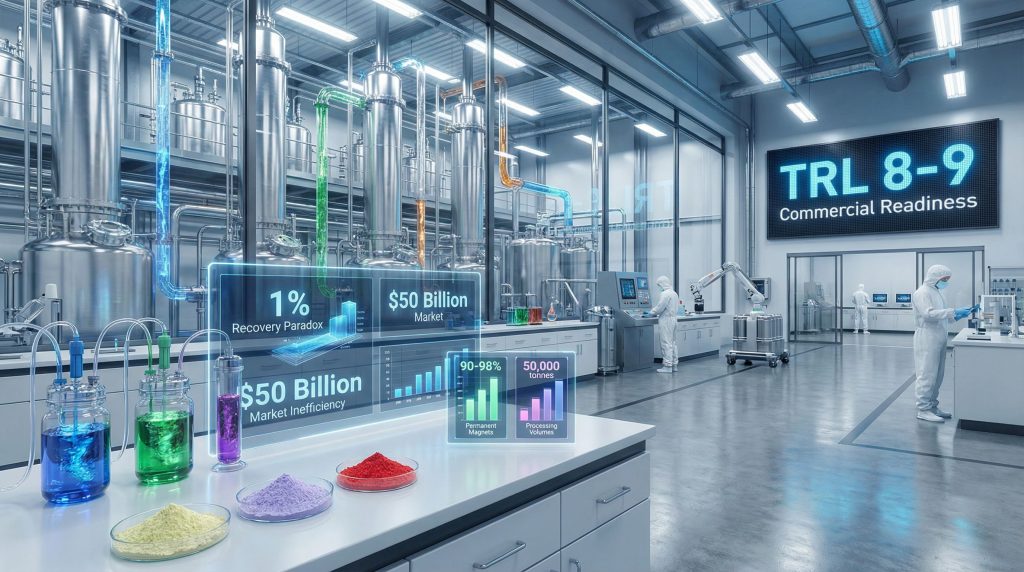
Why Current REE Recycling Rates Signal a $50 Billion Market Inefficiency
The stark reality of rare earth recycling becomes evident when examining global waste streams versus recovery statistics. Less than one percent of rare earth elements from end-of-life products currently undergo recycling, despite end-of-life electronics, automotive components, and renewable energy infrastructure containing substantial concentrations of these critical materials. This figure has persisted for over a decade, representing a systematic market failure that transcends simple technological limitations.
The 1% Recovery Paradox – Understanding Global Waste Streams
Annual waste generation presents a compelling picture of untapped resources. Permanent magnet waste streams alone generate approximately 50,000 tonnes globally each year, primarily from wind turbine decommissioning, electric vehicle motor replacements, and hard drive disposal. These magnets typically contain 25-35% rare earth content by weight, representing roughly 15,000-17,500 tonnes of potentially recoverable material annually.
Nickel-metal hydride battery waste contributes an additional 30,000 tonnes annually, with REE content ranging from 15-25% by weight. Phosphor waste from fluorescent lighting adds another 20,000 tonnes, though with lower concentration levels of 5-15%. Combined, these three primary waste streams contain an estimated 25,000-30,000 tonnes of dispersed rare earth elements that could theoretically supplement primary mining operations.
The geographic distribution of these waste streams creates additional complexity. European electronics waste alone accounts for approximately 9-10 million tonnes annually, with an estimated 30,000-40,000 tonnes of dispersed REE content across multiple product categories. However, collection infrastructure remains fragmented, with no centralised systems for high-value REE recovery at the scales needed for economic viability.
Economic Barriers vs. Technical Feasibility in REE Recovery
Current recovery costs present the primary barrier to scaled implementation. Processing costs for recycled REE typically range from $15-35 per kilogram under existing hydrometallurgical methods, while primary mining operations achieve costs of $8-20 per kilogram depending on ore grade and geographic location. This cost differential persists despite environmental externalities that favour recycling from a life-cycle perspective.
Several factors contribute to the economic challenge:
• Scale inefficiencies: Small batch processing increases per-unit costs compared to large-scale mining operations
• Collection and logistics: Dispersed waste streams require extensive transportation and sorting infrastructure
• Quality specifications: Recycled products often require additional purification steps to meet primary-grade purity standards
• Regulatory compliance: Hazardous material classifications for certain feedstocks add processing complexity and cost
The economic equation shifts significantly when considering feedstock type and concentration. Permanent magnet recycling approaches economic viability due to high REE concentrations and established separation techniques. Recovery rates of 90-98% are achievable for magnet waste, with relatively straightforward processing compared to lower-grade sources.
Quantifying the End-of-Life REE Opportunity by Product Category
| Waste Source | Annual Volume | REE Content | Recovery Potential | Economic Viability |
|---|---|---|---|---|
| Permanent Magnets | 50,000 tonnes | 25-35% | 90-98% recovery rate | High – near commercial viability |
| NiMH Batteries | 30,000 tonnes | 15-25% | 80-90% recovery rate | Medium – requires optimisation |
| Phosphor Waste | 20,000 tonnes | 5-15% | 70-85% recovery rate | Low-Medium – challenging economics |
| Electronic Components | 15,000 tonnes | 3-10% | 60-80% recovery rate | Low – research stage |
The opportunity cost calculation reveals the scale of market inefficiency. If current waste streams contain 25,000-30,000 tonnes of recoverable REE annually, but only 500-1,000 tonnes are actually processed, the value gap represents $750 million to $1.5 billion in lost economic potential at current spot prices. This figure excludes the strategic value of supply chain diversification away from concentrated primary production sources.
Regional variations in waste concentration create additional market dynamics. Japan and South Korea generate high-value electronic waste with concentrated REE content due to advanced manufacturing sectors, while European automotive sectors produce increasing volumes of permanent magnet waste from electric vehicle adoption. Furthermore, the implementation of Europe's critical raw materials facility demonstrates growing policy support for domestic processing capabilities. The United States faces particular challenges with dispersed waste streams across vast geographic areas, requiring different infrastructure approaches than more concentrated Asian or European models.
Technology Readiness Assessment – Which REE Recycling Methods Are Investment-Ready?
Technology maturity varies dramatically across different recycling approaches, with implications for both commercial deployment timelines and investment risk profiles. Understanding Technology Readiness Levels provides essential context for evaluating which methods can realistically contribute to supply chain resilience targets within policy-relevant timeframes.
Hydrometallurgical Processes – The Proven Commercial Pathway
Acid leaching combined with solvent extraction represents the most mature recycling technology, operating at Technology Readiness Level 8-9 across multiple industrial facilities. This proven pathway involves mechanical pre-treatment, followed by sulfuric or hydrochloric acid dissolution at 50-100°C, then selective solvent extraction using organic extractants such as 2-ethylhexyl phosphoric acid.
Industrial-scale facilities currently process 500-5,000 tonnes of pre-concentrated feedstock annually, achieving recovery efficiencies of 90-98% for permanent magnet sources. Purity levels exceed 99.5% for primary-grade oxides or chlorides, meeting specifications for downstream applications. Japanese facilities operated by Shin-Etsu Chemical subsidiaries and European pilot plants demonstrate commercial viability under current market conditions.
Capital expenditure requirements range from $20-50 million for industrial-scale facilities, depending on automation levels and environmental control systems. Operating costs typically fall between $5-15 per kilogram of REE recovered at high utilisation rates, though acid disposal and wastewater treatment add $2-4 per kilogram in environmental compliance costs.
Table: TRL Comparison of REE Recovery Technologies
| Technology | Current TRL | Commercial Readiness | Key Limitations |
|---|---|---|---|
| Acid Leaching | 8-9 | Ready | Environmental concerns, energy intensity |
| DES Systems | 4-6 | 3-5 years | Scale validation needed |
| MOF Separation | 3-5 | 5-10 years | Cost optimisation required |
| Ionic Liquids | 5-7 | 2-5 years | Toxicity assessment incomplete |
| Pyrometallurgy | 7-8 | Near-term ready | High energy consumption |
| Bioleaching | 3-4 | 5-15 years | Process control challenges |
Emerging Green Chemistry Solutions – Deep Eutectic Solvents and MOFs
Deep Eutectic Solvents represent a promising intermediate-term solution, currently at TRL 4-6 with potential for commercial deployment within 3-5 years. These mixtures of Lewis or Brønsted acids and bases exhibit melting points significantly below their individual components, enabling room temperature to 60°C processing compared to traditional high-temperature methods.
Laboratory demonstrations achieve 70-95% REE extraction from permanent magnet waste using choline chloride/urea mixtures, with reduced thermal energy requirements of 30-40% compared to conventional acid leaching. Solvent regeneration through 5-10 cycles appears feasible, though economic optimisation remains incomplete at industrial scales.
Current barriers include cost parity challenges, with DES production costs of $5-10 per litre requiring reduction to under $2 per litre for economic competitiveness. Manufacturing consistency for multi-tonne batches presents scaling challenges, while regulatory approval remains incomplete for some formulations despite generally favourable toxicity profiles.
Metal-Organic Frameworks offer potential for single-stage REE separation without multi-step solvent extraction cascades. These crystalline porous materials demonstrate adsorption capacities of 300-500 mg REE per gram of adsorbent under optimal conditions, with promising selectivity between light and heavy rare earths.
However, MOF technologies remain at TRL 3-5, requiring 5-10 years for commercial readiness. Manufacturing costs currently range from $100-500 per kilogram of MOF material, requiring reduction to under $50 per kilogram for economic viability. Scale-up from gram-level laboratory production to industrial tonne-level manufacturing represents a significant technological leap requiring validation.
Pyrometallurgical vs. Bio-hydrometallurgical Trade-offs
Pyrometallurgical processing operates at TRL 7-8 for specific applications, particularly permanent magnet recycling where high-temperature treatment at 1,000-1,500°C achieves 90-98% recovery rates with minimal impurity carryover. This approach offers the fastest pathway to commercial deployment for magnet waste streams, despite energy costs of $50-100 per kilogram of REE recovered at typical electricity rates.
Environmental considerations include significant energy consumption and emissions, though these may be offset through renewable energy integration or carbon pricing mechanisms. Moreover, the recent development of flash joule heating breakthrough technology offers promising alternatives for energy-efficient processing. Selective application to high-value feedstocks rather than universal deployment appears most economically rational.
Bio-hydrometallurgical approaches remain at early research stages (TRL 3-4) with 5-15 year commercialisation timelines. While these methods promise lower environmental impact through biological extraction mechanisms, challenges include microorganism optimisation, sterility requirements, and process control complexity that limit near-term commercial prospects.
What Makes REE Separation the True Strategic Bottleneck?
The critical distinction between rare earth recovery and rare earth separation reveals why recycling alone cannot resolve supply chain vulnerabilities. While mining and initial concentration represent the visible aspects of REE supply chains, the separation and refining stages determine both economic viability and strategic independence. This downstream processing capability, rather than raw material access, constitutes the primary competitive advantage that shapes global market dynamics.
Understanding the Processing Value Chain Beyond Mining
Rare earth processing involves multiple distinct stages, each requiring specialised technical expertise and infrastructure. Initial mining operations extract REE-bearing ores, typically bastnäsite, monazite, or ion-adsorption clays, achieving concentrates of 5-15% total rare earth oxide content. However, these mixed concentrates require extensive downstream processing to produce specification-grade individual elements.
Separation processes begin with acid dissolution to create rare earth solutions containing all 17 elements in varying proportions. The technical challenge lies in achieving high-purity separation between chemically similar elements, particularly within light rare earth groups (lanthanum through europium) and heavy rare earth groups (gadolinium through lutetium). This separation typically requires solvent extraction cascades with 20-100 individual extraction stages, each optimised for specific selectivity ratios.
The most sophisticated facilities employ computer-controlled extraction circuits with precise pH, temperature, and flow rate management across multiple processing trains. Developing this capability requires not only capital investment but also accumulated operational knowledge that takes years to optimise. This explains why new rare earth processing facilities often experience 2-3 year ramp-up periods to achieve nameplate production and specification compliance.
China's Midstream Dominance – Why Recycling Alone Isn't Sufficient
China's strategic position extends far beyond primary mining operations. The country processes approximately 85-90% of global rare earth production, even when initial mining occurs elsewhere. This dominance stems from three decades of accumulated expertise in separation chemistry, combined with integrated supply chains that reduce processing costs through economies of scale.
Chinese facilities benefit from several structural advantages:
• Integrated operations: Mining, separation, metal production, and alloy manufacturing occur within coordinated industrial clusters
• Accumulated knowledge: Three decades of operational optimisation and process refinement
• Scale economics: Large processing volumes reduce per-unit costs through fixed cost absorption
• Regulatory environment: Streamlined environmental and operational approval processes
• Skilled workforce: Specialised technical expertise in REE separation chemistry
Recycling operations that recover mixed rare earth concentrates from waste streams still require these same separation capabilities to produce specification-grade individual elements. Without domestic separation infrastructure, recycled REE concentrates would need export to existing processing facilities, perpetuating supply chain dependencies rather than resolving them.
Recent policy developments illustrate these dynamics. Export licensing requirements for rare earth processing technologies and equipment can create bottlenecks even when alternative supply sources exist. This regulatory leverage extends beyond physical materials to encompass the knowledge and equipment necessary for industrial-scale separation operations.
Critical Infrastructure Requirements for Western Supply Chain Independence
Developing independent rare earth processing capabilities requires coordinated investment across multiple infrastructure categories. Technical requirements extend beyond individual facility construction to encompass research capabilities, workforce development, and supporting industrial ecosystems.
Essential infrastructure components include:
• Separation facilities: Industrial-scale solvent extraction plants with 10,000-50,000 tonnes annual capacity
• Metal production: Reduction facilities for producing rare earth metals from purified compounds
• Alloy manufacturing: Specialised facilities for producing permanent magnet alloys and other high-value products
• Quality control laboratories: Advanced analytical capabilities for verifying product specifications
• Waste treatment systems: Environmental management for processing byproducts and effluents
• Research and development facilities: Continuous process optimisation and technology advancement capabilities
Capital requirements for comprehensive REE processing infrastructure range from $500 million to $2 billion depending on product scope and production capacity. However, these investments must be sustained over 5-10 year development periods to achieve operational maturity and cost competitiveness with established facilities.
The European Union's 25% recycling capacity target by 2030 recognises these infrastructure requirements, coupling recycling mandates with investment in domestic processing capabilities. Similar approaches in North America and other regions suggest growing recognition that recycling and separation infrastructure must develop in parallel rather than sequentially.
Workforce development presents an additional strategic consideration. Rare earth separation requires specialised chemical engineering expertise that takes years to develop through hands-on experience. Training programmes and knowledge transfer initiatives must begin well before facility construction to ensure operational readiness when infrastructure comes online.
Economic Modelling of REE Recycling Scenarios
Comprehensive economic analysis of rare earth recycling requires examining multiple variables across different feedstock types, processing scales, and technology pathways. Market dynamics vary significantly between permanent magnet recycling, battery processing, and phosphor recovery, each presenting distinct cost structures and revenue potential that influence investment decisions and policy priorities.
Cost-Benefit Analysis by Feedstock Type
Permanent magnet recycling presents the most favourable economics among current feedstock options. High REE concentrations of 25-35% by weight, combined with established processing techniques, enable recovery costs of $10-20 per kilogram of REE content. Revenue potential depends on product mix, with heavy rare earth elements like dysprosium and terbium commanding premium pricing of $300-800 per kilogram for specification-grade materials.
Economic models for permanent magnet facilities processing 1,000-2,000 tonnes of feedstock annually suggest positive cash flows within 3-5 years at current market prices. Key variables include:
• Feedstock acquisition costs: $0.50-2.00 per kilogram depending on collection infrastructure
• Processing costs: $8-15 per kilogram REE recovered including labour, chemicals, energy, and waste treatment
• Product mix: Heavy REE content significantly impacts revenue per tonne processed
• Market pricing: Rare earth price volatility affects project economics substantially
Table: REE Recovery Potential by Waste Stream
| Source | Annual Volume | REE Content | Recovery Rate | Economic Viability |
|---|---|---|---|---|
| Permanent Magnets | 50,000 tonnes | 25-35% | 90-98% | High |
| NiMH Batteries | 30,000 tonnes | 15-25% | 80-90% | Medium |
| Phosphors | 20,000 tonnes | 5-15% | 70-85% | Low-Medium |
| Electronic Components | 15,000 tonnes | 3-8% | 60-75% | Low |
NiMH battery recycling faces more complex economics due to lower REE concentrations and additional processing requirements for separating rare earths from nickel, cobalt, and other battery materials. Processing costs typically range from $15-25 per kilogram of REE recovered, while revenue potential remains constrained by light rare earth content rather than high-value heavy elements. However, recent developments in battery recycling breakthrough technology may improve these economics significantly.
Phosphor recycling presents the most challenging economics among major waste streams. REE concentrations of 5-15% require higher processing volumes per kilogram of recovered material, while europium and yttrium content varies significantly between fluorescent lamp types and ages. Economic viability often depends on co-processing with higher-value waste streams to achieve scale economics.
Regional Processing Capacity Requirements for 25% Recycling Targets
Achieving 25% recycling rates for rare earth supply would require substantial expansion of processing infrastructure across multiple regions. Current global REE consumption approximates 200,000-250,000 tonnes annually, suggesting 50,000-60,000 tonnes of recycled material needed to meet percentage targets.
Regional capacity requirements vary based on local waste generation and consumption patterns:
• European Union: 15,000-20,000 tonnes annual recycling capacity needed to support regional consumption and achieve policy targets
• North America: 12,000-18,000 tonnes capacity required, concentrated in automotive and electronics recycling
• East Asia (excluding China): 8,000-12,000 tonnes capacity for Japan and South Korea combined
• Other regions: 5,000-10,000 tonnes distributed capacity for remaining global markets
These capacity targets translate to approximately 20-30 industrial-scale recycling facilities globally, each processing 1,500-3,000 tonnes of mixed feedstock annually. Capital requirements range from $15-40 million per facility depending on technology pathway and environmental systems, suggesting total global investment needs of $400-800 million for infrastructure development.
Investment Thresholds for Industrial-Scale Deployment
Commercial-scale REE recycling facilities require minimum throughput levels to achieve cost competitiveness with primary mining operations. Economic modelling suggests threshold capacities of 1,000-1,500 tonnes annual feedstock processing for permanent magnet recycling, with higher thresholds of 2,000-3,000 tonnes for lower-grade sources like electronic waste.
Investment decision frameworks must account for several risk factors:
• Feedstock security: Long-term supply agreements for waste materials at predictable pricing
• Market price volatility: REE price fluctuations can affect project returns significantly over 10-15 year investment periods
• Technology risk: Newer processing technologies may offer advantages but carry execution risk compared to proven methods
• Regulatory changes: Environmental regulations and trade policies can affect both costs and market access
• Competition from primary supply: New mining projects or geopolitical supply changes can impact recycling economics
Venture capital and private equity investment in REE recycling has increased substantially, with funding rounds ranging from $10-50 million for technology development and early commercial deployment. Government co-investment through development banks and strategic investment funds provides additional capital sources, particularly for projects supporting supply chain resilience objectives.
The investment timeline for REE recycling projects typically spans 3-5 years from concept development through commercial operation. Technology selection, permitting, facility construction, and operational ramp-up each require 6-18 months, with additional time needed for feedstock supply chain development and market validation.
How Do Green Separation Technologies Change the Investment Landscape?
Advances in separation chemistry represent a potential paradigm shift for rare earth recycling economics, offering pathways to reduced environmental impact, lower energy consumption, and improved process selectivity. These emerging technologies could fundamentally alter investment calculations by reducing both operational costs and regulatory risks associated with conventional processing methods.
Ionic Liquids – Room Temperature Processing Economics
Ionic liquids enable rare earth separation at ambient temperatures, potentially eliminating the high-temperature processing requirements that represent significant portions of conventional processing costs. These molten salts remain liquid across wide temperature ranges while exhibiting negligible vapour pressure, reducing both energy consumption and environmental emissions compared to traditional organic solvents.
Laboratory demonstrations achieve selective REE extraction using ionic liquids based on imidazolium, pyridinium, or phosphonium cations paired with various anions optimised for specific rare earth elements. Separation factors between adjacent rare earths can exceed 100:1 under optimal conditions, significantly higher than conventional solvent extraction systems that typically achieve 2-10:1 selectivity.
Economic modelling for ionic liquid processes suggests potential cost reductions of 20-40% compared to conventional hydrometallurgy, primarily through:
• Energy savings: Room temperature operation eliminates heating and cooling infrastructure
• Solvent recovery: Low volatility enables near-complete solvent regeneration without losses
• Reduced complexity: Higher selectivity may enable fewer separation stages
• Environmental compliance: Lower toxicity profiles could reduce waste treatment costs
However, commercialisation faces several challenges. Ionic liquid synthesis costs currently range from $50-200 per kilogram depending on complexity, requiring reduction to $10-30 per kilogram for economic competitiveness. Additionally, long-term stability and regeneration capabilities need validation under industrial operating conditions with real waste feedstocks containing impurities not present in laboratory studies.
Flash Joule Heating – Energy Efficiency Breakthrough Analysis
Flash Joule heating represents a revolutionary approach to REE recovery using rapid electrical heating to achieve selective element liberation without conventional high-temperature furnaces. This technique applies brief electrical pulses (milliseconds to seconds) to achieve temperatures of 2,000-3,000°C instantaneously, followed by rapid cooling that can preserve specific phases or enable selective extraction.
Research at Rice University and other institutions demonstrates flash processing of electronic waste to recover rare earth concentrates with 60-80% efficiency using 100-1,000 times less energy than conventional pyrometallurgy. The process may enable selective recovery of specific elements or element groups without complete dissolution and re-precipitation cycles required by hydrometallurgical routes.
Energy consumption analysis suggests potential reductions to 5-15 kWh per kilogram of feedstock processed, compared to 50-150 kWh for conventional high-temperature processing. At industrial electricity rates, this translates to energy cost savings of $2-8 per kilogram of REE recovered, representing significant improvements in process economics.
Technical challenges include equipment durability under extreme thermal cycling, process control for consistent product quality, and scale-up from laboratory equipment processing grams per hour to industrial systems handling tonnes per day. Investment requirements for flash heating systems remain undefined at commercial scale, though early estimates suggest potential cost advantages through simplified equipment designs and reduced infrastructure requirements.
Acid-Free Dissolution Methods – Environmental and Cost Advantages
Conventional REE recycling generates substantial acid waste requiring neutralisation and disposal, adding $2-4 per kilogram to processing costs while creating environmental compliance challenges. Emerging dissolution methods using alternative chemistry could eliminate these costs while simplifying process control and reducing regulatory oversight requirements.
Deep eutectic solvents represent the most advanced acid-free approach, achieving REE dissolution rates comparable to mineral acids while maintaining neutral to mildly acidic pH levels. Choline chloride-based formulations can dissolve rare earth oxides from permanent magnets with 70-95% efficiency at 20-60°C, significantly milder conditions than concentrated acid processing at 80-100°C.
Economic advantages include:
• Elimination of acid waste: No neutralisation or hazardous waste disposal requirements
• Reduced infrastructure: Simplified materials of construction without acid-resistant equipment
• Lower energy consumption: Reduced temperature processing requirements
• Improved safety: Elimination of concentrated acid handling and storage
• Simplified permitting: Reduced environmental regulatory complexity
Molten salt processing offers another acid-free pathway, particularly for high-temperature applications like permanent magnet recycling. Alkaline salt mixtures can selectively dissolve rare earth compounds while leaving iron and other magnetic materials largely intact, enabling physical separation prior to chemical processing.
Research at national laboratories demonstrates selective REE extraction using sodium hydroxide-sodium carbonate salt mixtures at 400-600°C, achieving 85-95% recovery with minimal acid consumption for downstream purification. While still requiring elevated temperatures, energy consumption remains substantially lower than complete pyrometallurgical processing.
Investment implications for acid-free technologies include reduced capital costs for waste treatment infrastructure, simplified facility permitting and construction, and improved long-term operational flexibility as environmental regulations become more stringent. However, most acid-free methods remain at pilot scale, requiring 3-7 years for commercial deployment and scale validation.
The next major ASX story will hit our subscribers first
Strategic Implications for Supply Chain Resilience
The intersection of recycling rare earth elements with broader supply chain security objectives creates complex strategic considerations that extend beyond simple economic calculations. Government policies, international trade dynamics, and technology transfer constraints shape the investment landscape in ways that pure market mechanisms cannot address, requiring integrated analysis of technical, economic, and geopolitical factors.
Europe's 2030 Recycling Mandates – Policy-Driven Market Creation
The European Union's Critical Raw Materials Act establishes binding targets for recycling capacity that effectively create guaranteed market demand for REE recovery technologies. The 25% recycling capacity requirement by 2030 for strategic materials applies to rare earth permanent magnets, creating regulatory certainty that supports private investment in processing infrastructure.
Implementation mechanisms include several policy tools that directly impact project economics:
• Extended Producer Responsibility: Manufacturers become financially responsible for end-of-life product management, creating dedicated funding streams for recycling operations
• Public procurement preferences: Government purchasing policies favour products containing recycled content, establishing premium markets for recovered materials
• Trade protection measures: Import restrictions on non-recycled materials or export controls on waste streams can improve domestic processing economics
• Research and development funding: Direct government investment in technology development reduces private sector risk for advanced processing methods
The regulatory framework also establishes quality standards and certification requirements for recycled rare earth materials, addressing one barrier to market acceptance of recovered products. These standards create level playing fields between recycled and primary materials while ensuring specification compliance for critical applications.
Market creation extends beyond direct recycling requirements to encompass broader circular economy policies. Landfill restrictions for electronic waste, combined with materials recovery targets, increase waste collection rates and reduce feedstock acquisition costs for recycling operations.
Critical Materials Security vs. Processing Infrastructure Gaps
Supply chain resilience requires coordinated development of both recycling capabilities and domestic processing infrastructure. Current rare earth recycling initiatives often focus exclusively on material recovery without addressing downstream separation and refining needs, potentially creating new dependencies rather than resolving existing vulnerabilities.
The infrastructure gap manifests in several areas:
• Separation technology: Advanced solvent extraction and purification capabilities
• Metal production: Reduction facilities for converting purified compounds to metallic rare earths
• Alloy manufacturing: Specialised facilities for producing permanent magnet alloys and other high-value products
• Quality control: Analytical laboratories and certification capabilities
• Workforce expertise: Trained personnel for complex chemical separation processes
Strategic analysis suggests that recycling rare earth elements without simultaneous investment in separation infrastructure may perpetuate supply chain dependencies. Mixed rare earth concentrates recovered from waste streams would still require export to existing processing facilities, maintaining exposure to trade disruptions and export restrictions.
Government responses increasingly recognise these interdependencies. Furthermore, the broader mining industry evolution towards sustainable practices is driving innovation in processing technologies. The U.S. Defense Production Act investments, European Critical Raw Materials partnerships, and similar initiatives in Japan and South Korea link recycling capacity development with broader processing infrastructure objectives.
Technology Transfer and Intellectual Property Considerations
Advanced REE separation technologies represent strategic assets with implications for national security and industrial competitiveness. Technology transfer restrictions and intellectual property protections create additional complexity for international cooperation in recycling development while potentially limiting access to proven processing methods.
Current technology transfer constraints affect several areas:
• Equipment exports: Sophisticated separation equipment may face export licensing requirements
• Process know-how: Operational expertise and process optimisation knowledge remain closely guarded
• Research collaboration: International joint ventures face regulatory scrutiny and approval processes
• Personnel mobility: Restrictions on technical personnel exchange limit knowledge transfer
These constraints create both challenges and opportunities for recycling rare earth elements. While limiting access to proven Chinese processing technologies, restrictions also create protected markets for alternative approaches and indigenous technology development.
Intellectual property strategies increasingly focus on developing proprietary recycling and separation technologies that provide competitive advantages while avoiding reliance on restricted knowledge. Venture capital investment in recycling technologies often emphasises novel approaches that circumvent existing patent portfolios and technology transfer restrictions.
International cooperation frameworks attempt to balance technology sharing with security considerations through trusted partner arrangements, controlled technology sharing agreements, and multilateral research initiatives that exclude strategic competitors while promoting collaboration among allies.
Risk Assessment – Technical and Commercial Challenges
Comprehensive risk analysis for rare earth recycling investments must address both technical uncertainties inherent in emerging technologies and commercial risks associated with market volatility, regulatory changes, and competitive dynamics. In addition, the ongoing sustainability transformation across mining and materials recovery sectors adds another layer of complexity to these assessments. The intersection of these risk factors creates complex decision frameworks that require careful evaluation of probability distributions and mitigation strategies.
Scale-Up Barriers for Laboratory-Proven Technologies
The transition from laboratory demonstrations to industrial-scale operations presents significant technical and financial risks that historically plague cleantech investments. Many promising REE recycling technologies demonstrate impressive performance metrics at bench scale that prove difficult or impossible to maintain at commercial throughput levels.
Common scale-up challenges include:
• Heat and mass transfer limitations: Laboratory mixing and reaction kinetics may not translate to large-scale equipment
• Materials compatibility: Corrosion and equipment degradation under continuous operation with real waste feedstocks
• Process control complexity: Automated control systems for maintaining optimal conditions across varying feedstock compositions
• Product consistency: Achieving specification-grade quality with industrial processing equipment and procedures
• Equipment availability: Specialised processing equipment may require custom design and long procurement lead times
Statistical analysis of cleantech scale-up success rates suggests 60-80% of technologies that achieve proof-of-concept at laboratory scale encounter significant technical or economic challenges during pilot-scale demonstrations. Only 20-40% of pilot projects successfully transition to commercial operation within projected timelines and budgets.
Risk mitigation strategies include phased development approaches with staged investment releases, partnership arrangements that share technical risks between multiple parties, and comprehensive pilot testing programmes that validate performance under realistic operating conditions before committing to full-scale construction.
Toxicity and Life-Cycle Assessment Gaps in Novel Solvents
Emerging green chemistry solutions for REE recycling often lack comprehensive toxicological data and life-cycle assessments necessary for regulatory approval and environmental impact evaluation. This information gap creates both regulatory delays and potential liability exposure for facilities implementing novel processing technologies.
Specific assessment needs include:
• Acute and chronic toxicity: Human health impacts from occupational exposure and environmental releases
• Environmental fate: Biodegradation pathways, bioaccumulation potential, and ecosystem impacts
• Life-cycle analysis: Complete environmental footprint including solvent synthesis, transportation, use, and disposal
• Regulatory classification: Hazardous material designations that affect handling, transportation, and disposal requirements
Deep eutectic solvents and ionic liquids exemplify this challenge. While generally regarded as environmentally preferable to conventional organic solvents, comprehensive toxicological databases remain incomplete for many formulations under development. Regulatory agencies require extensive testing programmes that can add 2-5 years to commercialisation timelines and increase development costs by $5-15 million per novel solvent system.
The assessment gap creates competitive disadvantages for innovative technologies compared to established processes with well-documented environmental and health profiles. Conventional acid-based processing, despite known environmental impacts, benefits from decades of operational experience and established regulatory frameworks that streamline permitting and compliance.
Investment strategies must account for regulatory risk through extended development timelines, increased regulatory affairs budgets, and potential requirements for alternative technology pathways if novel solvents encounter approval difficulties.
Quality Specifications for Recycled vs. Primary REE Products
Product quality represents a critical commercial risk factor that affects both market acceptance and pricing for recycled rare earth materials. Stringent purity requirements in high-value applications like permanent magnets, electronics, and catalysts may favour primary materials over recycled products unless processing technologies can achieve equivalent specifications.
Key quality parameters include:
• Elemental purity: Individual REE content typically >99.0-99.9% depending on application
• Impurity profiles: Specific limits for iron, aluminium, thorium, uranium, and other elements
• Physical characteristics: Particle size distribution, crystal structure, and surface area
• Chemical stability: Resistance to oxidation, moisture absorption, and thermal degradation
Recycled materials often exhibit different impurity profiles compared to primary products due to contamination from host materials and processing chemicals. Permanent magnet recycling introduces iron, boron, and cobalt impurities that require removal for specification compliance. Electronic waste processing can introduce tin, lead, silver, and other elements not present in primary ore sources.
Market acceptance varies significantly across applications. Lower-purity applications like glass polishing compounds and ceramics readily accept recycled materials with 95-98% purity levels, while permanent magnet manufacturing requires >99.5% purity with strict limits on magnetic impurities.
Quality assurance systems for recycling operations must demonstrate consistent product specifications through comprehensive analytical testing and quality control procedures. This requirement adds operational costs but represents essential infrastructure for market acceptance and premium pricing of recycled products.
The development of innovative recycling technologies continues to advance, offering new solutions for achieving specification-grade purity from recycled feedstocks. Meanwhile, research into circular rare earth elements demonstrates the growing commercial viability of closed-loop processing systems that can match primary material quality standards.
Looking to capitalise on the next major mineral discovery?
Discovery Alert's proprietary Discovery IQ model delivers instant notifications of significant ASX mineral discoveries, turning complex market data into actionable investment insights. With less than 1% of rare earth elements currently being recycled globally despite massive waste streams containing valuable materials, the supply chain disruption opportunities from breakthrough discoveries in recycling technologies and critical minerals processing could generate substantial returns. Start your 30-day free trial today to position yourself ahead of the market for emerging opportunities in sustainable mining technologies.