June 7, 2026
Red Mud: Unlocking the Hidden Value in Industrial Waste
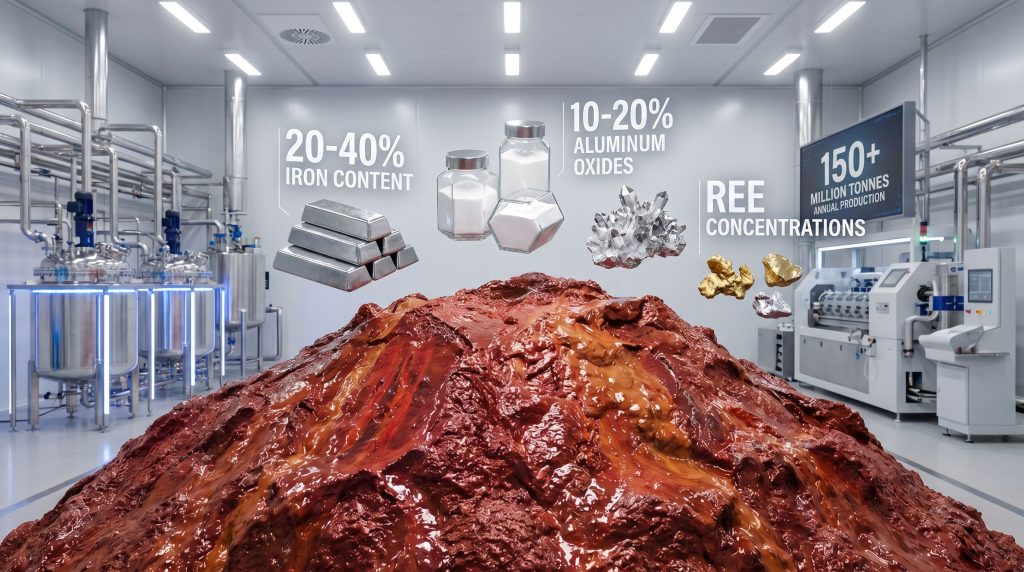
The global aluminium industry generates over 150 million tonnes of red mud annually, creating one of the world's largest industrial waste challenges while simultaneously housing concentrated deposits of strategically important metals. This alkaline byproduct of bauxite processing contains significant quantities of iron, titanium, gallium, scandium, and rare earth elements that traditional mining operations struggle to supply economically. As supply chain vulnerabilities intensify and environmental regulations tighten, red mud metals recovery emerges as a critical pathway for transforming industrial waste into strategic resources.
Modern waste management solutions increasingly focus on value extraction rather than simple disposal. The convergence of technological advancement, regulatory support, and commodity market dynamics creates unprecedented opportunities for commercial-scale red mud metals recovery operations that address both environmental liabilities and resource security objectives.
When big ASX news breaks, our subscribers know first
Understanding the Mineralogical Foundation of Red Mud Recovery
Red mud represents a complex metallurgical matrix containing multiple recoverable elements concentrated through the Bayer process used in alumina extraction. The residue typically contains 30-60% iron oxides, 10-20% aluminium oxides, and 3-50% silicon dioxide, though these percentages vary significantly based on the original bauxite source and processing parameters applied during refining operations.
Global red mud generation approaches 120 million tonnes annually according to International Aluminium Institute data, with cumulative stockpiles exceeding 3 billion tonnes worldwide. This material maintains a persistently alkaline pH between 10-13 due to residual sodium hydroxide from the Bayer process, creating long-term environmental management challenges that cost aluminium producers an estimated $10-20 per tonne of alumina produced.
The caustic nature of fresh red mud can reach pH levels above 13.5, containing 2-8% sodium hydroxide by weight. This alkalinity raises local soil pH, affects microbial communities, and creates groundwater contamination risks if containment systems fail. Storage facilities require active management for 50-100 years to prevent environmental impact, representing substantial ongoing financial obligations for operating companies.
Compositional Variability Across Global Sources
Bauxite geology significantly influences the metal content available for recovery from red mud. Australian bauxites typically yield red mud with 0.1-0.3% total rare earth elements, whilst Chinese sources can contain over 1.0% REEs. Mediterranean bauxite sources generally produce red mud with 0.05-0.15% rare earth concentrations, but may contain elevated titanium content ranging from 5-15% titanium dioxide.
Iron oxide percentages remain relatively stable across different sources, but the accessibility of contained metals varies based on mineralogical structure. Processing conditions including digestion temperature, caustic concentration, and residence time affect the crystalline structure of residual compounds, directly influencing subsequent recovery efficiency through hydrometallurgical or pyrometallurgical methods.
Research led by Columbia University's Greeshma Gadikota focuses on developing rigorous, environmentally responsible pathways for recovering critical metals from these complex materials. Her team positions red mud as presenting significant opportunities to strengthen resource security through technological innovation, particularly given the material's elevated concentrations of gallium, scandium, titanium, and rare earth elements.
Economic Drivers Behind Red Mud Valorisation
The financial case for red mud metals recovery stems from multiple converging factors that transform disposal costs into potential revenue streams. Current red mud management represents a significant operational expense, with per-tonne disposal costs ranging from $8-25 depending on storage methodology, regulatory requirements, and long-term remediation obligations.
For aluminium refineries generating 1 million tonnes of red mud annually, disposal costs alone can reach $8-25 million per year, representing 2-5% of typical refinery operating expenses. These costs continue indefinitely due to the persistent alkaline nature of the material and associated environmental monitoring requirements.
Revenue Potential from Integrated Recovery Operations
Metal recovery from red mud offers substantial revenue opportunities when commodity prices support extraction economics:
• Iron concentrate recovery: At current market prices of $90-120/tonne for high-grade iron concentrate, global red mud could theoretically yield 45-90 million tonnes of recoverable iron annually
• Gallium extraction: With red mud containing 50-200 ppm gallium and global generation of 150 million tonnes annually, theoretical gallium content reaches 7,500-30,000 tonnes, compared to current global primary production of only 250-300 tonnes
• Scandium oxide recovery: Market prices of $3,000-5,000/kg for scandium oxide make even modest extraction rates economically attractive given red mud concentrations of 100-800 ppm
• Titanium dioxide production: High-value pigment-grade titanium dioxide sells for $1,800-2,500/tonne, with recovery rates of 70-90% achievable through integrated processing
Critical to the economic equation is addressing strategic supply vulnerabilities. The United States maintains 100% import dependency for both gallium and scandium, creating national security implications that extend beyond pure economic considerations. Harvey Kaye of U.S. Critical Materials Corp. identifies these as strategic choke points for defence and aerospace industrial applications.
Cost Offset Mechanisms and Value Creation
Red mud metals recovery operations generate value through multiple pathways beyond direct metal sales:
- Avoided disposal expenditure: Each tonne processed eliminates ongoing storage and monitoring costs
- Land rehabilitation benefits: Site remediation can return disposal areas to productive use, creating annualised benefits of $5-15/tonne based on land value recovery
- Carbon credit potential: Avoided emissions from primary mining and processing qualify for credits worth $20-60/tonne CO₂ equivalent under European systems
- Co-product optimisation: Iron oxide recovery as the primary product by volume can offset process costs whilst secondary metals generate incremental margins
Furthermore, the relationship between environmental regulations and resource extraction creates additional economic incentives. Current defence-critical strategy initiatives increasingly emphasise domestic supply security for strategically important materials.
Target Metals and Market Dynamics
The metal content of red mud varies significantly based on bauxite source geology, but several elements consistently present attractive recovery opportunities. Understanding the concentration ranges, market applications, and pricing dynamics for each target metal is essential for evaluating project economics.
Iron and Aluminium Recovery Fundamentals
Iron represents the highest-volume recovery opportunity, with red mud typically containing 35-50% iron in practice. Hydrometallurgical recovery methods achieve 60-80% extraction of contained iron, producing concentrate suitable for steel industry applications. Current iron ore concentrate prices of $90-120/tonne provide the primary revenue stream supporting overall project economics.
Residual aluminium oxide content of 10-20% offers secondary value through applications in cement production (40-50% of market), refractory ceramics (20-30%), chemical feedstock (15-25%), and abrasives (5-10%). Recovery rates of 40-60% are achievable through selective leaching processes, with alumina prices ranging $250-400/tonne depending on purity specifications.
Critical and Strategic Metal Concentrations
Gallium recovery presents the highest strategic value given complete U.S. import dependency and defence applications in semiconductors, integrated circuits (90% of consumption), and optoelectronics. Red mud concentrations of 50-200 ppm gallium theoretically contain more gallium than current global primary production, though recovery rates and processing economics remain under development.
Market prices for gallium range $150-300/kg depending on purity, with semiconductor-grade material commanding premium pricing. Primary applications include integrated circuits, photovoltaic cells, and RF components, with demand growing due to 5G infrastructure deployment and electric vehicle adoption.
Scandium concentrations of 100-800 ppm in red mud exceed those found in most primary deposits. Current global production of only 10-15 tonnes annually as scandium oxide creates severe supply constraints despite growing demand for aluminium-scandium alloys in aerospace applications. Market prices of $3,000-5,000/kg for scandium oxide make even modest recovery rates potentially profitable.
Titanium and Rare Earth Element Potential
Titanium dioxide concentrations varying from 1-15% depending on bauxite source offer access to the $1.8-2.5 billion global pigment market. Mediterranean and select Australian red mud sources contain 5-15% TiO₂, with recovery rates of 70-90% achievable through integrated pyrometallurgical-hydrometallurgical processes.
Primary titanium dioxide applications include paint pigments (60% of market), coatings, plastics, and ceramics. Global demand of 6-7 million tonnes annually continues growing due to infrastructure development and automotive production, particularly in Asia-Pacific regions.
Rare earth element concentrations exhibit significant geographic variation, with Chinese bauxite-derived red mud containing over 1.0% total REEs compared to 0.1-0.3% in Australian sources. Recovery economics depend heavily on the specific rare earth distribution, as heavy rare earths command substantially higher prices than light rare earth elements.
Advanced Processing Technologies for Metal Extraction
Red mud metals recovery employs multiple technological approaches depending on target metals, feedstock characteristics, and economic constraints. Successful commercial implementation requires integrated processing strategies that optimise recovery across multiple elements whilst managing energy consumption and environmental impact.
Hydrometallurgical Recovery Pathways
Acid leaching processes using sulfuric or hydrochloric acid represent the most widely researched approach for red mud metals recovery. These methods operate at ambient or slightly elevated temperatures, typically 60-90°C, with acid concentrations of 0.5-2.0 M depending on target selectivity and recovery rates.
Selective precipitation through pH adjustment enables sequential metal recovery. Iron precipitation occurs at pH 2-3, aluminium recovery at pH 4-5, whilst rare earth elements require pH levels of 6-8 for optimal precipitation. This staged approach allows co-recovery of multiple metals from a single leaching operation.
Ion exchange and solvent extraction technologies provide high-purity separation for critical metals like gallium and scandium. Specialised resins achieve 90-95% recovery rates for gallium, whilst solvent extraction using tributyl phosphate or similar reagents enables scandium concentration to commercial-grade purity levels.
Advanced membrane technologies including reverse osmosis and ultrafiltration serve multiple functions in integrated processing systems. These technologies concentrate metal-bearing solutions, remove impurities, and enable water recycling to minimise environmental discharge requirements.
Pyrometallurgical Integration Strategies
High-temperature reduction processes using carbon-based reductants operate at 1,200-1,400°C to recover iron and other metals through direct reduction. This approach integrates well with existing steel production infrastructure, enabling red mud utilisation as an alternative iron source.
Smelting integration allows direct incorporation of red mud into conventional metallurgical operations. Aluminium smelters can potentially utilise red mud as flux material whilst recovering contained metals, though this requires careful management of impurity levels and energy balances.
Plasma treatment technologies offer highly selective metal recovery but require substantial energy inputs of 3-5 MWh per tonne processed. These methods achieve near-complete metal recovery but face economic constraints due to electricity costs.
Emerging Biotechnological Applications
Microbial leaching using acidophilic bacteria offers environmental advantages through lower chemical consumption and ambient temperature operation. Thiobacillus and Acidithiobacillus species effectively solubilise metals from red mud over 30-60 day processing periods, though recovery rates typically reach only 40-60% of contained metals.
Biosorption techniques employ specialised microorganisms or biological materials to selectively capture target metals from leach solutions. These methods provide high selectivity for gallium and rare earth elements but require careful optimisation of pH, ionic strength, and contact time parameters.
Research at Columbia University focuses on ambient-temperature oxidative leaching combined with selective separations for co-recovery of titanium dioxide and iron oxide. This approach emphasises environmentally responsible pathways whilst maintaining favourable techno-economic and life-cycle assessments.
What Are the Key Technical Challenges in Scaling Red Mud Processing?
Commercial-scale red mud metals recovery faces significant technical hurdles that require sophisticated engineering solutions and careful process optimisation. Understanding these challenges is essential for realistic assessment of project timelines and investment requirements.
Processing Complexity and Selectivity Management
Red mud contains over 20 different elements in varying concentrations, creating complex interactions during extraction processes. Competing reactions between target metals and matrix elements reduce selectivity and complicate purification protocols. Iron, aluminium, and silicon compounds can co-precipitate with valuable metals, requiring multiple separation stages to achieve commercial purity specifications.
Impurity management represents a critical technical challenge, as trace elements like chromium, vanadium, and arsenic must be controlled below strict limits for end-use applications. Semiconductor-grade gallium requires purity levels exceeding 99.9999%, necessitating extensive purification protocols that can account for 40-60% of total processing costs.
Matrix effects vary significantly between red mud sources, requiring customised processing protocols for different feedstocks. Australian red mud exhibits different leaching behaviour compared to Chinese or Caribbean sources due to mineralogical differences developed during the original Bayer process conditions.
Energy Requirements and Process Integration
Energy consumption represents a major economic constraint for red mud metals recovery operations. Hydrometallurgical processes typically require 500-800 kWh per tonne processed, whilst pyrometallurgical routes consume 1,500-3,000 kWh per tonne due to high-temperature requirements.
Heat integration opportunities exist through coupling red mud processing with aluminium refinery operations. Waste heat from alumina calcination can potentially supply 30-40% of thermal energy requirements for red mud treatment, improving overall process economics whilst reducing facility carbon footprint.
Chemical reagent costs account for 20-35% of operating expenses in hydrometallurgical routes. Acid consumption for leaching, neutralisation chemicals for pH adjustment, and specialised reagents for metal separation collectively represent substantial ongoing costs that must be optimised through process design.
Additionally, innovative approaches like flash joule heating recycling demonstrate potential for energy-efficient metal recovery from complex waste streams.
Environmental Management and Safety Protocols
Dust generation during red mud handling creates respiratory hazards requiring comprehensive containment and personal protective equipment protocols. Fine particulate matter with d50 values of 10-50 microns becomes airborne readily, necessitating enclosed handling systems and air filtration infrastructure.
Wastewater treatment complexity increases due to the multi-element nature of process streams. Treatment systems must simultaneously remove excess acids, neutralise alkaline components, precipitate heavy metals, and manage high dissolved solids concentrations before discharge or recycling.
Residual waste after metals extraction retains alkaline properties and requires long-term management similar to original red mud. Volume reduction of 30-50% is achievable through metals recovery, but remaining material still requires appropriate disposal or beneficial use applications.
The next major ASX story will hit our subscribers first
Leading Organisations and Research Initiatives
The development of red mud metals recovery technologies involves collaboration between commercial technology developers, academic research institutions, and government-funded programs. Understanding the key players and their specific contributions provides insight into the technological maturity and commercialisation timeline for different recovery approaches.
Commercial Technology Development Leaders
Orbite Technologies pioneered integrated alumina and rare earth extraction processes using proprietary acid leaching technology. Their approach demonstrated commercial-scale recovery of multiple metals from red mud whilst maintaining environmental compliance, though economic challenges led to operational restructuring in recent years.
Rusal, one of the world's largest aluminium producers, operates integrated aluminium-red mud processing initiatives across multiple facilities. Their research focuses on pyrometallurgical integration with existing smelting operations, enabling red mud utilisation as flux material whilst recovering contained iron and titanium.
Rio Tinto conducts scandium recovery pilot projects from bauxite residue at their Queensland alumina refineries. These operations target high-value scandium oxide production whilst investigating broader rare earth element recovery potential from Australian red mud sources.
Academic Research Excellence Centres
KU Leuven in Belgium leads European research in sustainable metals recovery methodologies through their Department of Materials Engineering. Their comprehensive dataset on red mud characterisation focuses on process optimisation for selective metal extraction whilst minimising environmental impact through closed-loop processing systems.
CSIRO Australia operates comprehensive red mud valorisation programs through their Mineral Resources division. Research encompasses hydrometallurgical process development, pyrometallurgical integration studies, and techno-economic modelling for commercial-scale implementation.
Columbia University's Lenfest Centre for Sustainable Energy, directed by Greeshma Gadikota, investigates ambient-temperature oxidative leaching for co-recovery of titanium dioxide and iron oxide. Their "Mud To Metal" research program examines mineralogical characterisation, selective separations, and life-cycle assessments for environmentally responsible metal recovery.
Strategic Government and Industry Partnerships
U.S. Critical Materials Corp. has established partnerships with Columbia University and Idaho National Laboratory to advance domestic supply capabilities for defence-critical metals. Their research focuses on gallium, scandium, titanium, and rare earth element recovery whilst supporting broader strategic supply chain objectives.
Idaho National Laboratory contributes nuclear industry expertise in materials processing and separations technology to red mud metals recovery research. Their capabilities in advanced analytical techniques and process modelling support optimisation of recovery protocols for multiple target metals.
European Union Horizon initiatives provide significant funding for circular economy applications in metal recovery from industrial waste streams. These programmes support collaborative research between universities, technology companies, and aluminium producers across member states.
Chinese Academy of Sciences operates extensive industrial waste valorisation studies through their Institute of Process Engineering. Research encompasses both fundamental understanding of red mud mineralogy and development of large-scale processing technologies suitable for China's substantial aluminium production capacity.
Economic Analysis and Investment Requirements
Understanding the financial parameters of red mud metals recovery projects requires detailed analysis of capital investments, operating costs, revenue projections, and sensitivity to commodity price fluctuations. These economic fundamentals determine commercial viability and investment attractiveness across different technological approaches.
Capital Investment Framework by Technology
| Recovery Method | Capital Investment | Operating Costs | Metal Recovery Rate | Break-even Metal Price |
|---|---|---|---|---|
| Hydrometallurgical | $50-80M per 1Mt/year | $200-300/tonne | Fe: 60-80%, Al: 40-60% | Iron: $400-500/tonne |
| Pyrometallurgical | $100-150M per 1Mt/year | $150-250/tonne | Fe: 70-90%, Al: 20-40% | Iron: $350-450/tonne |
| Hybrid Process | $80-120M per 1Mt/year | $250-350/tonne | Fe: 80-95%, Al: 50-70% | Iron: $450-550/tonne |
| Biotechnological | $30-50M per 1Mt/year | $180-280/tonne | Fe: 40-60%, REE: 60-80% | REE: $15-25/kg |
Capital intensity varies significantly based on target metals and processing complexity. Gallium and scandium recovery requires additional purification equipment that can increase capital costs by $20-40 million for commercial-scale operations, but these high-value metals justify the additional investment through premium pricing.
Revenue Optimisation Through Multi-Metal Recovery
Successful red mud metals recovery operations optimise revenue through integrated recovery of multiple metals rather than focusing on single elements. Iron and aluminium provide stable, high-volume revenue streams that support project economics, whilst gallium, scandium, and rare earth elements contribute high-margin revenue despite lower volumes.
Revenue distribution in typical integrated operations:
• Iron concentrate: 60-70% of total revenue
• Aluminium compounds: 15-25% of total revenue
• Gallium and scandium: 10-20% of total revenue
• Rare earth elements: 5-15% of total revenue
Market price volatility significantly affects project economics. Iron ore price fluctuations of ±30% can change project NPV by $50-100 million over a 20-year operating life, whilst gallium price variations of ±50% impact NPV by $20-40 million due to the smaller volume contribution.
Operating Cost Structure and Optimisation
Operating expenses for red mud metals recovery include several major categories:
• Energy costs: 25-35% of operating expenses (electricity for processing, steam for heating)
• Chemical reagents: 20-30% of operating expenses (acids, bases, specialised extraction chemicals)
• Labour and maintenance: 15-25% of operating expenses (skilled operators, equipment maintenance)
• Transportation and logistics: 10-15% of operating expenses (red mud transport, product shipping)
• Environmental compliance: 5-10% of operating expenses (monitoring, waste treatment, regulatory compliance)
Cost optimisation opportunities exist through integration with existing aluminium refining operations. Co-location benefits can reduce transportation costs by 50-70%, whilst shared utilities and infrastructure reduce capital requirements by $15-25 million for typical projects.
Geographic Variations in Red Mud Composition and Processing Potential
The economic viability of red mud metals recovery depends significantly on the source characteristics of the bauxite from which the red mud originates. Different geographic regions produce red mud with distinct mineralogical profiles that affect both processing complexity and metal recovery potential.
Australian Bauxite-Derived Red Mud Characteristics
Australian red mud typically contains higher iron content ranging from 45-60% Fe₂O₃, making it particularly attractive for iron recovery operations. The Darling Range bauxites processed at Alcoa's refineries produce red mud with moderate rare earth concentrations of 0.15-0.25% total REEs, but elevated scandium content of 150-300 ppm.
Mineralogical characteristics of Australian red mud include well-crystallised iron oxides (primarily hematite and goethite) that respond favourably to both acid leaching and pyrometallurgical reduction processes. Recovery rates of 75-85% for iron are achievable using conventional processing methods.
The relatively low silica content (typically 8-15% SiO₂) in Australian red mud reduces processing complexity and chemical consumption during hydrometallurgical treatment. This characteristic improves project economics by reducing reagent costs and minimising equipment corrosion issues.
Caribbean and South American Source Profiles
Caribbean bauxites, particularly from Jamaica and Suriname, yield red mud with elevated aluminium residuals ranging from 18-25% Al₂O₃, significantly higher than other global sources. This characteristic creates opportunities for aluminium recovery that can provide substantial secondary revenue streams.
Lower silica interference in Caribbean red mud (typically 3-8% SiO₂) simplifies processing protocols and reduces formation of silica gels that can complicate solid-liquid separation operations. Recovery operations benefit from faster filtration rates and reduced equipment scaling issues.
Gallium concentrations in Caribbean red mud typically range 80-150 ppm, higher than many global sources due to the specific geochemical conditions during bauxite formation. This elevated gallium content improves the economic attractiveness of integrated recovery operations targeting multiple critical metals.
Environmental Benefits and Circular Economy Integration
Red mud metals recovery contributes to environmental sustainability through multiple pathways that extend beyond simple waste volume reduction. Understanding these environmental benefits provides crucial context for regulatory support and public acceptance of recovery operations.
Waste Stream Reduction and Land Use Optimisation
Metal extraction from red mud can achieve volume reduction of 30-50% through removal of iron oxides and other recoverable materials, significantly decreasing the long-term storage requirements for aluminium producers. This volume reduction directly translates to reduced land use for disposal facilities and lower ongoing monitoring costs.
Land rehabilitation opportunities emerge as existing red mud disposal sites are processed for metal recovery. Sites that have operated for decades can potentially be remediated and returned to alternative uses, creating substantial economic value for facility operators and surrounding communities.
Prevention of groundwater contamination through active red mud processing reduces long-term environmental liability. Traditional disposal relies on passive containment that requires monitoring for 50-100 years, whilst active processing eliminates the source material and reduces monitoring obligations.
Carbon Footprint Analysis and Climate Benefits
Avoided emissions from primary metal production represent significant climate benefits from red mud metals recovery. Iron production from red mud avoids approximately 1.5-2.0 tonnes CO₂ per tonne of iron compared to primary steel production from iron ore and coal.
Energy recovery opportunities through process heat integration with aluminium refinery operations can reduce overall facility carbon emissions. Red mud processing can utilise waste heat from alumina calcination, reducing external energy requirements by 25-40% compared to standalone operations.
Transportation emission reductions occur when red mud processing is co-located with aluminium refineries, eliminating the need for long-distance waste transport to disposal facilities. This integration can reduce transportation-related emissions by 60-80% compared to remote disposal operations.
Moreover, the environmental considerations align with broader decarbonisation benefits in mining initiatives that prioritise sustainable resource extraction and processing methods.
Industrial Symbiosis and Circular Economy Development
Cross-industry material flows develop when red mud metal recovery integrates with steel production, chemical manufacturing, and construction sectors. Iron oxides from red mud can directly substitute for iron ore in steel production, whilst aluminium compounds serve cement and ceramics industries.
Resource efficiency improvements extend across multiple industrial sectors through red mud utilisation. Steel producers benefit from consistent iron feedstock supply, chemical companies access aluminium compounds, and construction industries utilise residual materials for concrete and road base applications.
Closed-loop aluminium production becomes achievable through red mud valorisation, where waste from alumina refining provides input materials for downstream industries whilst reducing overall resource consumption. This circular approach improves resource security and reduces dependence on primary mining.
Future Outlook and Strategic Investment Opportunities
The investment landscape for red mud metals recovery reflects convergence of environmental sustainability, strategic supply chain security, and technological maturity that creates attractive opportunities for diverse investor types. Understanding these dynamics enables informed participation in this emerging sector.
Successful commercial deployment depends on mine reclamation innovation that extends beyond traditional waste management approaches to create value-generating systems. The next decade will likely witness increasing integration between environmental remediation and resource recovery objectives.
Technology Licensing and Partnership Models
Strategic partnerships between aluminium producers and metals recovery specialists offer attractive investment structures that leverage existing infrastructure whilst accessing specialised expertise. These partnerships typically involve shared capital investment and revenue distribution based on contributed assets and capabilities.
Technology licensing models enable global deployment of proven processing methods whilst providing recurring revenue streams for technology developers. License fees typically range $5-15 per tonne of annual processing capacity plus royalty payments of 2-5% on recovered metal revenues.
Market penetration rates of 25-40% of global red mud generation are projected by 2035, creating substantial opportunities for technology providers and equipment suppliers. Early-stage investment in proven technologies offers the potential for significant returns as market adoption accelerates.
The future of red mud metals recovery represents a convergence of environmental necessity, technological capability, and economic opportunity. As regulatory frameworks evolve to support waste valorisation and supply chain security becomes increasingly critical, these projects will transition from experimental initiatives to essential industrial infrastructure.
Ready to capitalise on the next breakthrough in critical metals recovery?
Discovery Alert's proprietary Discovery IQ model delivers real-time alerts on significant ASX mineral discoveries, including emerging opportunities in waste-to-metals processing and critical materials recovery. Transform your approach to resource investment by accessing actionable insights that position you ahead of market movements in this rapidly evolving sector, from traditional exploration through to innovative industrial waste valorisation strategies. Begin your 14-day free trial today at Discovery Alert and secure your market-leading advantage.