
July 24, 2026
When Maritime Conflict Becomes a Mining Cost Problem
Global commodity markets have always been interconnected, but the speed at which geopolitical stress in one region transmits into operating costs for industries thousands of kilometres away is accelerating. Open-pit mining operations sit at an unusual intersection of this dynamic: they are simultaneously commodity producers and among the most fuel-intensive industrial operations on earth. When maritime trade routes face disruption, the cost consequences do not stay confined to shipping ledgers.
They travel upstream through crude oil benchmarks, into refined diesel markets, and land directly on mine-site operating budgets measured in dollars per ounce.
Understanding this transmission mechanism is essential for investors assessing near-term AISC guidance from gold and base metals producers, particularly as Red Sea attacks raise diesel costs for open-pit miners in ways that are both quantifiable and, critically, not uniform across the sector.
When big ASX news breaks, our subscribers know first
The Supply Disruption Convergence That Moved Markets
The oil price spike observed in the week ending July 24, 2026, was not the product of a single geopolitical flashpoint. It reflected the near-simultaneous compression of three major crude export corridors, each significant on its own terms. Furthermore, understanding crude oil price trends during previous disruption cycles helps contextualise just how unusual this convergence was.
Houthi forces claimed strikes on two Saudi oil tankers transiting the Red Sea, escalating an already volatile security environment that had been building for months. Separately, the Caspian Pipeline Consortium suspended loadings at its Black Sea terminal, a disruption that affected approximately 80% of Kazakhstan's crude oil export capacity. Kazakhstan then confirmed production cuts following suspected drone strikes on energy infrastructure, adding a third layer of supply uncertainty.
The combined effect was sharp and immediate:
| Benchmark | Peak Level Reached | July 24 Close | Weekly Change |
|---|---|---|---|
| Brent Crude | Above $100/bbl (July 23) | $96.70/bbl | ~+9.7% |
| WTI Crude | Near $92/bbl | $89.04/bbl | ~+8% |
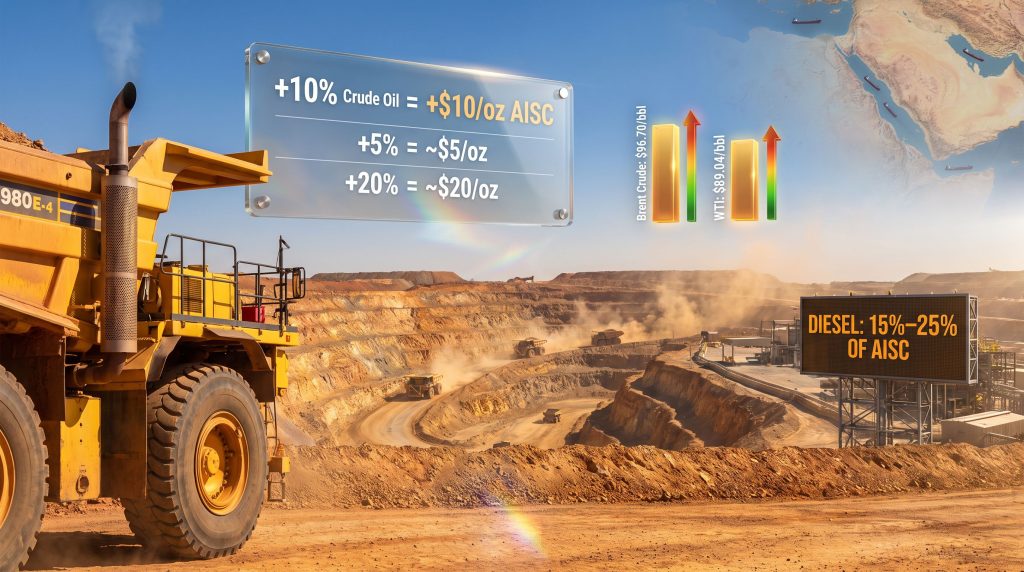
Brent's close above $100 on July 23 represented its first breach of that psychological threshold since May. The significance extends beyond the number itself: the $100 level triggers formal reassessment of fuel cost assumptions across the mining sector, as it pushes crude price increases toward and potentially beyond the thresholds embedded in AISC sensitivity frameworks.
The Diesel-to-AISC Transmission Mechanism
Why Open-Pit Operations Carry Structural Fuel Dependency
To understand why Red Sea attacks raise diesel costs for open-pit miners in a material rather than peripheral way, it is necessary to examine where diesel consumption actually sits within the open-pit cost structure. In addition, the broader commodity price impacts on mining company performance demonstrate how fuel costs interact with other variable inputs to erode margins.
Surface mining operations depend on diesel across several distinct cost centres, each with its own consumption profile:
- Haulage fleets are by far the largest single fuel consumption point. Diesel-powered haul trucks, often with capacities exceeding 200 tonnes, move vast quantities of ore and waste rock continuously. Fuel cost per tonne moved is highly sensitive to truck age, gradient, and haul distance.
- Drilling and blasting equipment requires diesel-powered drill rigs for blast hole creation before each blast. At large open-pit operations, this cycle repeats continuously across multiple benches.
- Ancillary and support equipment including dozers, graders, and water trucks consume diesel across the entire mine footprint.
- Remote power generation at off-grid processing plants and camp infrastructure represents a fixed diesel load that persists regardless of throughput.
Diesel typically accounts for 15% to 25% of AISC at open-pit gold operations, placing it among the most significant variable cost inputs the sector faces. Critically, it is also one of the inputs most directly exposed to external price shocks that have nothing to do with operational performance.
The Jefferies Sensitivity Framework in Practice
Jefferies' analytical framework establishes that every 10% increase in crude oil prices adds approximately $10 per ounce to all-in sustaining costs for open-pit gold producers. Brent's weekly gain of approximately 9.7% during the July 2026 disruption episode effectively reached this threshold. As Reuters reports, iron ore miners alone could face billions in additional fuel costs, underscoring how broadly this sensitivity extends across the sector.
This sensitivity figure is not an abstraction. It is a tool for converting crude price movements directly into per-ounce cost forecasting, and it gives investors a practical starting point for stress-testing producer guidance against different oil price scenarios.
| Crude Price Increase | Estimated Open-Pit AISC Impact |
|---|---|
| +5% | ~$5/oz |
| +10% | ~$10/oz |
| +20% | ~$20/oz |
| +30% | ~$30/oz |
Actual impact varies by producer based on open-pit production share, fuel hedging coverage, and fleet efficiency.
Producer Exposure Is Not Uniform: Why Open-Pit Share Determines Margin Risk
One of the most underappreciated aspects of fuel cost analysis in the mining sector is that open-pit production share functions as the primary structural variable determining how much of the crude price signal reaches the bottom line. This is a characteristic embedded in mine design and cannot be altered in response to short-term commodity price movements.
| Producer | Estimated Open-Pit Share | Relative Diesel Cost Exposure |
|---|---|---|
| G Mining Ventures | ~100% | Highest |
| Endeavour Mining | ~85% | High |
| Barrick Gold | ~52%–66% | Moderate to High |
Underground operations carry structurally lower diesel intensity for reasons that are both geometric and geological. Shorter haulage distances, typically measured in hundreds of metres rather than kilometres, reduce fuel consumed per tonne. Higher ore grades at underground mines mean fewer tonnes of material must be processed to produce an equivalent number of ounces, further reducing total diesel consumed per ounce produced.
Ventilation systems in underground operations do require energy, but the diesel per ounce metric still favours underground extraction in most comparative analyses.
Operational Disclosures Illustrate the Scale
Orla Mining's disclosed sensitivity provides one of the clearer producer-level data points available. The company has stated that a $10-per-barrel increase in oil prices adds approximately $2.50 per ounce to its 2026 AISC, with diesel representing roughly 4% of total operating costs at its operations.
While 4% may appear modest as a cost share, it is worth examining the compounding logic. A sustained $20-per-barrel increase, maintained across four quarters, adds approximately $5 per ounce annually. If gold prices do not rise in parallel, that increment flows directly into margin compression. The effect is amplified at producers with heavier open-pit weighting and less efficient haul infrastructure.
Freeport-McMoRan separately disclosed that elevated diesel prices, combined with higher sulfuric acid costs, pushed its 2026 cost estimates above January baseline projections. This is particularly notable because it demonstrates the pressure extends into base metals mining, not only gold. Sulfuric acid, a key reagent in copper heap-leach processing, is itself an energy-intensive product whose price partially tracks diesel and natural gas markets.
Fuel Hedging: Meaningful Protection With a Known Expiry Date
How Hedging Programs Function in the Mining Sector
Fuel hedging is the primary operational mechanism through which producers seek to insulate near-term AISC from spot crude price volatility. The standard approach involves locking in diesel prices 12 to 18 months in advance through forward contracts or options structures, creating a buffer between spot market movements and delivered fuel costs at the mine site. For a broader perspective on commodity hedging strategies across the sector, the interplay between hedging horizons and geopolitical risk is increasingly central to how producers structure their cost protection.
Producers including B2Gold and Kinross have implemented active fuel hedging programs that provide meaningful near-term protection. However, this protection has a defined horizon:
- 0 to 12 months: Hedged producers largely insulated from spot price movements; AISC guidance holds despite crude price spikes
- 12 to 24 months: As legacy hedges expire and are rolled at higher prevailing market prices, cost pressure begins transmitting into forward guidance
- Beyond 24 months: Full market exposure unless new hedging is established at favourable levels
| Scenario | Hedged Producer Impact | Unhedged Producer Impact |
|---|---|---|
| Brent +10% for one quarter | Minimal AISC revision | ~$10/oz increase |
| Brent +10% sustained for 18 months | Rising exposure as hedges roll | ~$10/oz sustained |
| Brent +20% sustained | Partial protection eroding | ~$20/oz increase |
The critical investor question is not whether a producer has hedging in place today, but what proportion of future diesel requirements remain hedged, at what price levels, and across what time horizon. Hedge book transparency in quarterly filings is therefore a meaningful due diligence input.
Shipping Data Versus Geopolitical Narrative: A Critical Distinction
What Vessel Traffic Actually Showed During the Disruption Period
One of the most analytically important separations to maintain when assessing the oil price impact is the distinction between actual physical shipping disruption and geopolitical risk premium. These two forces can diverge substantially, and conflating them leads to mispriced risk assessments. The mining geopolitics surrounding the Red Sea and adjacent waterways have consistently demonstrated this gap between narrative and physical data.
Vessel traffic data from the disruption period told a more nuanced story than the geopolitical headlines suggested:
- Strait of Hormuz: Transits held at approximately three vessels per day for a three-day period, with additional vessels continuing to enter the Gulf of Arabia. While below historical norms, this is inconsistent with a functional blockade.
- Bab el-Mandeb: Daily crossings actually increased to 32 from 26 on July 23, the peak disruption day, suggesting shipping operators were adapting rather than retreating.
UBS analyst Giovanni Staunovo observed that vessel traffic was continuing through the affected waterways, indicating shipping flows remained fundamentally intact. The implication for mining cost forecasting is significant: unless physical shipping volumes decline materially, the diesel cost impact on open-pit miners is more likely to reflect a risk premium that can deflate quickly than a structural supply deficit that compounds over time.
The Geopolitical Pressure Points Sustaining the Risk Premium
Even where physical shipping flows remain resilient, several stated intentions and policy postures sustain an elevated risk premium in crude pricing:
- The Houthi declaration of a naval blockade targeting Saudi Arabia's pipeline bypass route around the Strait of Hormuz
- Iranian pressure on Houthi forces to close Bab el-Mandeb if US military strikes continue
- US President Trump's stated intention to pursue further military action following continued Red Sea attacks
Each of these factors keeps oil market participants pricing a probability-weighted disruption scenario even when current vessel counts remain above blockade thresholds.
The next major ASX story will hit our subscribers first
Scenario Modelling: What Different Oil Price Trajectories Mean for AISC
J.P. Morgan's Base Case and Bear Case Compared
Institutional scenario modelling provides a structured framework for thinking about how long elevated crude prices persist and what the implications are for mine-site cost trajectories. Consequently, consulting the broader mining commodity outlook alongside these scenarios helps investors situate fuel cost pressures within a wider commodity context.
Base Case (supply disruptions persist approximately three months):
- Brent's monthly average moves toward ~$114 per barrel
- Open-pit AISC impact exceeds the $10 per ounce threshold established by Jefferies' sensitivity framework
- Producers without hedging coverage face meaningful upward pressure on guidance
Bear Case (shipping activity stabilises, risk premium deflates):
- Brent retreats toward the high-$80s
- AISC increase remains near the $10 per ounce level, contained but not eliminated
- WTI's position above $89 acts as a near-term floor reference point
Even the more optimistic scenario does not produce a zero cost impact. The question for investors is not whether diesel costs have risen, but whether the increase is transitory (absorbed in existing guidance) or structural (requiring formal AISC revision).
The Dual-Channel Effect: Why Delivered Diesel Costs Can Stay High Even If Crude Stabilises
An insight that is frequently overlooked in standard commodity cost analysis is that crude oil prices and delivered diesel costs at mine sites do not always move in lockstep. There are two distinct channels through which Red Sea attacks raise diesel costs for open-pit miners, and they operate partially independently. As analysis from the Canadian Mining Report on the diesel crisis illustrates, the Iran conflict's influence on operating costs demonstrates precisely this dual-channel dynamic.
Channel 1: The crude price channel
Reduced oil export supply from disrupted corridors drives Brent and WTI higher, increasing the feedstock cost for diesel refining globally.
Channel 2: The freight and insurance channel
Higher tanker freight rates and war-risk insurance premiums increase the delivered cost of refined diesel products independently of crude price movements. Industry reports during the disruption period indicated that clean-product tanker rates on routes crossing Bab el-Mandeb and the Suez Canal increased sharply, with some routes seeing rates nearly double.
The dual-channel structure means that even if crude oil benchmarks moderate, delivered diesel at remote mine sites may remain elevated if war-risk insurance premiums on refined product tankers persist. This is a cost mechanism that does not appear in standard crude-to-AISC sensitivity tables but can represent a material additional expense for operations in regions supplied by seaborne diesel.
Additionally, northwest European wholesale diesel prices rose approximately 12% from early 2024 levels in some reporting periods, reflecting the compounding of these supply pressures and the broader Russia-related constraints on refined product flows into European markets.
Key Monitoring Indicators for Mining Investors
The Confirmation Points That Will Define the Next Phase
Two data releases represent the most important near-term confirmation points for whether the July 2026 crude price surge translates into sustained AISC pressure or is absorbed without formal guidance revision:
1. EIA Weekly Petroleum Status Report (published each Wednesday)
Tracks US crude and refined product inventories. A continued drawdown in distillate stocks would signal tighter physical supply conditions. A build would suggest the market is absorbing the disruption without structural shortfall.
2. Q2 AISC Reporting Cycle (producer filings through August)
Second-quarter cost updates from major gold and base metals producers will reveal whether the oil price spike was absorbed within existing guidance or is compounding into formal revisions. Any upward diesel-line adjustment in AISC guidance confirms the market impact has been quantified and is real, not merely theoretical.
| Indicator | Signal: Cost Pressure Easing | Signal: Cost Pressure Intensifying |
|---|---|---|
| Hormuz daily transits | Return toward historical norms | Sustained hold at three vessels/day |
| Bab el-Mandeb crossings | Sustained above 30/day | Drop below 20/day |
| Brent price level | Retreat below $90/bbl | Sustained hold above $100/bbl |
| EIA distillate stocks | Week-on-week build | Continued drawdown |
| Producer AISC guidance | No revision or favourable revision | Upward revision citing diesel costs |
Frequently Asked Questions
How do Red Sea attacks raise diesel costs for open-pit miners?
Red Sea attacks affect diesel costs through two channels simultaneously. First, they create supply uncertainty that pushes crude oil benchmarks higher, increasing feedstock costs for diesel refining. Second, they elevate tanker freight rates and war-risk insurance premiums on refined product shipments, increasing the delivered cost of diesel at mine sites independently of the crude price movement.
Which mines face the greatest exposure to rising diesel prices?
Open-pit mines carry the highest structural fuel cost exposure because surface haulage operations consume dramatically more diesel per tonne of material moved than underground alternatives. Producers with the highest open-pit production share, such as G Mining Ventures at approximately 100%, face the greatest sensitivity, while producers with significant underground operations carry lower exposure.
Can miners hedge away the diesel cost risk entirely?
Hedging provides meaningful near-term protection but is not a permanent solution. Programs typically lock in prices 12 to 18 months ahead. As those contracts expire and are rolled at higher prevailing market prices, the cost pressure flows through to guidance. Investors should examine the expiry profile and coverage ratio of each producer's hedge book rather than treating hedging as binary protection.
What vessel traffic data should investors watch?
The most informative real-time signals are daily transit counts at the Strait of Hormuz and Bab el-Mandeb. During the July 2026 disruption, Hormuz transits held at approximately three vessels per day, while Bab el-Mandeb crossings actually rose to 32 from 26. Neither route showed traffic volumes consistent with a functional blockade, suggesting the oil price spike contained a significant risk premium component that could deflate if geopolitical tensions ease.
Summary: The Structural Variables That Determine Margin Outcome
The episode that unfolded across the week of July 21 to 24, 2026, illustrates how rapidly geopolitical disruption in maritime corridors can transmit into mining sector cost frameworks. Several structural conclusions can be drawn for ongoing portfolio assessment:
- Open-pit production share is the single most important structural variable determining which producers face the greatest per-ounce cost pressure from fuel price inflation
- The Jefferies $10/oz per 10% oil increase framework provides a practical tool for stress-testing guidance against different crude price scenarios, and was nearly fully triggered by Brent's weekly gain alone
- Fuel hedging is time-limited in its protection; understanding hedge book expiry timelines is as important as knowing whether hedging exists at all
- Shipping data is a more reliable real-time signal than geopolitical headlines for assessing whether the oil risk premium is justified by physical supply conditions
- The dual-channel effect on delivered diesel costs means crude price stabilisation does not necessarily mean immediate relief at the mine-site fuel supply point
- Q2 AISC filings through August represent the first formal test of whether the July oil price spike was absorbed in existing guidance or is compounding into cost revisions that will require market reassessment
Disclaimer: This article contains forward-looking scenarios and analytical frameworks sourced from third-party institutional research. The scenario models and sensitivity figures referenced represent analytical estimates and are not guarantees of future cost outcomes. Investors should conduct independent due diligence and consult qualified financial advisers before making investment decisions based on commodity price or AISC projections.
Want to Stay Ahead of ASX Mineral Discoveries Before the Market Moves?
Discovery Alert's proprietary Discovery IQ model delivers real-time alerts on significant ASX mineral discoveries, instantly converting complex mineral and commodity data into actionable investment insights — so you're never caught flat-footed when geopolitical shocks reshape sector margins. Explore Discovery Alert's discoveries page to see how historic finds have generated substantial returns, and begin your 14-day free trial today to secure a market-leading edge.