
July 21, 2026
The Underground Economics of Mine Reactivation: Why Flooded Shafts Tell the Real Story
Before a single ounce of gold can be extracted from a dormant mine, engineers must first confront one of the most capital-intensive and logistically demanding challenges in the entire mining lifecycle: underground water management. When a mine ceases operations, groundwater infiltrates the workings at a rate determined by local hydrology, rock permeability, and shaft depth. What accumulates over months or years is not simply an inconvenience but a fundamental barrier to every subsequent activity.
This technical reality sits at the heart of the Redwing mine restart in Zimbabwe, one of the most closely watched gold project reactivations currently advancing across sub-Saharan Africa. Understanding the dewatering challenge, and the broader five-step framework built around it, reveals something important about how modern mining companies approach the revival of legacy assets in frontier markets.
When big ASX news breaks, our subscribers know first
Redwing Mine: Eight Decades of Production History
Few gold mines in southern Africa carry the operational pedigree of Redwing. The mine ran continuously for the better part of 82 years, from 1941 through to 2023, accumulating a historical production record estimated at close to 2 million ounces of gold across its working life. That figure positions it not as a marginal prospect but as a genuinely productive orebody that fell victim to timing rather than geological exhaustion.
The mine entered care and maintenance between 2019 and 2020, a period coinciding with deteriorating economic conditions in Zimbabwe that made continued extraction commercially unviable at prevailing costs and currency arrangements. The underlying ore body did not change. The economics did.
Namib Minerals, listed on the Nasdaq under the ticker NAMM, subsequently acquired the asset and has since been repositioning it as the centrepiece of a broader Zimbabwean gold development strategy. The company's total planned capital deployment across both the Redwing and the nearby Mazowe mine projects sits in the range of $300 million to $400 million, with approximately $200 million of that earmarked for Redwing specifically.
Dewatering: The Prerequisite That Determines Everything Else
The dewatering of Redwing's underground workings commenced on 29 January 2026 and remains the single most operationally critical activity currently underway at the site. As of mid-2026, the programme has extracted approximately 544,000 cubic metres of water from the mine, reducing the underground water level by 21.9 metres. The current water surface sits at roughly 74.9 metres below the shaft collar, with full dewatering targeted for completion in Q4 2026.
To contextualise the scale of this effort, 544,000 cubic metres is equivalent to roughly 218 Olympic-size swimming pools. Managing this volume requires significant pumping infrastructure, power supply reliability, and continuous monitoring to prevent inrush events that could damage already-compromised underground structures.
Dewatering is not simply about removing water. It is about restoring the structural integrity of shaft linings, station infrastructure, and horizontal development headings that may have experienced varying degrees of deterioration during the inundation period. Each metre of water level reduction must be accompanied by inspection and, where necessary, rehabilitation before personnel can safely advance further underground.
The dewatering timeline carries downstream consequences for the entire project. Until the workings are accessible, no meaningful underground drilling can occur, no resource extension work can begin, and no engineering assessment of existing infrastructure can be completed with the precision required for a bankable feasibility document.
The Five-Step Restart Framework: A Gated Accountability Structure
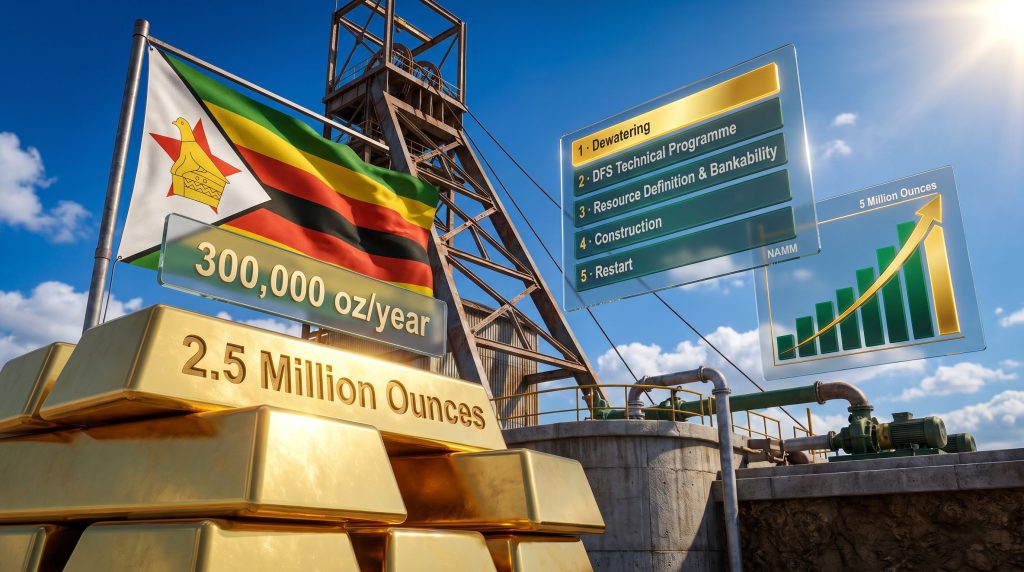
Namib Minerals has structured the Redwing mine restart in Zimbabwe around a sequential, five-step pathway in which each phase acts as a formal gate for the one that follows. This architecture is deliberately designed to create transparency for investors, lenders, and development finance institutions by providing clear milestones against which progress can be independently assessed.
The five steps are as follows:
- Dewatering – Extraction of accumulated underground water to restore safe access (In progress, Q4 2026 target)
- DFS Technical Programme – Execution of the technical workstreams comprising the definitive feasibility study (Fully funded, Q1 2027 completion target)
- Resource Definition and Bankability – Advancing the DFS to full bankability, incorporating drill results, resource estimation, and mine design optimisation (Funding being actively pursued)
- Construction – Capital works to rehabilitate and expand mine infrastructure to the configuration required for full-scale production
- Restart – Phased return to active gold production (Projected late 2027 to 2028)
Running in parallel with this gated sequence, and not subject to its gate conditions, are two additional site workstreams: a power infrastructure upgrade and an equipment refurbishment programme. These are classified by the company as enablers, meaning their purpose is to compress the elapsed time between feasibility completion and construction commencement.
Why Step Three Is the Most Consequential Milestone
Of the five steps, Step 3 carries the greatest strategic weight. Its function extends well beyond standard feasibility refinement. The company has indicated that this phase will determine whether Redwing's mineral resource base, when combined with the orebody's strike extent and potential down-dip extensions, can support a fundamental redesign of the operation from its current inherited configuration to a larger-scale, economically sustainable mining system.
This is a materially important distinction. Many mine restarts simply recommission existing infrastructure and resume production at historical rates. The Redwing programme appears to be evaluating whether the asset justifies a more ambitious redesign, one that would require greater upfront capital but deliver meaningfully higher annual output and a longer operational life.
The outcome of Step 3 will also determine the financing structure for Steps 4 and 5. Without a bankable feasibility document that demonstrates economic viability at scale, project finance lenders will not commit capital. Step 3 is therefore not merely a technical milestone; it is the commercial gateway through which the entire $200 million development programme must pass.
Resource Potential: Current Estimates and Exploration Upside
| Resource Parameter | Estimated Figure |
|---|---|
| Current Estimated Gold Resource | 2.5 million ounces |
| Exploration Target (Post-Programme) | Up to 5 million ounces |
| Projected Annual Production (Full Operation) | 300,000 ounces per year |
The gap between the current resource estimate and the exploration target reflects the significance of the down-dip extension programme. Greenstone-hosted gold deposits of the type found in Zimbabwe's Mutare and Manicaland regions commonly exhibit substantial continuity at depth. However, demonstrating that continuity requires systematic resource drilling programs from underground platforms, which cannot commence until dewatering is complete.
If the 5-million-ounce exploration target is confirmed through drilling, Redwing would represent one of the most significant undeveloped gold deposits currently advancing through feasibility in the southern African region. At a projected production rate of 300,000 ounces per year, the mine would achieve payback on its capital investment within a timeframe that, under current gold price conditions, would appear attractive to institutional investors.
For broader context, Zimbabwe's total national gold output has historically ranged between 25 and 35 tonnes per year. A single operation producing 300,000 ounces annually (approximately 9.3 tonnes) would represent roughly 25 to 30 percent of that national total, a concentration of output that underscores both the opportunity and the responsibility this project carries for the country's gold sector.
Geological Factors Worth Understanding
Zimbabwe's gold mineralisation is predominantly hosted within Archaean greenstone belts, some of the oldest and most gold-prospective geological formations on the planet. Redwing sits within this highly endowed geological setting, where orebody geometries tend to be structurally controlled and amenable to bulk underground mining methods.
The concept of down-dip extensions referenced repeatedly in Namib's project communications refers to the continuation of an orebody along its dip plane at increasing depth. In greenstone-hosted systems, gold mineralisation does not always terminate cleanly at the base of existing mine workings. Structural controls such as shear zones, fold hinges, and lithological contacts can maintain grade continuity to considerable depth, which is precisely what the Step 3 resource definition programme is designed to evaluate.
Furthermore, when interpreting drill results from extension programmes of this type, investors should pay close attention to continuity of grade, not merely headline intercepts, as the former is what ultimately supports a robust resource estimate.
It is worth noting that the speculative upside of doubling a resource from 2.5 to 5 million ounces through drilling is not uncommon in structurally controlled greenstone settings, but it is by no means guaranteed. Resource extension drilling carries genuine geological risk, and investors should treat exploration targets as indicative rather than confirmed until supported by JORC or equivalent-compliant drill results.
Financing Architecture: The Ecobank Facility and Its Strategic Logic
One of the more sophisticated elements of Namib Minerals' approach to the Redwing mine restart in Zimbabwe is the indirect financing mechanism it has constructed around the How Mine asset. Bulawayo Mining Company, the wholly-owned subsidiary that owns and operates the producing How Mine, has secured a $5 million, 36-month term facility from Ecobank Zimbabwe following the bank's independent credit assessment.
The facility is earmarked for capital works at How Mine and is expected to be serviced entirely from that operation's existing production revenues. This is significant because it effectively ring-fences How Mine's capital expenditure under dedicated debt, freeing up the internally generated cash flow that was previously being consumed by those works.
That redirected cash flow is now committed to funding the DFS technical programme at Redwing, making Step 2 fully funded without requiring any additional equity from shareholders. The financial engineering here is elegant: a producing asset's balance sheet capacity is being leveraged to accelerate the development of a dormant one, without diluting existing holders.
Funding Roadmap Summary
| Funding Stage | Source | Status |
|---|---|---|
| Step 2 – DFS Technical Programme | Internal cash flow (redirected via Ecobank facility) | Fully funded |
| Step 3 – Resource Definition and Bankability | Strategic investors, lenders, DFIs | Active engagement underway |
| Steps 4 and 5 – Construction and Restart | Staged capital; structure to be determined | Dependent on Step 3 outcomes |
The company has explicitly committed to a non-dilutive funding strategy wherever possible, prioritising debt and project finance structures over equity issuance. While this approach is clearly shareholder-friendly in principle, it introduces a dependency on the availability and timeliness of external debt capital, which in frontier market contexts can be subject to extended negotiation periods and variable credit appetite.
The next major ASX story will hit our subscribers first
Key Risks Investors Should Understand
Technical and Operational Risks
- The volume of water already extracted (544,000 cubic metres) signals the extent of underground rehabilitation that remains before safe drilling access is restored
- Resource definition outcomes under Step 3 may not support the larger-scale redesign the company is targeting, which would constrain both the production ceiling and the financing structure available for construction
- Power infrastructure in Zimbabwe remains a variable, and the reliability of the grid connection underpinning both dewatering and future operations is a factor that mine management must mitigate through independent supply or backup capacity
Financial and Timeline Risks
- Step 3 funding remains unsecured, representing the single largest near-term dependency in the project's execution pathway
- Zimbabwe's currency and regulatory environment continues to evolve, and large-scale capital projects denominated in US dollars face ongoing exposure to policy changes affecting foreign exchange repatriation, royalty structures, and import of capital equipment
- The non-dilutive preference, while strategically sound, may slow capital mobilisation if development finance institutions or lenders require extended due diligence periods
| Milestone | Target Date | Risk Level |
|---|---|---|
| Dewatering Completion | Q4 2026 | Moderate |
| DFS Technical Programme Completion | Q1 2027 | Low (fully funded) |
| Step 3 Funding Secured | H1 2027 (estimated) | High |
| Construction Commencement | Mid-2027 (estimated) | High |
| Production Restart | Late 2027 to 2028 | High |
Zimbabwe's Investment Environment and What It Means for Redwing
Zimbabwe's gold sector has undergone a meaningful structural shift over the past decade. The government has actively pursued foreign direct investment in mining, streamlined certain regulatory processes, and signalled a desire to increase formal sector gold output as a source of foreign currency earnings. The Deputy Minister of Mines has conducted on-site inspections of Redwing's infrastructure rehabilitation progress, reflecting institutional awareness of the project's scale and significance.
This level of governmental visibility should be understood in its proper context. It reflects awareness of the project's potential contribution to national output rather than constituting any formal designation, permitting acceleration, or financial commitment from the state. The project's commercial viability rests entirely on the outcomes of the DFS, the resource definition programme, and the securing of appropriate private and institutional capital.
The combined $300 million to $400 million planned across Redwing and Mazowe represents one of the largest private capital commitments to Zimbabwe's gold sector in recent memory. Consequently, successful execution of this programme through 2027 and 2028 would likely attract additional foreign direct investment interest across Zimbabwe's broader, substantially underexplored gold belt. The prevailing gold price outlook adds further weight to the case for timely development, given that current conditions appear supportive of new project financing. In addition, the broader gold market outlook for 2025 and beyond suggests sustained institutional interest in underdeveloped African gold assets.
Frequently Asked Questions: Redwing Mine Restart in Zimbabwe
When will the Redwing mine restart production?
Full production is not expected until late 2027 or 2028 at the earliest, subject to the completion of the DFS, the securing of Step 3 funding, and the execution of the construction phase. Current 2026 activity relates specifically to dewatering and parallel enabling works.
How much gold does Redwing mine contain?
The current mineral resource estimate stands at approximately 2.5 million ounces, with an exploration programme targeting a potential increase to 5 million ounces subject to successful resource definition drilling. The larger figure should be treated as an exploration target rather than a confirmed resource.
What is Redwing mine's projected annual production rate?
Once fully operational, the mine is targeting approximately 300,000 ounces of gold per year, though this figure is contingent on the Step 3 bankability assessment confirming that the operation can be redesigned to support that production rate.
How is the Redwing restart being financed?
The DFS technical programme is fully funded through internally generated cash flow, unlocked by a $5 million, 36-month facility from Ecobank Zimbabwe secured against How Mine's capital works programme. Funding for Step 3 and beyond is being pursued through strategic investors, lenders, and development finance institutions on a non-dilutive basis where possible.
Who owns Redwing mine?
The mine is owned through Bulawayo Mining Company, a wholly-owned subsidiary of Namib Minerals (Nasdaq: NAMM).
This article is intended for informational purposes only and does not constitute financial advice. Statements regarding resource targets, production forecasts, funding timelines, and project milestones are forward-looking and subject to material uncertainty. Readers should conduct their own independent research and consult qualified financial advisers before making any investment decisions. All figures cited reflect publicly available information as of the time of writing.
Want to Stay Ahead of the Next Major Gold Discovery?
Discovery Alert's proprietary Discovery IQ model delivers real-time alerts on significant ASX mineral discoveries, instantly translating complex geological data into actionable investment insights — explore Discovery Alert's dedicated discoveries page to see how historic finds have generated substantial returns, and begin your 14-day free trial today to position yourself ahead of the broader market.