
May 11, 2026
Why Nevada's Refractory Gold Problem Makes Processing Infrastructure the Real Asset
The economics of gold mining in Nevada have never been purely geological. For decades, the state's producers have navigated a structural bottleneck that sits not in the ground but in the plant: the challenge of processing refractory sulphide-hosted gold, where the ore itself resists the conventional extraction methods that work elsewhere in the world. Understanding this processing constraint is the starting point for understanding why the i-80 Gold Lone Tree facility represents something more than a refurbishment project.
Nevada hosts some of the most significant gold endowments on the planet, yet a substantial portion of that resource base cannot be unlocked through standard cyanide leaching alone. When gold is physically enclosed within arsenopyrite or pyrite mineral structures, the cyanide solution used in conventional leaching simply cannot reach it. The surrounding sulphide mineral acts as a physical barrier. Furthermore, ore mineralogy and economics are deeply intertwined in this geological context, since the crystal structure of arsenopyrite physically surrounds gold particles at the microscopic level.
Pressure oxidation technology applies elevated pressure and injected oxygen inside a reactor vessel called an autoclave, breaking down that mineral matrix chemically before conventional carbon-in-leach extraction proceeds. Without this step, the gold stays in the ground regardless of grade.
This is not a niche metallurgical condition. Across i-80 Gold's Nevada underground mine portfolio, arsenopyrite is the dominant sulphide host mineral. The geological setting that makes these deposits high-grade is the same setting that makes them refractory. The processing requirement is not a preference; it is a metallurgical necessity derived directly from how the gold is mineralised.
The scarcity of autoclave infrastructure within Nevada compounds this dynamic. Only a small number of pressure oxidation facilities exist within the state, and most are controlled by the major integrated producers. Mid-tier and junior producers without their own autoclave access are structurally dependent on third-party toll milling arrangements. Those arrangements carry a cost that rarely appears in headline capital expenditure figures but compounds materially across the production life of a refractory portfolio: the payability gap.
When big ASX news breaks, our subscribers know first
The Payability Gap: What Toll Milling Actually Costs a Mid-Tier Producer
From 57% to 92%: The Recovery Differential That Defines the Lone Tree Investment Case
Under a typical toll milling arrangement, the ore owner receives payment based on the toll processor's recovery economics, not on the full contained gold content of the ore. For i-80 Gold's refractory material processed through third-party facilities, the effective payability factor currently sits at approximately 55% to 60% of contained gold. That means for every ounce of gold in the ground, less than three-fifths reaches the revenue line.
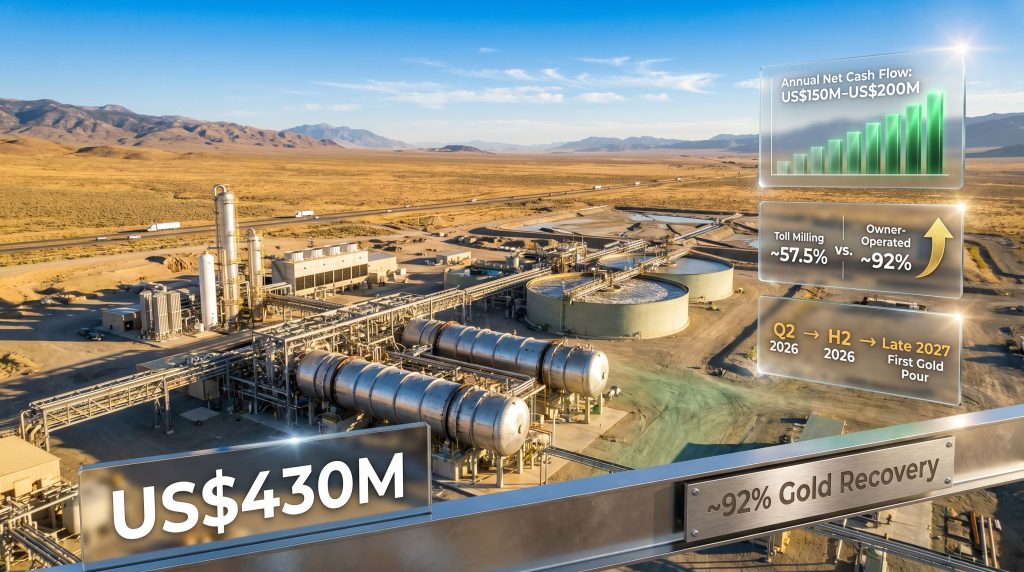
The i-80 Gold Lone Tree facility, once operational, is projected to deliver an average gold recovery of approximately 92%. The arithmetic of that shift is straightforward but its scale is substantial. Moving from a midpoint payability of roughly 57.5% to 92% represents a gain of 34 to 37 percentage points on every ounce of refractory gold processed. Applied across the combined feed volume from three high-grade underground mines, this recovery differential is the primary financial driver behind the Lone Tree refurbishment.
Moreover, the relationship between gold price and mining equities means that this recovery improvement is amplified during periods of elevated gold pricing, as each additional recovered ounce is worth more to the revenue line. At approximately US$3,000 per ounce gold and annual production of 150,000 to 160,000 ounces, the projected annual net cash flow from Lone Tree once fully operational is estimated at US$150 million to US$200 million. Against a total capital cost of US$430 million, the implied payback period is approximately 12 to 24 months at current gold pricing.
This is not a marginal improvement on an existing processing arrangement. It is a fundamental transformation of the revenue model, achieved by internalising a processing step that previously transferred a substantial share of each ounce to a third-party operator.
What Makes Lone Tree a Brownfield Project, and Why That Classification Is Commercially Significant
The Structural Difference Between Refurbishing and Building
The term brownfield is used loosely in mining, but at Lone Tree it carries specific technical meaning. The facility was originally commissioned in 1991 and operated under pressure oxidation from 1993 until 2007, when it was placed into care and maintenance. That operational history leaves behind something greenfield projects cannot replicate: a fully permitted processing facility with major infrastructure components already on site.
The existing asset inventory at Lone Tree includes the oxygen plant, autoclave reactor vessel, carbon-in-leach circuit, mercury abatement scrubber, cyanide destruction system, water treatment infrastructure, refinery, tailings filtration system, tailings transfer pad, and material feed preparation systems. None of these components needs to be installed from cleared ground. The refurbishment programme focuses on reactivating, upgrading, and aligning these assets with current environmental compliance standards and the target recovery profile of approximately 92% average gold recovery.
Greenfield vs. Brownfield: A Structural Comparison
The practical difference between the two development pathways is most visible in the direct construction hour estimate. Greenfield autoclave projects of comparable processing capacity typically require in excess of one million direct construction hours, reflecting the full scope of site establishment, infrastructure installation, drainage provision, utility connections, and sequential equipment commissioning. Lone Tree's estimated direct construction footprint is approximately 600,000 hours, roughly half that exposure.
| Metric | Lone Tree (Brownfield) | Comparable Greenfield Autoclave |
|---|---|---|
| Estimated Direct Construction Hours | ~600,000 | Typically >1,000,000 |
| Primary Permitting Status | In place (core facility) | Typically outstanding |
| Site Establishment Required | No | Yes |
| Existing Infrastructure On Site | Yes (comprehensive) | No |
| Pre-Production Risk Categories Open | Schedule only | Financing, permitting, schedule |
The permitting dimension adds further differentiation. Primary approvals for the core processing infrastructure are already held. Remaining permitting activity consists of renewals and standard environmental controls rather than primary approvals that could introduce timing uncertainty. Consequently, at comparable capital cost, a greenfield autoclave project would typically carry three open pre-production contingency categories at the point of construction decision: financing, permitting, and schedule. Lone Tree entered the Q1 2026 construction decision with only schedule execution outstanding.
How the Lone Tree Processing Circuit Actually Works
The Metallurgical Rationale for Pressure Oxidation in Nevada's Geological Setting
Gold mineralised within arsenopyrite exists in a state that metallurgists describe as occluded or locked within the mineral matrix. The crystal structure of arsenopyrite physically surrounds the gold particles, preventing cyanide solution from making contact during conventional leaching. The only commercially viable approach to liberating this gold at scale is to destroy the host mineral's crystal structure before attempting extraction.
Pressure oxidation achieves this by subjecting finely ground ore to simultaneous elevated pressure and oxygen injection inside an autoclave vessel. The combination drives a rapid chemical oxidation reaction that breaks down the arsenopyrite, releasing the gold into a form that carbon-in-leach extraction can then recover efficiently. The process is well established across Nevada's major producing operations, and the execution team at Lone Tree includes personnel with direct operating experience at multiple autoclave facilities across the state's gold mining district.
The Dual-Circuit Architecture and Its Operational Advantage
Lone Tree's processing design incorporates two complementary circuits rather than a single linear pathway, and this distinction carries meaningful operational implications for a multi-mine feed portfolio.
Circuit 1: Pressure oxidation to carbon-in-leach
This is the primary refractory pathway. Sulphide-hosted ore is ground, subjected to pressure oxidation in the autoclave, and then processed through the carbon-in-leach circuit for gold extraction. This circuit is designed to handle the arsenopyrite-dominant feed from all three underground mines.
Circuit 2: Oxide bypass to carbon-in-leach
High-grade oxide material bypasses the autoclave entirely, proceeding directly to carbon-in-leach after grinding. This preserves autoclave capacity for material that genuinely requires oxidation and allows oxide feed to be processed at lower unit cost without displacing refractory throughput.
The bypass mechanism creates 5% to 10% throughput headroom above the nameplate capacity of approximately 827,800 tonnes per annum (equivalent to approximately 2,268 tonnes per day at 85% plant availability). A purpose-built greenfield facility designed to the same nameplate specification would not carry this flexibility at commissioning; Lone Tree's dual-circuit architecture embeds it into the operational baseline from day one.
Processing Circuit Component Breakdown
| Component | Function |
|---|---|
| Oxygen Plant | Supplies oxygen for autoclave pressure oxidation reaction |
| Autoclave Reactor | Pressure oxidation of sulphide-hosted refractory feed |
| Grinding Circuit | Ore size reduction ahead of autoclave or bypass |
| Carbon-in-Leach Circuit | Gold extraction following oxidation or oxide bypass |
| Mercury Abatement Scrubber | Captures mercury released during oxidation process |
| Cyanide Destruction System | Neutralises cyanide in tailings before discharge |
| Water Treatment System | Process water management and compliance |
| Tailings Filtration System | Solid waste dewatering and management |
| Tailings Transfer Pad | Filtered tailings storage |
| Refinery | Final gold recovery and dore production |
| Material Feed Systems | Ore handling, blending, and circuit feed preparation |
Capital Cost Anatomy: Understanding the US$430 Million Estimate
Why AACE Classification Matters for Cost Confidence
The confidence level of a capital cost estimate in mining is determined as much by its engineering basis as by the headline number. The AACE International classification framework provides a standardised hierarchy for this purpose, ranging from Class 5 (order-of-magnitude, conceptual) through to Class 1 (definitive, construction-ready). Each class carries a defined accuracy range that reflects the percentage of project definition completed at the time of estimation. Understanding this framework is closely related to how a definitive feasibility study anchors project economics at later development stages.
The Lone Tree capital estimate is anchored by an AACE Class 3 engineering study completed in Q4 2025, with approximately 30% of detailed engineering already complete at the time the Board construction decision was granted in Q1 2026. The COO of i-80 Gold has indicated that the vast majority of the estimate was developed at Class 2 detail, meaning a significant portion of the cost basis is supported by an even higher engineering definition than the Class 3 classification formally requires. This positioning provides above-average confidence for a project at this stage of the development cycle.
The estimate is further supported by approximately 14,000 individual cost line items, developed following extensive trade-off studies across major scope decisions. The granularity of that line-item count is a meaningful indicator of estimate specificity; early-stage studies typically operate from cost-per-tonne benchmarks and equipment class estimates rather than individual line-item pricing across nearly every scope element.
Capital Cost Breakdown by Category
| Cost Category | Estimated Value (US$M) |
|---|---|
| Pressure Oxidation Circuit and Utilities | 86 |
| Tailings Filtration | 50 |
| Reagents and Utilities | 39 |
| Neutralisation, CIL, and Cyanide Destruction | 28 |
| Power and Electrical | 20 |
| Refinery | 16 |
| Grinding Circuit | 14 |
| Total Direct Costs | 253 |
| Indirect Costs | 91 |
| Contingency (~12% of total) | 43 |
| Owner's Costs | 25 |
| Capital Spares | 18 |
| Total Capital Estimate | 430 |
The 12% contingency allocation within the published total is notable for two reasons. First, it is included within the stated capital cost rather than being presented as a separate sensitivity, meaning the headline figure already accounts for execution uncertainty. Second, the capital spares allocation of US$18 million signals that operational readiness planning has been incorporated into the capital programme from the outset rather than deferred to post-construction budgeting.
The Hub-and-Spoke Model: Three Underground Mines, One Central Processor
Why Centralised Processing Is the Economically Rational Architecture
The geological consistency across i-80 Gold's Nevada underground portfolio, where arsenopyrite-hosted refractory mineralisation dominates each deposit, both necessitates and justifies the hub-and-spoke processing architecture. Installing separate permitted, engineered, and funded pressure oxidation infrastructure at each mine site would be economically irrational at current development scales and would multiply the permitting, capital, and operational complexity of the overall programme. Centralising processing at Lone Tree eliminates this duplication.
The incremental feed model that follows from this architecture is equally significant. Rather than requiring simultaneous mine and processing ramp-up at each site, each underground operation feeds into Lone Tree as its development advances. The processing facility scales with the combined ore delivery from all three mines, and the oxide bypass adds a further layer of flexibility. As each mine's feed composition shifts between refractory and oxide material across its operating life, Lone Tree can route oxide ore through the bypass circuit without competing for autoclave capacity.
Feed Source Resource Summary
| Underground Mine | Resource Category | Contained Gold (oz) | Grade (g/t Au) |
|---|---|---|---|
| Granite Creek | Measured and Indicated | 261,000 | 10.5 |
| Granite Creek | Inferred | 326,000 | 13.0 |
| Archimedes | Indicated | 436,000 | 7.6 |
| Archimedes | Inferred | 988,000 | 7.3 |
| Cove | Indicated | 310,000 | 8.2 |
| Cove | Inferred | 1,160,000 | 8.9 |
The grade profile across these three operations is particularly relevant to the Lone Tree economics. Understanding cut-off grade economics is essential here, since at 10.5 grams per tonne Measured and Indicated and 13.0 grams per tonne Inferred, Granite Creek's grade sits well above the threshold at which pressure oxidation processing becomes economically self-justifying. The combined inferred resource at Archimedes and Cove exceeds 2.1 million ounces at grades averaging above 8 grams per tonne, providing significant long-term feed visibility for a facility designed to operate across a multi-decade production horizon.
The next major ASX story will hit our subscribers first
Funding Structure and Construction Timeline
A Four-Instrument Capital Stack Exceeding US$1.0 Billion
The i-80 Gold Board of Directors granted a positive construction decision in Q1 2026 following the completion of a full financing programme that assembled more than US$1.0 billion in available capital across four distinct instruments. The structure of this capital stack is relevant to risk assessment: distributing financing across equity, a gold prepay facility of up to US$250 million, convertible senior notes, and a royalty arrangement with Franco-Nevada spreads the refinancing and dilution risk that would accompany a single-instrument approach.
The involvement of Franco-Nevada through a royalty arrangement is worth noting from a market confidence perspective. Franco-Nevada's investment thesis centres on large, long-life, low-cost assets with established geological and metallurgical foundations. Its participation in the Lone Tree financing structure reflects an institutional assessment of the facility's production longevity and processing economics that carries independent signalling value for the broader investor community.
Construction Milestone Sequence
| Milestone | Target Timing |
|---|---|
| Board Construction Decision | Q1 2026 |
| Demolition Commencement | Q2 2026 |
| Main Construction Start | H2 2026 |
| First Gold Pour Target | Late 2027 |
| Full Production Ramp-Up | 2028 onwards |
The demolition phase beginning in Q2 2026 reflects the brownfield nature of the programme: existing structures and equipment requiring replacement or upgrade must be cleared before new installation can proceed. This sequencing is fundamentally different from greenfield construction scheduling, where site preparation and infrastructure establishment precede all equipment installation. At Lone Tree, the demolition scope is bounded by the existing footprint, compressing both the pre-construction preparation period and the associated schedule exposure.
Projected Economics and Long-Term Strategic Positioning
What Owner-Operated Processing Delivers Across a Multi-Mine Portfolio
The economic transformation from toll milling to owner-operated processing at Lone Tree is best understood not as a one-time improvement but as a structural change to the revenue model that compounds across every ounce of refractory gold processed over the facility's operating life.
| Economic Metric | Projected Value |
|---|---|
| Annual Gold Production | 150,000 to 160,000 oz |
| Average Gold Recovery | ~92% |
| Gold Price Assumption | ~US$3,000/oz |
| Projected Annual Net Cash Flow | US$150M to US$200M |
| Total Capital Cost | US$430M |
| Estimated Payback Period | ~12 to 24 months |
i-80 Gold's stated production growth trajectory targets a transition from sub-50,000 ounces per year toward more than 600,000 ounces per year by the early 2030s. The i-80 Gold Lone Tree facility is the processing backbone enabling that transition. Without owner-operated autoclave capacity, that growth trajectory would either remain toll-milling dependent, capping the recoverable revenue per ounce, or require capital allocation to per-mine processing infrastructure that would multiply project complexity and permitting exposure across the portfolio.
Furthermore, investors evaluating different gold mining stock types will recognise that owning one of only two autoclave facilities in Nevada controlled by a gold company creates a competitive positioning advantage that extends well beyond the immediate production economics. Should the broader Nevada refractory gold sector require additional processing capacity as established autoclave facilities reach capacity constraints, Lone Tree's throughput headroom and dual-circuit flexibility position i-80 Gold as a potential toll processor for third-party ore sources, reversing the payability dynamic that currently constrains its own production.
This article is for informational purposes only and does not constitute financial or investment advice. Projected cash flows, payback periods, gold recovery rates, and production targets are forward-looking estimates subject to material risks including commodity price movements, construction delays, metallurgical variability, and regulatory changes. Readers should conduct independent due diligence and consult a qualified financial adviser before making investment decisions.
Want to Catch the Next Major Gold Discovery Before the Market Does?
Discovery Alert's proprietary Discovery IQ model scans ASX announcements in real time, delivering instant alerts on significant mineral discoveries — including high-grade gold opportunities like those reshaping Nevada's refractory processing landscape — so subscribers can act ahead of the broader market. Explore how historic discoveries have generated extraordinary returns on Discovery Alert's dedicated discoveries page, and begin your 14-day free trial today to secure a genuine market-leading edge.