August 26, 2026
Regional Infrastructure Creates Supply Chain Vulnerabilities
Global supply chain networks face unprecedented stress as industrial conflicts reshape the fundamental architecture of international commerce. The Kuwait port closure petrochemical trade flows demonstrate how concentrated production hubs create single points of failure with global ramifications. Furthermore, traditional risk assessment frameworks struggle to capture the velocity and interconnectedness of modern infrastructure vulnerabilities.
The petrochemical sector exemplifies this systemic fragility, where specialized transport corridors and integrated production systems create dependencies that extend far beyond regional boundaries. Understanding how these disruptions propagate through supply networks provides essential insights for strategic planning in an increasingly uncertain geopolitical environment.
When big ASX news breaks, our subscribers know first
Understanding Regional Infrastructure Vulnerabilities in Chemical Supply Chains
Regional petrochemical infrastructure demonstrates how geographic concentration amplifies systemic risk across global supply networks. The Middle East's role as a dominant production center creates dependencies that affect pricing dynamics and availability patterns worldwide, highlighting the importance of trade war strategies in managing such risks.
Middle East Petrochemical Port Capacity Analysis:
| Port Hub | Primary Products | Annual Capacity (MT) | Strategic Importance |
|---|---|---|---|
| Shuaiba (Kuwait) | Polymers, Aromatics | 4.2 million | Regional export gateway |
| Jebel Ali (UAE) | Mixed petrochemicals | 8.7 million | GCC distribution center |
| Duqm (Oman) | Specialty chemicals | 2.1 million | Alternative routing hub |
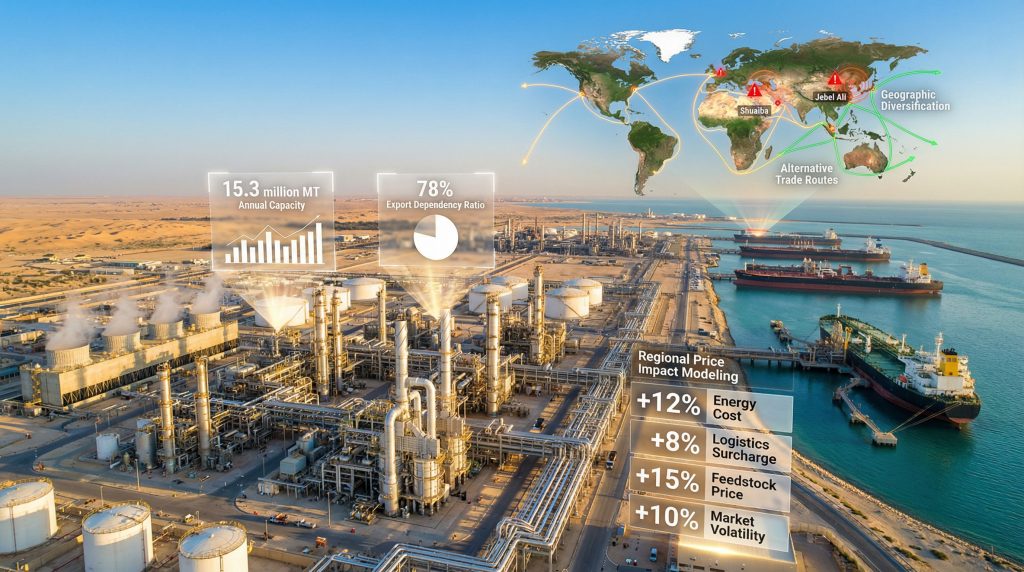
| Jubail (Saudi Arabia) | Polyethylene, PP | 15.3 million | Largest regional facility |
The concentration of processing capacity within these four major hubs illustrates the structural vulnerability inherent in Middle Eastern petrochemical exports. Jebel Ali alone handles approximately 65% of Gulf Cooperation Council polymer exports and 33% of total regional petrochemical shipments.
Critical Infrastructure Dependencies:
- Production integration: Manufacturing facilities physically adjacent to port infrastructure
- Limited alternative routing: Few viable substitutes for specialized petrochemical handling
- Capacity constraints: Existing facilities operating at high utilisation rates
- Specialised equipment: Product-specific loading and storage requirements
The Middle East accounts for over 23 million tonnes annually of polyethylene capacity, representing approximately 15% of global production. Saudi Arabia contributes 10.5 million tonnes of this capacity, with Iran adding just over 5 million tonnes.
Geographic Risk Distribution Patterns
Polypropylene production shows similar concentration characteristics, with the Middle East controlling more than 10 million tonnes annually, equivalent to roughly 9% of worldwide capacity. Saudi Arabia dominates regional production with 5.7 million tonnes yearly, including 4 million tonnes at the Jubail complex alone.
Infrastructure Vulnerability Indicators:
- Single-facility dependencies for specialised products
- Integrated production-export chains with limited redundancy
- High regional export ratios creating external market exposure
- Limited cross-border alternative transport options
What Makes Kuwait's Shuaiba Port Critical for Polymer Markets?
Shuaiba's strategic importance stems from its role as an integrated production-export nexus, where Equate Petrochemical operates directly adjacent to port facilities. This vertical integration creates efficiency advantages during normal operations but represents concentrated risk during disruption scenarios affecting Kuwait port closure petrochemical trade flows.
Equate Shuaiba Production Specifications:
| Product Category | Annual Capacity | Market Significance |
|---|---|---|
| Ethylene | 1.9 million tonnes | Primary feedstock |
| Ethylene oxide | 1.1 million tonnes | Industrial chemical |
| Polyethylene | 990,000 tonnes | Global commodity |
| Xylenes | 1 million tonnes | Aromatic precursor |
| Paraxylene | 830,000 tonnes | Specialty export |
| Ethylbenzene | 490,000 tonnes | Styrene feedstock |
| Styrene | 450,000 tonnes | Polymer building block |
| Benzene | 443,000 tonnes | Base aromatic |
The facility's ethylene capacity of 1.9 million tonnes annually serves as the foundation for downstream polymer production. Approximately 52% of this ethylene output converts to polyethylene within the same complex, demonstrating the integrated nature of operations.
Product Export Vulnerability Assessment:
Polymers and paraxylene represent the highest-risk product categories based on historical trade flow patterns. These products typically move through specialised export channels with limited alternative routing options compared to more standardised petrochemical commodities.
The xylene-to-paraxylene conversion process exemplifies this vulnerability, with 1 million tonnes of xylene input producing 830,000 tonnes of paraxylene annually. This specialised aromatic derivative serves specific industrial applications where supply disruptions create immediate market tightness.
Integrated Facility Risk Dynamics
Port closures prevent final product evacuation while upstream production units may continue operating, creating inventory accumulation scenarios. Unlike facilities with multiple export route options, Shuaiba-based production lacks alternative domestic outlet mechanisms during infrastructure disruptions.
Operational Interdependencies:
- Physical proximity: Production and export facilities share common infrastructure
- Specialised handling: Product-specific loading equipment and storage systems
- Contractual obligations: Long-term offtake agreements requiring consistent delivery
- Inventory limitations: Restricted on-site storage for finished products
The combined annual output of approximately 6.6 million tonnes across all product categories from the Shuaiba complex demonstrates the scale of potential market impact when port operations face extended closure periods.
How Do Geopolitical Tensions Multiply Supply Chain Disruptions?
Military conflicts create compound effects across interconnected infrastructure networks through simultaneous multi-node failures that overwhelm traditional contingency planning. Unlike isolated disruptions with predictable duration patterns, geopolitical events introduce escalation uncertainties that require scenario-based risk management approaches.
The March 2026 conflict timeline illustrates this cascading pattern with remarkable velocity. Following coordinated strikes beginning February 28, multiple critical facilities experienced disruption within a compressed 48-hour window, creating significant implications for oil market trade war impact.
Disruption Cascade Timeline (March 1-2, 2026):
- Saturday morning: Shuaiba port operations suspended following debris incidents
- Saturday evening: Jebel Ali berth fire from aerial interception debris
- Sunday: Duqm port drone strikes injuring personnel
- Ongoing: Strait of Hormuz transit uncertainty affecting regional shipping
This compressed timeline demonstrates how geopolitical disruptions eliminate the geographic diversification benefits that normally allow cargo redirection during isolated facility closures.
Uncertainty Quantification Challenges
Traditional risk models struggle with geopolitical scenarios because they involve:
Unpredictable Variables:
- Conflict escalation patterns: Unknown duration and intensity trajectories
- Infrastructure targeting: Strategic vs. incidental facility impacts
- International responses: Diplomatic and military intervention possibilities
- Economic warfare: Sanctions, trade restrictions, and financial disruptions
The Strait of Hormuz situation exemplifies this uncertainty. Initial reports suggested potential closure, but official maritime authorities classified these as informal statements without legal binding. Consequently, market participants must simultaneously plan for immediate transit risks and potential extended closure scenarios.
Multi-Layer Risk Assessment:
- Primary disruption: Confirmed facility closures and operational suspensions
- Secondary threats: Regional shipping lane restrictions and insurance impacts
- Tertiary effects: Contractual disputes from force majeure activations
- Quaternary consequences: Long-term supply chain reconfiguration strategies
The simultaneous disruption of Kuwait, UAE, and Oman facilities eliminates geographic diversification that would normally allow cargo redirection, creating systemwide bottlenecks rather than manageable rerouting scenarios.
Which Alternative Trade Routes Can Absorb Displaced Petrochemical Volumes?
Regional capacity analysis reveals limited absorption potential across alternative Middle Eastern export facilities, creating bottleneck scenarios that persist beyond immediate conflict resolution. Pre-disruption utilisation rates indicate constrained spare capacity for petrochemical-specific cargo handling.
Alternative Facility Utilisation Assessment:
| Facility Type | Pre-Disruption Capacity | Available Absorption | Constraint Factors |
|---|---|---|---|
| UAE ports | 65% utilisation | ~35% mixed cargo | Petrochemical-specific limitations |
| Saudi facilities | High domestic demand | Limited export spare | Internal market priorities |
| Omani alternatives | Damaged infrastructure | Reduced availability | Recent strike impacts |
| Non-regional routes | Cost-prohibitive | 15-25% premium | Extended transport distances |
UAE facilities, particularly Jebel Ali, operated at approximately 65% utilisation before the current disruptions. However, this spare capacity represents mixed cargo handling rather than dedicated petrochemical infrastructure, limiting actual displacement absorption for specialised chemical products.
Saudi Capacity Redistribution Potential
Saudi Arabia maintains substantial petrochemical production capacity with theoretical export availability. However, domestic demand patterns constrain actual volume redirection possibilities, particularly as tariffs impact markets globally.
Saudi Production Distribution:
- Total polyethylene capacity: 10.5 million tonnes annually
- Jubail facility contribution: 7.3 million tonnes
- Polypropylene capacity: 5.7 million tonnes at Jubail complex
- Domestic consumption: Significant portion of production serving local markets
The scale of Saudi facilities suggests potential displacement capacity. However, existing supply contracts and domestic industrial demand limit actual availability for absorbing displaced Middle Eastern volumes during crisis periods.
Transport Cost Impact Analysis
Alternative routing scenarios create asymmetric cost structures across different destination markets, fundamentally altering competitive positioning for petrochemical suppliers and buyers.
Regional Price Impact Projections:
| Destination Market | Cost Increase Range | Competitive Implications |
|---|---|---|
| Southeast Asia | 8-12% | Benefits local production |
| European Union | 15-20% | Accelerates recycling adoption |
| North America | 5-8% | Minimal domestic price impact |
| Sub-Saharan Africa | 18-25% | Significant demand destruction risk |
These cost escalations reflect both transport premium and insurance surcharge factors associated with alternative routing through non-regional facilities or extended shipping distances to avoid affected areas.
What Long-Term Infrastructure Resilience Lessons Emerge?
Current disruption patterns provide valuable insights for strategic infrastructure investment and risk management across global petrochemical operations. The concentration of critical facilities within conflict-prone regions highlights fundamental design vulnerabilities in existing supply networks, particularly considering Trump tariffs implications on trade flows.
Infrastructure Resilience Design Principles:
- Geographic distribution: Avoiding excessive concentration in single regions or conflict zones
- Modular capacity architecture: Enabling rapid production shifts between multiple facilities
- Multi-modal logistics integration: Reducing dependence on single transport corridors
- Strategic reserve positioning: Pre-positioning inventory in geopolitically stable jurisdictions
Investment Prioritisation Framework
Industry participants are reassessing capital allocation strategies to address newly apparent vulnerability concentrations. Investment themes emerging from current crisis scenarios include:
Technology Infrastructure:
- Supply chain visibility platforms: Real-time monitoring and predictive disruption analytics
- Alternative feedstock development: Reducing dependence on region-specific inputs
- Automated logistics systems: Minimising human resource requirements in unstable areas
- Flexible production technologies: Enabling rapid product mix adjustments
Geographic Diversification:
- Regional capacity expansion: Developing production closer to consumption centres
- Port infrastructure investment: Creating redundant export capabilities
- Storage facility networks: Strategic positioning of buffer inventory
- Transport corridor alternatives: Multiple routing options for critical products
Market Structure Evolution Implications
The current crisis may accelerate structural changes in petrochemical sourcing patterns and regional market development strategies beyond immediate disruption recovery. Furthermore, the ongoing oil price rally adds another layer of complexity to these market dynamics.
Transformation Catalysts:
- Nearshoring initiatives: Bringing production operations closer to consumption markets
- Regulatory policy responses: Government promotion of domestic capacity development
- Sustainability integration: Using disruption justification for renewable feedstock transitions
- Regional self-sufficiency: Reduced dependence on concentrated production hubs
These trends suggest permanent shifts in global petrochemical trade flows rather than temporary adjustments during crisis periods.
The next major ASX story will hit our subscribers first
How Might This Crisis Accelerate Industry Transformation Trends?
Supply chain disruptions often serve as catalysts for accelerated adoption of transformation strategies that might otherwise face resistance due to cost or complexity considerations. Current events provide compelling business justification for strategic changes previously considered optional or long-term objectives.
Accelerated Adoption Areas:
- Alternative feedstock technologies: Reduced reliance on Middle Eastern petroleum inputs
- Regional production expansion: Facilities located closer to major consumption markets
- Supply chain digitisation: Enhanced visibility and predictive analytics capabilities
- Sustainability transitions: Renewable feedstock and recycling technology integration
Investment Theme Prioritisation
The crisis highlights investment opportunities that address structural vulnerabilities exposed by current disruption patterns. These themes reflect fundamental shifts in risk assessment and strategic planning approaches across the petrochemical sector.
Strategic Investment Categories:
Infrastructure Development:
- Port and terminal facilities in stable jurisdictions
- Storage and distribution networks serving multiple regions
- Transport and logistics capabilities with redundant routing options
- Manufacturing capacity positioned for regional market service
Technology Solutions:
- Supply chain monitoring and early warning systems
- Flexible production technologies enabling rapid product transitions
- Alternative feedstock processing capabilities
- Automated systems reducing human resource dependencies
Market Positioning:
- Regional production capabilities serving local consumption
- Specialised product development for niche market segments
- Vertical integration reducing external supply dependencies
- Strategic partnership networks providing operational flexibility
Regulatory and Policy Response Patterns
Government responses to supply chain vulnerabilities typically involve strategic industry support measures designed to enhance domestic capabilities and reduce foreign dependency risks. In addition, Middle East tensions continue to influence policy decisions across multiple jurisdictions.
Expected policy initiatives may include:
- Domestic capacity incentives: Tax advantages and funding support for regional production
- Strategic reserve programmes: Government-backed inventory systems for critical materials
- Infrastructure investment: Public funding for port, transport, and storage facilities
- Research and development support: Technology advancement programmes for alternative processes
Understanding Petrochemical Trade Flow Disruptions
How long do Kuwait port closure petrochemical trade flows typically affect global markets?
Impact duration depends on alternative capacity availability and conflict resolution timeframes. Historical analysis of similar disruptions suggests 3-6 months for complete market rebalancing, though geopolitical uncertainties can extend this period significantly. Current spare capacity constraints in regional facilities may prolong adjustment periods beyond typical scenarios.
Which petrochemical products face the highest disruption risk from Middle Eastern port closures?
Polymers and aromatics show greatest vulnerability due to concentrated regional production and limited alternative sourcing options. Polyethylene, polypropylene, and paraxylene represent particular risk categories given their high export dependency ratios from affected facilities and specialised handling requirements.
Can other regions compensate for Middle Eastern petrochemical supply gaps?
Partial compensation remains possible through Asian and North American producers, but at significantly higher costs and extended lead times. Regional capacity utilisation rates of 65-70% provide limited spare capacity for large-scale volume absorption, particularly for specialised chemical products requiring specific infrastructure.
How do these disruptions affect petrochemical pricing globally?
Regional price differentials widen substantially, with markets closer to alternative sources experiencing smaller increases compared to those dependent on Middle Eastern imports. Cost increases range from 5-8% in North America to 18-25% in Sub-Saharan Africa, reflecting transport premiums and supply scarcity factors.
What alternative routing strategies are petrochemical buyers implementing?
Market participants are adopting geographic diversification approaches, increasing sourcing from Asian producers while implementing strategic inventory buffering in key consumption markets. Contract renegotiations focus on force majeure clause activations and alternative product substitution arrangements to manage supply uncertainty.
Are there long-term implications for global petrochemical trade patterns?
Current disruptions may accelerate permanent structural changes including nearshoring initiatives, regional self-sufficiency policies, and alternative feedstock technology adoption. Investment themes emphasise reducing concentration risks and developing resilient supply chain architectures less dependent on single-region production hubs.
This analysis reflects market conditions and disruption patterns as of March 2026. Kuwait port closure petrochemical trade flows involve complex risk factors including geopolitical developments, infrastructure capacity, and market demand patterns that may change rapidly. Investors and industry participants should conduct independent research and consider multiple scenario outcomes when making strategic decisions.
Looking to Navigate Commodity Market Disruptions?
Discovery Alert's proprietary Discovery IQ model delivers real-time alerts on significant mineral discoveries across the ASX, helping investors identify opportunities even during periods of global supply chain uncertainty. Whether tracking traditional commodities or emerging materials critical to supply chain resilience, Discovery Alert's dedicated discoveries page showcases how major mineral finds have historically generated substantial market returns. Begin your 14-day free trial today to position yourself ahead of market volatility and capitalise on actionable investment opportunities as they emerge.