June 30, 2026
The Hidden Physics of Steel: Why Cleaning Up the World's Most Important Metal Is So Difficult
Every tonne of steel ever produced carries an embedded story of chemistry, thermodynamics, and energy. Long before engineers began talking about green transitions or carbon neutrality, the blast furnace had already reached a kind of physical perfection. Centuries of incremental improvement had pushed the dominant steelmaking process so close to its theoretical limits that no further optimisation could meaningfully reduce its carbon output. This is the central and largely underappreciated reality confronting sustainable steel manufacturing challenges today: the problem is not inefficiency. The problem is that the most widely used production method in the world is already extraordinarily efficient at doing something that is, by its very chemistry, carbon-intensive.
Understanding this distinction changes how the entire decarbonisation conversation should be framed. It shifts the question from how to make existing steelmaking cleaner to whether it is even possible to decarbonise without rebuilding the industry's core architecture from scratch. The answer, increasingly, is no. And the implications of that answer are vast, expensive, and still unresolved.
When big ASX news breaks, our subscribers know first
Steel's Carbon Problem Is Structural, Not Operational
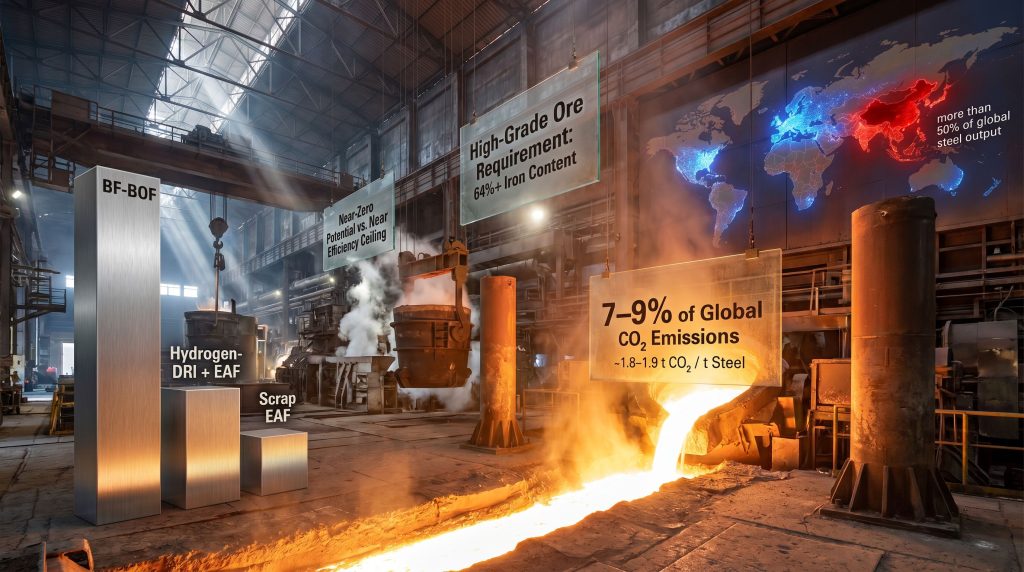
Steel production is responsible for approximately 7 to 9 percent of total global CO₂ emissions, making it one of the most carbon-intensive sectors in the entire industrial economy. To put that in context, the aviation industry, which receives enormous public scrutiny for its climate footprint, accounts for roughly 2.5 percent of global emissions. Steel's contribution is more than three times larger.
The dominant production pathway, the blast furnace-basic oxygen furnace (BF-BOF) route, generates roughly 1.8 to 1.9 tonnes of CO₂ for every tonne of crude steel produced (World Steel Association, 2023). This figure is not the result of poor engineering or outdated equipment. It reflects the stoichiometric reality of iron oxide reduction: carbon, in the form of coke derived from metallurgical coal, acts as both the energy source and the chemical reducing agent in the blast furnace. When carbon strips oxygen from iron ore to produce molten iron, CO₂ is the inevitable byproduct. There is no version of this chemistry that avoids it.
This is the core challenge: the BF-BOF process is operating at close to its theoretical thermodynamic ceiling. Emissions cannot be meaningfully reduced through process optimisation because most of the efficiency gains that were available have already been captured over decades of engineering refinement.
Why Demand Growth Makes the Problem Compoundingly Worse
Complicating the emissions picture is the fact that global steel demand is not contracting. It is growing, driven by infrastructure investment across rapidly developing economies in South and Southeast Asia, Sub-Saharan Africa, and Latin America. The International Energy Agency projects that steel demand could increase by as much as 30 percent by 2050 relative to current levels, driven largely by construction, transportation, and energy infrastructure build-out in these regions.
The China steel and iron ore market currently accounts for more than 50 percent of global crude steel output (World Steel Association, 2024), a level of geographic concentration that shapes everything from ore pricing to the global pace of the green transition. Because China's steel industry remains heavily reliant on coal-based production, any credible global decarbonisation scenario requires a fundamental transformation of Chinese steelmaking at a scale and speed that has no historical precedent in heavy industry.
This creates a structural contradiction at the heart of sustainable steel manufacturing challenges: the regions where demand is growing fastest are also the regions where financial, technical, and energy infrastructure constraints make the transition to low-carbon production most difficult.
The Technical Maze: Why No Single Technology Solves the Problem
Hydrogen-Based Reduction: High Promise, High Constraints
The pathway most widely cited as the long-term solution for near-zero-emission steelmaking is hydrogen direct reduced iron (H2-DRI), in which green hydrogen replaces coke as the reducing agent in iron ore processing. When powered by renewable electricity, this route can theoretically reduce steelmaking emissions by over 90 percent compared to the BF-BOF baseline. Furthermore, advances in hydrogen iron ore reduction technology are accelerating, offering fresh pathways for producers willing to invest early.
But the practical constraints are severe and often underappreciated in mainstream coverage of the green steel transition.
First, H2-DRI technology demands high-purity iron ore with iron content at or above 64 percent. This is not a minor technical preference. The higher iron content is required because impurities such as silica, alumina, and phosphorus interfere with reduction kinetics at the temperatures achievable in direct reduction reactors, and because electric arc furnace steelmaking, which processes the DRI output, has limited tolerance for gangue minerals.
The problem is that ore of this quality represents a small fraction of global iron ore reserves and production. The vast majority of seaborne iron ore trade is centred on grades of 58 to 62 percent Fe content, which falls well below the threshold needed for DRI without significant beneficiation.
Second, green hydrogen itself remains expensive to produce at scale. Electrolysis of water using renewable electricity is technically proven, but current production costs range from USD 4 to USD 10 per kilogram in most regions, compared to approximately USD 1 to USD 2 per kilogram for fossil-based hydrogen (IEA, 2023). Closing that cost gap requires massive scale-up of both electrolyser manufacturing and renewable energy capacity simultaneously.
The Scrap Paradox: Clean but Scarce
Electric arc furnace production using recycled scrap steel is the lowest-carbon route commercially available today, emitting roughly 0.4 to 0.6 tonnes of CO₂ per tonne of steel when powered by low-carbon electricity compared to nearly 1.9 tonnes for BF-BOF. Yet scaling this pathway faces a constraint that is physical rather than financial: there is not enough scrap.
Global scrap demand already exceeds supply in several regions, and the gap is expected to widen significantly as more producers attempt to shift toward EAF-based production. The availability of recyclable steel is fundamentally tied to the age and volume of the existing steel stock in an economy. Developed economies with large, ageing infrastructure bases generate substantial scrap flows. Rapidly developing economies, where the steel stock is new and still accumulating, generate far less.
This geographic mismatch between where scrap is available and where steel demand is growing fastest represents a fundamental physical limit on how quickly the industry can scale the scrap-based EAF pathway. There is also a quality dimension that is rarely discussed outside of technical circles. Not all scrap is equal. High-residual scrap, contaminated with copper, tin, or other tramp elements from end-of-life products like automobiles and electronics, cannot be used for producing high-specification flat products such as automotive sheet steel without dilution with virgin iron units.
As the share of EAF production grows, pressure on high-quality, low-residual scrap will intensify, creating a two-tier scrap market that could structurally disadvantage producers without access to clean feedstocks. According to research on technologies and challenges for sustainable steel production, this feedstock quality issue remains one of the most underestimated barriers to full-scale EAF adoption globally.
The CCUS Gap: A Bridge With Missing Spans
Carbon capture, utilisation, and storage technologies offer a mechanism for reducing emissions from existing BF-BOF infrastructure without requiring full decommissioning. However, deployment has been slow, and the reasons are systemic rather than incidental.
| Challenge | Detail |
|---|---|
| Capital cost | CCUS retrofit costs for steel plants typically range from USD 50 to USD 100+ per tonne of CO₂ captured |
| Storage infrastructure | Geological CO₂ storage requires proximity to suitable formations and dedicated pipeline networks |
| Regulatory frameworks | CO₂ sequestration permitting varies significantly by jurisdiction and remains immature in many regions |
| Energy penalty | CO₂ capture processes consume additional energy, reducing overall plant efficiency |
| Long-term liability | Uncertainty about long-term subsurface storage integrity creates insurance and legal complexities |
The consensus view among industrial decarbonisation researchers is that CCUS functions best as a transitional mechanism rather than a permanent solution, buying time for hydrogen and EAF pathways to mature while avoiding premature stranding of productive assets.
Capital, Consolidation, and the Investment Paradox
Transitioning a single integrated steel facility from BF-BOF to hydrogen-based DRI plus EAF production can require capital investment in the range of USD 1 to USD 3 billion, depending on plant scale, location, and the degree of infrastructure that must be built from scratch. This includes not only the production equipment itself but also the green hydrogen supply chain, renewable energy procurement or co-located generation, and grid connection upgrades that are often substantial.
Early movers in the green steel transition absorb disproportionate capital risk in an immature technology market, while those who delay face the accelerating risk of being locked into stranded BF-BOF assets as carbon pricing mechanisms escalate.
This creates a strategic bind that is particularly acute for smaller and mid-tier producers. Large integrated steelmakers with diversified revenue bases, access to international capital markets, and strong balance sheets are better positioned to stage and finance multi-year transition programmes. Smaller producers face a structural disadvantage: insufficient financial capacity to fund technology transformation while simultaneously managing the ongoing capital requirements of operating existing assets.
The predictable consequence is industry consolidation. Producers unable to fund the transition will face a narrowing set of options: acquisition by larger competitors, market exit, or repositioning toward niche high-value steel products where scale is less critical and green premiums can be more readily captured. Consequently, the green steel pricing dynamics that emerge from this consolidation will reshape competitive positioning across the sector for decades to come.
The Certification Bottleneck: When Green Means Different Things to Different People
Even where producers invest successfully in low-carbon production, realising the commercial benefit depends on selling green steel at a price premium that justifies the higher cost of production. And that premium depends on buyers trusting that the green label is meaningful.
This is where the certification problem becomes a major structural constraint on market development. Current green steel certification frameworks face several unresolved methodological challenges:
- Integrated steel plants have highly complex, intertwined material and energy flows, making clean attribution of emission reductions to specific product batches technically difficult
- Additionality requirements, which determine whether emission reductions are genuine new improvements rather than baseline credits, must be both credible enough to maintain market integrity and achievable enough to incentivise investment
- Without harmonised global standards, competing certification schemes risk fragmenting the market and creating greenwashing exposure that could undermine buyer confidence at a critical early stage of market development
Without globally aligned accounting methodologies and credible third-party verification systems, the green steel premium market cannot scale to the level needed to drive broad industry transformation. This is a governance challenge as much as a technical one, and progress has been slow relative to the urgency of the underlying problem. The World Steel Association's framework on climate action offers one reference point, though industry-wide adoption remains inconsistent.
Market Headwinds: Overcapacity, Trade Tensions, and Energy Volatility
The economics of green steel investment do not exist in isolation. They are embedded in a global market structure characterised by chronic overcapacity, primarily driven by China's dominant and often state-subsidised production base, which has consistently suppressed benchmark steel prices for years. When prevailing steel prices are depressed by excess supply, the additional cost of low-carbon production cannot be recovered through a green premium in price-sensitive end markets like construction and civil infrastructure.
Energy cost volatility adds another layer of systemic risk. EAF and hydrogen-DRI production routes are highly sensitive to electricity input costs. A European steelmaker committing to a hydrogen-DRI facility in the mid-2020s faces a payback horizon measured in decades, during which time renewable electricity prices, grid access costs, and hydrogen supply chain economics could shift substantially in either direction. Furthermore, the compounding effect of tariffs and iron ore markets adds another dimension of uncertainty for producers navigating long-term investment decisions.
The next major ASX story will hit our subscribers first
The Skills Gap: An Underweighted Risk in Most Decarbonisation Plans
Technology transitions in heavy industry depend not only on capital and equipment but on the human capacity to operate, maintain, and optimise new production systems. The shift toward hydrogen metallurgy, electrified production, and digitally controlled process environments demands technical competencies that are largely absent from the current steel workforce.
Critical skill gaps include:
- Hydrogen handling, safety, and process chemistry
- High-power electrical systems and EAF operation
- Data-driven process control and AI-assisted quality management
- Circular economy logistics, scrap grading, and tramp element management
- Carbon accounting and sustainability reporting under evolving regulatory frameworks
Workforce retraining programmes require long lead times and compete for resources against the capital demands of the technology transition itself. In regions where technical education infrastructure is less developed, this skills gap can delay commissioning of new facilities and reduce operational efficiency during the critical early years when cost recovery depends on achieving design performance levels.
Regulatory Pressure: Europe Leads, the World Watches
The regulatory landscape for sustainable steel manufacturing challenges is evolving rapidly, though unevenly across regions. Europe is the most aggressive jurisdiction, deploying both carbon pricing through the EU Emissions Trading System and the Carbon Border Adjustment Mechanism (CBAM), which imposes carbon costs on imported steel from countries with weaker climate regulations. This mechanism is reshaping competitive dynamics globally by effectively exporting a carbon price to the international steel trade.
| Region | Carbon Pricing Mechanism | Regulatory Stringency |
|---|---|---|
| European Union | EU ETS + CBAM operational | High |
| United States | IRA tax credits, voluntary frameworks | Moderate |
| China | National ETS (steel inclusion developing) | Developing |
| India | Perform, Achieve & Trade energy efficiency scheme | Low to Moderate |
| Japan/South Korea | Carbon pricing pilots and sector R&D programmes | Moderate to High |
Beyond carbon, steelmakers face a broadening compliance burden across water use, particulate emissions, solid waste classification, and land remediation standards. The cumulative financial weight of this multi-dimensional regulatory pressure compounds the capital demands of the energy transition itself, particularly for facilities in older industrial regions where legacy contamination issues and ageing infrastructure create additional compliance complexity.
What a Realistic Transition Actually Looks Like
The honest assessment of sustainable steel manufacturing challenges is that no single technology, policy lever, or market mechanism is sufficient on its own. Effective decarbonisation of the steel sector requires a coordinated, multi-horizon approach. In addition, the mining decarbonisation benefits that flow upstream from a cleaner steel industry further strengthen the economic case for accelerating this transition. That approach must combine:
Near-term actions (now to 2030):
Maximising energy efficiency in existing facilities, increasing scrap utilisation, fuel switching where feasible, and deploying CCUS on high-emission point sources where geological conditions allow.
Medium-term investments (2030 to 2040):
Expanding EAF capacity in regions with access to low-carbon electricity and quality scrap, scaling hydrogen-DRI pilot projects to commercial scale, and developing upstream high-grade ore supply chains.
Long-term transformation (2040 and beyond):
Full-scale hydrogen-DRI hubs co-located with renewable energy generation, circular economy maturation to close scrap quality and availability gaps, and globally harmonised carbon accounting standards that enable green steel market depth.
Critically, none of these horizons can be pursued in isolation from adjacent sectors. Affordable green hydrogen depends on the energy sector scaling electrolysis and renewable generation. High-grade iron ore availability depends on mining sector investment in beneficiation and exploration. Long-term capital commitment depends on stable, predictable carbon pricing frameworks that can survive political cycles. Every link in this chain is interdependent, and weakness at any point creates systemic exposure that no individual steelmaker can fully mitigate through internal strategy alone.
The sustainable steel manufacturing challenges facing the industry are not primarily technological. They are structural, economic, geopolitical, and human. The technologies exist or are in credible development. What remains unresolved is whether the global coordination required to deploy them at the necessary scale and speed can be achieved within the timeframes that climate science demands.
Disclaimer: This article contains forward-looking statements, projections, and analytical perspectives that reflect current industry research and publicly available data. These should not be construed as investment advice. Market conditions, technology costs, and regulatory frameworks are subject to change. Readers are encouraged to conduct independent research before making financial or operational decisions based on information contained herein.
Want To Capitalise On The Mineral Discoveries Powering The Green Steel Transition?
As sustainable steel manufacturing accelerates demand for high-grade iron ore, green hydrogen, and critical minerals, Discovery Alert's proprietary Discovery IQ model delivers real-time alerts the moment significant ASX mineral discoveries are announced — ensuring subscribers are positioned ahead of the broader market. Explore historic discoveries and their exceptional returns, then begin a 14-day free trial at Discovery Alert to secure an immediate market-leading advantage.