June 30, 2026
The Mineral Architecture of Modern War: Why Processing Location Is Now a National Security Variable
Modern military platforms are not constrained primarily by manpower, firepower, or even funding. Increasingly, they are constrained by materials. The guidance system in a precision munition depends on rare earth magnets. The battery pack powering a reconnaissance drone relies on processed graphite. The armor plate protecting a soldier from ballistic threats is built around boron carbide. Each of these materials traces its processing journey, in most cases, through a single country: China.
That concentration of processing power has quietly become one of the most significant vulnerabilities in U.S. defense readiness, and the U.S. Army has now moved to address it in a structurally novel way. Rather than lobbying for industrial subsidies or waiting for commercial markets to reshore supply chains organically, the Army is deploying its own real estate as a national security instrument, converting underutilised land at domestic military installations into sovereign-controlled mineral processing capacity.
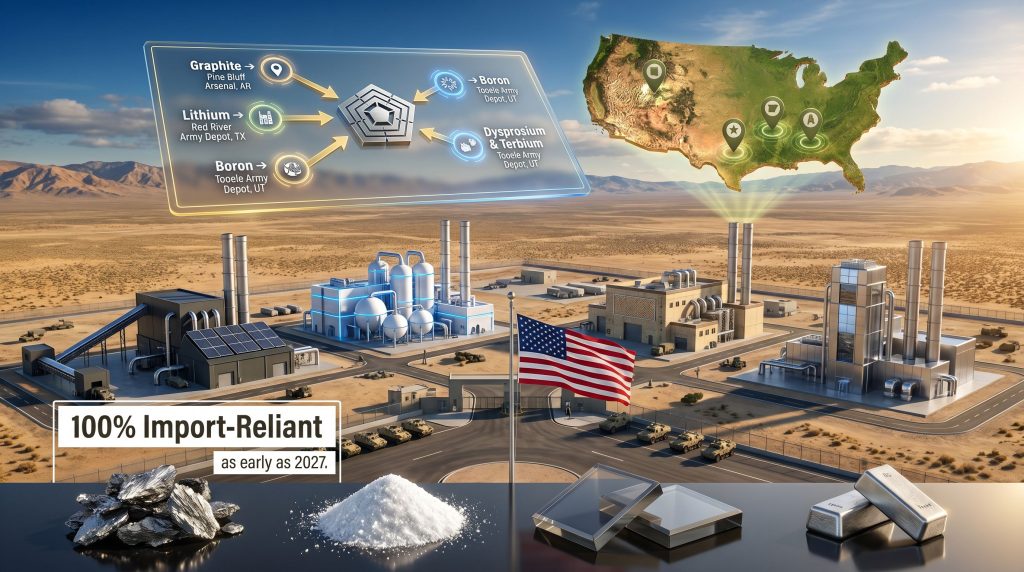
On June 25, 2026, the Army announced the conditional selection of four companies to build privately financed army critical mineral processing plants at installations across five states. The scope covers graphite, lithium, boron, dysprosium, and terbium — five minerals whose absence from any modern weapons platform would degrade or disable it entirely.
When big ASX news breaks, our subscribers know first
The Supply Chain Vulnerability That Decades of Policy Failed to Solve
Understanding why this initiative matters requires stepping back from the programme itself and examining the structural problem it is designed to solve. The United States currently imports 100% of its natural graphite, making it the only major defence economy with zero domestic production of a mineral that serves as the single largest component by weight in lithium-ion batteries.
That statistic alone is striking, but the fuller picture is more complex. It is not simply that the U.S. lacks graphite mines. The more critical constraint is processing capacity. Raw graphite must be purified, shaped, and coated into spherical graphite before it can serve as an anode material in battery cells. China controls the dominant share of this processing infrastructure globally, meaning that even if alternative graphite were mined elsewhere, the refining pathway still runs through Chinese industrial facilities in many cases.
The same logic applies across multiple defence-critical minerals. Furthermore, consider the following breakdown:
| Mineral | Primary Military Application | Current U.S. Supply Status |
|---|---|---|
| Graphite | Lithium-ion batteries, thermal protection systems, aerospace components | 100% import-reliant |
| Lithium | Energy storage for drones, EVs, soldier electronics, tactical vehicles | Largely foreign-sourced |
| Boron | Ballistic armor plating, rocket propellants, munitions stabilizers | Foreign-dependent |
| Dysprosium | High-performance permanent magnets for precision weapons, electric motors | China-dominated supply |
| Terbium | Heat-resistant magnets for sonar, radar, extreme-temperature platforms | China-dominated supply |
These five minerals are not peripheral inputs to military hardware. They are embedded in the core architecture of modern defence capability, from the armour a soldier wears to the guidance electronics inside a precision-guided munition. Disrupting access to any one of them creates cascading failures across multiple platforms simultaneously.
The critical minerals demand landscape has intensified significantly in recent years, as defence agencies have come to recognise that material access is now as strategic a concern as troop deployment or weapons procurement.
China's 2010 rare earth export restriction campaign directed at Japan provided a concrete historical example of how mineral supply chains can be weaponised as geopolitical leverage. That episode — where China temporarily curtailed rare earth shipments in the context of a territorial dispute — triggered a global scramble to diversify sourcing that continues to influence policy today. Defence planners are acutely aware that a similar restriction applied to battery-grade graphite or heavy rare earth elements during a period of heightened tension could compromise production timelines for critical weapons systems. Consequently, rare earth supply chains have become a central pillar of national security planning.
How the Enhanced Use Lease Model Turns Army Land Into Industrial Policy
The mechanism the Army is using to stand up these facilities is less familiar than its strategic rationale, but understanding it is essential to evaluating the programme's real-world viability.
The Enhanced Use Lease (EUL) authority allows the Army to lease non-excess, underutilised land at military installations to private-sector partners. The Army retains title to the land at all times. Private companies bear the entire burden of financing, designing, permitting, constructing, operating, securing, and eventually decommissioning the processing facilities. No appropriated taxpayer capital is deployed to build these plants.
In lieu of cash rent payments, lessees fund infrastructure improvements directly on the host installations. These can include upgraded utilities, modernised grid connections, enhanced site infrastructure, and mission-capability improvements that benefit the Army's ongoing operations. The Army also mandates that each selected company post a decommissioning bond, ensuring that funds are ring-fenced to restore the land to its original condition at lease expiration, regardless of the company's future financial status.
Jeff Waksman, the Army's principal deputy assistant secretary for installations, energy, and environment, described the approach as one that enables the Army to help build a critical minerals industrial base that supports soldiers without placing any taxpayer dollars at risk.
Eligibility criteria for participating companies are designed to exclude foreign-controlled entities:
- Must be organised under U.S. law
- Must maintain majority domestic ownership and control
- Must have a U.S. place of business
- All infrastructure improvements must comply with Davis-Bacon prevailing wage requirements
- All materials and construction must adhere to Buy American Act provisions
The strategic logic of using military bases specifically — rather than commercial industrial parks — is not incidental. Army installations offer pre-existing security perimeters, federal land jurisdiction that can streamline certain regulatory pathways relative to state and local approvals, established utility infrastructure, and proximity to defence logistics networks. For companies seeking to anchor domestic supply chains with long-term security of tenure, access to a federally controlled site carries meaningful risk-reduction value that no commercial industrial zone can replicate. The defense production act framework has similarly sought to leverage government authority to accelerate domestic mineral production, however the EUL model is distinctive in its use of land rather than capital as its primary lever.
Four Installations, Five Minerals, One Strategic Framework
The June 25, 2026 announcement identified four companies conditionally selected across five installations, with construction targeted to begin as early as 2027 and initial operating capability expected by or before 2028, subject to completion of all required environmental and regulatory reviews. According to reporting by the U.S. Army, these selections represent the first time military land has been formally designated for private mineral processing under the EUL framework.
| Army Installation | State | Selected Company | Target Mineral(s) |
|---|---|---|---|
| Pine Bluff Arsenal | Arkansas | Empire State Mines (Titan Mining Corp.) | Graphite (primary plant) |
| Anniston Army Depot | Alabama | Empire State Mines (Titan Mining Corp.) | Graphite (expansion facility) |
| Red River Army Depot | Texas | EnergyX Technologies Inc. | Lithium |
| Tooele Army Depot | Utah | Ioneer USA Corp. | Boron |
| Tooele Army Depot | Utah | REalloys Inc. | Dysprosium and Terbium |
Tooele Army Depot, a 43,000-acre installation in the Utah desert, is notable as the only base selected to host two separate processing facilities under this programme — a reflection of both its scale and its strategic positioning within the western United States mineral corridor.
Army Deputy Under Secretary David Fitzgerald noted that this initiative demonstrates the Army's ability to operate in a fundamentally different way, delivering outcomes on timelines that would have been considered unthinkable just 18 months prior.
Ending Graphite Dependency: From a New York Mine to Two Army Bases
Empire State Mines, a subsidiary of Titan Mining Corp., is pursuing a vertically integrated domestic graphite supply chain anchored at its Kilbourne graphite project in New York State. The two-stage processing strategy places a primary plant at Pine Bluff Arsenal in Arkansas, followed by an expansion facility at Anniston Army Depot in Alabama.
The output targeted at both facilities is purified and coated graphite suitable for defence, energy storage, and industrial applications. Within the military context, this material directly addresses two distinct capability requirements:
- Battery anodes for high-performance lithium-ion cells powering unmanned aerial vehicles, wireless military communications equipment, and hybrid-electric tactical ground vehicles
- Thermal protection and aerospace components where graphite's unique heat-resistance and structural properties are irreplaceable
The Kilbourne project has attracted significant policy attention prior to the Army selection. The U.S. Export-Import Bank has issued a letter of interest for a $120 million loan to support development at Kilbourne, and the project has been accepted into the FAST-41 streamlined federal permitting programme. It is important to note that FAST-41 acceptance represents a procedural permitting framework, not a guarantee of approval or project-specific government backing.
Titan Mining President and CEO Rita Adiani described the conditional selection as a turning point in ending U.S. dependence on Chinese-controlled supply chains and characterised the Kilbourne-to-Army-base pathway as a central component of the broader reshoring effort for defence-critical minerals.
Lithium from Texas Brine: EnergyX and the Smackover Formation
The lithium processing facility planned for Red River Army Depot in Texas introduces one of the more technically distinctive elements of the entire programme: direct lithium extraction from brine.
EnergyX Technologies has developed a proprietary platform called GET-Lit that targets lithium dissolved in subsurface brine rather than extracting it from hard-rock mineral deposits or relying on solar evaporation ponds. The source resource is Project Lonestar, which targets the Smackover Formation — a limestone brine reservoir of significant scale extending from eastern Texas across to the Florida Panhandle.
Direct lithium extraction technology offers a meaningful processing speed advantage over conventional evaporation-pond methods used in South American lithium production, where brine must sit in open ponds for months or years before lithium concentrations reach commercially viable levels. DLE technology condenses that timeline substantially, which has important implications for surge production capacity in a defence context.
EnergyX is currently operating a GET-Lit pilot plant that is producing lithium samples for qualification testing by U.S.-based electric vehicle manufacturers, battery producers, and defence procurement entities. The Red River facility would upgrade Smackover brine-derived lithium into battery-grade lithium carbonate and lithium hydroxide — the two refined forms required by most lithium-ion cell manufacturers.
EnergyX CEO Teague Egan framed the Red River partnership as a foundation for ensuring Project Lonestar can deliver a secure, domestically sourced supply of battery-grade lithium to support the country's energy, manufacturing, and national security requirements.
The next major ASX story will hit our subscribers first
Boron Carbide: The Material Standing Between Soldiers and Ballistic Threats
Of all the minerals targeted by the army critical mineral processing plants programme, boron carbide may be the least familiar to general audiences but carries some of the most direct implications for troop survivability.
Boron carbide ranks among the hardest materials known to science, trailing only cubic boron nitride and diamond on the hardness scale. Its combination of extreme hardness and low density makes it uniquely suited to ballistic armour applications where weight is a critical constraint. Specifically, boron carbide is a primary material in:
- Enhanced Small Arms Protective Inserts (ESAPI): the ceramic armour plates worn by ground troops inside body armour carriers, designed to stop rifle rounds that would defeat softer armour materials
- Ceramic armour shields on combat helicopters: providing ballistic protection without the weight penalty of steel armour plating
- Rocket propellant stabilisers: where high-purity boron compounds serve as energetic and stabilising components in specialised munitions
Ioneer USA Corp.'s upstream resource for this programme is its Rhyolite Ridge project in Nevada, which hosts the largest boron reserve outside of Türkiye. Annual boric acid production capacity at Rhyolite Ridge is expected to reach 135,500 metric tons. The Tooele Army Depot facility would function as a downstream upgrading step, converting Rhyolite Ridge boric acid into defence-grade boron carbide and high-purity boron compounds.
Ioneer Managing Director and CEO Bernard Rowe characterised boron as foundational to modern military power and force protection, emphasising that domestic production would reduce over-reliance on foreign sources while strengthening the industrial base supporting the Joint Force.
Heavy Rare Earths: The Invisible Enablers of Precision Warfare
Dysprosium and terbium occupy a distinct category within the rare earth elements: heavy rare earth elements (HREEs). This classification is important because HREEs are geologically scarcer than light rare earths, more concentrated in Chinese deposits, and more technically demanding to separate and process. China's effective near-monopoly on HREE processing represents one of the most acute single-point vulnerabilities in the entire U.S. defence minerals supply chain.
The primary function of dysprosium and terbium in defence applications is to enhance the performance envelope of neodymium-iron-boron (NdFeB) permanent magnets under high-temperature and high-stress conditions. Without these additions, the magnets used in precision-guided munition guidance systems, electric motors in unmanned platforms, and sonar and radar networks would lose their magnetic properties at elevated operating temperatures, causing system failures. In this respect, military critical minerals extend well beyond the obvious battlefield hardware into the invisible electronic architecture underpinning modern warfare.
REalloys Inc. is developing what it describes as a mine-to-magnet supply chain anchored in feedstocks sourced from allied nations, explicitly designed around a zero-adversary-nexus principle — meaning no material inputs are sourced from geopolitical competitors at any stage of the supply chain. The Tooele Army Depot facility would serve as the processing hub converting HREE feedstocks into refined dysprosium and terbium for U.S. defence magnet manufacturing.
Retired Army General Jack Keane, who serves as a REalloys director, described the Tooele selection as an important step for American national security and critical mineral sovereignty, emphasising that the mine-to-magnet model aligned with what the Joint Force requires to maintain uninterrupted access to the heavy rare earth elements powering its most advanced weapons systems.
Risks, Timelines, and What Investors and Policymakers Should Watch
The conditional nature of these awards deserves emphasis. As of June 2026, formal lease agreements remain under negotiation. No construction can proceed until all environmental and regulatory reviews are completed, including requirements under the following frameworks:
- National Environmental Policy Act (NEPA): full environmental impact assessment
- Clean Air Act: emissions permitting for processing facility operations
- Clean Water Act: discharge and stormwater compliance
- Federal, state, and local permitting: jurisdiction-specific approvals at each installation
The realistic risk factors for this programme include:
- Permitting timeline extension: NEPA reviews for industrial facilities on federal land can extend well beyond initial projections, particularly if public comment periods generate substantive objections
- Private financing risk: companies bear full capital responsibility; project viability depends on each company's balance sheet strength and ability to raise construction financing in prevailing credit markets
- Technology qualification risk: novel processing technologies, particularly DLE at commercial scale, must demonstrate consistent output quality before defence procurement agencies approve them as qualified sources
- Geopolitical acceleration or disruption: escalating trade tensions could accelerate programme urgency but might also complicate the import of processing equipment or intermediate materials during the build phase
The Comparative Policy Landscape: How EUL Fits the Broader Toolkit
The Enhanced Use Lease model is one of several mechanisms the U.S. government is deploying to address critical mineral dependency. Understanding how it compares to other approaches clarifies what it uniquely contributes. As Mining.com has reported, the programme represents a significant step in the broader effort to onshore strategic mineral processing within the U.S. defence industrial base.
| Policy Mechanism | Approach | Example |
|---|---|---|
| Enhanced Use Leasing (EUL) | Military land as processing infrastructure | Army base mineral plants |
| DOD Direct Investment | Grant or loan funding to mineral developers | DOD critical mineral grants |
| Export-Import Bank Financing | Loan support for upstream development | $120M Kilbourne interest |
| FAST-41 Permitting | Streamlined federal environmental review | Empire State Mines |
| Strategic Stockpiling | Reserve accumulation for supply disruption | National Defence Stockpile |
What distinguishes the EUL model from all other approaches in this table is the absence of any public capital outlay. The Army is not writing cheques. It is converting dormant land into a policy instrument — one that simultaneously delivers upgraded base infrastructure, creates domestic processing capacity for army critical mineral processing plants, and generates long-term supply chain resilience without a line item in the defence budget.
Furthermore, if the model proves viable across these five initial facilities, it carries obvious potential for expansion into additional mineral categories including cobalt, nickel, and manganese, and to other installations across the Army's extensive real estate portfolio.
Frequently Asked Questions: Army Critical Mineral Processing Plants
Will taxpayer money fund these facilities?
No. Under the Enhanced Use Lease structure, private companies bear all financing responsibilities. Infrastructure improvements on host installations serve as in-kind rent, meaning the Army gains upgraded facilities without deploying public capital.
Which minerals will be processed at Army bases?
The four conditionally selected facilities will target graphite, lithium, boron, dysprosium, and terbium — minerals essential to batteries, armour, munitions, precision guidance, and advanced electronics across U.S. military platforms.
When will these facilities be operational?
Construction is targeted to begin as early as 2027, with initial operating capability expected by or before 2028, contingent on completion of all required environmental and regulatory reviews.
Why military bases rather than commercial industrial sites?
Military installations offer pre-existing security perimeters, federal land jurisdiction, established infrastructure, and proximity to defence logistics networks — advantages that commercial sites typically cannot replicate at equivalent cost or security level.
What happens to the land when leases end?
Each selected company is required to post a decommissioning bond ensuring funds are available to return the land to its original condition at lease conclusion.
This article contains forward-looking statements regarding project timelines, construction schedules, and processing capacity targets. All such statements are subject to regulatory, financial, and technical risks. Readers should not treat conditional lease selections as confirmed operational outcomes. Independent due diligence is recommended before drawing investment or policy conclusions from this material.
For ongoing coverage of U.S. critical mineral policy and defence supply chain developments, Metal Tech News provides detailed reporting on mining technology, rare earth elements, and technology metals across defence and energy sectors.
Want to Know Which ASX Mineral Discoveries Could Benefit From the Critical Minerals Boom?
Discovery Alert's proprietary Discovery IQ model scans ASX announcements in real time, delivering instant alerts on significant mineral discoveries across graphite, lithium, rare earths, and beyond — turning complex data into actionable investment insights before the broader market reacts. Explore how historic mineral discoveries have generated substantial returns on Discovery Alert's dedicated discoveries page, and begin your 14-day free trial today to position yourself ahead of the next major find.