June 30, 2026
The Customs Blind Spot at the Heart of Europe's Aluminium Sanctions
Supply chain policy rarely fails at its stated intention. It fails at its unstated assumptions. When the European Union constructed its sanctions architecture around Russian aluminium, the underlying assumption was straightforward: restrict direct imports, restrict Russian revenues. What that framework did not fully account for was the commercial logic of third-country processing, a mechanism that has allowed Russian aluminium reaching the EU despite sanctions to remain a persistent and commercially significant problem.
This is not a fringe concern or a marginal volume issue. The structural dynamics connecting Russian smelters, Turkish extruders, and European construction supply chains represent one of the more commercially significant gaps in the current sanctions regime. Understanding it requires looking beyond the headline ban, and furthermore, examining the aluminium tariffs impact that compounds pressure on European supply chains.
When big ASX news breaks, our subscribers know first
Understanding How the Third-Country Processing Gap Works
The legal architecture of trade origin rules is built around transformation, not source tracking. Under standard customs frameworks, goods that undergo sufficient processing in a third country can qualify for that country's certificate of origin. For manufactured goods, this principle exists for legitimate commercial reasons. For sanctions enforcement, however, it creates an exploitable gap.
The mechanism operates in five commercially logical steps:
- Russian primary aluminium in the form of billets or ingots is exported to a third country, most notably Türkiye or China.
- That metal is processed into semi-finished or finished products such as extrusion profiles, rods, tubes, sheets, or structural components within the receiving country.
- The finished goods are exported to European buyers under the third country's certificate of origin.
- At EU customs, these products do not trigger Russian aluminium sanctions because the declared country of origin is non-Russian.
- The Russian producer collects export revenue; the European buyer receives competitively priced aluminium products that meet EU import documentation requirements.
The result is a commercially self-sustaining circuit. Russian metal earns export revenue, third-country processors gain a cost-competitive input, and European buyers access below-market pricing without the paperwork complications of direct Russian procurement.
The distinction that makes this possible is conceptually simple: current EU sanctions address the country of last processing, not the country of smelting. Until origin rules require disclosure of the entire upstream smelting chain, the gap remains structurally intact.
What the EU's Sanctions Timeline Actually Permits
The EU's 16th sanctions package, adopted in February 2025, introduced a phased approach to Russian aluminium restrictions rather than an immediate hard ban. Understanding the timeline clarifies why significant volumes have continued flowing through legitimate and indirect channels alike.
| Sanctions Milestone | Date | Key Detail |
|---|---|---|
| 16th Sanctions Package Adopted | February 2025 | Introduced phased prohibition with transitional quota |
| Transitional Quota Period | Until February 26, 2026 | Up to 275,000 tonnes allowed, representing ~80% of 2024 import levels |
| Pre-Contract Extension Quota | Until December 31, 2026 | Additional 50,000-tonne allowance for existing contractual commitments |
| Full Import Prohibition | Early 2027 | Complete ban on direct Russian primary aluminium imports |
Even within this framework, the direct import channel remained partially open through transitional arrangements. In the first eleven months of 2024, approximately 320,000 tonnes of unwrought Russian aluminium entered the EU, representing roughly 6% of total EU aluminium imports. While EU dependence on Russian aluminium has declined from around 25% in 2018 to approximately 12% in 2023, the absolute tonnages involved remain commercially material.
Crucially, none of these milestones address the indirect processing channel. The full ban expected in early 2027 applies to direct imports only. Products manufactured from Russian metal in third countries remain outside the scope of existing measures.
Türkiye's Dual Position: The Most Critical Structural Link
No single country better illustrates the indirect exposure risk than Türkiye. Its position in global aluminium trade creates a structurally embedded connection between Russian smelting capacity and European downstream demand that cannot be resolved through direct import restrictions alone.
The Supply Side: Russian Aluminium Into Türkiye
- In 2025, Türkiye sourced approximately 20% of its primary aluminium imports from Russia, making Russia its second-largest supplier
- Russian shipments to Türkiye grew by approximately 5% year-on-year
- Those shipments generated more than EUR 800 million (approximately USD 914 million) in Russian export revenues
- Russian billets were sold into Türkiye at approximately 11% below comparable EU import prices, creating a structural cost incentive for Turkish processors to favour Russian feedstock
The Demand Side: Turkish Aluminium Into Europe
- Türkiye is the EU's largest external supplier of aluminium extrusions, accounting for roughly 55% of European imports of profiles, rods, bars, and tubes
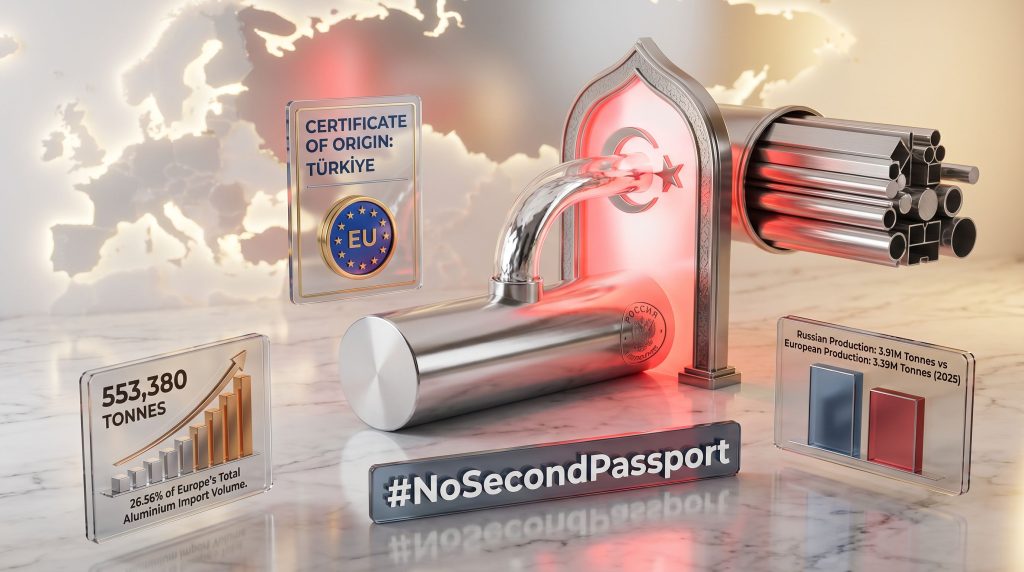
- In 2025, Türkiye exported approximately 553,380 tonnes of aluminium bars, rods, profiles, foil, pipes, tubes, plates, sheets, strips, and wire into European markets
- This volume represented a 26.56% share of Europe's total aluminium import volume of approximately 2.08 million tonnes
When a country sources roughly one-fifth of its primary aluminium from Russia while simultaneously supplying more than half of Europe's extruded aluminium imports, the potential for indirect Russian metal exposure across European supply chains is both structurally embedded and commercially substantial.
The price dynamics compound the problem. Turkish extrusions have entered European markets at prices below EU averages across several product categories, making Russian-origin feedstock commercially rational for Turkish processors competing for European contracts. The sanctions regime, as currently constructed, does nothing to interrupt this pricing logic.
Russia vs. Europe: The Production Deficit That Constrains European Options
One reason the indirect processing route remains commercially attractive is that Europe cannot simply substitute domestic production for the volumes involved. Russian primary aluminium output has consistently exceeded European production over recent years by a margin that matters.
| Year | Russian Production | European Production | Russian Surplus |
|---|---|---|---|
| 2023 | 3.82 million tonnes | 3.17 million tonnes | ~20.5% higher |
| 2024 | 3.98 million tonnes | 3.20 million tonnes | ~19.6% higher |
| 2025 | 3.91 million tonnes | 3.39 million tonnes | ~13.3% higher |
Europe's 2025 production improved by approximately 5.9% year-on-year, while Russian output contracted modestly by around 1.76%. This convergence trend is encouraging, but it masks a persistent structural reality: over the three-year period, Russia has maintained a production advantage of at least 10% over Europe.
Closing that gap through organic European capacity growth would require sustained capital investment over multiple years. The aluminium supply leaders operating at scale outside Russia and Europe will likely play a pivotal role in bridging this deficit.
The production gap is not merely a volume problem. It is a competitive pricing problem. Russian smelters, particularly those operating in Siberia with access to low-cost hydropower, produce aluminium at energy costs that European smelters facing high electricity prices and carbon compliance obligations cannot easily match.
The Carbon Compliance Paradox: Why Closing the Gap Has Hidden Costs
European aluminium producers operate under two overlapping carbon cost frameworks: the EU Emissions Trading System (ETS) and the Carbon Border Adjustment Mechanism (CBAM). Both impose costs that affect the relative competitiveness of European-origin aluminium compared to imports. In addition, European industrial demand trends suggest that downstream manufacturers will face increasing pressure from both sides of the cost equation.
What makes Russian aluminium particularly complicated to replace is its carbon profile. Siberian smelters, powered predominantly by hydroelectric generation, produce primary aluminium with a relatively low carbon intensity. For European buyers managing CBAM obligations, this low-carbon footprint has genuine commercial value — not just as an ethical preference but as a measurable cost reduction in carbon compliance accounting.
The policy paradox this creates is significant:
- Tightening sanctions on Russian aluminium forces European buyers toward alternative supply sources
- Many alternative sources carry higher carbon intensity than Russian hydropower-based production
- Higher-carbon imports increase the effective CBAM cost burden for European downstream manufacturers
- This cost pressure falls hardest on sectors like construction and automotive that depend heavily on extruded aluminium products
Cutting off low-carbon Russian aluminium supply without simultaneously securing equivalent low-carbon alternatives risks creating a situation where sanctions designed to weaken Russia inadvertently weaken European industrial competitiveness and push up embodied carbon in European manufacturing supply chains.
Furthermore, the broader low-carbon metals transition underway in European industry will only intensify this tension between sanctions policy and decarbonisation objectives.
The next major ASX story will hit our subscribers first
Middle East Instability and the Secondary Risk Amplifier
The Gulf region accounts for approximately 9% of global primary aluminium production, with major capacity concentrated in countries including the UAE, Bahrain, and Saudi Arabia. For Türkiye specifically, Gulf nations supplied approximately 42% of its aluminium ingot imports in 2025, making the Middle East a primary non-Russian supply option for Turkish processors.
If geopolitical instability in the region disrupts Gulf aluminium exports, the commercial logic for increasing Russian procurement intensifies. Türkiye would face higher input costs or supply shortfalls from its Gulf suppliers with no immediately scalable alternative other than Russian metal. Under those conditions, the indirect exposure risk for European supply chains deepens considerably.
This scenario also affects European producers directly. The Gulf represents one of the few regions capable of supplying low-carbon primary aluminium at scale as an alternative to Russian material. If that supply becomes constrained or unreliable, Europe's options for maintaining both supply volumes and carbon compliance targets narrow significantly.
The Revenue Picture: What Current Enforcement Is Failing to Address
The financial scale of the gap between sanctions intent and operational effect becomes clearer when looking at the revenue numbers. Industry analysis indicates that approximately USD 10 billion reached Russia from primary aluminium exports in the year prior to June 2026. With around 90% of Russian aluminium now directed toward non-EU markets, Russian producers have adapted their trade flows without experiencing a proportionate revenue decline.
The EUR 800 million-plus in Russian export revenues generated specifically through Turkish aluminium trade in 2025 represents a concrete illustration of what the indirect processing channel is worth in commercial terms. This is not theoretical leakage. It is a quantifiable revenue stream flowing to Russian aluminium producers through a route the current sanctions framework does not reach.
Corporate Procurement: Where Policy Intent Meets Commercial Reality
Beyond the indirect processing channel, documented procurement activity from European companies highlights the gap between the political intent of sanctions and actual purchasing behaviour. Known transactions since the conflict began include:
| Company | Country | Metal | Estimated Value |
|---|---|---|---|
| GGP Metal Powder | Germany | Copper | ~USD 66 million |
| Safran | France | Titanium | ~USD 25 million |
| Elval Halcor | Greece | Aluminium | ~USD 13 million |
These figures underscore that binding enforcement mechanisms, rather than voluntary compliance frameworks, are what close gaps in practice.
What Effective Enforcement Would Actually Require
The European aluminium industry body has advanced a multi-layered enforcement framework under its #NoSecondPassport campaign, built around the principle that Russian primary aluminium should not be permitted to acquire a new national identity through processing in an intermediate country. Consequently, addressing Russian aluminium reaching the EU despite sanctions requires both stronger traceability rules and coordinated policy responses across member states.
The core recommended policy actions include:
- Enforceable indirect ban: Prohibit EU imports of any products manufactured from Russian primary aluminium in third countries, regardless of the declared country of last processing
- Mandatory three-point origin disclosure: Require exporters to declare both the first and second countries of smelting as well as the last country of casting, creating an auditable upstream chain
- Enhanced customs inspections: Implement targeted screening protocols for aluminium imports from jurisdictions identified as high-risk transit points
- Systemic volume monitoring: Establish surveillance mechanisms for countries purchasing Russian aluminium volumes disproportionate to their domestic consumption needs
- Product-level due diligence: Apply heightened requirements specifically to billets, extrusions, and semi-finished products — the categories most commonly used in third-country processing schemes
The three-point origin disclosure proposal is technically significant. Current customs documentation typically captures the last country of processing. Requiring disclosure of the smelting chain would create a paper trail that connects finished goods back to the original production source, making it substantially harder to obscure Russian-origin metal through downstream fabrication.
However, enforcement alone is insufficient. The green transition raw materials agenda will also need to account for how aluminium supply security intersects with Europe's broader decarbonisation commitments.
Geopolitical Scenarios and Their Supply Chain Consequences
Three distinct risk pathways could shape how this situation evolves over the near term.
Scenario 1: Middle East Supply Disruption
Escalating instability reduces Gulf aluminium exports to Türkiye. Turkish processors increase Russian procurement to compensate. Turkish-origin extrusion exports to the EU rise, carrying higher embedded Russian metal content. European indirect exposure deepens while formal sanctions remain unchanged.
Scenario 2: Sanctions Tighten Before Alternatives Are Secured
The EU moves to enforce an indirect ban without first establishing reliable alternative low-carbon supply agreements. European downstream manufacturers face elevated input costs and potential supply shortfalls. CBAM-exposed producers lose access to competitively priced low-carbon feedstock and face rising carbon compliance costs simultaneously.
Scenario 3: Effective Enforcement With Coordinated Supply Transition
Mandatory origin traceability requirements are implemented. Third-country processors face commercial disincentives for routing Russian metal toward EU-bound products. Russian indirect revenues from European markets decline materially. European producers and policymakers use the transition period to secure supply agreements with allied-nation producers offering credible low-carbon alternatives.
The difference between Scenario 2 and Scenario 3 is not the enforcement ambition. It is whether the supply side transition is coordinated with the demand side restriction. Industry observers monitoring the challenges of Russian aluminium sanctions have consistently noted this coordination gap as the central policy challenge.
Frequently Asked Questions: Russian Aluminium and EU Sanctions
Is Russian aluminium currently banned from entering the EU?
Direct imports of Russian primary aluminium are subject to a phased prohibition under the EU's 16th sanctions package. Transitional quotas allowed up to 275,000 tonnes until February 2026, with an additional 50,000-tonne allowance for pre-existing contracts through end of 2026. A complete ban on direct imports is expected by early 2027. The indirect processing channel through third countries remains outside the scope of current measures.
Why is Türkiye the most commercially significant link in the indirect import chain?
Türkiye simultaneously sources roughly 20% of its primary aluminium from Russia and supplies approximately 55% of EU extruded aluminium imports. No other country combines those two positions at the same scale, making it the most commercially embedded connection between Russian production and European consumption.
What does the #NoSecondPassport campaign propose?
It advocates for EU policy reforms that would prevent Russian aluminium from effectively changing its declared origin through third-country processing. Central proposals include an enforceable indirect import ban and mandatory multi-point origin traceability requirements covering the full smelting chain.
Why does cutting Russian aluminium carry carbon compliance risks for European industry?
Siberian smelters powered by hydroelectricity produce aluminium with relatively low carbon intensity. Replacing that supply with higher-carbon alternatives increases the CBAM cost burden for European downstream manufacturers, creating a tension between sanctions policy and industrial decarbonisation objectives.
This article is intended for informational purposes only and does not constitute financial, legal, or investment advice. Statistics, trade volumes, and policy timelines referenced are drawn from publicly available industry reporting as of mid-2026. Readers should conduct independent research before making decisions based on the information presented here.
Want to Stay Ahead of the Next Major Mineral Discovery on the ASX?
Discovery Alert's proprietary Discovery IQ model delivers real-time alerts on significant ASX mineral discoveries, instantly translating complex commodity data across more than 30 resources into clear, actionable insights for both traders and long-term investors — start your 14-day free trial today and gain a market-leading edge, or explore Discovery Alert's discoveries page to understand why major mineral finds have historically generated substantial returns.