June 30, 2026
The Structural Fragility Behind Wartime Fuel Systems
Energy systems built on razor-thin margins between production and consumption carry an inherent and often invisible vulnerability. Under normal peacetime conditions, a refinery producing just enough to meet daily domestic demand functions adequately. However, when that system faces sustained external disruption, the absence of any meaningful buffer transforms a manageable operational stress into a full-scale supply crisis almost overnight. This is precisely the dynamic now unfolding inside Russia, where the intersection of wartime infrastructure damage, chronic underinvestment in strategic fuel reserves, and a sanctions-constrained maintenance environment has produced a Russia fuel crisis and gasoline shortages of a scale and persistence that the Kremlin can no longer quietly absorb.
Understanding why this crisis has proven so difficult to contain requires looking beyond the headlines and examining the structural mechanics of Russia's domestic fuel market, the strategic logic of Ukraine's refinery targeting campaign, and the cascading economic pressures now radiating outward into agriculture, industrial logistics, and civilian daily life.
When big ASX news breaks, our subscribers know first
Why Russia's Gasoline System Had No Room for Error
Russia's domestic refining sector was not engineered with resilience in mind. For decades, the country's crude oil producers prioritised export volumes over domestic refining throughput, exporting raw crude rather than processed fuel products wherever margins permitted. This created a system in which gasoline production historically tracked domestic demand with minimal surplus, leaving virtually no buffer capacity to absorb unplanned outages.
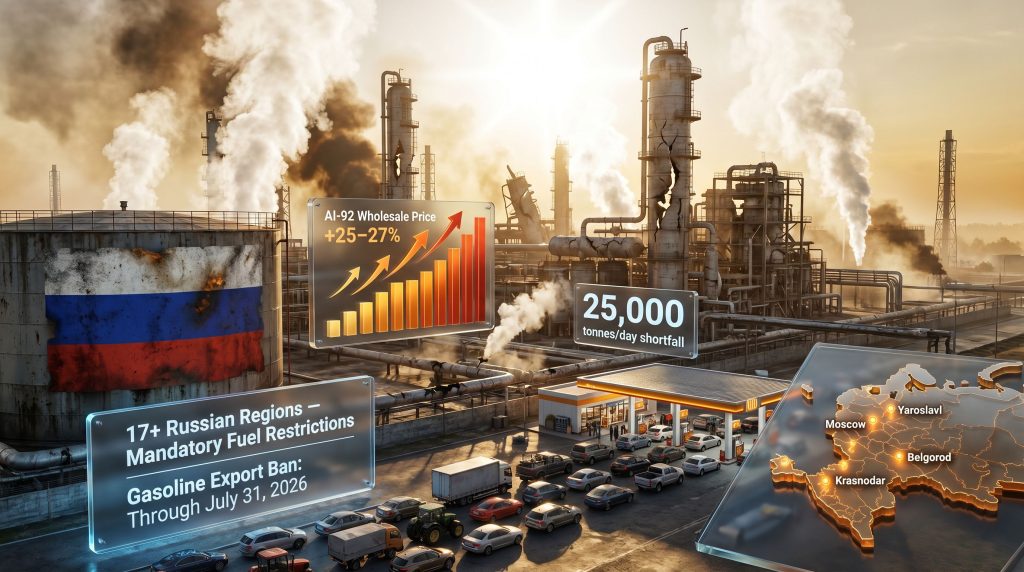
The numbers make this structural fragility stark. Daily domestic gasoline consumption in Russia runs at approximately 110,000 tonnes, while current refinery output has fallen to roughly 85,000 tonnes per day, producing a structural gap of approximately 25,000 tonnes daily. On peak disruption days, Ukraine's drone campaign has reduced Russian refining capacity by nearly one-fifth, compounding that baseline shortfall significantly.
Critically, this vulnerability does not extend uniformly across all fuel categories. Russia maintains a historical export surplus in diesel, which means diesel supply, while under pressure, retains a comparative degree of resilience. Gasoline is the exposed flank. Unlike diesel, there is no meaningful strategic reserve cushion for gasoline capable of absorbing sustained production losses across multiple facilities simultaneously. Independent fuel retailers, who collectively account for approximately 40% of total Russian fuel sales, have found themselves unable to reliably restock AI-92 and AI-95 grade gasoline, the two grades most widely consumed by civilian and agricultural users.
The AI-92 and AI-95 Problem
For readers unfamiliar with Russian fuel grade designations, AI-92 and AI-95 refer to the octane ratings of the gasoline blends used most commonly across Russia's civilian vehicle fleet. AI-92 is the standard grade used by the majority of passenger cars and light commercial vehicles, while AI-95 is the premium grade preferred by newer and higher-performance engines. Both grades are produced through the same refinery cracking and reforming processes, meaning any refinery shutdown directly reduces availability of both simultaneously.
This is a subtler point than it might appear. Because Russia cannot selectively redirect refinery damage toward less critical fuel grades, each strike against a processing facility removes capacity across the entire light fuel product slate. The knock-on effect consequently reaches petrol stations, agricultural machinery operators, and industrial logistics chains simultaneously.
Ukraine's Refinery Strike Campaign: Operational Depth and Strategic Intent
The geographic scope of confirmed refinery strikes has drawn significant attention from analysts tracking the conflict's economic dimensions. Ukrainian forces have demonstrated the ability to reach targets well beyond the immediate front line, with confirmed strikes against the Slavyansk oil refinery in the Krasnodar region, located approximately 300 kilometres from the active front, and a refinery in the Yaroslavl region, approximately 700 kilometres from the Ukrainian border. According to reporting by Radio Free Europe/Radio Liberty, the Krasnodar strike killed one person and triggered fires that forced operational shutdowns.
Ukrainian President Volodymyr Zelenskyy has framed these strikes explicitly as operations designed to degrade Russia's capacity to sustain its military offensive. On June 25, 2026, Zelenskyy confirmed the authorisation of a 40-day security service operation intended to apply sustained economic and military pressure. The strategic logic is multilayered: disrupting fuel supply chains simultaneously strains military logistics, creates visible civilian hardship, and strains agricultural productivity during the critical summer harvest window.
Strategic insight: Targeting refinery infrastructure represents a deliberate shift from battlefield attrition toward systemic economic warfare. Historical precedents, including Allied bombing campaigns against Axis fuel infrastructure in World War II, suggest that sustained refinery targeting can produce compounding logistical effects over 6 to 18 month timeframes when strikes are maintained with sufficient frequency and accuracy.
The dual vulnerability created by physical strike damage combined with sanctions-constrained maintenance timelines makes reconstruction substantially more difficult than either factor would be in isolation. Damaged refineries in Russia face extended repair timelines partly because Western sanctions have sharply curtailed access to advanced processing technology, spare parts, and maintenance equipment. One major Moscow-area refinery is projected to remain offline until as late as 2027 due to the severity of strike-related damage, according to reporting by OilPrice.com. This is a structural supply constraint, not a cyclical one, and it cannot be resolved through short-term reserve drawdowns.
Geographic Spread: Which Regions Are Affected?
The Russia fuel crisis and gasoline shortages have spread far beyond the regions closest to the conflict zone. At least 17 Russian regions have implemented mandatory fuel restrictions, with dozens of additional regions reporting voluntary rationing imposed by private fuel companies.
| Region | Reported Shortage Type | Restriction Status |
|---|---|---|
| Crimea | AI-92 and AI-95 scarcity | 20-litre cap; voucher system introduced |
| Moscow | General gasoline shortfall | 20-150 litre cap per driver |
| Krasnodar | Refinery strike damage | Fire-related shutdown confirmed |
| Yaroslavl | Refinery strike damage | Operational reduction confirmed |
| Belgorod | AI-92 container restrictions | Portable container fill ban |
| Siberia | Distribution chain breakdown | Spot shortages reported |
| Kursk | Proximity to conflict zone | Compounded supply disruption |
| St. Petersburg | Northern supply chain strain | Private company rationing |
| Far East | Logistics-driven shortfall | Regional supply delays |
| Ryazan | Refinery-adjacent supply gap | Independent station restocking failures |
In Crimea, initial purchase caps of 20 litres per transaction were accompanied by a voucher-based allocation system introduced to manage queue pressure. In Moscow and northern Russia, major fuel retail chains including Lukoil, Gazprom, ORTK, and General Fueller independently implemented per-driver purchase caps ranging from 20 to 150 litres per visit. Video footage and social media documentation captured extended queues and confrontations at fuel stations, providing visible civilian evidence of a shortage that official communications had sought to minimise.
Economic Consequences: Wholesale Prices and Agricultural Risk
The price signal within Russia's wholesale fuel market has been unambiguous. Wholesale prices for AI-92 gasoline rose between 25% and 27% between mid-February and late May 2026, a sharp acceleration that precedes further retail price inflation once pre-strike buffer stockpiles are fully exhausted. Retail price pressures are expected to intensify through the second half of 2026 as those inventory cushions are drawn down.
The agricultural sector faces particularly acute exposure. Russia's farming operations depend heavily on both diesel and gasoline during the June through August harvest window, when fuel demand peaks precisely at the moment supply is most constrained. Russian authorities have publicly prioritised fuel allocation for agro-industrial enterprises in an attempt to protect harvest operations, but the structural production shortfall means prioritisation involves redistribution of scarcity rather than resolution of it.
Warning: The convergence of wartime infrastructure damage, an active gasoline export ban, and peak seasonal agricultural demand creates a triple-pressure scenario that historical analogues suggest is extremely difficult to stabilise quickly without either a cessation of hostilities or a substantial rebuild of refinery capacity.
Industrial logistics, construction, and manufacturing sectors face secondary disruptions as independent fuel retailers fail to maintain consistent supply chains, adding cost and delay pressures to an already sanctions-stressed economy. Furthermore, these pressures interact directly with broader oil market trade impacts that have been reshaping global energy dynamics throughout 2025 and into 2026.
How Moscow Is Responding: Policy Levers Under Pressure
The Russian government has deployed a range of policy tools in an attempt to contain the crisis, though each carries its own economic trade-off.
Measures currently active:
- A complete gasoline export ban extended through July 31, 2026, redirecting all domestic production toward internal consumption
- Emergency fuel rationing across more than 17 regions
- Strategic reserve drawdowns to supplement production shortfalls
- A dedicated fuel supply task force operating continuously
Measures under active consideration:
- A complete ban on diesel exports, a significant policy escalation given Russia's historical position as a major diesel exporter and the foreign currency revenue implications
- Mandatory domestic refining quotas requiring oil companies to process a higher proportion of their crude within Russian territory
Rosneft, Russia's state-controlled energy giant, has proposed requiring oil companies to refine a minimum of 30% of their crude production domestically, rather than exporting it in unprocessed form. According to OilPrice.com reporting, this proposal is designed to structurally increase domestic fuel availability. If enacted, it would represent a fundamental restructuring of Russia's oil sector economics, reducing export revenues while attempting to shore up domestic supply. The proposal signals that Moscow recognises the current crisis as a structural problem requiring structural remedies, not merely a temporary imbalance addressable through reserve management.
The next major ASX story will hit our subscribers first
The Sanctions Multiplier Effect on Repair Timelines
One dimension of the Russia fuel crisis and gasoline shortages that receives insufficient attention in mainstream coverage is the compounding interaction between physical strike damage and the sanctions-driven maintenance constraint. Russia's refinery infrastructure was substantially built and maintained using Western technology, equipment, and engineering expertise. The effect of sanctions on Russian oil infrastructure has been particularly pronounced in this context, severely restricting access to replacement components, advanced catalyst materials, and specialist maintenance contractors since the imposition of comprehensive Western sanctions following the February 2022 invasion of Ukraine.
This creates a dual vulnerability that is qualitatively different from either factor in isolation. A refinery damaged in a strike in a pre-sanctions environment could be rebuilt within a predictable and compressed timeframe using international supply chains. In the current environment, the same damage triggers repair timelines measured in years rather than months. The Moscow-area refinery projected to remain offline until 2027 exemplifies this dynamic. Even if Ukrainian strike activity were to pause entirely, the structural supply deficit would persist well into the medium term.
Geopolitical Context: Negotiations, Iran, and the War's Trajectory
The broader geopolitical oil price analysis for 2025 and 2026 provides important context for understanding how Russia's domestic fuel pressures interact with global energy markets. The Russia fuel crisis and gasoline shortages are ultimately inseparable from the broader trajectory of the conflict itself. According to RFE/RL reporting, Putin indicated readiness to continue diplomatic negotiations and suggested that a US negotiating team may travel to Moscow once Washington concludes its engagement with Iran over the concurrent Middle East conflict.
This linkage between separate geopolitical theatres reflects the interconnected nature of 2026's multi-front strategic environment. In addition, developments such as the Venezuela oil policy shift and the broader global oil price shock of 2025 have added further complexity to how global producers and consumers are navigating the current supply environment.
Any meaningful ceasefire or operational pause would be a prerequisite for beginning credible refinery reconstruction. Without such a pause, each month of continued operations brings additional strike risk against facilities already operating under constrained maintenance conditions. The fuel crisis duration is therefore not primarily a technical or economic question, but a function of when, and whether, the conflict moves toward de-escalation.
Scenario Pathways: Where the Crisis Goes From Here
| Scenario | Probability Assessment | Key Indicators |
|---|---|---|
| Continued escalation, deepening shortages | High | Strikes continue through Q3 2026; diesel export ban enacted; harvest disruption materialises |
| Partial stabilisation through reserve drawdown | Moderate | July production targets partially met; retail price inflation contained below 15%; structural vulnerability persists |
| Diplomatic pause enables reconstruction | Low near-term | Ceasefire reduces strike frequency; repair timelines compress; normalisation possible by mid-2027 |
Each scenario carries distinct implications for Russia's domestic economic stability, its capacity to sustain military operations, and the timeline for any return to normal fuel availability for Russian citizens and industries.
Key Data Points at a Glance
| Metric | Data Point |
|---|---|
| Daily consumption vs. production gap | ~25,000 tonnes/day shortfall |
| Wholesale AI-92 price increase (Feb-May 2026) | 25-27% |
| Regions with mandatory fuel restrictions | 17+ |
| Independent retailer market share affected | ~40% of fuel sales |
| Gasoline export ban duration | Through July 31, 2026 |
| Moscow refinery projected offline period | Until 2027 |
| Crimea per-person purchase cap | 20 litres |
| Furthest confirmed refinery strike distance | ~700 km from Ukrainian border |
Frequently Asked Questions
What is causing Russia's gasoline shortage in 2026?
The shortage results from a combination of Ukrainian drone strikes disabling key refinery capacity, a structural daily production deficit of approximately 25,000 tonnes relative to domestic consumption, and the absence of meaningful strategic gasoline reserves to absorb disruptions.
Which fuel grades are most affected?
AI-92 and AI-95 gasoline grades are experiencing the most acute shortages. These are the octane-rated civilian and agricultural fuel grades produced through the same refinery processes. Diesel supply remains comparatively stable due to Russia's historical export surplus in that category.
What is Rosneft's proposed solution?
Rosneft has proposed mandating that oil companies refine a minimum of 30% of their crude production domestically rather than exporting it in raw form, structurally increasing domestic fuel availability at the cost of reduced export revenue.
How long could the crisis last?
At least one major Moscow-area refinery is projected to remain offline until 2027. Given the combination of ongoing strike risk, sanctions-constrained repair timelines, and structural production gaps, the crisis is expected to persist through at least the remainder of 2026, and potentially well beyond, absent a major shift in the conflict's trajectory.
Disclaimer: This article contains forward-looking analysis, scenario projections, and assessments of economic and geopolitical developments. These represent analytical perspectives based on available information as of the time of writing and should not be construed as investment advice. Readers are encouraged to consult primary sources and independent expert analysis before drawing conclusions for any investment or strategic purpose.
Want to Track the ASX Stocks Positioned Around Global Energy Disruptions?
Discovery Alert's proprietary Discovery IQ model delivers real-time alerts on significant ASX mineral discoveries the moment they are announced, turning complex market signals into actionable investment insights — explore historic discoveries and their returns to understand the scale of opportunity, then begin your 14-day free trial at Discovery Alert to position yourself ahead of the broader market.