June 29, 2026
The Economics of Extraction: Why Profitable Margins Keep Illegal Bauxite Mining Alive in Pahang
Understanding why illegal bauxite mining in Pahang persists requires stepping back from the headlines and examining the fundamental economics at play. When the gap between extraction costs and prevailing international commodity prices is wide enough to generate substantial profit even after bribes, logistics, and operational risk are factored in, enforcement raids become a recurring cost of doing business rather than an existential deterrent. This is the structural reality that has defined Pahang's bauxite problem since the moratorium was first imposed in January 2016, and it remains the defining challenge a decade later.
Bauxite is not a glamorous commodity. It does not attract the same investor attention as lithium, cobalt, or rare earth elements. Yet it is the irreplaceable feedstock for aluminium production, and aluminium sits at the centre of nearly every major industrial transition currently underway, from electric vehicle lightweighting to utility-scale solar panel framing and aerospace component manufacturing. That demand trajectory creates persistent international appetite, and Pahang's deposits, sitting close to established port infrastructure at Kuantan, remain commercially attractive in ways that explain why illegal operators keep returning.
When big ASX news breaks, our subscribers know first
Why Pahang's Bauxite Deposits Remain a Target a Decade After the Moratorium
The Geology Behind the Commercial Appeal
Pahang's bauxite deposits are primarily lateritic in origin, formed through the prolonged tropical weathering of aluminium-rich parent rocks. This weathering process produces gibbsite-dominant bauxite, which is among the most readily processable forms for alumina refining. Unlike karst or diasporic bauxite deposits found in parts of Europe and the Middle East, which require high-temperature, high-pressure refining conditions, gibbsitic bauxite dissolves efficiently under standard Bayer process conditions.
This geological characteristic matters commercially. Lower refining energy requirements translate directly into lower operating costs for alumina producers, making gibbsitic feedstock from Southeast Asia particularly attractive to Chinese refineries optimising for margin. The deposits in the Bukit Goh and Bukit Kuantan corridors are considered high-grade relative to regional alternatives, with alumina content levels that support competitive extraction economics.
The Price Margin That Sustains Criminal Enterprise
At its operational peak between 2014 and early 2016, Malaysia briefly ranked among the world's largest exporters, with bauxite production by country rankings shifting dramatically as Kuantan port handled export volumes that temporarily made it one of the busiest bauxite shipping terminals in Asia. The speed of that boom, driven largely by surging Chinese industrial demand and near-absent regulatory enforcement, demonstrated how quickly informal supply chains can scale when price incentives align.
The moratorium disrupted those flows but did not eliminate underlying market incentives. International bauxite spot prices have remained sufficiently elevated relative to Pahang's low extraction costs to sustain viable margins for illegal operators. When supply disruptions in major producing nations such as Guinea or Australia create periodic price spikes, those margins widen further, triggering intensified extraction activity in unmonitored corridors.
The economic margin between illegal extraction costs and international bauxite prices remains wide enough to sustain criminal enterprise even under active enforcement pressure, a structural challenge that cannot be resolved through raid-based responses alone.
The June 2026 Felda Bukit Goh Operation: What the Evidence Reveals
A Multi-Agency Response to a Commercial-Scale Operation
A coordinated enforcement action conducted at an oil palm plantation in the Felda Bukit Goh area of Kuantan resulted in nine arrests in late June 2026. The arrested individuals comprised four Malaysian nationals and five foreign workers who were unable to present valid identification documents or work permits at the time of the inspection.
The operation was executed as a joint effort involving the intelligence branch of the General Operations Force (GOF) 7th Battalion based in Kuantan, the Pahang State Enforcement Unit, and the Criminal Investigation Division of the Kuantan District Police. The multi-agency structure reflects an evolved enforcement approach, with earlier single-agency operations having demonstrated significant vulnerabilities to advance warning and evasion by operators with insider contacts. Furthermore, illegal bauxite mining operations of this nature have historically proven difficult to contain even under moratorium conditions.
Scale of the Seizure: What RM 3.75 Million in Confiscated Assets Represents
The assets seized during the operation point to a well-resourced, commercially organised enterprise rather than opportunistic small-scale extraction.
| Seized Item | Quantity | Operational Significance |
|---|---|---|
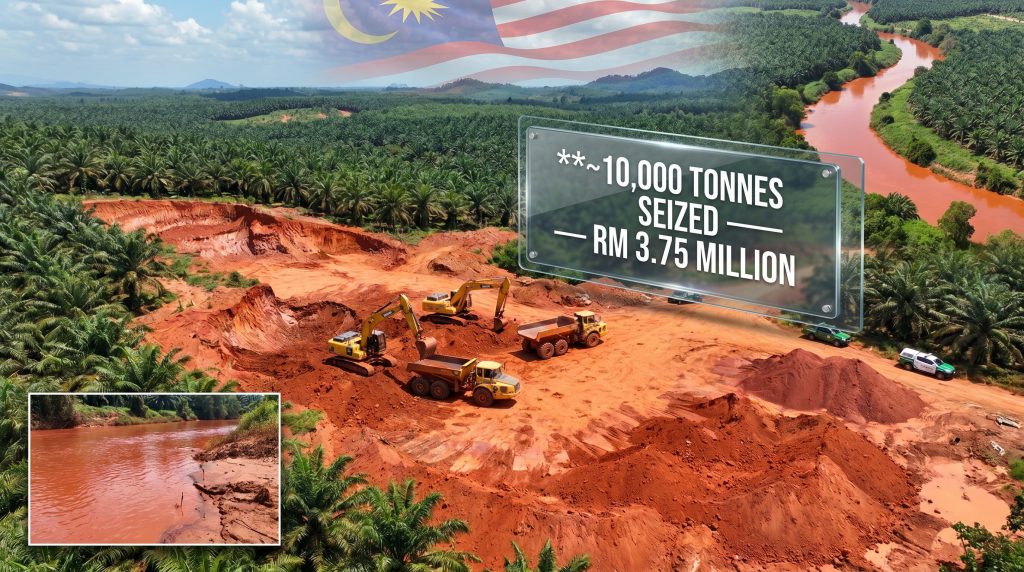
| Bauxite-bearing soil stockpiles | ~10,000 tonnes | Primary mineral asset; submitted for geoscience compositional analysis |
| Dumper trucks | 3 | Heavy haulage capacity consistent with commercial-volume transport |
| Excavators | 2 | Mechanised extraction indicating planned, systematic operation |
| Operational documents | 6 items | Potential evidence of supply chain links, buyer networks, and financial flows |
| Total estimated asset value | ~RM 3.75 million (approx. USD 923,000) | Among the larger single-site seizures in recent Pahang enforcement history |
Soil samples collected from the stockpiles were referred to the Department of Minerals and Geoscience for compositional analysis to formally confirm bauxite content and grade. All work activity at the plantation was ordered to cease immediately pending the outcome of ongoing investigations.
The Agricultural Lease as Operational Cover: A Sophisticated Evasion Mechanism
Perhaps the most strategically significant detail to emerge from early investigations is how the operation was concealed. The land in question belongs to a Felda settler and was leased to a registered company in March 2026. The stated purpose of the lease was land clearing and replanting activities, which are entirely routine within the Felda agricultural settlement framework.
Investigators believe this legitimate-sounding arrangement was specifically constructed to provide legal cover for accessing the site and commencing mineral extraction. Once operational, extracted material was reportedly transported to a processing facility in Gebeng, Kuantan, before being sold to buyers. The existence of a multi-stage supply chain, from plantation extraction to industrial processing to commercial sale, indicates this was not an improvised operation.
Warning: The deliberate use of legitimate agricultural lease agreements to mask mineral extraction activity represents a significant evolution in evasion sophistication. Standard land-use monitoring frameworks are not designed to detect excavation activity disguised within normal agricultural clearance operations. This creates a detection gap that enforcement agencies must now address systematically.
The 2015 to 2016 Environmental Catastrophe: Context the Numbers Cannot Fully Capture
How an Unregulated Boom Became a National Governance Crisis
The current enforcement environment cannot be understood without examining how severely the 2015 to 2016 bauxite surge damaged both the physical landscape and Malaysia's regulatory credibility. During that period, extraction volumes escalated at a pace that overwhelmed every layer of state oversight. The absence of meaningful environmental controls meant that mine sites operated without dust suppression, without tailings management, and without erosion control measures.
The Kuantan River system turned visibly red from bauxite-laden runoff, an image that circulated internationally and became emblematic of resource governance failure in the region. The visual impact was striking enough to attract significant international media coverage, creating reputational consequences that extended well beyond Malaysia's borders.
The Lasting Environmental and Social Damage
| Impact Category | Documented Consequence |
|---|---|
| Water contamination | Kuantan river system severely discoloured; elevated heavy metal concentrations detected in water samples |
| Agricultural disruption | Residual soil toxicity continuing to impede replanting by Felda settler communities |
| Respiratory health impacts | Chronic red dust exposure linked to respiratory distress across affected residential zones |
| Regulatory response | 34 contractor licences revoked; full suspension of all extraction activities |
| Rehabilitation status | No comprehensive, approved land rehabilitation programme implemented as of mid-2026 |
A proposed large-scale rehabilitation and mining project covering the Bukit Goh and Bukit Kuantan areas was rejected after failing its Environmental Impact Assessment. This outcome, while environmentally defensible, created a practical paradox: affected land is too contaminated for productive agricultural use, yet no approved remediation pathway exists to restore it. Felda settlers whose livelihoods depend on palm oil cultivation continue to bear the long-term economic consequences of this unresolved situation.
The Corruption Dimension: Enforcement Failures From the Inside Out
Institutional Complicity and Its Effect on Deterrence
Perhaps the least discussed but most structurally damaging aspect of Pahang's illegal bauxite mining problem is the documented involvement of enforcement personnel in facilitating illegal operations. Past investigations by the Malaysian Anti-Corruption Commission identified senior officials from the Customs Department, the Land and Mines Office, and other regulatory bodies as participants in networks that allowed illegal extraction to continue.
This institutional dimension fundamentally alters the risk calculus for illegal operators. When there is reasonable expectation that enforcement action can be anticipated through insider channels, the deterrent value of any single raid diminishes significantly. It also explains why the same geographic corridors continue to see repeat illegal activity despite multiple previous enforcement operations.
The presence of undocumented foreign workers at the June 2026 site introduces an additional layer of concern. Labour trafficking and the employment of undocumented migrants are separate criminal dimensions that may be structurally embedded within the same networks operating the mineral extraction itself, creating overlapping enforcement challenges across multiple legal jurisdictions.
Structural Weaknesses That Compound the Problem
-
Land tenure complexity: The Felda settler model creates jurisdictional ambiguity between federal agricultural institutions and state mineral rights authorities, creating enforcement gaps that operators exploit deliberately.
-
Supply chain opacity: The movement of extracted material through intermediate processing facilities in Gebeng before export effectively launders the mineral origin, making provenance tracing extremely difficult.
-
Cross-agency coordination deficits: The fragmentation of enforcement responsibility across multiple agencies has historically created blind spots that well-informed operators can navigate.
-
Foreign labour dependency: Undocumented workers reduce operational costs and create a layer of organisational deniability between ground-level activity and those directing operations.
-
Absence of rehabilitation incentives: Without a viable pathway to legal land use, affected land parcels remain in a regulatory grey zone that enables continued exploitation.
Pahang Bauxite in the Global Supply Chain: Why External Demand Cannot Be Ignored
The International Market Forces Driving Continued Extraction
Any honest analysis of illegal bauxite mining in Pahang must account for the demand-side pressures that originate far beyond Malaysian borders. The commodity price impacts on extraction economics are particularly significant, as China's aluminium refining sector represents the world's largest single source of bauxite import demand, and its appetite for cost-competitive feedstock remains structurally elevated.
| Demand Driver | Relevance to Pahang Extraction Economics |
|---|---|
| Chinese aluminium refinery capacity growth | Sustains persistent import demand for low-cost bauxite feedstock |
| Electric vehicle and lightweight materials expansion | Increases downstream aluminium demand, supporting bauxite price floors |
| Periodic supply disruptions in Guinea and Australia | Creates price spikes that temporarily widen illegal extraction margins |
| Processing infrastructure in Gebeng, Kuantan | Enables rapid conversion of raw ore into commercially tradeable product |
Global aluminium demand growth is projected to accelerate through the late 2020s, driven by the intersection of electrification, renewable energy infrastructure buildout, and continued aerospace sector expansion. This macro-demand environment creates a persistent commercial logic for bauxite extraction in Pahang that operates independently of Malaysian domestic policy settings.
A lesser-known dynamic in bauxite trade is the role of intermediate trading entities that operate between extraction sites and end refiners. These intermediaries typically absorb provenance risk, repackaging mineral shipments in ways that obscure origin documentation. The processing stage at Gebeng, identified in the June 2026 investigation, represents precisely this kind of supply chain obfuscation point. Furthermore, major aluminium mining companies operating through legitimate channels face increasing competitive pressure from material sourced through these opaque networks.
The next major ASX story will hit our subscribers first
Long-Term Consequences If the Cycle Remains Unbroken
Environmental Tipping Points and Irreversible Degradation
Continued mechanised extraction in areas already stressed by a decade of inadequate rehabilitation pushes degraded ecosystems progressively closer to thresholds beyond which natural recovery becomes extremely slow or practically impossible. Soil compaction from heavy excavation equipment compounds existing toxicity damage, extending rehabilitation timelines even if a formal remediation programme were to begin today.
Groundwater contamination pathways, once established through repeated surface disturbance, can persist for decades, creating long-term risks for municipal water security across the Kuantan corridor. The health and livelihood costs of this kind of slow environmental attrition fall disproportionately on Felda settler communities who have the least capacity to absorb them.
Malaysia's Critical Minerals Credibility at Stake
Malaysia's broader aspiration to participate in globally diversified critical mineral supply chains, as international buyers seek to reduce dependence on geopolitically concentrated sources, is directly undermined by the persistence of illegal extraction in Pahang. International aluminium buyers and downstream manufacturers face increasing ESG due diligence obligations that require demonstrable provenance verification throughout their supply chains.
Bauxite sourced through channels that cannot demonstrate compliance with environmental and labour standards is becoming commercially unviable in formal trade relationships with major industrial buyers in Europe, North America, and Japan. This commercial pressure, if properly channelled through export documentation requirements, represents one of the more powerful levers available to Malaysian authorities. In addition, the broader challenge of mining sustainability transformation across Southeast Asia makes Malaysia's ability to demonstrate credible governance increasingly important for its long-term standing in global mineral trade.
A Reform Architecture That Could Break the Cycle
Enforcement intensity alone has not resolved the problem over a decade of moratorium. A more durable solution requires simultaneous action across multiple dimensions:
-
Land lease audit protocols: Mandatory geospatial monitoring of all new lease agreements in bauxite-bearing zones, with automatic detection triggers for excavation activity inconsistent with declared agricultural purposes.
-
Supply chain traceability requirements: Processing facilities operating in Gebeng and similar industrial zones should be required to maintain certified mineral provenance records, creating accountability at the point of ore conversion.
-
Rehabilitation-first licensing conditions: Any future consideration of legal mining resumption should be contingent on demonstrable progress in remediating previously damaged sites rather than simply obtaining EIA approval for new extraction areas.
-
Community reporting mechanisms: Formally empowering Felda settler communities with protected reporting channels would convert affected residents from passive victims into active monitoring participants.
-
Export documentation alignment with ESG standards: Aligning Malaysian mineral export documentation with the due diligence requirements of major importing nations would make illegally sourced bauxite commercially unviable in formal trade channels.
Strategic Observation: The most durable solution to illegal bauxite mining in Pahang is not enforcement intensity alone. It is restructuring incentives across the entire supply chain so that legal compliance becomes the economically rational choice for every actor, from the landowner executing a lease agreement to the export terminal processing the shipment.
Frequently Asked Questions: Illegal Bauxite Mining in Pahang
What is the current legal status of bauxite mining in Pahang?
A moratorium on bauxite mining in Pahang has been in place since January 2016 and has been extended multiple times. As of mid-2026, no large-scale licensed extraction has resumed. Any mining activity occurring on the ground operates outside this regulatory framework and is considered illegal.
How much bauxite was seized in the June 2026 Felda Bukit Goh operation?
Authorities seized approximately 10,000 tonnes of bauxite-bearing soil, along with three dumper trucks, two excavators, and six operational documents. The total estimated value of confiscated assets was approximately RM 3.75 million, equivalent to around USD 923,000.
Why does illegal bauxite mining persist despite a decade-long moratorium?
Several reinforcing factors sustain activity: strong external demand from aluminium-producing nations, high profit margins relative to enforcement risk, the use of agricultural lease agreements as operational cover, documented corruption within enforcement institutions, and the absence of a functional land rehabilitation programme. The combination of economic incentive and institutional vulnerability creates conditions that no single enforcement response can fully address.
What is the significance of the Gebeng processing facility connection?
The identification of a processing facility in Gebeng, Kuantan, as a downstream link in the supply chain is significant because it confirms that the June 2026 operation was not an isolated or artisanal enterprise. Processing at an industrial facility before commercial sale is a hallmark of organised supply chain activity, and it creates an additional investigative thread for authorities pursuing upstream and downstream network participants.
Is corruption a documented factor in enforcement failures?
Yes. Past investigations by the Malaysian Anti-Corruption Commission identified the involvement of senior officials from multiple enforcement and regulatory bodies in facilitating illegal operations. These findings represent a structural governance vulnerability that extends well beyond the capacity of field-level enforcement to resolve independently.
Disclaimer: This article contains forward-looking observations, market projections, and analytical commentary based on publicly available information as of mid-2026. Commodity price forecasts and demand projections are inherently subject to uncertainty and should not be interpreted as investment advice. Readers should independently verify regulatory status and enforcement developments before drawing conclusions for commercial or investment purposes.
Want to Track ASX Mineral Discoveries Before the Broader Market Does?
Discovery Alert's proprietary Discovery IQ model delivers real-time alerts on significant ASX mineral discoveries across more than 30 commodities, including bauxite and aluminium-linked plays, converting complex geological and market data into clear, actionable insights for investors at every level. Explore Discovery Alert's dedicated discoveries page to understand how historic mineral discoveries have generated substantial returns, and begin your 14-day free trial today to position yourself ahead of the market.