June 29, 2026
The Quiet Transformation Reshaping Latin America's Most Underrated Mining Jurisdiction
Few investment narratives in global resources carry the structural depth of Brazil's current mining cycle. While most commodity headlines fixate on Chilean copper or Australian lithium, a far more complex and diversified transformation is underway across Brazil's geological terranes. The country is not simply experiencing a cyclical uptick in commodity prices. It is undergoing a fundamental reorientation of its resource sector, from a legacy iron ore and bauxite economy toward a multi-commodity critical minerals demand platform with direct relevance to every major energy transition supply chain on the planet.
Understanding this shift requires looking beyond project announcements and into the capital mechanics, geological realities, and geopolitical forces converging simultaneously across six Brazilian states.
When big ASX news breaks, our subscribers know first
What Is Actually Driving the Current Investment Surge in Mining Projects in Brazil?
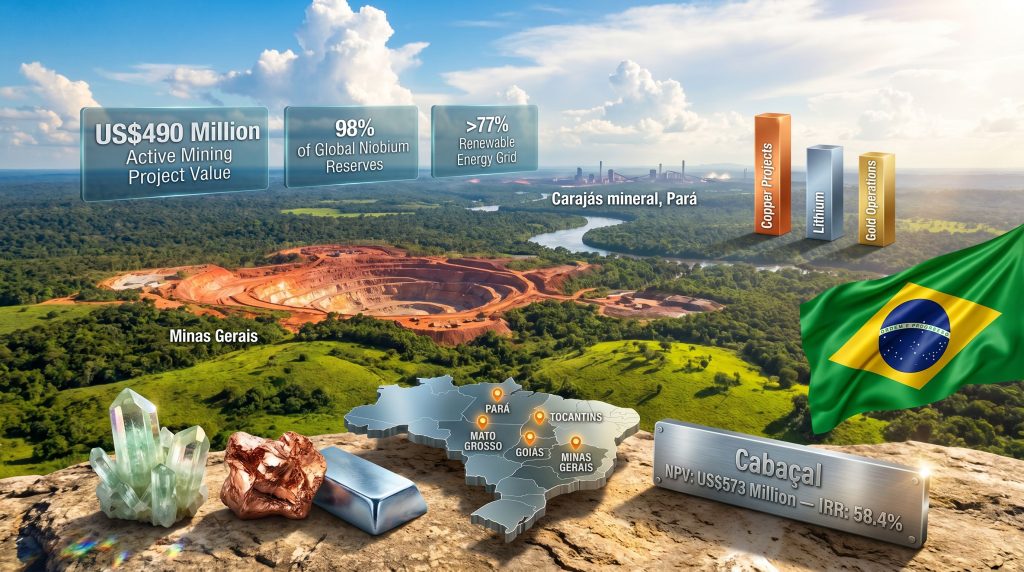
The immediate catalyst is straightforward: approximately US$490 million in active mining project value is currently being mobilised across Brazil through a combination of asset acquisitions, equity fundraising, and structured project financing. However, the deeper question is why Brazil, and why now.
Three structural forces are converging:
- Brazil's electricity grid is over 77% renewable, making it one of the lowest Scope 2 emissions intensity mining jurisdictions in the world. For institutional investors applying ESG screening criteria, this is no longer a secondary consideration. It is a primary investment filter.
- Global energy transition commodity demand is creating upstream supply pressure across copper, lithium, nickel, cobalt, and platinum group metals (PGMs). Brazil holds significant deposits of all five.
- Geopolitical supply chain realignment is accelerating Western interest in non-Chinese critical mineral sources. Brazil's Atlantic coastline, political stability relative to Andean peers, and established export infrastructure position it as a logical anchor supplier.
Brazil's Commodity Portfolio: A Dual-Cycle Investment Profile
What distinguishes Brazil from most other mining jurisdictions is the breadth of its commodity exposure. The country simultaneously participates in mature bulk commodity markets and frontier energy transition metals.
| Commodity | Brazil's Global Standing | Primary Production States |
|---|---|---|
| Iron Ore | 2nd largest global exporter | Minas Gerais, Pará |
| Niobium | Controls ~98% of known global reserves | Minas Gerais |
| Lithium | Emerging South American hub | Minas Gerais (Jequitinhonha Valley) |
| Bauxite | Significant regional producer | Pará |
| Copper | Growing strategic importance | Pará, Goiás |
| Gold | Modern production revival underway | Goiás, Tocantins, Mato Grosso |
| Nickel/PGM | Active frontier exploration | Pará |
Key Insight: Brazil's niobium position deserves particular attention. With roughly 98% of known global reserves, it holds a near-monopoly on a metal critical to high-strength steel production. This is one of the most underappreciated strategic commodity positions held by any single country, yet it rarely features in mainstream critical mineral discussions.
How Brazil's Regional Geography Shapes Its Mining Project Pipeline
Minas Gerais: Legacy Production Meets the Lithium Frontier
Minas Gerais is the historical spine of Brazilian mining. It hosts 40 of Brazil's 100 largest operating mines, anchored by iron ore production in the Quadrilátero Ferrífero, a geological formation that has supported continuous industrial mining for well over a century. Legacy gold operations at sites like Morro Velho and Cuiabá represent more than 120 years of industrial mining history and an estimated 2,000-plus tonnes of historical gold output, placing them among the most productive underground gold systems ever worked in the Western Hemisphere.
The state's emerging identity, however, is increasingly defined by the Jequitinhonha Valley, known internationally as Brazil's Lithium Valley. This corridor of lithium-bearing pegmatite formations is transitioning from artisanal and small-scale extraction toward large-scale mechanised production. Furthermore, the lithium demand boom is intensifying focus on this region as a strategic supply source. The critical bottleneck is not geological — it is infrastructural.
Road access, reliable water supply, and grid power connectivity will determine the pace at which Lithium Valley reaches industrial-scale output. Brazil's stated policy objective is to develop domestic lithium hydroxide and lithium carbonate processing capacity rather than exporting raw spodumene, which would position the country to capture significantly more value per tonne from its lithium endowment.
Pará and the Carajás Province: The World's Most Minerally Diverse Region
The Carajás mineral province in Pará is geologically exceptional. Within a single contiguous region, it hosts economically significant deposits of iron ore, copper, nickel, bauxite, gold, and manganese. This multi-commodity concentration within a single infrastructure corridor dramatically reduces the capital intensity of new project development, since roads, ports, and power transmission built for iron ore operations can be leveraged by copper and nickel developers entering the same region.
Active project work in Pará currently spans:
- Iron oxide copper-gold (IOCG) exploration targeting copper mine development outcomes
- PGM-nickel deposit delineation at frontier exploration stage
- Bauxite capacity life extension for existing operations
- Early-stage gold exploration across underexplored structural corridors
Goiás, Tocantins, and Mato Grosso: The Central-Western Growth Belt
Brazil's central-western states are undergoing a meaningful expansion of their mining identity. Historically overshadowed by Minas Gerais and Pará, this corridor is now home to newly commissioned gold operations, active nickel and cobalt exploration, and mid-scale development projects attracting capital in the US$40–50 million range. This geographic diversification of Brazil's mining activity reduces jurisdictional concentration risk for investors and broadens the country's overall project pipeline depth.
The Most Significant Active Mining Projects in Brazil in 2026
Gold: Three Operations Anchoring Brazil's Production Revival
Mara Rosa Gold Mine (Goiás) — Hochschild Mining
Hochschild's Mara Rosa operation entered commercial production in 2024, establishing the company's first South American asset outside of its traditional Peru and Chile base. Projected output exceeds 100,000 ounces per year, validating Brazil's central belt as a viable destination for mid-tier gold producers. According to Brazil's mining industry analysis, the country's gold sector is experiencing one of its most significant capital inflows in recent history.
Tocantinzinho Gold Mine (Tocantins) — G Mining Ventures
First gold was poured at Tocantinzinho in July 2024. The operation is targeting steady-state production of approximately 175,000 ounces per year sustained across a 10-year mine life, making it one of the most significant new gold production sources in Latin America from a jurisdiction with comparatively low sovereign risk.
Xavantina Gold-Silver Mine (Mato Grosso)
The polymetallic profile of Xavantina adds commodity diversification within a single project footprint. A 2026 capital allocation of US$40–50 million reflects active development-stage progress, with the gold-silver combination offering natural revenue hedging against single-metal price cycles.
Combined projected output from Mara Rosa and Tocantinzinho alone exceeds 275,000 ounces per year, a figure that places Brazil's gold revival in measurable context against established Latin American gold jurisdictions.
Copper and Polymetallic Projects: The Energy Transition Core
Cabaçal Copper-Gold Project — Meridian Mining
The Cabaçal project's pre-feasibility economics are exceptional by any benchmark. The study outlines a project NPV of US$573 million and an IRR of 58.4%, placing it among the highest-return undeveloped copper assets in Latin America. The copper-gold polymetallic profile provides natural protection against copper price volatility, a structural advantage for project financing. In addition, definitive feasibility studies at this stage typically unlock access to a broader range of institutional debt and equity capital.
Serra da Estrela IOCG Project — Aura Minerals (Carajás, Pará)
IOCG deposit formation — the same deposit classification that hosts some of the world's largest copper systems — is being targeted at Serra da Estrela within the Carajás province. The regional infrastructure advantage significantly reduces greenfield development risk.
A note on IOCG deposits for less technical readers: Iron oxide copper-gold systems are a specific class of hydrothermal deposit characterised by their association with magnetite or hematite, large physical footprints, and typically long mine lives. They are often amenable to both open-pit and underground mining methods, giving developers flexibility in project design.
PGM and Nickel: Brazil's Frontier Critical Mineral Position
Luanga PGM + Nickel Deposit — Bravo Mining (Pará)
The Luanga project has completed a drilling programme that confirmed 17 high-priority exploration targets, substantially expanding its resource delineation potential. PGM-nickel combinations are directly relevant to two critical supply chains: battery technology (nickel) and catalytic converter manufacturing (platinum, palladium, rhodium).
Brazil's emergence as a PGM exploration jurisdiction is strategically significant given that global PGM supply has historically been dominated by South Africa and Russia, representing meaningful supply chain concentration risk for Western industrial economies.
A Landmark Geological Discovery: Brazil's First Gold Porphyry System
Maria Bonita Gold Porphyry — Altamira Gold
This discovery warrants particular attention from both geological and investment perspectives. The confirmation of Brazil's first gold porphyry system at Maria Bonita opens an entirely new class of exploration target across the country's geological terranes.
Porphyry-style mineralisation is important to understand because:
- It is typically associated with large-scale, bulk-tonnage, long-life deposits rather than high-grade narrow-vein systems
- Porphyry copper-gold systems host the majority of the world's largest producing copper mines (including Escondida in Chile and Grasberg in Indonesia)
- The identification of a gold porphyry system in Brazil suggests that the country's geological framework may be capable of hosting larger-scale gold deposits than previously modelled
- This has implications for exploration methodology and target generation across underexplored Brazilian terranes where similar intrusive geology exists
This discovery is one of the most strategically significant geological events in Brazilian mining in recent decades, though it remains largely underreported in mainstream investment media.
Bauxite: Sustaining Capacity in Established Operations
East Zone Bauxite Expansion — MRN Mineração Rio do Norte (Pará)
MRN's capacity sustaining strategy illustrates an important capital allocation philosophy that distinguishes mature mining operations from development-stage projects. Rather than pursuing greenfield development, MRN is advancing Front-End Loading (FEL) engineering on an East Zone expansion while scheduling its complementary West Zone supplement for online commissioning in 2028.
FEL engineering is a staged cost estimation and project definition methodology widely used in the mining industry to progressively refine capital cost estimates before committing full construction budgets. Furthermore, renewable-powered mining is expected to play an increasing role in underpinning MRN's long-term operational cost structure as grid decarbonisation continues.
How Capital Is Being Structured Across Brazil's US$490 Million Project Pipeline
The US$490 million figure encompasses three distinct capital mechanisms, each serving a different function in the project development ecosystem:
| Capital Mechanism | Function | Typical Project Stage |
|---|---|---|
| Asset acquisitions and strategic purchases | Resource inventory growth for operators | Exploration to pre-feasibility |
| Equity fundraising via public and private markets | Fund drilling, feasibility studies, construction | Exploration through construction |
| Project-level debt and structured financing | Bridge between feasibility and production | Feasibility to construction commencement |
Analytical Framework: Brazil's mining capital structure in 2026 reflects a three-tier ecosystem. Majors are reinvesting operating cash flows into capacity sustaining programmes. Mid-tier operators are advancing development-stage assets toward construction decisions. Junior companies are funding exploration programmes that will define the next generation of project inventory. A healthy distribution across all three tiers is a hallmark of a maturing mining jurisdiction.
Regulatory Landscape: Rigorous, ESG-Aligned, and Post-Brumadinho
Brazil's environmental licensing framework, administered at the federal level by IBAMA, operates through a multi-stage process. The three licensing stages — Licença Prévia (preliminary), Licença de Instalação (installation), and Licença de Operação (operation) — create timeline risk but also produce projects with substantially stronger social licence outcomes than jurisdictions with lighter-touch permitting regimes.
For institutional investors, this depth of regulatory scrutiny is increasingly viewed as a positive signal rather than a friction cost. The Brazilian Mining Association (IBRAM) has been instrumental in advocating for frameworks that balance environmental rigour with investment certainty.
The Brumadinho tailings dam failure of 2019, which caused the deaths of 270 people, permanently elevated tailings storage facility standards across the entire Brazilian mining sector. New projects now face significantly more stringent tailings management requirements, raising upfront capital costs but reducing the catastrophic tail risk that has historically repriced entire mining portfolios overnight.
Indigenous land and environmental overlay risks remain material considerations, particularly in Pará and Amazonas. Projects that invest early in community engagement and environmental baseline studies consistently demonstrate better permitting outcomes and more durable social licence, which institutional capital increasingly treats as a prerequisite rather than an optional expenditure.
The next major ASX story will hit our subscribers first
Brazil's Position in Global Critical Mineral Supply Chain Realignment
The geopolitical context surrounding mining projects in Brazil has shifted materially in recent years. Western industrial economies are actively seeking to reduce their dependence on Chinese processing and refining capacity across battery mineral supply chains. Brazil's combination of lithium, nickel, cobalt, and copper resources, delivered through a low-carbon electricity grid, creates a compelling supply profile for European battery manufacturers and North American industrial consumers.
The energy transition commodity concentration in Brazil's current project pipeline is striking. Estimates suggest that more than 60% of active project development work in the Brazilian mining sector is now targeting energy transition commodities, including lithium, cobalt, copper, and nickel. Consequently, this represents a deliberate reorientation of exploration capital away from traditional bulk commodities — a shift that has occurred relatively rapidly and is not yet fully reflected in mainstream investor perception of the country's resource sector identity.
Key Data Summary: Brazil's Mining Sector in 2026
| Metric | Data Point |
|---|---|
| Total active project value (purchases + fundraising) | ~US$490 million |
| Renewable energy share of Brazil's electricity grid | >77% |
| Minas Gerais share of Brazil's 100 largest mines | 40 mines |
| Brazil's global niobium reserve share | ~98% |
| Tocantinzinho projected annual gold output | ~175,000 oz/year |
| Cabaçal project NPV | US$573 million |
| Cabaçal project IRR | 58.4% |
| Luanga high-priority drill targets confirmed | 17 targets |
| Historical gold output from legacy Minas Gerais mines | >2,000 tonnes |
| Energy transition commodity share of active project portfolios | >60% |
| West Zone bauxite commissioning target | 2028 |
| Xavantina 2026 capital allocation | US$40–50 million |
Three Strategic Conclusions for Investors and Industry Observers
- Brazil's mining investment cycle is structurally broadening beyond its iron ore and gold legacy. The country's project pipeline now spans every critical mineral category relevant to the global energy transition, creating a multi-commodity investment thesis with unusually diverse commodity exposure across mining projects in Brazil.
- The capital formation ecosystem is functioning across all project stages, from junior exploration equity raises to mid-tier development financing and major operator sustaining capital reinvestment. This breadth signals a healthy and self-reinforcing investment environment rather than a narrow, commodity-price-driven spike.
- Regulatory and ESG alignment is becoming a competitive advantage for Brazil relative to peers. The green energy grid, evolving permitting frameworks, and post-Brumadinho tailings standards are collectively raising Brazil's standing among institutional investors applying responsible mining screening criteria.
Disclaimer: This article is intended for informational purposes only and does not constitute financial or investment advice. Mining project economics, production forecasts, and resource estimates are subject to material risks and uncertainties. Readers should conduct independent due diligence before making any investment decisions. Forward-looking statements regarding project timelines, output targets, and capital requirements may differ materially from actual outcomes.
Want to Identify the Next Major Mineral Discovery Before the Broader Market Does?
Brazil's multi-commodity mining transformation is just one example of how rapidly significant resource opportunities can emerge across global markets — Discovery Alert's proprietary Discovery IQ model delivers real-time alerts on significant ASX mineral discoveries, turning complex geological and commodity data into actionable investment insights for both short-term traders and long-term investors. Explore historic discoveries and their exceptional market returns, then begin your 14-day free trial at Discovery Alert to position yourself ahead of the market.