June 29, 2026
The Geopolitics of Pressure and Dialogue: How Military Escalation Shapes Nuclear Diplomacy
History offers a consistent lesson in great power negotiations: the most consequential diplomatic breakthroughs rarely emerge from calm. They tend to follow moments when both sides have absorbed enough cost to recognise that continued conflict carries a higher price than compromise. The evolving engagement between Washington and Tehran in 2026 fits this pattern precisely. Following a weekend of military exchanges that rattled global energy markets, both governments signalled their willingness to return to the table, with fresh US and Iran talks in Doha scheduled for Tuesday, June 30, 2026.
Understanding why this diplomatic sequence matters requires stepping back from the immediate events and examining the structural forces at play across multiple dimensions: energy security, nuclear non-proliferation architecture, regional power dynamics, and the economics of coercive diplomacy. Furthermore, the geopolitical oil price factors at work here are among the most consequential seen in recent years.
When big ASX news breaks, our subscribers know first
Why the Strait of Hormuz Is the Real Centre of Gravity
Before examining the negotiating positions of either government, it is worth understanding why this particular conflict carries such outsized consequences for the global economy. The Strait of Hormuz, a narrow channel of water situated between Oman and Iran, functions as the world's most strategically sensitive energy chokepoint.
The numbers are stark:
| Metric | Data Point |
|---|---|
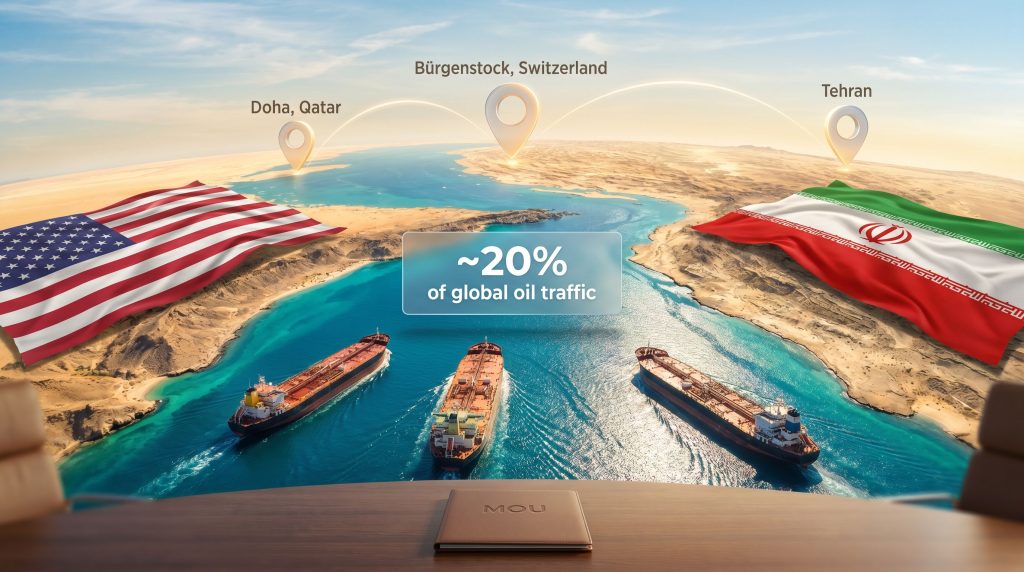
| Share of global oil traffic transiting the strait | ~20% |
| Geographic location | Gulf between Oman and Iran |
| Strategic classification | Critical energy chokepoint |
| Impact of closure scenario | Immediate global oil price shock |
Roughly one-fifth of all oil traded globally passes through this waterway every day. For context, that volume encompasses the combined daily oil exports of Saudi Arabia, the UAE, Kuwait, Iraq, and Iran. Any disruption, whether through direct military action, mining of shipping lanes, or sustained harassment of commercial vessels, immediately feeds into crude oil futures markets with near-instant price consequences.
Iran's capacity to threaten access to the strait gives Tehran a form of asymmetric leverage that is disproportionate to its conventional military capabilities relative to the United States. It does not need to win a military confrontation to impose significant economic pain on global consumers and US political credibility. The threat itself carries value.
The Hormuz Premium and What It Means for Markets
Commodity analysts frequently refer to the concept of a geopolitical risk premium embedded in crude oil pricing. During periods of Hormuz tension, this premium reflects the probability-weighted cost of supply disruption being priced into forward contracts. The premium is not static: it expands rapidly during military exchanges and compresses just as quickly when diplomatic signals improve.
This dynamic explains why President Trump publicly highlighted the decline in US crude oil prices following the stand-down agreement, specifically noting that prices had returned to levels last seen before the conflict began on February 28. From a political economy standpoint, lower fuel prices represent a tangible domestic benefit that creates incentives on the US side to sustain the diplomatic channel even when negotiations are difficult.
The correlation extends beyond crude oil into liquefied natural gas freight rates and tanker insurance premiums. When Hormuz tension escalates, shipping insurers impose war-risk surcharges on vessels transiting the region, effectively taxing global energy trade. These surcharges then ripple through to end consumers in Europe and Asia, creating a distributed economic pressure that turns a regional dispute into a globally felt cost.
A Conflict That Required Escalation to Restart Diplomacy
The weekend military exchanges that immediately preceded the announcement of fresh US and Iran talks in Doha were not a deviation from the diplomatic process. They were, in a structurally important sense, a part of it. The Trump administration has pursued what strategists describe as a coercive diplomacy model: the simultaneous application of military pressure and conditional diplomatic engagement. In addition, the global trade war impacts of sustained regional instability have amplified pressure on both sides to seek resolution.
The sequence followed a recognisable pattern:
- Iran conducted attacks targeting commercial shipping in the Strait of Hormuz.
- The United States launched strikes on Iranian military assets in direct response.
- Iran considered retaliatory options but recognised the escalation calculus favoured a return to talks.
- Both sides agreed to a stand-down: a mutual tactical pause on hostilities without formal verification mechanisms.
- Iran formally requested a fresh meeting, which Trump publicly confirmed via Truth Social.
This sequence is not accidental. The stand-down agreement, as confirmed by a US official cited by CNBC, established that both sides would pause hostilities and that commercial vessels could move freely through the strait. The official further indicated that technical discussions on all areas of the memorandum of understanding would continue.
A stand-down arrangement differs from a formal ceasefire in a critically important way: it lacks binding verification mechanisms and can be revoked unilaterally at short notice. It creates space for diplomacy without constraining either party's future military options.
White House Press Secretary Karoline Leavitt made clear that the US was maintaining its deterrence posture in parallel with diplomatic engagement, stating that the US would uphold its end of the ceasefire while retaining the right to respond to further violence in kind. According to reports on the US-Iran negotiations, these talks represent one of the most significant diplomatic engagements between the two countries in decades.
The Negotiating Table: Venues, Participants, and What Each Represents
The geography of these negotiations is itself analytically significant. The 2026 diplomatic engagement has unfolded across multiple venues, each serving a distinct functional purpose.
| Period | Location | Key Participants | Primary Focus |
|---|---|---|---|
| May 2026 | Doha, Qatar | Iranian FM Araghchi, Parliament Speaker Ghalibaf, Iranian Central Bank Governor, US officials | Ceasefire extension, Hormuz access, frozen assets |
| Early June 2026 | Bürgenstock Resort, Switzerland | VP JD Vance (US), Araghchi and Ghalibaf (Iran), Qatar and Pakistan as mediators | Nuclear oversight sequencing, sanctions relief, de-escalation mechanisms |
| Late June 2026 | Doha, Qatar (upcoming) | Steve Witkoff, Jared Kushner (US), Iranian technical teams | MOU technical follow-up, operational sequencing |
Qatar's role as a consistent venue and mediator deserves particular attention. Doha has served as a back-channel bridge between Washington and Tehran for many years, a function built on Qatar's unique positioning as a state that maintains functional relationships with both the United States, which hosts a major military base on Qatari soil, and Iran, with which it shares the world's largest natural gas field. This dual relationship makes Qatar structurally irreplaceable as an intermediary.
Pakistan's emergence as a co-mediator in the Switzerland summit signals a broadening of the diplomatic coalition. Pakistan brings its own set of relationships with both parties and adds a degree of Islamic world legitimacy to the process that purely Western-mediated frameworks sometimes lack.
The arrival of Iran's Central Bank Governor at the May 2026 Doha sessions is a detail worth noting. It signals that Tehran treats financial architecture as a front-line issue in these negotiations, not a technical afterthought to be resolved once political agreement is reached.
The US Diplomatic Team: Roles and Mandate
On the American side, the delegation structure reflects the Trump administration's approach of deploying trusted political insiders rather than traditional career diplomats for high-stakes negotiations:
- Vice President JD Vance led the US delegation at the Bürgenstock summit level, signalling the political weight Washington assigned to the Switzerland engagement.
- Steve Witkoff, serving as special envoy, has been tasked with direct engagement and the technical MOU discussions that translate political agreement into operational commitments.
- Jared Kushner, acting as a senior diplomatic advisor, travelled for bilateral sessions as part of the fresh Doha talks confirmed for Tuesday.
The Four Unresolved Fault Lines
Describing the negotiations as having made constructive progress with remaining gaps is standard diplomatic language. Decoding what lies beneath that framing requires understanding the specific structural disagreements that have resisted resolution across multiple rounds of talks.
Nuclear Compliance and Oversight Sequencing
The most technically and politically complex issue concerns the order of steps in the nuclear compliance process. Washington's position holds that Iran must demonstrate verifiable reductions in uranium enrichment levels and stockpile sizes before any sanctions relief is granted. Tehran's position, informed by the experience of the JCPOA withdrawal in 2018, is that Iranian concessions made ahead of guaranteed sanctions relief simply expose Iran to future US policy reversals without protection.
The sequencing disagreement is not merely procedural. It reflects a fundamental trust deficit rooted in the history of the relationship. Iran's negotiators point to the fact that their government fulfilled JCPOA obligations only to see the US unilaterally exit the agreement, leaving Iran with nothing. Rebuilding the verification architecture that both sides can accept as credible is arguably the deepest challenge in the entire negotiation.
Sanctions Relief: Timing and Conditionality
Directly connected to the sequencing issue is the question of when and under what conditions sanctions are lifted. The US approach links sanctions removal to certified compliance milestones, creating a graduated relief structure. Iran is seeking upfront relief, or at minimum, a binding commitment to relief that cannot be revoked by a future administration.
This creates what negotiators sometimes call a chicken-and-egg problem: each side is willing to deliver its concession only after it receives the other's, and neither is willing to move first.
Frozen Asset Release
Iran holds a significant quantity of sovereign assets frozen in third-party jurisdictions as a result of sanctions regimes. The scale of these holdings represents a material factor in Tehran's domestic economic stabilisation agenda. Iran's negotiating team has consistently pushed for the immediate unfreezing of these funds, while the US maintains that asset release must be tied to nuclear compliance progress.
Strait of Hormuz: Implementation, Not Principle
Both sides nominally agree that the strait should be open to commercial traffic. However, the disagreement here is operational rather than strategic: who removes mines from shipping lanes, on what timeline, under whose verification framework, and how transit fee disputes are resolved. These implementation questions may appear technical, but unresolved operational details have historically been sufficient to collapse agreements that seemed close to finalisation.
Scenario Analysis: Three Potential Outcomes
Given the structural complexity of the outstanding issues, how might the current negotiation track resolve?
| Scenario | Likelihood Assessment | Key Enabling Conditions | Market and Geopolitical Impact |
|---|---|---|---|
| Full Framework Agreement | Lower near-term probability | Both sides accept a verified sequencing compromise across nuclear and sanctions issues | Significant crude oil price decline; regional de-escalation |
| Partial MOU with Technical Follow-Up | Highest near-term probability | Agreement on Hormuz access and ceasefire structure; nuclear issues partially deferred | Moderate market stabilisation; continued engagement |
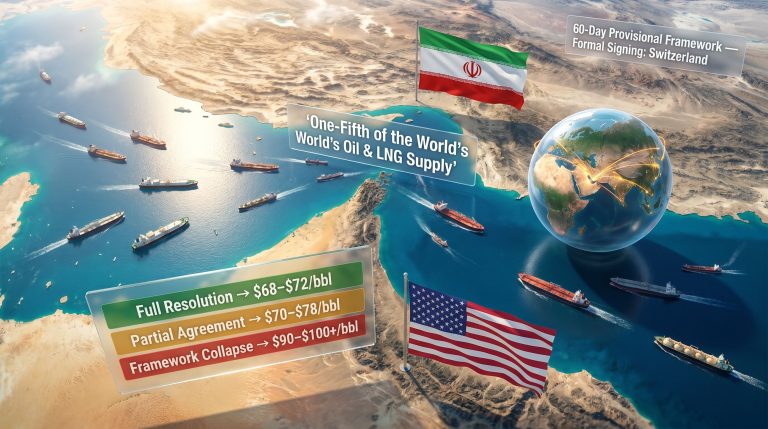
| Breakdown and Re-Escalation | Elevated tail risk | Trust deficit widens; military incident resumes; stand-down collapses | Sharp oil price spike; regional security deterioration |
The most likely near-term outcome is a partial memorandum of understanding that locks in the Hormuz access framework and ceasefire parameters while leaving the harder nuclear compliance questions to subsequent rounds of negotiation. This would be consistent with the pattern established in the Switzerland sessions, which produced significant engagement time without a final comprehensive agreement.
A Memorandum of Understanding in this context represents a structured framework document that outlines agreed principles and sequencing commitments without constituting a legally binding treaty. It functions as a roadmap that technical working groups then translate into operational obligations.
The next major ASX story will hit our subscribers first
The Broader Regional Stakes
Any durable agreement between Washington and Tehran would reshape the strategic environment across the broader Middle East in ways that extend far beyond the two primary parties. Consequently, understanding the geopolitical mining landscape and commodity exposure linked to this region becomes increasingly relevant for investors and analysts alike.
For Gulf Cooperation Council states, a US-Iran framework changes the regional security calculus significantly. States such as Saudi Arabia and the UAE have built their security postures partly around the premise of an adversarial Iran contained by US pressure. A negotiated reduction in that pressure raises questions about the durability of existing security arrangements.
For Israel, the core concern is nuclear. Any agreement that leaves Iran with even a residual enrichment capability carries the risk of breakout capacity, the ability to move toward a nuclear weapon faster than international inspectors can detect and respond. Israel's red lines on Iranian nuclear capability do not map neatly onto the concession space available to US negotiators.
For the global non-proliferation regime, the verification architecture negotiated in any US-Iran agreement sets a precedent. How snap inspections are structured, what role the IAEA plays, and whether compliance certification is tied to political relationships or independent technical assessment will influence how other regional actors interpret the norms available to them.
For OPEC+ and global energy markets, OPEC's market influence becomes a critical variable should any Iranian sanctions relief expand Tehran's export capacity. The scale of Iranian oil exports currently suppressed by sanctions represents a meaningful market variable that could significantly alter production management dynamics.
Furthermore, gold safe-haven demand has risen notably throughout this period of uncertainty, as investors seek protection against the volatility generated by unresolved military and diplomatic tensions in the region.
What to Watch in the Coming Weeks
The trajectory of these negotiations will be signalled by observable indicators across several dimensions. US-Iran ceasefire reports suggest that both sides have agreed to halt strikes ahead of the Doha meeting, though the durability of this arrangement remains to be seen.
- Technical session outcomes in Doha: Whether the Tuesday meeting produces a joint statement or technical working-group mandates will indicate how much ground was covered at the Switzerland summit.
- Oil market reactions: Crude prices will function as a real-time sentiment indicator for the negotiating track's perceived trajectory.
- Iran's domestic political signalling: The presence of senior political figures such as Parliament Speaker Ghalibaf in these delegations suggests domestic buy-in for the process, but internal Iranian politics remain a constraint on how far negotiators can move.
- US domestic political dynamics: The Trump administration's public framing of the talks, including Trump's commentary on declining fuel prices, suggests the economic benefits of de-escalation are being communicated directly to US voters, creating political incentives to sustain progress.
- Mediator continuity: Qatar's and Pakistan's continued active engagement is structurally essential. Any deterioration in either mediator's relationships with the primary parties would create significant friction in the process.
The resumption of US and Iran talks in Doha following a weekend of military exchanges is neither a triumph nor a failure. It is an indicator that both sides have assessed the cost of full escalation and found it unacceptable relative to continued engagement. Whether that shared cost assessment is sufficient to bridge four deeply contested structural disagreements remains the central question shaping global energy markets, regional security architecture, and the long-term credibility of nuclear non-proliferation frameworks.
This article contains analysis of ongoing diplomatic negotiations and forward-looking assessments of geopolitical scenarios. Such analysis involves inherent uncertainty and should not be construed as a definitive prediction of outcomes. Readers are encouraged to consult multiple sources for a comprehensive understanding of rapidly evolving events.
Want to Stay Ahead of ASX Discoveries Driven by Geopolitical Shifts?
When Middle East tensions reshape global commodity markets, the knock-on effects for ASX-listed miners and explorers can be swift and significant — Discovery Alert's proprietary Discovery IQ model delivers real-time alerts the moment major mineral discoveries hit the ASX, turning complex market signals into actionable investment opportunities. Explore historic discovery returns on Discovery Alert's discoveries page and begin your 14-day free trial to position yourself ahead of the market.