June 29, 2026
The Quiet Revolution Reshaping Eurasian Trade Geography
For centuries, the great overland routes connecting East Asia to Europe were eclipsed by maritime trade. The economics of containerised shipping made sea lanes dominant, and for decades, land-based corridors were treated as secondary options reserved for landlocked nations with no alternative. That calculus is now shifting in fundamental ways, driven not by a single policy decision but by the convergence of geopolitical instability, naval chokepoint vulnerability, and a deliberate long-term infrastructure strategy centred on the China Central Asia rail link to Turkmenistan.
The launch of a new freight rail service connecting China's Qinghai Province with Turkmenistan's western Balkan Velayat region is one visible expression of this broader transformation. However, understanding what it means requires looking well beyond the inaugural train.
When big ASX news breaks, our subscribers know first
What the New Xining to Turkmenistan Rail Route Actually Involves
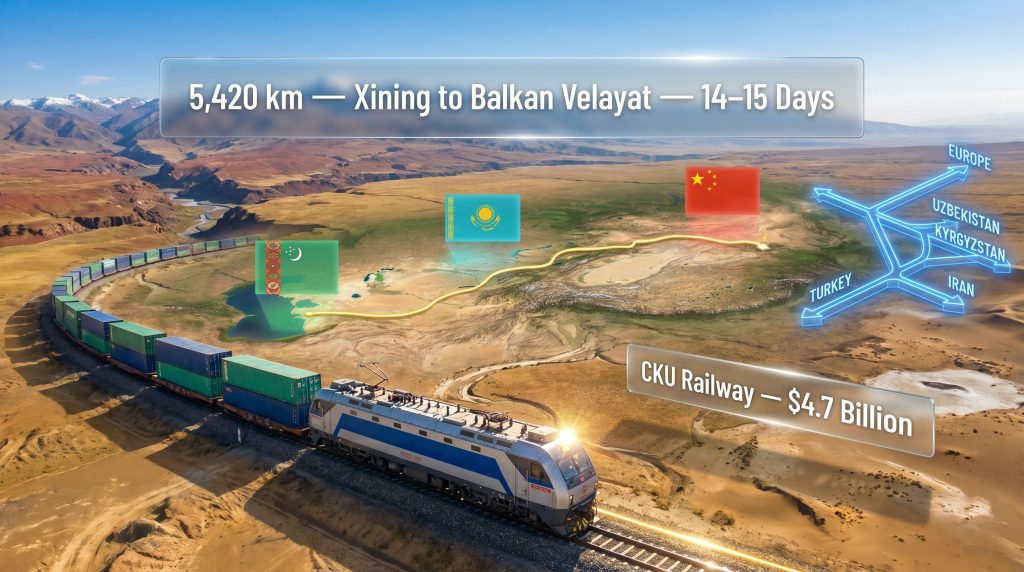
The newly inaugurated service covers approximately 5,420 kilometres, linking Xining, the capital of China's Qinghai Province, with a strategically positioned freight terminal in Balkan Velayat in western Turkmenistan. The journey spans two countries, crosses through Kazakhstan as a transit corridor, and uses the Horgos border crossing in Xinjiang as its primary gateway.
The inaugural train carried 55 containers loaded with electrical appliances, automotive components, clothing, and everyday consumer goods, with an estimated transit time of 14 to 15 days. State broadcaster CCTV confirmed the departure details.
| Feature | Detail |
|---|---|
| Departure Point | Xining, Qinghai Province, China |
| Destination | Balkan Velayat, Western Turkmenistan |
| Total Distance | 5,420 km (approx. 3,367 miles) |
| Transit Time | 14 to 15 days |
| Train Capacity | 55 containers |
| Key Border Crossing | Horgos, Xinjiang |
| Transit Country | Kazakhstan |
| Cargo Types | Electrical appliances, auto parts, clothing, daily goods |
What makes this route geographically significant is not simply its length. Balkan Velayat sits on Turkmenistan's western edge, adjacent to the Caspian Sea. This positions it as a natural staging point for onward movement toward Iran, Turkey, and ultimately European markets, making the terminal a potential node in a far longer transcontinental corridor.
How Qinghai Became a Transcontinental Rail Hub
Qinghai's emergence as a gateway for international freight is relatively recent. Since launching its first China-Europe rail service in 2016, the province has steadily expanded its international rail reach to 16 cities across 10 countries. The addition of Turkmenistan means its Central Asian network now covers Kazakhstan, Uzbekistan, and Turkmenistan, marking a meaningful expansion of market access for exporters based in western China.
This evolution is worth noting because Qinghai is not a traditional industrial or logistics powerhouse. Its elevation to transcontinental hub status reflects a deliberate infrastructure strategy rather than organic economic growth, with investment channelled through Belt and Road Initiative frameworks that prioritise overland connectivity across Central Asia. Furthermore, new rail routes bypassing Russia have reinforced the strategic importance of these emerging corridors.
The Central Asian Rail Connectivity Landscape in 2026
Despite the new service, a fully direct China-to-Turkmenistan rail link does not yet exist in purely operational terms. Kazakhstan continues to serve as the essential backbone of China's Central Asian rail architecture, providing transit infrastructure that all other corridor routes depend upon.
| Country | Direct Rail Link with China | Transit Route Used |
|---|---|---|
| Kazakhstan | Operational | Direct via Horgos/Dostyk |
| Uzbekistan | Indirect | Via Kazakhstan |
| Turkmenistan | Indirect | Via Kazakhstan |
| Kyrgyzstan | Indirect | Via Kazakhstan |
| Tajikistan | Indirect | Via Kazakhstan |
This dependency on Kazakhstan as the central transit nation is both a structural feature and a potential vulnerability. Any disruption to Kazakhstani infrastructure, border processing capacity, or political arrangements has cascading effects across all five Central Asian corridor nations. Consequently, diversifying transit pathways is as strategically important as establishing new destinations.
Why the Horgos Border Crossing Is Central to Everything
Horgos has grown into China's most important overland trade gateway with Central Asia. Located in Xinjiang, it functions as a dual border crossing with both road and rail infrastructure, and its capacity has expanded considerably over the past decade. For rail freight specifically, Horgos handles the gauge transition requirements between Chinese standard gauge and the broader Soviet-era gauge used across Central Asia, making it an unavoidable chokepoint in the physical sense, even as policy and investment work to ease throughput bottlenecks.
The China-Kyrgyzstan-Uzbekistan Railway: The Missing Link
Perhaps no single infrastructure project will do more to reshape this corridor than the China-Kyrgyzstan-Uzbekistan (CKU) Railway, a project with a headline cost of $4.7 billion USD that has spent decades in planning before reaching its current stage of active development. The rail link between Kyrgyzstan and Uzbekistan is widely regarded as a key mechanism through which China is raising its influence across the region while skirting Russian-dominated routes.
CKU Railway Key Facts:
- Project Value: $4.7 billion USD
- Route: Kashgar (China) through Kyrgyzstan to Andijan (Uzbekistan)
- Annual Freight Capacity: Up to 15 million tonnes per year
- Kyrgyz Section Approved: June 2023
- Intergovernmental Agreement Ratified: June 2024
- Technical Challenge: Rail gauge change required at Makmal, approximately 150 km from the Chinese border
The CKU line matters because it would, for the first time, create a route connecting China to Uzbekistan that does not pass through Kazakhstan. This fundamentally alters the geometry of Central Asian rail logistics. Uzbekistan sits geographically adjacent to Turkmenistan, meaning a functional CKU corridor would open a southern pathway from China through Kyrgyzstan, into Uzbekistan, and onward to Turkmenistan without relying on the Kazakhstani transit network.
The Gauge Change Problem at Makmal
One of the less-discussed but technically significant complications in CKU planning involves the gauge transition requirement at Makmal, a location roughly 150 kilometres from the Chinese border inside Kyrgyzstan. China operates on standard gauge (1,435mm), while the post-Soviet rail network across Central Asia uses broad gauge (1,520mm). At Makmal, freight must either be transshipped between train sets or handled through bogie exchange technology, adding time, cost, and infrastructure complexity to what would otherwise be a seamless crossing.
Resolving this bottleneck efficiently is not merely a technical exercise; it determines whether the CKU Railway can achieve the throughput volumes its capacity figures suggest.
Mapping the Full Corridor: China to Europe Without Russian Infrastructure
When the CKU Railway becomes operational and is combined with existing links through Turkmenistan, the resulting corridor creates a continuous overland freight pathway: China to Kyrgyzstan to Uzbekistan to Turkmenistan to Iran to Turkey to Europe. This routing is significant not only in trade terms but in geopolitical ones, particularly given the evolving geopolitical landscape reshaping global resource and trade flows.
| Corridor | Russia Dependency | Key Transit Nations | Geopolitical Risk Level |
|---|---|---|---|
| Northern (Trans-Siberian) | High | Russia, Kazakhstan | High |
| Trans-Caspian (TCTC) | None | Kazakhstan, Turkmenistan, Iran, Turkey | Medium |
| CKU-Enhanced Route | None | Kyrgyzstan, Uzbekistan, Turkmenistan, Iran | Medium-Low |
The Trans-Caspian Transport Corridor (TCTC) has attracted attention from both the European Union and the European Bank for Reconstruction and Development, both of which have engaged with it as a freight alternative that bypasses Russian territory entirely. For European supply chain planners managing exposure to sanctions regimes, geopolitical disruption risk, and post-Ukraine routing uncertainty, a fully functional Trans-Caspian corridor represents a meaningful diversification tool.
The Trans-Caspian corridor's appeal is not purely commercial. For European importers, routing freight through a network that avoids Russian infrastructure eliminates a category of political and regulatory risk that northern routing cannot eliminate regardless of transit time or cost advantages.
The Strait of Hormuz Factor: When Maritime Disruption Forces a Strategic Rethink
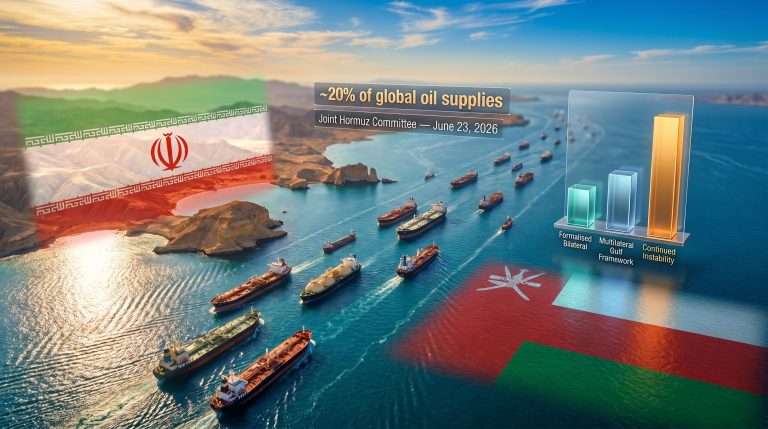
The Strait of Hormuz handles a substantial share of global energy and commodity shipping. When access to this chokepoint is disrupted or threatened, the cascading effects on global freight economics are immediate and severe. The effective closure of the Strait during the US-Israeli military conflict with Iran placed this vulnerability into sharp focus, accelerating interest in overland alternatives that had previously been treated as long-term strategic investments rather than near-term necessities.
For China specifically, the implications are acute. A significant portion of China's energy imports and export freight routes interact with Persian Gulf and Indian Ocean sea lanes. Rail infrastructure that creates viable land-based alternatives reduces exposure to any single maritime disruption event, providing what amounts to a geopolitical insurance policy built in steel and concrete. In addition, the broader US-China trade war has further incentivised Beijing to develop routing options that reduce dependence on sea lanes vulnerable to political pressure.
Sustained investment in transcontinental rail has materially reduced China's vulnerability to naval chokepoint disruptions. This strategic buffer has grown in commercial and geopolitical importance as tensions across multiple maritime zones have intensified simultaneously.
The next major ASX story will hit our subscribers first
Belt and Road Architecture and the Five Nations Railway Concept
The Belt and Road Initiative, which now counts more than 150 partner nations across Asia, Africa, Europe, and Latin America, provides the structural financing and political framework within which these rail corridors are developed. The Xining-to-Turkmenistan service and the CKU Railway are both expressions of a coherent, long-term strategy to build a China-centred Eurasian trade architecture rather than isolated infrastructure projects.
A proposed Five Nations Railway Corridor involving China, Kyrgyzstan, Tajikistan, Afghanistan, and Iran has also entered planning discussions, signalling that the current infrastructure buildout is understood by Chinese planners as a foundation layer for a much more extensive network. While this concept remains speculative in implementation terms, its emergence in official discussions reflects the ambition of the underlying strategy.
Turkmenistan's position in this architecture is particularly interesting. As a transit state sitting between Central Asia's core and the Iranian rail network, it occupies a geographic location that any China Central Asia rail link to Turkmenistan corridor must pass through or around. Its domestic rail modernisation capacity and political willingness to participate in multilateral freight agreements will significantly influence how quickly these corridors can reach their theoretical potential. Furthermore, securing access to critical raw materials along these routes adds another dimension to their strategic value.
Frequently Asked Questions: China Central Asia Rail Link to Turkmenistan
Is There a Direct Rail Line Between China and Turkmenistan Right Now?
No fully direct rail line exists. The current service from Xining to Balkan Velayat transits through Kazakhstan, making it an indirect connection that depends on Kazakhstani rail infrastructure for the middle portion of its journey.
How Long Does Freight Take to Travel from Xining to Balkan Velayat?
The inaugural service is scheduled to complete the 5,420 kilometre journey in approximately 14 to 15 days.
When Will the China-Kyrgyzstan-Uzbekistan Railway Open?
No confirmed operational date has been publicly announced. The intergovernmental agreement was ratified in June 2024, and construction planning is ongoing, but the project's complexity and gauge transition requirements mean timelines remain uncertain.
How Does the New Rail Route Reduce China's Dependence on Sea Shipping?
By creating a viable overland freight path to Central Asia and eventually Europe, the route provides an alternative for exporters when maritime lanes are disrupted, congested, or subject to elevated geopolitical risk. It does not eliminate sea shipping dependency but meaningfully diversifies available routing options, thereby strengthening global supply chains against future disruptions.
What Is the Trans-Caspian Transport Corridor?
The TCTC is a multimodal freight corridor that connects China through Central Asia, across the Caspian Sea, through the Caucasus, and into Europe without passing through Russian territory. It has received engagement from the EU and the European Bank for Reconstruction and Development as a geopolitically significant alternative freight route.
Infrastructure Milestones That Will Define This Corridor's Future
The strategic value of the China Central Asia rail link to Turkmenistan will ultimately be determined by a series of infrastructure and policy developments that extend well beyond the inaugural freight service. Indeed, this broader geopolitical minerals race across Eurasia underscores just how intertwined resource access and infrastructure development have become.
Critical milestones to monitor:
- CKU Railway construction progress and the resolution of the Makmal gauge transition challenge
- Expansion of Horgos border crossing processing capacity to handle increased freight volumes
- EU and EBRD deepening of engagement with Trans-Caspian Transport Corridor development
- Turkmenistan's domestic rail network modernisation investments and cross-border agreement activity
- Shifts in China-to-Europe freight volume distribution between sea and rail as maritime disruption events accumulate
- Progress on the speculative Five Nations Railway Corridor concept involving Afghanistan and Iran
The current moment represents an early but accelerating phase in the reorganisation of Eurasian trade geography. The infrastructure being laid today will shape freight economics, geopolitical leverage, and supply chain architecture for decades. What began as a 55-container train departing Xining is, in its broader context, one data point in a transformation that extends across the entire Eurasian landmass.
Want to Stay Ahead of the Resource Opportunities Reshaping Eurasian Trade Routes?
As transcontinental rail corridors unlock access to Central Asia's vast mineral wealth and reshape global supply chains, Discovery Alert's proprietary Discovery IQ model delivers real-time alerts on significant ASX mineral discoveries — instantly translating complex data across 30+ commodities into actionable investment insights. Start your 14-day free trial at Discovery Alert today, or explore how historic mineral discoveries have generated substantial market returns for well-positioned investors.